
After Episode 12, Sam Lim and I take “The Oath” never to watch The Americans again

Screen Shot 2013-04-29 at 3.29.18 PM

Sam: A couple of unexpecteds happened this week, but I think this show lost me so long ago that it didn’t even interest me. (I suppose my overall negativity toward this show doesn’t spruce up the conversation much, does it?)

First, I forgot to mention last week that the developments with Clark/Phil and Martha are entertaining in a terrible way. I feel horrible for her, since she’s getting completely duped. But it is funny to watch Phil in these moments.

This week took it to a whole new level though. Granny playing his mom and Elizabeth playing his sister? Martha’s mom’s comment that “I can see the family resemblance!” just made it that much better. I laughed, not because it was funny, but it was just so…laughable.

I did not think Nina would get out alive whenever Arkady and team found out she was the mole, but the way it happened when it actually did just saved her for Season Two, I think. Somewhat lame, but better than perhaps the cliché “she’s gonna get shot” story. I now shift my money to Granny getting axed in the last episode. (On a side note: we still haven’t seen that scene of her and Arkady in the car shot by SIPA, have we?)

The Paige-Matthew dynamic was somewhat predictable, and honestly, I’m not sure how much it actually adds to the story as a whole, except that Paige can talk to Elizabeth about her relationship problems. Not so interesting.

Overall, I just can’t wait until this season is over, so we can go back to reviewing some actual good shows. Your thoughts? Continue reading After Episode 12, Sam Lim and I take “The Oath” never to watch The Americans again

Right Question, Wrong Case: Louisiana Dodges a Bullet as Supreme Court Dismisses Inmate’s Speedy Trial Claim

Samuel Alito
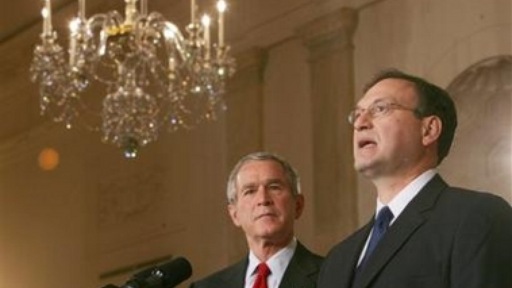
Tl;dr version of today’s dismissal: Jonathan Boyer is a man who deserves to be in prison, so it’s not necessary to talk about what Louisiana’s criminal justice system might have gotten wrong. Picture of Justice Samuel Alito via PBS.

(Update: This post was revised on April 30, 2013. See the post history at the bottom for more details.)

Back in January, I wrote in this space about Boyer v. Louisiana, in which an indigent death penalty defendant argued that the state had violated his constitutional right to a speedy trial when it failed to provide funds for his court-appointed counsel, resulting in a seven-year wait for trial from prison. The Supreme Court had just heard oral argument on the agreed-upon question of whether Louisiana’s lack of necessary funds for defendants could be weighed against the state under the Court’s speedy trial analysis. My answer to this key issue then was (and still is) yes–regardless of Jonathan Boyer’s eventual conviction for the murder for which he was charged, the state needs to bear some responsibility for its failure to repair the infamous and well-documented funding crisis in its public defense system, which has led directly to long delays for the trials of indigent defendants.

Today, however, the Supreme Court dismissed Boyer’s case without even reaching this important constitutional question, seemingly unable to look past the heinous shooting death of which Boyer stood accused. In a one-sentence, 5-4 decision, an ideologically-divided Court stated that it had been “improvidently granted” (or, “DIG,” in Court-watcher parlance), meaning that it should have never agreed to hear the case at all. The reason? As Justice Samuel Alito explains in his concurrence, ((Justice Alito’s concurrence was joined by Justice Clarence Thomas, who, as you may remember, stole the show at the January argument by breaking a nearly seven-year silence and cracking a joke about the quality of Boyer’s defense counsel.)) some of the justices do not accept the premise that it was actually Louisiana that caused the “lengthy delay between [Boyer’s] arrest and trial,” despite the state’s longstanding problems with indigent defense. Rather, they believe that the defendant himself convoluted and muddled the path to trial. Since they don’t think that Louisiana was at fault, the question that the Court had originally agreed to hear–which had assumed the state was the party responsible for the delay–was not the correct one the case should be decided on.

To reach DIG, Justice Alito had to step over the Louisiana Court of Appeals’ factual finding that “[t]he majority of the seven-year delay was caused by the ‘lack of funding’” and the state’s own admission that it could not free up adequate money to pay Boyer’s two court-appointed counsel to mount a capital murder defense. Attributing Louisiana’s admitted lack of funds to mere “confusion about which branch of the state government was responsible for paying [the defense attorney’s] fees,” Alito looks to the record and describes the state getting railroaded by the defendant’s counsel when in fact it was trying to bring Boyer to justice promptly. In Alito’s recounting, Boyer’s attorneys took advantage of the “confusion” by repeatedly delaying a funding hearing, as well as asking for multiple continuances of trial even after the state dropped its pursuit of the death penalty (thus making the case less expensive to defend). Explaining away the plain language of the Louisiana Court of Appeals’ conclusion about the cause of delay, Alito insists that the words “lack of funding” “most likely means” the hoopla surrounding the funding of the indigent Boyer’s trial (which to Alito was largely caused by Boyer himself), rather than, well, the state’s lack of funding.

Of course, in the eyes of the Supreme Court’s conservative majority, what really did Boyer in is the fact that he was eventually convicted of murder, a fact that makes him a less sympathetic plaintiff than if he had been exonerated at trial after languishing for seven years in prison. Just to remind us all of what kind of person the state was dealing with, Alito writes:

The evidence of petitioner’s guilt was overwhelming. He gave the police a detailed statement describing the murder; his brother, an eyewitness, agreed to testify about the crime; multiple other members of petitioner’s family told police that they had heard petitioner confess; and petitioner’s fingerprints were found in the victim’s truck.

Accordingly, a sense of “well, he deserved it anyway” permeates the concurrence–Jonathan Boyer was found guilty of shooting a man to death, so it’s no big loss to society to dismiss his case and avoid the larger question of whether Louisiana also did something wrong here. In fact, Justice Alito thinks that Boyer has already gamed the system through his delaying tactics and gotten a better deal out of the state as a result: “It is also quite clear that the delay caused by the defense likely worked in petitioner’s favor…[W]hat started out as a very strong case of first-degree murder ended up, after much delay, in a conviction for lesser offenses.”

Having successfully schemed his way to get out of the death penalty, Jonathan Boyer doesn’t deserve anything more from this court. What Alito pointedly ignores, however, is the fact that even if this is true in Boyer’s case, Boyer is not the only indigent inmate in Louisiana’s prisons who has seen a trial delay thanks to dithering (or “confusion”) on the part of the state.

Justice Sonia Sotomayor’s dissent against the improvident grant ruling points out as much. Writing for herself and Justices Breyer, Kagan and Ginsburg, Sotomayor doesn’t disagree with the jury finding that Boyer was guilty of second-degree murder, but she does think that the Court needs to take this opportunity to clarify the state’s speedy trial obligations, precisely because Boyer’s situation is not a unique or isolated one. Specifically, Sotomayor states that the lower court should have weighed the failure to fund against the state in Boyer’s speedy trial challenge:

Placing the consequences of such a delay squarely on the State’s shoulders is proper for the simple reason that an indigent defendant has no control over whether a State has set aside funds to pay his lawyer or fund any necessary investigation. The failure to fund an indigent’s defense is not as serious as a deliberate effort by a State to cause delay… But States routinely make tradeoffs in the allocation of limited resources, and it is reasonable that a State bear the consequences of these choices.

Justice Sotomayor warns that the Court may have avoided that constitutional issue today, but sooner or later, it will have to come up with an answer about the state’s accountability. In the meantime, indigent inmates in Louisiana continue to await trials from behind bars due to the state’s funding crisis, being treated as if they were guilty before proven innocent (or guilty)–a fact that Sotomayor backs up with empirical studies showing significant understaffing of Louisiana’s public defender services and average waits of 501 days between felony arrests and trials in some parishes. Jonathan Boyer’s case may have been particularly outrageous in just how long he had to wait for his, but, as Sotomayor writes, his case is indicative of “larger, systemic problems in Louisiana.” What Justice Alito and the majority forget is that the Sixth Amendment speedy trial guarantee applies to both the innocent and the guilty–and the longer the Court sits on its hands, the more likely it is that an innocent version of Jonathan Boyer will be needlessly imprisoned for years while awaiting acquittal.

As it turns out, Boyer v. Louisiana is a prime example of the right question coming before the Supreme Court but with the wrong facts and the wrong plaintiff. The Court surely would have been more hesitant to dismiss the case wholesale had the defendant been more sympathetic, the crime less horrible, the facts more ambiguous. The Boyer DIG also highlights the unique difficulty of Sixth Amendment speedy trial cases: because the Supreme Court said in 1973’s Strunk v. United States that the proper remedy for a speedy trial violation is an outright reversal of any conviction (or dismissal of indictment), courts are very hesitant to permit such a drastic measure unless they are convinced of the defendant’s innocence. This was undoubtedly a result that Justice Alito and the conservative majority did not want to see with Boyer, who they (and a non-unanimous jury) have decided deserves to spend life in prison without parole. Due to the zero-sum nature of speedy trial disputes, however, the Court’s dismissal today lets the state of Louisiana off scot-free for its failure to fix its admittedly broken indigent defense system.

Enhanced by Zemanta

When Bad Things Happen to Good Justices: Justice Breyer Falls Off Bicycle, Part III.

BREYER
It could not have happened to a nicer justice: Justice Stephen Breyer reads to children on Dr. Seuss Day in 2003. Picture via NPR.

Whenever you hear about a piece of bad news befalling a Supreme Court justice, eight times out of ten it’s going to be about Justice Stephen Breyer. The 74-year-old has been the victim of quite a few strokes of bad luck since stepping into the public eye, including a 1993 accident in which he was struck by a car while biking in Boston and suffered a punctured lung and several broken ribs, a 2011 fall off his bicycle that resulted in a broken collarbone, and not one but two home robberies in 2012 (one of which involved a machete-wielding stranger). On Saturday, the Supreme Court issued a press release stating that Justice Breyer had been involved in yet another bicycle spill, this time fracturing his right shoulder and necessitating surgery. Breyer is currently recuperating at a Georgetown hospital and is expected to be released early next week.

Perhaps partially because of his unlucky streak ((On the bright side, it hasn’t been all bad news for Justice Breyer this month, as the francophile was recently inducted into France’s ultra-exclusive Académie des Sciences Morales et Politiques.)) and partially because of the “lull” in Supreme Court news this weekend–oral arguments for this term just wrapped up on Wednesday and the press corps is still anxiously awaiting the Court’s opinions for affirmative action and same-sex marriage–Justice Breyer’s accident has received rather heavy coverage in the media. With all of his bike mishaps, I’m a little surprised that someone hasn’t already set up a Kickstarter campaign for getting the man a Segway. Given Breyer’s reputation as the Court’s most cheerful and optimistic justice, though, and the fact that his previous falls don’t seem to have stopped him, I’m sure Washington, D.C. residents will be seeing him zipping around on his bike again in no time. The jury’s still out, however, on just how long it will take before Justice Antonin Scalia–his long-time sparring partner and the sarcastic, temperamental yang to Breyer’s eager, sanguine yin–teases his colleague in public about this.

How we are all unwitting terrorists

twitter

There’s been a lot of speculation in the past week or so about the Twitter feeds of Dzhokhar and Tamerlan Tsarnaev. Here are a few representative samples from The New York Times alone. First up is columnist Charles Blow:

On Friday, BuzzFeed and CNN claimed to verify Dzhokhar’s Twitter account. The tweets posted on that account give a window into a bifurcated mind — on one level, a middle-of-the-road 19-year-old boy, but on another, a person with a mind leaning toward darkness.

He was a proud Muslim who tweeted about going to mosque and enjoying talking — and even arguing — about religion with others. But he seemed to believe that different faiths were in competition with one another. On Nov. 29, he tweeted: “I kind of like religious debates, just hearing what other people believe is interesting and then crushing their beliefs with facts is fun.”

Dzhokhar Tsarnaev had strong views on the Middle East, tweeting on Nov. 28, “Free Palestine.” Later that day he tweeted, “I was going to make a joke about Hamas but it Israeli inappropriate.”

Toward the end of last year, the presence of dark tweets seemed to grow — tweets that in retrospect might have raised some concerns.

He tweeted about crime. On Dec. 28 he tweeted about what sounds like a hit-and-run: “Just saved a bunch of money on my car insurance by switching my car into reverse and driving away from the accident.” And on Feb. 6 he tweeted, “Everything in life can be free if you run fast enough.”

He posted other tweets that could be taken as particularly ominous.

Oct. 22: “i won’t run i’ll just gun you all out #thugliving.”

Jan. 5: “I don’t like when people ask unnecessary questions like how are you? Why so sad? Why do you need cyanide pills?”

Jan. 16: “Breaking Bad taught me how to dispose of a corpse.”

Then yesterday, the Times‘ head book reviewer, Michiko Kakutani, delved in a little further:

Given the layers of irony, sarcasm and joking often employed on Twitter, it can be difficult to parse the messages of a stranger. Yet some of them can seem menacing or portentous, given what we now suspect: “a decade in america already, I want out,” “Never underestimate the rebel with a cause” or, drawing from lyrics from a Kendrick Lamar song, “No one is really violent until they’re with the homies.” But others suggest a more Holden Caulfield-like adolescent alienation: “some people are just misunderstood by the world thus the increase of suicide rates.” Sometimes, Dzhokhar sounds downright sentimental (unless, of course, he is being ironic): “There are enough worms for all the birds stop killing each other for ‘em.”

Parts of Dzhokhar’s VKontakte page are harsher and more serious. Under personal priority, it says “Career and money.” Under worldview, it says “Islam.” There is a link to a video indicating outrage at the violence in Syria, and a link to an Islamic Web site that says “And do good, for Allah loves those who do good.” Another video features a blind boy talking to an older man, saying he believes his blindness will be absolved on Judgment Day; the man starts to cry, and wonders how many people who have their sight are as committed to the study of the Koran as the boy.

To her credit, she at least had the self-awareness to observe the obvious:

These posts instantly became dots that people began trying to connect. Some details ratified the views of those former friends and neighbors who said they were utterly shocked at the brothers’ possible involvement in such a horrifying crime. Other posts pointed to Tamerlan Tsarnaev’s growing interest in Islamic radicalism and possibly a dark subtext to the friendly, boy-next-door affect of Dzhokhar.

At the same time, they were reminders of the complexities of online identity — of the ways in which people strike poses and don masks on the Web (which can sometimes turn into self-fulfilling prophecies), and the ways in which the Web can magnify or accelerate users’ interests and preoccupations.

The social media droppings the Tsarnaev brothers left behind not only attest to their own immersion in the interactive, electronic world, but they have also provided everyone else with plenty of digital data from which to try to extract patterns and possible meaning — fulfilling that very human need to try to make narrative sense of the tragic and the overwhelming.

And, unsurprisingly, BuzzFeed and New York Magazine, among others, joined in on the Twitter-parsing/stalking fun as well.

You may see where I’m going with this. Yes, it increasingly looks like Tamerlan and Dzhokhar Tsarnaev bought into a radical fringe of Islam prior to bombing the Boston Marathon. And so it is theoretically possible that breadcrumbs from their evolving radicalization are discoverable by sifting through tweets and Russian social networking sites.

But it is much, much more likely that these tweets are simply being scrutinized with that 20/20 hindsight so familiar to tragic events: everything always looks clearer in the rear-view mirror. Even the most “menacing” of Dzhokhar’s tweets pointed out by the mainstream media reveal less “a “bifurcated mind…leaning toward darkness” and more the typical musings of a 19-year-old college student.

This voyeuristic, retrospective fine-combing of the younger Tsarnaev’s Twitter profile is not only useless. It is counterproductive and dangerous too: reading too deeply into the abbreviated, 140-character-length thoughts of a suspected bomber promotes the notion that such heinous acts could have been stopped if only we had been able to access more information earlier on — if only we had been watching earlier on.

There are signs of this mindset already. Take this article from today’s Boston Globe:

House Speaker John Boehner this morning said he was concerned that federal agencies hadn’t learned their lessons from the attacks of Sept. 11, 2001, and he vowed to hold agency heads responsible if they didn’t do enough to stop the Boston bombings.

The response in Washington is increasingly focused on potential intelligence failures, and a lack of sharing information among territorial federal agencies – a problem that was supposed to be fixed after the attacks nearly 12 years ago.

“I have concerns about what agencies knew what — and the fact that it wasn’t shared,” Boehner said at a press conference. “You know if the information is good enough for one agency of the government, why shouldn’t it be appropriate for other agencies of the government? We’re going to get to the bottom of it.”

It’s the same story in The New York Times:

Emerging from a closed two-hour hearing with three senior law enforcement and intelligence officials, several members of the Senate Intelligence Committee raised new questions about how the F.B.I. and the Department of Homeland Security apparently handled information about Tamerlan Tsarnaev, 26, the suspect who was killed in a shootout with the police on Friday.

“I’m very concerned that there still seem to be serious problems with sharing information, including critical investigative information,” Senator Susan Collins, Republican of Maine, told reporters. “That is troubling to me that this many years after the attacks on our country in 2001, that we still seem to have stovepipes that prevent information from being shared effectively, not only among agencies but also within the same agency, in one case.”

The problems with these interpretations are twofold. First, they assume that some form of Omniscience Lite is actually achievable. Well, it’s not. There is no such thing as perfect intelligence nor perfect crime prevention (sorry, Minority Report aficionados). Terrorism will happen from time to time. Maybe instead of freaking out, we can actually try to (gasp) get a little more used to it and, therefore, manage to return to normalcy more quickly.

Secondly, the implications of this type of thinking can be quite terrifying. If, with the benefit of hindsight, we can now perfectly see the seeds of radicalism sprouting on Dzhokhar Tsarnaev’s Twitter feed, then it follows that we can discover — and halt — someone’s budding radicalization taking place right now, in real-time. Many are already advocating for increased surveillance, more CCTV cameras, and so on. But even beyond the installation of more virtual eyes over our urban areas, the impulse to counter terrorism with an even bigger Big Brother is just one more step in the wrong direction for a country that’s already all too willing to surrender its civil liberties in the service of an unconvincing “security.”

Which brings me to the headline of this post. Take a look at the below tweets of mine, and then try to imagine reading them after I’ve been accused of a hypothetical bombing:

http://twitter.com/jaypinho/status/1637073148710912

http://twitter.com/jaypinho/status/45353903868485632

http://twitter.com/jaypinho/status/89339781535899648

http://twitter.com/jaypinho/status/94878752827375616

http://twitter.com/jaypinho/status/125352426701209601

http://twitter.com/jaypinho/status/226286900388966400

http://twitter.com/jaypinho/status/260104243510407168

http://twitter.com/jaypinho/status/270555250694426624

http://twitter.com/jaypinho/status/279597722326147073

http://twitter.com/jaypinho/status/281503668493246465

http://twitter.com/jaypinho/status/327061292244418560

Do you see the problem here? It took me all of about ten minutes to select these tweets out of nearly 5,000 I’ve written. So yes, there are plenty of dots and data points in a Twitter feed. But connecting them arbitrarily after the fact to create a portrayal of something sinister does nothing to help prevent terrorism. And it may do a lot to help push us just a little bit closer to 1984.
Enhanced by Zemanta

The power of the bully pulpit

There’s been a lot of talk lately about Obama’s (non-)use of the bully pulpit in pressing his agenda, especially in the wake of his administration’s embarrassing defeat on gun control. Maureen Dowd kicked things off on Sunday:

How is it that the president won the argument on gun safety with the public and lost the vote in the Senate? It’s because he doesn’t know how to work the system. And it’s clear now that he doesn’t want to learn, or to even hire some clever people who can tell him how to do it or do it for him.

It’s unbelievable that with 90 percent of Americans on his side, he could get only 54 votes in the Senate. It was a glaring example of his weakness in using leverage to get what he wants. No one on Capitol Hill is scared of him.

Even House Republicans who had no intention of voting for the gun bill marveled privately that the president could not muster 60 votes in a Senate that his party controls.

That got the ball rolling. Yesterday, The New York Times Michael D. Shear and Peter Baker reported on the same theme:

Senator Mark Begich, Democrat of Alaska, asked President Obama’s administration for a little favor last month. Send your new interior secretary this spring to discuss a long-simmering dispute over construction of a road through a wildlife refuge, Mr. Begich asked in a letter. The administration said yes.

Four weeks later, Mr. Begich, who faces re-election next year, ignored Mr. Obama’s pleas on a landmark bill intended to reduce gun violence and instead voted against a measure to expand background checks. Mr. Obama denounced the defeat of gun control steps on Wednesday as “a shameful day.”

But Mr. Begich’s defiance and that of other Democrats who voted against Mr. Obama appear to have come with little cost. Sally Jewell, the interior secretary, is still planning a trip to Alaska — to let Mr. Begich show his constituents that he is pushing the government to approve the road.

The trip will also reinforce for Mr. Begich and his colleagues a truth about Mr. Obama: After more than four years in the Oval Office, the president has rarely demonstrated an appetite for ruthless politics that instills fear in lawmakers. That raises a broader question: If he cannot translate the support of 90 percent of the public for background checks into a victory on Capitol Hill, what can he expect to accomplish legislatively for his remaining three and a half years in office?

But Jonathan Chait isn’t having any of it:

During Bill Clinton’s first two terms, a Democratic senator from a red state (Richard Shelby of Alabama) defected on key votes. Clinton tried the “ruthless” approach of punishing Shelby by denying him these sorts of discretionary executive branch perks — first limiting his tickets to a ceremony honoring the Alabama football team, then threatening to move some NASA jobs out of his state. The tactic was universally seen to have backfired.

Did it really backfire? Probably not. Shelby voted the way he did because he assessed his own beliefs and interests. But that is the beauty of ignoring structural factors for stories about people: You can always tell a new one. If the president was nice, he should have been mean. If he was mean, he should have been nice. (Unless he prevailed, in which case his shrewd politicking saved the day!)

Obama faces a House controlled by far-right Republicans, and a Senate majority not sufficient to break what has become a routine supermajority requirement. And note that despite his national majority, Obama carried only 48 percent of House districts and 52 percent of the states, short of the threshold for passing laws in either chamber, which suggests that even a perfect effort to apply his popularity to any given issue is insufficient to pass a law.

Chait has a point. But I think there are two questions at play here simultaneously. One relates to Obama’s seeming unwillingness to get his hands dirty and shake some senators down, LBJ-style. The other is essentially a structural problem: when the vast majority of Americans support a legislative measure and it fails to succeed, one must ask whether our system is designed correctly for modern governance.

The answer to that question is almost assuredly no. The very fact that many news organizations now refer to votes that fail to obtain a supermajority in the same way they report on ones that don’t even receive a simple majority — as if the two scenarios equally demonstrate the bill’s unpopularity — is proof that the grinding inefficiency of Congress has permeated all aspects of our political activity. Broken institutions are so commonplace we don’t even notice them anymore.

This part is not Obama’s fault. But ironically enough, what the president’s team excelled at during his presidential campaign — setting the tone of the conversation early and defining his opponent before he had a chance to introduce himself to the broader public — his administration has abjectly failed at now. Virtually every major proposal Obama has introduced since he took office has been exaggerated, demonized, castigated, and lied about incessantly — only now and then provoking long-overdue and (by that point) completely ineffective responses in defense. So there is something to the bully pulpit theory. But it has less to do with what Obama should do today, now that gun control has lost anyway, and more to do with what he should have done years ago.

Enhanced by Zemanta

“Covert War” on the audience: Sam Lim and I detest Episode 11 of The Americans

Sam: I’m just bored at this point. This episode did nothing for me, since I honestly don’t think it presented anything new.

Nina and Stan almost broke it off, but it didn’t seem to last. Stan’s wife is mad at him, and so is his son. Phil and Elizabeth are still apart, although it seemed like she was going to ask him to move back but then her passive-aggressiveness got the best of her so he’s still not moving back home yet. And Elizabeth and Granny had not one but TWO utterly ear-splitting dialogues that made me want to gouge out my eyes.

Oh, and they decided to bring back flashbacks because another underdeveloped character died. I will say I thought it strange that the dude compared Elizabeth and Phil’s relationship to his own relationship with his dog.

Did I miss anything?

Jay: Nope, you really didn’t.