Bros – Wolf Alice
Photo for tonight

The bombing backlash, and a false equivalence
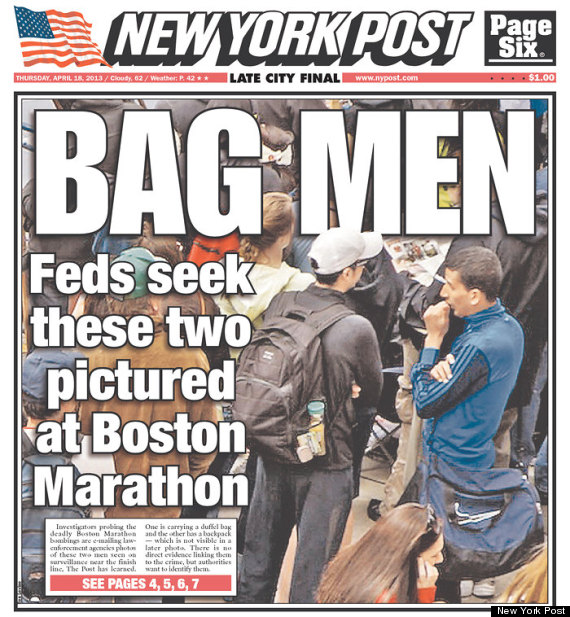
Jonathan Chait recaps the checkered performance of the media and the public in the Boston marathon bombing story:
In polarized America, both the reds and the blues have legitimate reason to fear that a tragedy will unleash an overly broad backlash. Liberals recall the false blame heaped on Muslim terrorists after Oklahoma City, and the real blame of 9/11 transforming into a fever of Bush-worship and jingoism. Conservatives recall mainstream reporters rushing to blame them, falsely, for shootings in Aurora and Tucson. It is also true that many Americans are eager, in senseless and fearful situations, for confirmation that the particular evil on display is the brand that conforms to their particular worldview. On Monday, there was comfort for some in the idea that the bombing was an act of tea-party loonies looking to exploit tax day. Among that same cohort was relief when the first pictures of the Tsarnaevs were released: The suspects were white, not Arab—maybe they were just another set of crazed teens with access to firearms. All week, nearly everyone was in a frenzy to profile, even those who should have known better.
There’s just one problem with this analysis: the consequences of misidentification are disproportionately stacked on one “side.” After the Oklahoma City bombing, the arrest and eventual execution of Timothy McVeigh had relatively little impact on American foreign and domestic policy. Sure, security was beefed up around federal buildings and other areas of interest, and President Bill Clinton attempted to leverage the attack into increased government powers, but life mostly went on.
Even after Aurora and Tucson, no one was rushing to strip conservatives of their legal rights, to surveil them more intensely, or anything else of the sort. Even if the killers had been conservatives, the most that liberals could’ve achieved is to point out (quite fairly) that conservatives can be just as extremist and violent as liberals (or liberals’ perceived “allies:” more on that in a moment).
Take, for example, the Norwegian massacre in 2011. Much of the American media rushed to broaden the scope of the gruesome attack, speculating immediately that the perpetrator was Muslim and, in so doing, implicating an entire religion. When it turned out he was a Christian conservative extremist instead, the cacophony of media bloodlust and anti-Muslim vitriol dwindled to mere whispers, the target of public anger was narrowed to a single man, and familiar defenses were trotted out: he was a lone madman, he didn’t represent any group other than himself, etc. These are, of course, sentiments not afforded Muslims and Arabs very often by these same publications.
There are, in other words, very light societal consequences for terrorism committed by ideological neighbors of the American conservative spectrum. But how quickly the tables turn when the suspect is a Muslim. (This is, in itself, an irony: nothing about fundamentalist Islam is remotely linkable to conventional liberalism, whereas fundamentalist Christianity is a crucial element within American conservatism. Islamic fundamentalism is, in fact, a much closer cousin of its Christian counterpart than it is of American progressivism.)
When the suspect is a Muslim, the consequences tend to be far greater and the overreactions more severe. September 11th, via a combination of mass hysteria, presidential incompetence, and public geopolitical ignorance, became a clear example of the catastrophe that can be unleashed on people-groups even in countries completely unrelated to the attacks.
A similarly frenzied dynamic is already enveloping the Boston Marathon bombing suspects, in some quarters. None other than U.S. Senator Lindsey Graham began publicly advocating the denial of basic rights to Dzhokhar Tsarnaev yesterday (a plea that was eventually successful, using a controversial “public safety” measure):
If captured, I hope Administration will at least consider holding the Boston suspect as enemy combatant for intelligence gathering purposes.
— Lindsey Graham (@GrahamBlog) April 19, 2013
The last thing we may want to do is read Boston suspect Miranda Rights telling him to "remain silent."
— Lindsey Graham (@GrahamBlog) April 19, 2013
The least of my worries is a criminal trial which will likely be held years from now. #Boston
— Lindsey Graham (@GrahamBlog) April 20, 2013
The Law of War allows us to hold individual in this scenario as potential enemy combatant w/o Miranda warnings or appointment of counsel.
— Lindsey Graham (@GrahamBlog) April 20, 2013
The goal is to gather intelligence and protect our nation which is under threat from radical Islam. #Boston
— Lindsey Graham (@GrahamBlog) April 20, 2013
The questioning of an enemy combatant for national security purposes has no limit on time or scope.
— Lindsey Graham (@GrahamBlog) April 20, 2013
Indeed, Graham, joined by Senators John McCain and Kelly Ayotte, as well as Representative Peter King, released a statement imperiously deeming Tsarnaev a “good candidate for enemy combatant status” and concluding:
We hope the Obama Administration will consider the enemy combatant option because it is allowed by national security statutes and U.S. Supreme Court decisions.
We continue to face threats from radical Islamists in small cells and large groups throughout the world. They have, as their primary focus, killing as many Americans as possible, preferably within the United States. We must never lose sight of this fact and act appropriately within our laws and values.
Even seemingly unrelated public policy issues are coming under fire as a “result” of the Boston Marathon bombing. See this piece from today, for example:
Opponents of immigration reform — the most promising priority of Obama’s second term remaining after the defeat of gun control — are already using the attack to try to slow progress on a bipartisan Senate bill.
More broadly, the attack is raising questions about how the administration should deal with 19-year-old Dzhokhar Tsarnaev, who was captured Friday after an exhaustive manhunt in Boston, and concerns over whether the FBI was too complacent in letting his older brother Tamerlan Tsarnaev out of its sight after interviewing him in 2011.
So yes, it is true that, once the initial shock of the tragedy itself has been absorbed, both liberals and conservatives begin wincing at the possible fallout depending on who committed the crime. But as we have learned well over the years, public policy changes most when the suspect is part of a group used as a favorite conservative punching bag (in this case, Muslims). When the suspect is in any way connected to conservatism, the consequences are virtually nonexistent.
Related articles


Divergent Views about the United States’ Place in World as Supreme Court Limits Reach of Alien Tort Statute
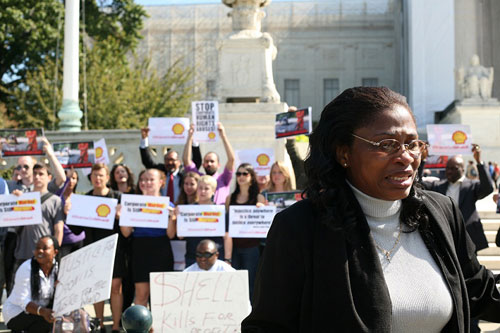
The Supreme Court on Wednesday curtailed victims’ ability to seek recourse in the United States for human rights abuses committed abroad, in a 9-0 ruling that sought to protect American corporations from being tried overseas for the same. Though all justices concluded that there was no place in American courts for an Alien Tort Statute (ATS) suit brought by a slain Nigerian activist’s widow against multinational company Shell, they seemed to agree on little else. In particular, Chief Justice John Roberts’ majority opinion and Justice Stephen Breyer’s concurrence revealed sharply divergent views about the United States’ role in the global human rights landscape.
At the heart of Kiobel v. Royal Dutch Petroleum lies the claim that Shell helped Nigeria’s Sani Abacha dictatorship perpetrate a number of horrific human rights atrocities in the 1990’s. Esther Kiobel, whose husband Dr. Barinem Kiobel had served as a prominent voice for the Ogoni people in the Niger Delta, alleges that Shell recruited the dictatorship to help quell opposition after the Ogoni mobilized against the corporation’s activities in that region. Shell purportedly gave food, money, transportation and the use of property to the Nigerian military as it raped and killed its way through Ogoni villages. Dr. Barinem Kiobel was one of the local activists the military arrested and executed.
After fleeing the country and obtaining asylum in the United States, Esther Kiobel and eleven other Nigerian nationals filed an Alien Tort Statute claim in federal court against Royal Dutch Petroleum (Shell’s parent company) for aiding and abetting torture, extrajudicial killings and other crimes against humanity. The ATS was originally written in 1789 to provide a cause of action for three things: acts of piracy, violations of “safe conduct” and assaults on foreign ambassadors in the U.S. It lay largely dormant for the next two centuries, until enterprising human rights lawyers dusted the statute off and began using it to bring civil suits against retired foreign government officials suspected of violating international law (typically the torturing and killing of their countrymen). While this modern use of the ATS has been controversial–particularly in pro-business crowds that fear a landslide of ATS claims against corporations working with unsavory regimes abroad–courts have generally accepted its application to extraterritorial human rights abuses. This reading stems from two rationales: (1) the plaintiffs, who are usually asylees and other immigrants who have escaped brutal regimes elsewhere, are unlikely to receive justice in the country where the crimes were perpetrated, and (2) as a defender of human rights, the United States should send a message that such violations are unacceptable regardless of where they occurred.
The Supreme Court, however, definitively rejected this permissive interpretation yesterday, pulling back the ATS to cover only a very small subset of human rights violations committed abroad. Chief Justice John Roberts, writing the majority opinion for himself and Justices Kennedy, Scalia, Alito and Thomas, expressed concern that a far-reaching ATS would trigger conflict between the laws of the United States and other nations. Because this statute implicates foreign policy–a field that the judiciary has traditionally been very reluctant to step into–Roberts began with a “presumption against extraterritoriality,” which is a fancy way of saying that we assume Congress wanted the statute to apply only to conduct in the United States, unless it says otherwise.
The Chief Justice then looked through the text, history and the purposes of the ATS for any indication that Congress wanted the statute to apply to acts abroad (spoiler alert: he found none). While there is in fact evidence that the Congress of 1789 had intended for the ATS to cover some overseas crimes–one of the main objectives for its passage, after all, was to combat acts of piracy, which by definition take place on the seas, outside of the United States–Roberts stated that pirates “may well be a category unto themselves” because of the way they operate outside of any jurisdiction. Drawing a firm line between the stateless nature of the high seas, which lie “beyond the territorial jurisdiction of the United States or any other country,” and a sovereign territory with an established legal system such as Nigeria, the Chief Justice worried that “unwarranted judicial interference” in the legal processes of the latter would produce serious foreign policy ramifications. Thus, corporations accused of aiding human rights abuses abroad should not be “fair game” in the same way that pirates are.
Echoing Solicitor General Don Verrilli’s warnings at the oral argument about reciprocity, the Chief Justice’s opinion also reflected concerns that a favorable ruling for Kiobel could lead to Americans (both individuals and corporations) being tried in foreign courts for human rights abuses committed in the United States “or anywhere else in the world.” Furthermore, the Chief Justice soundly rejected the idea that the presumption against extraterritoriality can be overcome because the United States must act as a human rights watchdog for the world. “There is no indication that the ATS was passed to make the United States a uniquely hospitable forum for the enforcement of international norms.” He concluded that courts must assume the ATS does not apply to overseas conduct, save for a very small and nebulously-defined exception: cases where the connection to the United States has “sufficient force to displace the presumption against extraterritorial application.”
Justice Stephen Breyer, on the other hand, still believes that the United States has a role to play as an international human rights leader. Though he ultimately agreed that the United States courts are not the appropriate fora for this specific case, Breyer favors a more expansive reading of the ATS’ reach. His concurrence, which was joined by Justices Ginsburg, Kagan and Sotomayor, rejected Roberts’ presumption in favor of a “sufficient ties to the United States” test that would apply to both claims of domestic and overseas human rights abuses. American courts should be able to hear a ATS claim if one or more of three things can be shown: (1) the alleged abuse occurred on American soil, (2) the defendant is an American national, and/or (3) the defendant’s conduct implicates a “distinct American interest,” which in Breyer’s estimation would include the United States’ interest in not becoming a “safe harbor (free of civil as well as criminal liability) for a torturer or other common enemy of mankind.” Justice Breyer found that Kiobel’s case failed to satisfy any of these three requirements, as the alleged violations occurred in Nigeria, the parties were all foreign nationals, and Shell was not directly responsible for the torture or the killing.
Breyer’s concurrence presents a markedly more optimistic picture of the United States as a “custodian” of human rights (albeit one that may not be warranted given the unending stream of news about the United States’ use of torture post-9/11 and its continued drone strikes in the Middle East). It leaves considerably more wiggle room for ATS jurisdiction over extraterritorial claims, especially where the alleged perpetrators of violations committed abroad–the “pirates of today,” according to Breyer–have relocated to the U.S. Whereas Roberts’ diminishing of the ATS insulates Americans from human rights litigation in foreign courts but leaves the U.S. open as a haven for rights violators, Breyer’s approach reverses the incentives: it deters war criminals from escaping to the United States and sends the message that the U.S. is against acts of torture and genocide, but may leave Americans vulnerable to reciprocity overseas (as well as accusations of gross hypocrisy).
In all, the Kiobel decision comes as a huge relief for corporations, with one miniscule silver lining for human rights activists. While it will be much harder to bring foreign abuse cases in the United States courts, the Supreme Court did leave the door slightly open for future litigation on whether corporations can be liable for human rights abuses. ((Congress could also, as Roberts indicated in the majority opinion, retool the ATS or author a new statute that explicitly imposes liability on companies that have abetted atrocities abroad and have corporate presence in the United States. This seems very unlikely to happen, though.)) This was the original, narrower question on which the lower courts had decided Esther Kiobel’s case, before a group of attorneys representing corporations other than Shell asked the Supreme Court to consider instead the far broader claim of the ATS’ applicability to all extraterritorial conduct, whether perpetrated by individuals or corporations. Chief Justice Roberts’ limitation of the ATS gave them what they wanted this time. But there may well come a day when the right case with the right facts–one with “sufficient force to displace the presumption against extraterritorial application”–will fit through that tiny sliver of space and land before the Supreme Court. A battered ATS lives to see another day, but just barely.
Colbert on Boston
The Colbert Report
Get More: Colbert Report Full Episodes,Indecision Political Humor,Video Archive
Running from terror in Boston

http://twitter.com/rolldiggity/status/323888998558867456
On the third floor of the Columbia University Graduate School of Journalism is the Pulitzer World Room, a mid-sized chamber that could easily double as a church sanctuary. Today, at around 2:30 PM, I arrived there to cover the official announcement of the Pulitzer Prize winners that was scheduled to take place at 3 PM.
After setting up with my computer, camera, and obligatory coffee, I began scanning TweetDeck, trying to find which hashtag was associated with the event and generally catching up on news. At around 2:51 PM, I ran across this tweet:
Two huge explosions just went off at #bostonmarathon finish. Cops running.
— Will Ritter (@MrWillRitter) April 15, 2013
At the time, it seemed out of place in my newsfeed, but it quickly became apparent just how relevant it was. Within minutes, a torrent of reports began flooding my computer screen in 140-character increments.
As it turns out, few places are more depressing than Twitter in the aftermath of a tragedy. What remains for most sentient human beings an unalloyed catastrophe that is mourned in solidarity with its victims requires all of thirty seconds on Twitter to devolve into a circus of self-righteous finger-wagging.
Of which I, like so many others, played my part. And yet there were so many aspects of today’s perfect Twitter storm that were so enraging in their lack of imagination and their utter predictability that it all felt, somehow, as if it were too much to handle at once.
I am from Boston (Everett, more precisely), and — like all Bostonians — have walked down Boylston Street far too many times to remember. Patriots’ Day is really, in the end, about two things: morning baseball and the Boston Marathon. Drinking plays a large role in both, and that is that.
And so part of my disbelief at the initial reports stemmed directly from the fact that a bombing in my hometown seemed so surreal, so otherworldly, so impossible, that it couldn’t have actually happened. I tried getting through to my parents and my little sister and kept bumping up against voicemail messages, endlessly ringing phones, and the even more ominous technical messages informing me the call could not be connected “at this time.” Eventually, I discovered none of them had even been in Massachusetts that day, let alone at home in Boston. But the horror remained.
There is a natural coming together after a tragedy. But even within this organic human impulse are concentric circles, ever-widening (or ever-narrowing, depending on the perspective) to include various scopes of “there”-ness. On September 11th, all Americans felt like New Yorkers. And all New Yorkers felt as if they had been at Ground Zero.
In reality, some people actually were there. Then, these geographical distinctions seemed not to matter. But today, there appeared to be a self-sorting taking place: the Bostonians versus the non-Bostonians, the true mourners versus the politicizers, those who demonstrated online “tact” versus the opportunists, and so on.
And yet we were all opportunists. If nothing else, today reminded me of how enormously petty people can be, as an actual human calamity was subsumed online under a wave of concern trolling and one-upsmanship. I don’t mean to pick on any one person in particular — because there truly was an enormous number of people doing this today — but it just so happened that one particular tweeter was especially prolific in this regard:
http://twitter.com/SaraMorrison/status/323880863672709120
http://twitter.com/SaraMorrison/status/323881303307075584
http://twitter.com/SaraMorrison/status/323888982779916288
http://twitter.com/SaraMorrison/status/323924796918358017
http://twitter.com/SaraMorrison/status/323950201163354112
Again, my point is not to pick on Morrison, with whom I’ve briefly interacted on Twitter in the past without incident (is there such a thing as a Twitter incident? a Twitcident?). She’s just the one particular user handle I remember from a long day of staring at my computer screen. I normally find her quite interesting, which is why I follow her in the first place.
But tweets like the above, in which boundaries are quickly drawn and stakes are claimed to some online/virtual form of legitimacy or sensitivity are just…ridiculous. Similarly maddening (and yet entirely predictable) is the knee-jerk scouring for the nearest maniac to provide a useful unhinged quote:
http://twitter.com/zackbeauchamp/status/323904005384323074
Controversial group Westboro Baptist Church says it will picket funerals of those killed by Boston Marathon bombs.
— Matthew Keys (@MatthewKeysLive) April 16, 2013
Why do these people even matter? Coverage is exactly what they want, but it is not at all clear what they have achieved to deserve it.
One final complaint: the obsession with the word “terrorism.” Everyone seemed to be holding his or her breath, waiting for the magic “T word” to escape President Obama’s lips during his press conference: after he didn’t, the conversation on TV turned to why not, and the conversation on Twitter turned to castigating the conversation on TV. This entire succession itself played out like a tired TV sitcom, with all the characters playing to typecast without the faintest trace of irony. Indeed, as Nate Silver succinctly put it:
What matters: 1) who did it; 2) how they did it; 3) why they did it. What doesn't matter: what we call it.
— Nate Silver (@NateSilver538) April 15, 2013

Thoughts on NYT Op-Ed re: Teacher Professionalization
I don’t normally write on non-higher ed issues in education, but this recent New York Times op-ed piece entitled “Teachers: Will We Ever Learn” has gotten a fair amount of traction on the interwebs. In fact, I heard about it in several emails from friends and colleagues who care about education issues as much as I do, so I thought I’d share my response to some of the key sections of the op-ed (which I encourage you to read in full):
In April 1983, a federal commission warned in a famous report, “A Nation at Risk,” that American education was a “rising tide of mediocrity.” The alarm it sounded about declining competitiveness touched off a tidal wave of reforms: state standards, charter schools, alternative teacher-certification programs, more money, more test-based “accountability” and, since 2001, two big federal programs, No Child Left Behind and Race to the Top.
But while there have been pockets of improvement, particularly among children in elementary school, America’s overall performance in K-12 education remains stubbornly mediocre. Continue reading Thoughts on NYT Op-Ed re: Teacher Professionalization
Kim Jong-Un and Ayatollah Khamenei walk into a bar
Andrew Sullivan pinpoints the illogic of the American political class’s obsession with Iran while simultaneously mocking North Korea:
2 A.M. Tune
Demons – The National
Looking forward to this stellar group’s new album, Trouble Will Find Me, which is out on May 21. I’ll always associate them with one of the most memorable nights of my life: Grant Park in Chicago on November 4, 2008, as President-elect Barack Obama emerged to raucous celebration.
The music that played as we waited for him to appear? “Fake Empire.”
Photo for tonight