The gold-plated rock worth billions

Note from Jay Pinho: Below is the inaugural guest post on The First Casualty, with many more to come. Erik Landstrom is a master’s degree candidate in International Affairs at the School of International and Public Affairs (SIPA) at Columbia University in New York. His studies concentrate on Energy and Environment, which he blogs about at his new site, Erik Landstrom on Energy. This post is adapted from one on his site.

If you weren’t aware of it, I will try to update you on a little-known fact that has, strangely enough, avoided much media attention, crowded out by “You didn’t build that” and most recently the “47%.” Right now the second- and third-largest economies in the world, Japan and China, are engaged in a territorial dispute that has a significant probability of getting worse before it gets better. They are fighting over a seemingly worthless rock formation in the South China Sea (the same one that figured in the 2010 fishing boat incident, if you remember).

The Senkaku (Japan), Diaoyu (China), or Tiaoyutai (Taiwan) islands

So why are they fighting about these seemingly worthless rocks? Most of you probably know the answer: potential mineral and hydrocarbon resources that exist in the area, as well as fishing rights. Both countries are signatories to the UNCLOS, or in plain-speak “Law of the Sea,” which stipulates that any state might claim an Exclusive Economic Zone (EEZ) 200 nautical miles (nm) out to sea. Inhabitable islands have the right to claim this as well; however, the above island should by all rights be classified as an uninhabitable rock, reducing its ability to claim significant surrounding space. China does not take this stance. (I will return to talk about UNCLOS in other posts, specifically why the U.S. has not signed it.)

In other words, this rock is not worthless. It is potentially more expensive per gram/ounce than had it been made out of pure gold! Prove that it is inhabitable and you win the jackpot.

So the rock formation has become the center of attention for world power politics and is a likely stage for many future skirmishes and standoffs. Especially taking into account China’s current build-up of naval capabilities coupled with its claim (see below) to basically the entire contested area, the entire region is slightly worried. Leon Panetta, the US Defense Secretary, is in the region to continue talks on a regional ballistic missile system that will protect Japan from attacks by North Korea, but as we can all see from the timing it will probably serve a dual purpose. China’s response was to launch a major naval exercise involving around 40 missiles.
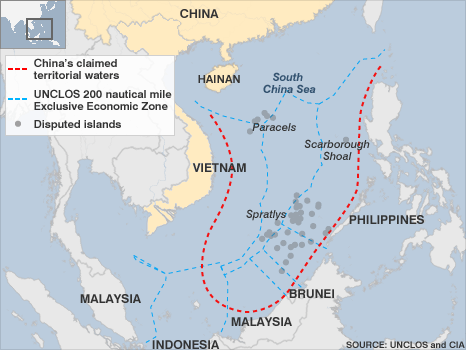
No one knows how much oil or gas exists in the South China Sea as no exploration data exists (only estimations). The estimations of oil resources have ranged between ~20bn barrels and ~200 barrels, and gas reserves are said to be around 900tcf (trillion cubic feet). For those of you that have a hard time putting the numbers in perspective, the U.S., which is the 3rd-largest oil producer in the world, has between 22-30bn barrels of P90 (90% probability) oil reserves. And Qatar, which has the 3rd-largest gas reserves, has 884tcf. How much exists around this specific rock formation is unknown.

Soledad O’Brien is a truth vigilante

Jay Rosen noted an encouraging development from CNN’s Soledad O’Brien, seen below (on Monday’s show) challenging reigning Republican doofus (and U.S. Representative from New York) Peter King on his “Obama’s apology tour” lies.

O’Brien is on somewhat of a roll, as she managed to reduce another Romney surrogate to flailing ad hominem attacks last month when his “reality” simply refused to match up with, well, Reality’s reality.

This is exactly the type of journalism we need to see more often if the infamous “post-truth” trend in American campaign seasons is to be stopped. It’s going to take aggressive but fair questioning, backed with judiciously researched data and facts. And it’s going to require a journalistic courage not to back down in the face of screaming old white men (or black men, or white women, or anyone else).

Over time, these confrontations could even become less necessary as campaigns readjust, knowing they won’t get away with telling lies on a national TV channel devoted to journalism. It goes without saying that journalists must be aggressive with lies told by both sides, but it doesn’t take a Ph.D. in political science to see that the vast majority of bald-faced lies, distortions, and half-truths is coming from the right wing these days. It’s time to remind them we’re not all as stupid as they clearly think we are.

Turncoats, man your stations

Harvard Law professor Cass Sunstein makes the point that, to convince ideologically rigid audiences of a fact, it is less important how persuasive the argument is and more important who is the one making it:

People tend to dismiss information that would falsify their convictions. But they may reconsider if the information comes from a source they cannot dismiss. People are most likely to find a source credible if they closely identify with it or begin in essential agreement with it. In such cases, their reaction is not, “how predictable and uninformative that someone like that would think something so evil and foolish,” but instead, “if someone like that disagrees with me, maybe I had better rethink.”

Our initial convictions are more apt to be shaken if it’s not easy to dismiss the source as biased, confused, self-interested or simply mistaken. This is one reason that seemingly irrelevant characteristics, like appearance, or taste in food and drink, can have a big impact on credibility. Such characteristics can suggest that the validators are in fact surprising — that they are “like” the people to whom they are speaking.

It follows that turncoats, real or apparent, can be immensely persuasive. If civil rights leaders oppose affirmative action, or if well-known climate change skeptics say that they were wrong, people are more likely to change their views.

I’m skeptical as to what extent this theory applies to ethnic, racial, and sexual minorities who have conservative or otherwise unorthodox ideologies for their groups, however. It seems the term “self-hating [insert minority group here: Jew, black, gay, etc.]” is very quickly applied to various targets by many critics in order to diminish the inevitable megaphone effect of the anomalous spokesman or spokeswoman. Supreme Court Justice Clarence Thomas comes immediately to mind, but countless other examples exist as well: Norman Finkelstein, Noam Chomsky, members of GOProud, and even Barack Obama, to name a few.

Perhaps we’ve crossed some invisible line as a nation, and even these helpful “turncoats” can no longer inspire our trust. They certainly don’t persuade me much. I’m a little unclear as to whether this says more about me, or more about the turncoats.

Fresh new faces at The First Casualty

One of the most important aspects of blogging successfully is keeping current. Lately, I’ve found this increasingly hard to do, as school-related and other extracurricular projects have eaten away steadily at my rapidly diminishing free time.

Paradoxically, even while posting less, I’ve probably spent more time thinking about the blog recently than I used to in the past, however. And I think I may have discovered a partial antidote to the large periods of silence between blog posts: guest contributions.

The great thing about inviting others to join me on this blog from time to time is that it accomplishes several objectives at once: 1) it adds valuable new perspectives (and even ideologies) in a wide array of fields and niches to a site that tends towards one-dimensionalism, 2) it relieves some of the pressure on me to post ever more frequently, and 3) it keeps the blog current.

I’m not yet entirely certain what form the guest posts will take, but a few general guidelines are already taking form in my head. Although I cannot guarantee any regularity to the posts, as this depends on my schedule and theirs, the general idea will be for each guest blogger to specialize in something they have studied (or are studying) at an advanced level, worked on professionally, or otherwise engaged in on an academic or professional (or comparably rigorous) level.

Over the next several weeks to a month, expect to see some really interesting topics (ones I am neither qualified nor courageous enough to write about myself) written by some truly fascinating people. At present, this group is limited to a small handful, but I fully anticipate adding to this team as we go forward. Tell your friends!

Was that noise we just heard the last nail in Romney’s coffin?

Probably not. But these comments — spoken at a private event and captured secretly on camera — will certainly bring him closer to the brink:

There are 47 percent of the people who will vote for the president no matter what. All right, there are 47 percent who are with him, who are dependent upon government, who believe that they are victims, who believe the government has a responsibility to care for them, who believe that they are entitled to health care, to food, to housing, to you-name-it. That that’s an entitlement. And the government should give it to them. And they will vote for this president no matter what…These are people who pay no income tax…[M]y job is is not to worry about those people. I’ll never convince them they should take personal responsibility and care for their lives.

[youtube http://www.youtube.com/watch?feature=player_embedded&v=XnB0NZzl5HA]

Barney Frank: always good for a pithy quote

From Alec MacGillis’ fascinating piece for The New Republic, “How Paul Ryan Convinced Washington of His Genius:”

“I’ve literally never heard or read anything from [Ryan] that’s surprising or new,” Barney Frank told me late this summer. So why the big-thinker reputation? “Because he is being graded on a curve with a bunch of guys who jump into the Sea of Galilee because they want to be closer to God.”

The New York Times’ credibility takes another blow

The new New York Times public editor has already stepped in it, it would seem. From Margaret Sullivan’s column yesterday:

Readers are quick to cite examples. Several who wrote to me thought there was an element of false balance in a recent front-page article in The Times on the legal battles over allegations of voter fraud and vote suppression — hot topics that may affect the presidential race.

In his article, which led last Monday’s paper, the national reporter Ethan Bronner made every effort to provide balance. Some readers say the piece, in so doing, wrongly suggested that there was enough voter fraud to justify strict voter identification requirements — rules that some Democrats believe amount to vote suppression. Ben Somberg of the Center for Progressive Reform said The Times itself had established in multiple stories that there was little evidence of voter fraud.

“I hope it’s not The Times’s policy to move this matter back into the ‘he said she said’ realm,” he wrote.

The national editor, Sam Sifton, rejected the argument. “There’s a lot of reasonable disagreement on both sides,” he said. One side says there’s not significant voter fraud; the other side says there’s not significant voter suppression.

“It’s not our job to litigate it in the paper,” Mr. Sifton said. “We need to state what each side says.”

Mr. Bronner agreed. “Both sides have become very angry and very suspicious about the other,” he said. “The purpose of this story was to step back and look at both sides, to lay it out.” While he agreed that there was “no known evidence of in-person voter fraud,” and that could have been included in this story, “I don’t think that’s the core issue here.”

It’s shocking to read a national reporter so casually dismiss the central point of his own article:

In the last few weeks, nearly a dozen decisions in federal and state courts on early voting, provisional ballots and voter identification requirements have driven the rules in conflicting directions, some favoring Republicans demanding that voters show more identification to guard against fraud and others backing Democrats who want to make voting as easy as possible.

The most closely watched cases — in the swing states of Ohio and Pennsylvania — will see court arguments again this week, with the Ohio dispute possibly headed for a request for emergency review by the Supreme Court.

But this is the New York Times, after all. Even a column ostensibly criticizing the use of false equivalence manages to boldly reassert the practice by the bottom of the page.