Midnight Shallows – Mt. Wolf
Professor McCain
There’s a veritable feast of things to love in this video. First, it’s hard not to appreciate FOX‘s Brian Kilmeade delivering his profound commentary: “I have a problem helping those people out if they’re screaming that after a hit.” (Yelling “Allahu akbar” is, presumably, more offensive than stating, “Oh, yeah, look at those dead bastards.” Or openly rooting for an injured enemy soldier to pick up a weapon so you have a right to open fire on him. Or saying, while discussing a child wounded by your side’s gunfire, “Well[,] it’s their fault for bringing their kids into a battle.”)
But it only gets better from there, when John McCain gets all professorial:
Would you have a problem with Americans and Christians saying, “Thank God, thank God?” That’s what they’re saying. Come on! Of course they’re Muslims, but they are moderates. And I guarantee you that they are moderates. I know them, and I’ve been with them. For someone to say “Allah akbar” is about as offensive as someone saying “thank God.”
Aside from the fact that it’s funny to see John McCain suddenly realize that Muslims are human too, it’s even more hilarious to hear him say “I know them, and I’ve been with them.” Indeed he does, and has: unfortunately, it appears he couldn’t tell the moderates apart from the terrorist kidnappers. (Don’t you hate when that happens?)

A real LOL ad
This is the first time I’ve laughed out loud for a commercial in awhile. The closing line is killer:
Justifying the unjustifiable in Syria
Let’s start with the premise that some wars are justifiable. I’m with Jonathan Chait there. But he loses me very shortly thereafter in his piece from Tuesday:
The merits of intervening in Syria strike me as both a closer call and a lower-stakes matter than what we think of as “major wars.” The apparently forthcoming operation has much more modest ends than the intervention in Libya, which I supported and that succeeded in its aim. We will not be toppling a brutal regime or preventing an imminent massacre. The purpose of air strikes is to impose a cost on regimes that deploy chemical weapons against civilians. Attacking the Syrian regime won’t stop all future massacres of civilians, or even all chemical attacks on civilians, but it does strike, on balance, as better than doing nothing at all.
Essentially every line of this paragraph is inaccurate or incoherent. First, what, exactly, constitutes a “major war?” If a two-year-old civil war with a death toll exceeding 100,000 and displaced totals in the millions doesn’t count as one, then I’m not certain what it would take to persuade Chait of the war’s significance. (Like Mitt Romney’s conception of the upper class as households earning over $250,000 annually, it appears that Chait’s dataset of “major wars” is restricted to ones in which Americans die in sufficiently large numbers.)
I get what he’s trying to say: war may be devastating Syria, but an American intervention would pose little risk to the United States. To illustrate this point, he compares the proposed military action in Syria to that in Libya and concludes that the former actually represents the safer course of action.
This is, of course, absurd. Libya was led by Muammar Qaddafi, an increasingly isolated autocrat whose idiosyncrasies even his authoritarian Arab brothers despised, and they were only too happy to be rid of him. Virtually no one felt threatened, or was even particularly bothered, by what transpired in Libya: only a duped Russia (sign up for the no-fly zone, stay for regime change!) and a coterie of jittery Middle Eastern despots showed much concern. It was quite clear, in the end, that Qaddafi had no real leverage with anyone.
Contrast that with the situation in Syria today. Assad has the support of both Hezbollah and Iran. Oh, and Russia, which has already warned of the “catastrophic consequences” of an intervention in the Middle East. Meanwhile, Israel is standing ready to respond in case of retaliation in the event of an American-led strike in Syria. In short, it is really quite easy to imagine a scenario in which at least six nations (Syria, Lebanon, Russia, Iran, Israel, and the United States — and this doesn’t even include likely NATO partners such as the U.K.) are pulled into an increasingly intractable conflict. Syria is intricately woven into the political fabric of the Middle East in a way that Qaddafi’s Libya could only dream of being.
But Chait doesn’t stop there. He also insists, echoing a persistent journalistic theme that bears little resemblance to reality, that the Libya operation was a success. It is unclear whether he is referring to the prevention of a massacre in Benghazi or regime change itself as barometers of victory. In this failure, however, he is at least joined by the initial proponents of the Libya intervention, none of whom seemed to know the true objective either. In a preemptive rebuttal of his critics, he writes:
The argument for intervening in Libya was not that doing so would turn the country into a peaceful, Westernized democracy moving rapidly up the OECD rankings. It was that it would prevent an immediate, enormous massacre of civilians. Libya remains an ugly place; it would have been so regardless of whether NATO intervened. But the narrow, humanitarian goal that drove the U.S. to act was unambiguously accomplished without the larger dangers of mission creep that foes warned against.
Again, this is sheer madness. The “narrow, humanitarian goal” to which Libya intervention advocates staked their early justifications was to prevent a massacre in Benghazi by establishing a no-fly zone, and not regime change. Of course, we never had any definitive proof that such a massacre would take place, only the histrionics of a famously melodramatic leader. So was the intervention a success? Only if measured against the presumed alternative of a guaranteed massacre, an event that — by definition — we can never know for certain would have happened in the first place. The goal was far from “unambiguously accomplished.”
What really gets me, though, is this part: “…without the larger dangers of mission creep that foes warned against.” This is a truly astounding declaration. Here is a White House statement from March 22, 2011:
Ben Rhodes, a deputy national security adviser, issued a statement acknowledging that President Obama would like to see a democratic government in Libya, but explained that the aim of the U.S. military’s intervention there is not to enact regime change.
“We’re clarifying, as we’ve said repeatedly, that the effort of our military operation is not regime change, that as we actually say in this readout, it’s the Libyan people who are going to make their determinations about the future,” Rhodes said. “We support their aspirations, their democratic aspirations, and have stated that Gadhafi should go because he’s lost their confidence.”
This “narrow, humanitarian” NATO campaign to prevent a massacre eventually lasted seven months, included nearly 8,000 bombs and missiles, and played a decisive role in the rebels’ eventual capture of Qaddafi — long after he possessed any capacity to massacre anyone.
And yet even this incongruence is hardly the worst aspect of Chait’s argument. That prize is awarded to this sentence: “Libya remains an ugly place; it would have been so regardless of whether NATO intervened.”
Exactly. That’s just the point.
And so here we are again, pondering a supposedly limited engagement in Syria. Once again, the White House has explicitly denied that the goal of the (decreasingly hypothetical) intervention in Syria would be regime change. Once again, the objective is muddy: murkier, even, than the Libya strikes — which were at least superficially described, at the outset, as a response to an impending massacre. In Syria, the massacre has already taken place, and Obama has seemingly settled on the phrase “strong signal” (against the use of chemical weapons) as ample justification for a potential military mission.
And, once again, Syria will remain an ugly place with or without external intervention.
Chait concludes thusly:
But I continue to be amazed that some of my younger liberal friends find it so easy to dismiss any weighing of pros and cons by venturing arguments structurally identical to ones that, in a domestic context, they recognize as absurd.
I, in turn, continue to be amazed that Jonathan Chait finds war so casually justifiable. In the first quote I excerpted in this post, he wrote: “Attacking the Syrian regime won’t stop all future massacres of civilians, or even all chemical attacks on civilians, but it does strike, on balance, as better than doing nothing at all.”
That’s right: an intervention strikes him as better than doing nothing. That’s only slightly worse than going to war to send a “strong signal.” And yet, “doing nothing at all” isn’t even an option on the table. (For one, the U.S. has already promised to supply the rebels with arms, even if that vow has not necessarily been fulfilled yet.)
Indeed, this is the principal victory that the national security hawks have wrested from their dovish foes in the American political sphere: the idea that ever deciding not to intervene somewhere is a form of cowardice and isolationism. It’s why Rand Paul is consistently portrayed as a hermetic isolationist for the sole crime of opposing thoughtless military adventurism. (He’s rightly portrayed as a “wacko bird” for many other things, however.) And it’s why the decision to go to war is consistently portrayed as a garden-variety policy decision, like raising taxes or modifying vehicle emissions standards.
But it’s not. John Adams once said that “great is the guilt of an unnecessary war.” After a string of them — initiated via flawed reasoning and later feted for their imaginary victories — it appears that war remorse, like John Adams, is history.

2 A.M. Tune
Don’t Be So Hot – Me And My Drummer
Journalistic civil war
David Carr has really hit the nail on the head with his latest:
The larger sense I get from the criticism directed at Mr. Assange and Mr. Greenwald is one of distaste — that they aren’t what we think of as real journalists. Instead, they represent an emerging Fifth Estate composed of leakers, activists and bloggers who threaten those of us in traditional media. They are, as one says, not like us.
“By no means was I treated as a hero when I first came forward. I was indicted and spent two years in court,” Mr. Ellsberg said in an interview. “But in those days, journalists were not turning on journalists. With Snowden in particular, you have a split between truly independent journalists and those who are tools — and I mean that in every sense of the term — of the government. Toobin and Grunwald are doing the work of the government to maintain relationships and access.”

Growing out of guilty pleasures
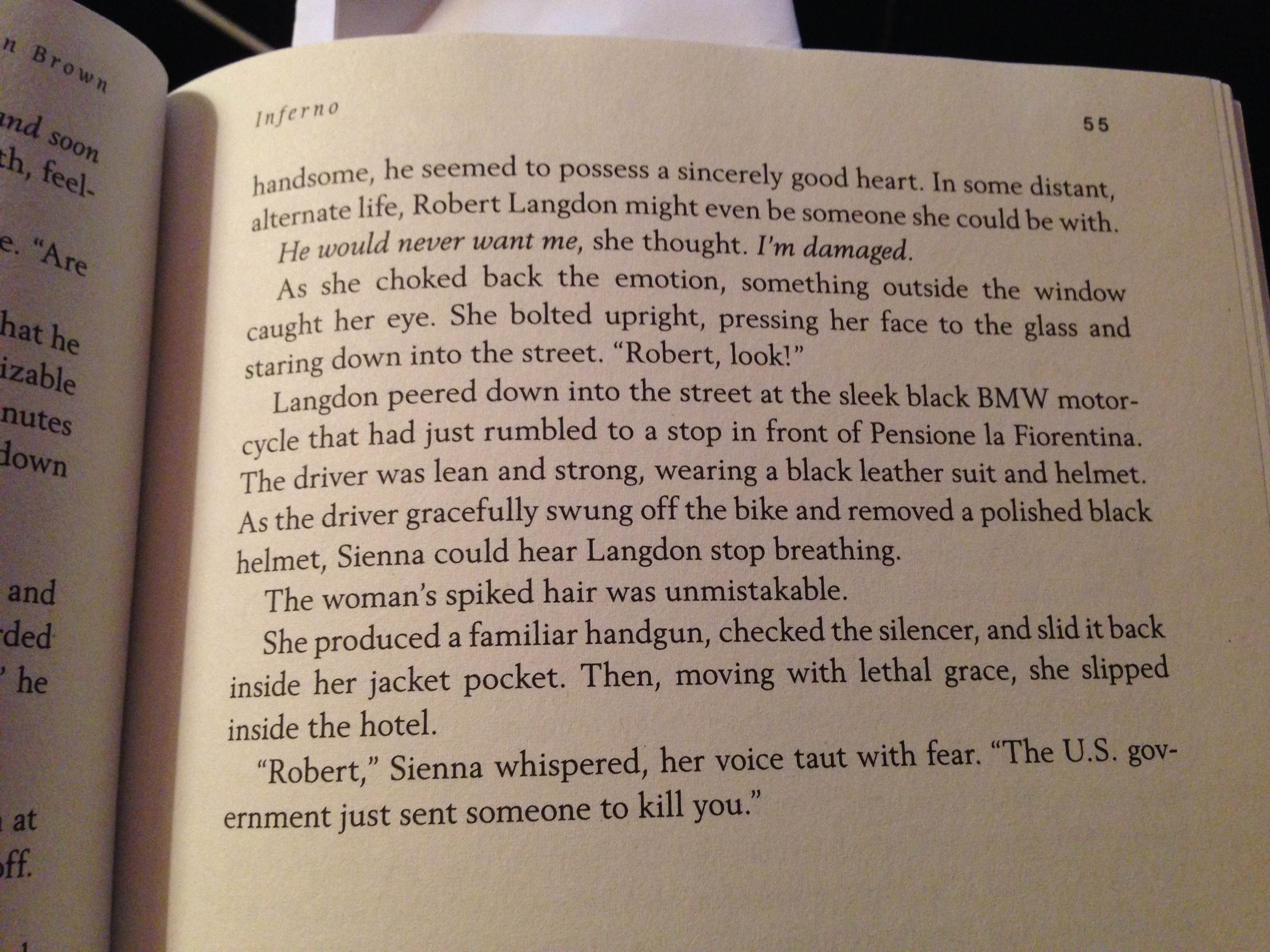
On an impulse, I recently purchased Dan Brown’s latest novel, Inferno. Although I admittedly read and enjoyed The Da Vinci Code, Angels and Demons, and The Lost Symbol in the past, this time something irreversible finally seems to have taken place. Yes, in the past I’d already resigned myself to Brown’s eyeroll-inducing italics, smiled at his strained metaphors, even accepted his jarring similes.
But this one may be a bridge too far. File this one under “Oh, The Lengths to Which I Will Go on a Family Vacation.”

2 A.M. Tune
Never Be the Same – Little Majorette
Not sure what they’re putting in the water up there in northern Europe, but all musical instruments and voices turn to gold somewhere upwind of Berlin.
2 A.M. Tune
Lost Track of Time – MTNS
Trouble in cyber-paradise
Yesterday Full Stop published my dual book review of Susan Crawford’s Captive Audience: The Telecom Industry and Monopoly Power in the New Gilded Age and Jaron Lanier’s Who Owns the Future? An excerpt from the essay here:
The consumer as loser is nearly a meme at this point, so thoroughly has the Great Recession imprinted its insignia on the wearied American mindset. Nevertheless, Crawford warns, the consolidation of the American Internet access bottleneck is particularly worthy of hand-wringing. As other advanced economies like South Korea and Japan rocket ahead in embracing fiber-optic connectivity – complete with 1Gbps symmetric data speeds that remain incomprehensible to most Americans – the United States finds itself in the humiliating position of aiming for a minimum national broadband speed of 4Mbps (download-only; 1 Mbps upload) by 2020.
Underlying this technological angst is something deeper, more primal. It is the sense that some right, however virtualized, is being denied by the cartelization of the American telecom space. It is the realization, further still, that our international peers are enjoying the fruits of their justly obtained lightning-speed access while those of us holding American passports are condemned to the endless purgatory that is YouTube’s “loading” spin-wheel.
