Do I even remember how to do this anymore? I guess we’ll find out:
Vapour – Vancouver Sleep Clinic
Do I even remember how to do this anymore? I guess we’ll find out:
Vapour – Vancouver Sleep Clinic
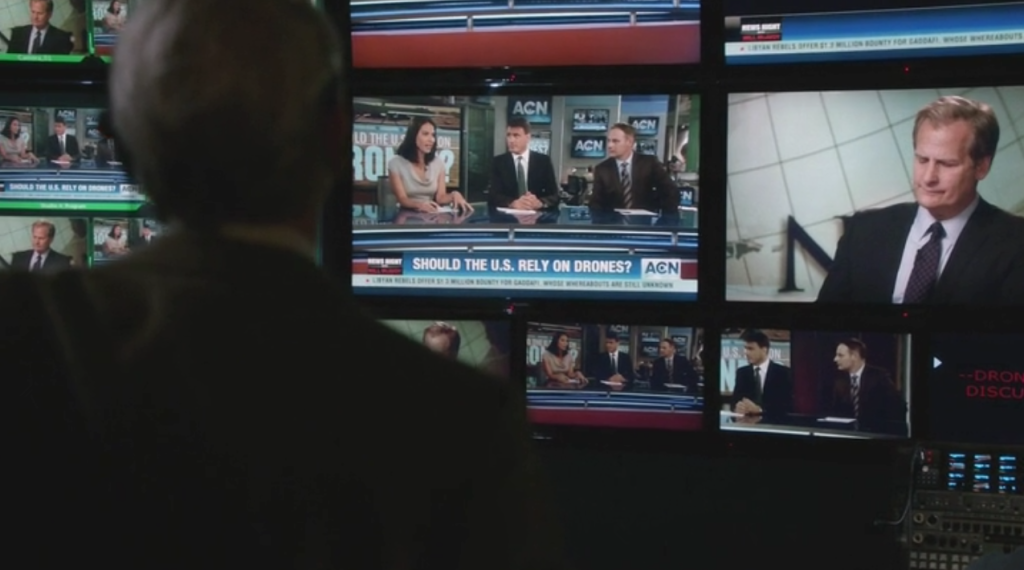
HBO’s The Newsroom returned to television last night, and it was borderline obsessive about drone strikes. (As for the storytelling itself, there is, so far, no sign of improvement since the conclusion of Season 1.) In the midst of the rhetorical maelstrom — this is an Aaron Sorkin show, after all — I couldn’t help but notice that Sloan Sabbith (Olivia Munn) had this to say about drone strikes during an on-air panel:
We don’t know exactly what that collateral damage is because of the lack of any transparency or accountability. Now factor in that the B.D.A. — the bomb damage assessment — counts all military-age males as militants.
The show depicted this particular airing of News Night as having taken place on August 24th, 2011. The only problem? The New York Times actually broke the story about all military-age males being counted as combatants nearly a full year later, in an article published on May 29, 2012:
It is also because Mr. Obama embraced a disputed method for counting civilian casualties that did little to box him in. It in effect counts all military-age males in a strike zone as combatants, according to several administration officials, unless there is explicit intelligence posthumously proving them innocent.
…
But in interviews, three former senior intelligence officials expressed disbelief that the number could be so low. The C.I.A. accounting has so troubled some administration officials outside the agency that they have brought their concerns to the White House. One called it “guilt by association” that has led to “deceptive” estimates of civilian casualties.
“It bothers me when they say there were seven guys, so they must all be militants,” the official said. “They count the corpses and they’re not really sure who they are.”
As far as I know, the closest that most of the mainstream media came to openly contesting the administration’s counting policy before the night of August 24th, 2011 was in another New York Times article from August 11th of that year:
The civilian toll of the C.I.A.’s drone campaign, which is widely credited with disrupting Al Qaeda and its allies in Pakistan’s tribal area, has been in bitter dispute since the strikes were accelerated in 2008. Accounts of strike after strike from official and unofficial sources are so at odds that they often seem to describe different events.
The debate has intensified since President Obama’s top counterterrorism adviser, John O. Brennan, clearly referring to the classified drone program, said in June that for almost a year, “there hasn’t been a single collateral death because of the exceptional proficiency, precision of the capabilities we’ve been able to develop.” Other officials say that extraordinary claim still holds: since May 2010, C.I.A. officers believe, the drones have killed more than 600 militants — including at least 20 in a strike reported Wednesday — and not a single noncombatant.
But that article is a far cry from the definitive declaration made by Sloan Sabbith on last night’s episode of The Newsroom. I suppose this is just one more trademark of Aaron Sorkin. It’s not just his depiction of women that’s anachronistic: even his series on news reporting can’t get the story in the right order.


I’m still here. But I’ll be here more…soon.

In a barn-burner of a decision today, the Supreme Court found unconstitutional the federal Defense of Marriage Act (DOMA), striking down the law based on a combination of states’ rights, equal protection and due process arguments. As expected, Justice Anthony Kennedy wrote the majority opinion for United States v. Windsor, joined by Justices Breyer, Kagan, Sotomayor and Ginsburg. Justices Scalia, Roberts, Alito and Thomas dissented, with the former three each penning his own dissent.
The voiding of DOMA, which had kept the United States government from recognizing married same-sex couples, means that all legally-married couples can now receive the federal benefits allocated based on marital status, regardless of whether your spouse is of the same sex or not. The question of whether you can legally marry a person of the same sex in the first place, however, remains in the hands of the states, as the Court stopped short of declaring same-sex marriage to be a fundamental right.
The above interactive graphic shows key quotes from the justices, pulled from the March oral argument and from today’s ruling. You can scroll over each justice to open up a text box with his/her quotes. The red dot indicates the author of the majority opinion; yellow dots indicate the other justices in the majority; blue dots indicate the dissenters.
Further analysis of the Court’s decision in United States v. Windsor to come.

We are now hours away from the last rulings of the Supreme Court’s term, and we know for certain that we’ll be getting a decision in United States v. Windsor, the challenge to the federal Defense of Marriage Act (as well as Hollingsworth v. Perry, the California Proposition 8 case). On the eve of what will surely be a historic day for gays and lesbians across the country, it’s worth going back and reading the March oral argument for the case. A few points I’d like to make ((With the major caveat, of course, that I realize oral arguments are not always an accurate indicator of the eventual outcome of a case.)):
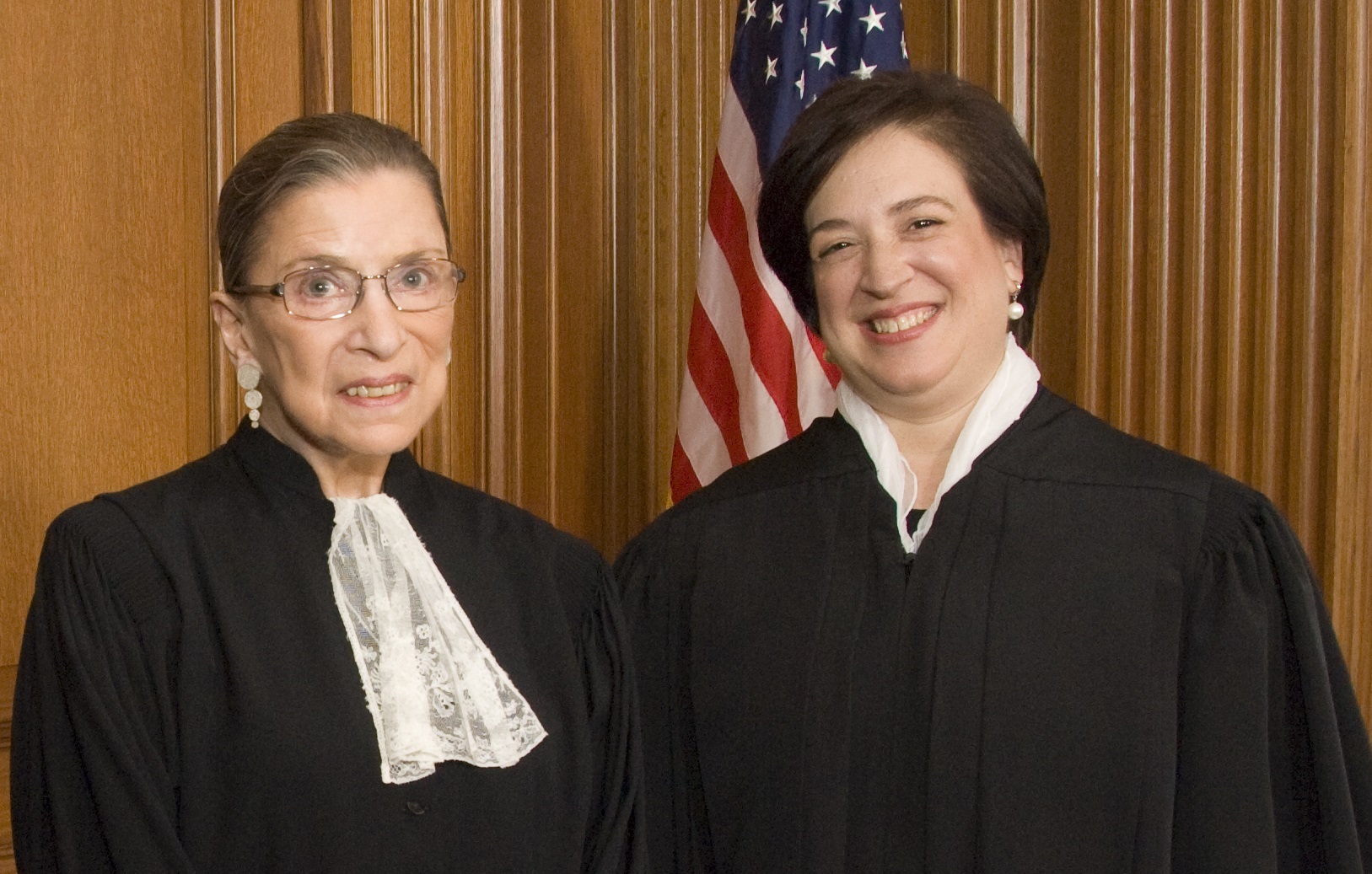
While the lion’s share of attention re: DOMA has been focused on Kennedy (including, of course, this post, which has already given him three bullet points), I also want to highlight a couple of points that Justices Ruth Bader Ginsburg and Elena Kagan made at the Windsor oral argument:
Finally, it bears remembering that exactly ten years ago, the Supreme Court issued its landmark decision in Lawrence v. Texas, striking down the criminal convictions of two men who had been arrested and tried under a Texas law that prohibited certain forms of sexual conduct between members of the same sex. In overruling an earlier Supreme Court decision that had upheld the application of state sodomy bans to gay and lesbian sexual activity, majority opinion author Justice Anthony Kennedy invoked the Founding Fathers:
They knew times can blind us to certain truths and later generations can see that laws once thought necessary and proper in fact serve only to oppress. As the Constitution endures, persons in every generation can invoke its principles in their own search for greater freedom.
In a few short hours, we’ll find out just how committed Kennedy and the rest of the Supreme Court remain to this principle.
In a highly-anticipated 5-4 decision today, the Supreme Court struck down a key part of the Voting Rights Act, ending nearly a half-century of robust federal supervision over the election procedures of states with histories of racial discrimination.
At issue in Shelby County v. Holder was the Act’s requirement that certain states and districts obtain federal approval prior to changing their election laws, in a process known as Section 5 “preclearance.” To determine which areas of the country would be “covered” and therefore subject to preclearance, Congress in 1965 wrote into the Act a coverage formula, also known as Section 4. This formula asked whether a jurisdiction had a voting test in the 1960s or 70s, and had low voter registration or turnout at the time; if the answer was yes, then Section 5 applied to that jurisdiction.
In 2006, Congress renewed the Voting Rights Act without making any changes to the Section 4 coverage formula. Shelby County, a covered jurisdiction in Alabama, challenged the constitutionality of the Act. Today, a majority of Justices agreed that the coverage formula “can no longer be used as a basis for subjecting jurisdictions to preclearance,” saying that the decades-old data does not reflect the strides that states have made in eradicating voter discrimination. Chief Justice John G. Roberts’ majority opinion left it open to Congress to re-write a new coverage formula, but as Rick Hasen of the Election Law Blog notes, this is highly unlikely given the degree of polarization in today’s Congress. It’s interesting to note that the Court did not get to the constitutionality of Section 5, but it didn’t have to–invalidating Section 4 releases all jurisdictions swept up by the formula, effectively stripping the Voting Rights Act of most of its power.
Collectively, the majority opinion, concurrence and dissent run 68 pages long, but I’ve assembled some highlights from each Justice, which you can read by scrolling over the graphic above. (You can also enlarge the graphic by hovering over the icon in the top-left corner and selecting the link to “see more.”) Each dot will open up a box that shows key quotes from that Justice: one (or two) from the March oral argument, and one from today’s decision (if the Justice wrote an opinion, concurrence or dissent). The red dot indicates the author of the majority opinion. The yellow dots indicate the rest of the Justices who were in the majority, and the blue dots indicate the dissenters.
From yesterday’s online New York Times comes a story titled “As Social Media Swirl Around It, Supreme Court Sticks to Its Analog Ways:”
The Web is ready, too. On Thursday, after the justices once again did not issue rulings in any of the biggest cases, news organizations blared the “news” to their followers. “BREAKING NEWS: No major decisions from Supreme Court today,” the Yahoo News site announced on its Twitter feed. Another Twitter user wryly observed: “Clearly all Supreme Court judges were unpopular kids in high school and, excited by all the attention now, are gonna drag this out.”
A year ago, in the minutes before the court announced its decision on President Obama’s health care law, Twitter users posted more than 13,000 messages a minute about the court. (By comparison, there were 160,000 a minute at the height of the presidential debate in Denver last year.)
And then today, another story headlined “A Panda Escapes From the Zoo, and Social Media Swoop In With the Net:”
To help find Rusty, a raccoon-size mammal with a striped tail and moon-shaped face, the zoo turned to social media, and suddenly half of official Washington broke from Serious Events to tune in to the saga of the runaway panda.
On Twitter and Facebook, the hunt for 11-month-old Rusty, whom the zoo acquired three weeks ago as a partner to a female panda named Shama, exploded in a mix of concern, humor and, this being Washington, the goring of political oxen.
“Rusty the Red Panda eats shoots and leaves,” Jake Tapper, CNN’s chief Washington correspondent, filed to Twitter.
Doug Stafford, a senior aide to Senator Rand Paul, Republican of Kentucky, called the escape a cautionary tale. “If we don’t use drones to spy on everyone, the pandas will win,” he wrote.
The zoo announced Rusty’s disappearance to its thousands of Twitter followers in a message at 11:51 a.m, which was retweeted nearly 3,000 times in an hour.
At midday, mentions of “Rusty” on Twitter nearly equaled those of “Obama.” ABC News started a blog with “live coverage” of the search.
“Please help us find Rusty,” the zoo pleaded on Twitter, explaining that he was last seen at 6 p.m. on Sunday and might be nearby “hiding in a tree.”
On its Facebook page, the zoo said keepers were combing the Asia Trail habitat, whereRusty and Shama live between the Japanese giant salamander and the small-clawed otter, since 8 a.m. But in an ominous note, the zoo said it was possible Rusty had been stolen.
Look, I get it. The New York Times has discovered social media, and it is on it. But please, please — stop with the constant stories devoted to people who…tweet. Or who post the occasional snarky Facebook post.
This is not news. This is actually rather mundane, and is best replaced by an article on almost anything else.
And yes, I realize I have just made the problem worse.