Tag Archives: SCOTUS

The Supreme Court Hears Same-Sex Marriage Cases: A Brief Reading List

Edie Windsor

Edie Windsor. Picture courtesy of the New York Times. 

All eyes are on the Supreme Court this morning as it prepares to finally hear two cases on same-sex marriage, the civil rights issue of our time. Starting shortly after 10 a.m. today, a 60-minute oral argument will be held for Hollingsworth v. Perry, which questions the constitutionality of California’s Proposition 8 restricting the definition of marriage to one woman and one man. Tomorrow morning, the Justices will hold a 110-minute argument for United States v. Windsor, in which the Supreme Court could strike down the 17-year-old Defense Of Marriage Act (DOMA) that denies federal benefits to same-sex couples even if their marriages are recognized by the state. (The Court is expected to release the audio recording and transcript for each argument shortly after it ends.)

Given the historical significance of these two cases, it’s not surprising that the Internet has lit up with a maelstrom of commentary on just about everyone and anyone who is even remotely connected to either suit. From current Chief Justice John Roberts to former Justice Harry Blackmun, the marquee duo of lawyers challenging Proposition 8 to the people who have been paid to wait in line since Thursday night for the chance to score seats at the oral arguments, everything SCOTUS-related has come under increasing scrutiny as March 26, 10 a.m. draws near. Lest you are feeling overwhelmed by this deluge of information or just looking to do a little bit of last-minute reading as we wait for the Court to wrap up the day’s oral argument, I’ve compiled some of what I think are the most helpful and informative articles for understanding who’s who and what’s going on:

The Overview: Hundreds of articles have picked apart the individual issues and key players before the Court. For one centralized, concise summary of all the legal issues at stake in Hollingsworth and Windsor, the inimitable SCOTUSblog has two primers from Amy Howe. For a quick-hits list of things to watch for at the arguments, go to CNN’s Matt Smith or Slate’s Emily Bazelon, both of whom have highlighted the most important things to know.

The Plaintiffs of Proposition 8: Unsurprisingly, the media has made much hay of the human interest stories behind these cases. The two couples handpicked from California to challenge Prop 8–Kris Perry and Sandy Stier, Paul Katami and Jeff Zarrillo–are profiled in USA Today as “workaday couples living the American Dream, with one exception–they can’t marry their partners.” Perry and Stier also recently gave an interview to the Associated Press (found via the Huffington Post) in which they recall how they’ve lived the last four years in a “pins-and-needles way” while litigating their case up to the nation’s highest court.

The Lawyers Challenging Proposition 8: One of the most dramatic storylines in a case chock-full of them has to be the partnership of superstar lawyers David Boies and Ted Olson, who were famously opponents in Bush v. Gore. The conservative Olson, a former Solicitor General for the U.S. under President George W. Bush, was initially met with some skepticism when he announced that he would be joining Boies in the fight against Prop 8; the Los Angeles Times profiles him here. David Boies, for his part, gave an interview to USA Today two weeks ago stating his belief that Hollingsworth v. Perry will be decided in their favor with more than five votes.

The Plaintiffs of DOMA: “I came to New York to let myself be gay.” Edie Windsor, an 83-year-old widow and former IBM engineer who was engaged to Thea Spyer for 40 years and married for two before Spyer’s death, is the subject of an illuminating New York Times piece about her reasons for challenging the federal government. New York Magazine recently compiled a slideshow of pictures from Windsor and Spyer’s life together.

The Lawyer Challenging DOMA: Though Windsor–with her winsome personality, elegant looks and her compelling love story–now looks like what civil rights lawyers would call the perfect plaintiff for same-sex marriage, her case was rejected by a major gay rights organization before being picked up by Roberta Kaplan, an attorney with Paul, Weiss, Rifkind, Wharton & Garrison. Kaplan, who has said that it took her all of five seconds to decide that she wanted to litigate Windsor’s case, explains her reasoning to Advocate.

Justice Anthony Kennedy: The current swing vote on an increasingly polarized Court, Justice Kennedy’s jurisprudence isn’t always easy to pin down, but he has been sympathetic to gay rights in the past. Famously, he cast the deciding vote (and wrote the opinions) in both Romer v. Evans, which threw out a Colorado law barring anti-gay discrimination laws, and Lawrence v. Texas, in which the Court overturned a Texas sodomy law that was used to prosecute a gay couple for consensual sexual activity. Back in December, when the cases were first granted, Jeffrey Rosen of The New Republic considered whether Kennedy would go for a broad constitutional ruling or a narrow one in light of his previous rulings. Garrett Epps of The Atlantic writes here that we can expect Kennedy to stick to his record of defending both states’ rights and gay rights.

Justice Antonin Scalia: Just as Kennedy is known for leaning libertarian on gay rights issues, Scalia is quite well-known for his moral opposition to same-sex marriage. The big question going into today and tomorrow’s arguments is what he will say this time about gay marriage, and how offensive it will be. Mother Jones and ABC News have both compiled some of Justice Scalia’s thoughts on same-sex marriage over the years, including pieces of his dissents in Romer and Lawrence, and his now-infamous comments comparing disapproval of homosexuality to disapproval of murder, made during a speech at Princeton in 2012.

The Families of the Supreme Court: Robert Barnes of the Washington Post discusses the love lives and marriages of the Justices, noting that many of them have not chosen the “traditional” marriage or childbearing arrangements that Prop 8 and DOMA supporters trumpet. The Los Angeles Times also brings up the fact that Chief Justice John Roberts has a gay cousin, Jean Podrasky, who will be in attendance at the oral arguments this week in the ‘families and friends of SCOTUS’ section. Podrasky told the LA Times: “I believe he sees where the tide is going… I absolutely trust that he will go in a good direction.”

The Shadow of Roe v. Wade: When the DOMA and Prop 8 suits were first filed, many wondered whether pushing same-sex marriage through the courts rather than the state-by-state legislative process was a mistake, pointing to the cautionary tale of Roe v. Wade, which polarized the debate on abortion. The New York Times writes on the shadow of Roe here.

The Forerunners: Linda Greenhouse of the NYT delves into the notes of the late Justice Harry Blackmun (the author of Roe v. Wade) to ascertain his thoughts on same-sex marriage, an issue that the Supreme Court wouldn’t even touch while Blackmun was on the bench in the 1970’s. Greenhouse also highlights the story of Jack Baker and James McConnell, a Minnesota couple who took their state to court in 1970 for their right to marry each other, and reflects on how much public opinion has changed since then.

The Public: Public support for same-sex marriage has snowballed in the last year, and it’s impossible to think that the Justices haven’t noticed. The Pew Research Center found in a March 2013 poll that support had swelled to a high of 48% (versus 43% of respondents who were opposed to same-sex marriage). NPR has created a timeline tracking same-sex marriage in the courts and in pop culture here.  Meanwhile, sensing this change in the air, members of Congress have been tripping over each other to announce their support for same-sex marriage before the Supreme Court speaks, as TIME reports. Mother Jones has compiled a timeline of politicians’ about-faces on this issue.

The People Standing in Line: SCOTUSblog reported last week that people were lining up outside of the courthouse for oral argument seats as early as Thursday night, and the media promptly descended. One man tells the National Journal that he has conducted over 200 interviews while waiting in line. Meanwhile, Adam Liptak and SCOTUSblog trade barbs over the fact that at least some of those in line were paid to stand (or, sit) there by wealthier lawyers who want a seat at the historic hearings but not the five-day wait.

The Possible Outcomes:  Finally, the New York Times has a very helpful infographic here about the possible ways in which the Supreme Court could decide both cases, and what states each outcome would affect.

Supreme Court Opinion Alert: In Kirtsaeng v. Wiley, Supreme Court Chooses Consumers of Foreign-Made Products over Copyright Holders

libraries

The American Library Association estimates that libraries in the United States contain over 200 million foreign-printed books. Picture via Wired.

Eliciting a huge sigh of relief from libraries, museums, used-car salesmen and wide swaths of eBay and Amazon, the Supreme Court held today that buyers of foreign-made works do not have to seek permission from the copyright holders to import the works into the United States. Under the 6-3 ruling in Kirtsaeng v. John Wiley & Sons, a copyright owner’s exclusive distribution rights to a product is extinguished once it is legally sold–even if the work in question was manufactured abroad and then brought overseas to be sold for a “gray market” profit.

Those who remember being broke students and working extra shifts at the university library, participating in mundane experiments for the Psychology department for a $5 bill, or balking at the price of required textbooks in the bookstore might appreciate the ingenuity of Supap Kirtsaeng. Kirtsaeng, a Thai student who had come to the United States in 1997 to study mathematics and subsequently obtained an undergraduate degree from Cornell and a Ph.D. from USC, had been looking for a way to make some cash while in the U.S. After he noticed that the textbooks he purchased in the United States were more expensive than identical Asian editions that he could buy back home, he asked friends and family to mail copies of the Asian editions to him for resale. Despite the fact that the foreign edition textbooks specifically carried a page stating that such books were not to be exported out of Europe, Asia and the Middle East, Kirtsaeng sold them in the United States, reimbursed his friends and family for the price of the books purchased in Thailand, and kept the difference.

Naturally, John Wiley, the publisher of the textbooks and the owner of Wiley & Sons Asia (the subsidiary that produced the Asian editions), did not appreciate Kirtsaeng’s moneymaking scheme and brought a copyright infringement suit once it caught wind of his business. To do this, however, they had to get around the “first sale” doctrine, an exception written into the Copyright Act which cuts off a manufacturer’s exclusive right to distribute a copyrighted work at the moment that it is originally sold. Once a lawful sale is made, the copyright holder no longer gets a say in where the product can go, and the buyer is free to do what he/she wants to do with it–whether the buyer’s purpose to gift it, put it in a library, donate it to a museum, or resell it to fellow students.

While there is no dispute that this purchaser-friendly first sale doctrine applies to domestically made works, Wiley successfully argued in lower courts that the language of the exception, as codified under Section 109(a) of the Copyright Act, only applies to works that are “lawfully made under this title.” In Wiley’s interpretation, the phrase “lawfully made under this title” limits the first sale exception to only works that are produced in territories subject to the Copyright Act (the United States), and not works that are made overseas, where the Copyright Act has no force. Under such a reading, then, Kirtsaeng needed Wiley’s permission to import the Asian textbooks into the United States and sell them there. Since he had not done so, the trial court found that he had infringed Wiley’s copyright and awarded Wiley damages of $75,000 per work, totaling $600,000 in all. The Second Circuit affirmed this ruling.

Today, however, the Supreme Court rejected that argument by a 6-3 vote, ruling that the “first sale” doctrine has no geographical limitation and does in fact apply to works manufactured abroad. Justice Stephen Breyer, writing for a majority that included Chief Justice Roberts and Justices Sotomayor, Alito, Kagan and Thomas, pointed out that Wiley’s interpretation of “lawfully made under this title” would affect many sections of the Copyright Act, leading to a parade of nonsensical and nearly-unenforceable horribles. For example, this reading would give copyright owners the power not only to control the resale but also the display of foreign-made works–the result being that tourists would not be able to attach to their cars bumper stickers bought on vacation, arcades would not be able to install video games manufactured overseas, and teachers would not be able to show their students documentaries made abroad without first obtaining permission from the copyright holder.

Breyer’s opinion snowballs on: havoc would be wreaked on museums and libraries across the country, which collectively host millions of foreign-made works. Technology companies that create products made of multiple copyrightable foreign-manufactured components would be affected. The used-car market–a good portion of which involves cars made abroad–and the $2.3 trillion imported goods market would be impacted. Looking to the text and the history of the Copyright Act and “considerations of simplicity and coherence,” Breyer concluded that Congress could not have intended such restrictive consequences. Thus, the first sale doctrine barred John Wiley from exercising distribution rights over the Asian-edition textbooks that were lawfully sold to Kirtsaeng’s family and friends.

Justice Ruth Bader Ginsburg’s dissent, which was joined by Justice Kennedy in full and Justice Scalia in part, argued that the Court’s ruling “shrinks to insignificance” copyright protections against gray market unauthorized imports and hurts the U.S.’ trade interests in the long run. Characterizing Breyer’s parade of horribles as “imaginary” and “absurd,” the dissent dismissed the majority’s fear of a flood of litigation against museums and libraries and used-car salesmen, pointing out that the Copyright Act already has other exemptions that would allow for the importation, without copyright holders’ permission, of products for certain governmental, academic, educational and personal uses.

From a practical standpoint, however, it isn’t difficult to see why Breyer, and not Ginsburg, was able to line up five Justices behind his position. In the end, there are just too many things in this country that would have been swept up under Wiley & Sons’ proposed rule, and the deep fear of an ensuing legal avalanche won the day for Supap Kirtsaeng. Few things are made in the USA anymore, and foreign trade is increasingly important to the national economy. Giving publishers and manufacturers such immense and potentially perpetual power over legally sold products would have up-ended, as Breyer said, “ordinary scholarly, artistic, commercial and consumer activity,” and it is too late for Wiley to go back and change the rules that everyone has been playing by for decades. Some genies, as it turns out, cannot be put back into their Made In China bottles.

Supreme Court Must-Read: Jeffrey Toobin’s New Yorker Profile of Justice Ruth Bader Ginsburg

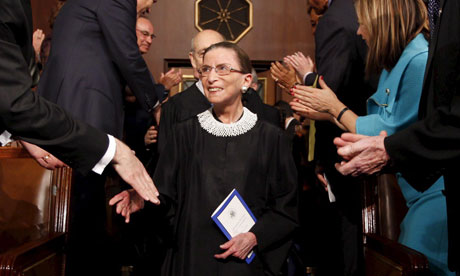
Ruth Bader Ginsburg SOTU

She’s still got it: Justice Ruth Bader Ginsburg receives a warm welcome at the State of the Union.

The New Yorker has just published Jeffrey Toobin’s illuminating profile on Justice Ruth Bader Ginsburg ahead of her 80th birthday on March 15th. (Subscribers to the magazine can access the full text of the ironically-titled piece, “Heavyweight,” at this link.) Chronicling Justice Ginsburg’s early struggles in the male-dominated legal world of the 1950s (Ginsburg had trouble finding someone who would hire her despite having graduated first in her class at Columbia Law), her triumphs as a leading women’s rights advocate with the ACLU, her marriage to the late tax attorney Martin Ginsburg, and her tenure on the Supreme Court, the profile is an understated and touching pre-tribute to the Justice who conventional wisdom tells us is most likely to retire next.

From same-sex marriage ceremonies to retired Justice Sandra Day O’Connor, partial-birth abortion bans to Lilly Ledbetter, “Heavyweight” is full of interesting tidbits and little gems from Justice Ginsburg herself

On her brief-writing strategy while litigating cases before the Supreme Court:

“I was doing all these sex-discrimination cases, and my secretary said, ‘I look at these pages and all I see is sex, sex, sex. The judges are men, and when they read that they’re not going to be thinking about what you want them to think about,’ ” Ginsburg recalled. Henceforth, she changed her claim to “gender discrimination.”

On work-life balance:

“It bothers me when people say to make it to the top of the tree you have to give up a family. They say, ‘Look at Kagan, look at Sotomayor’ … What happened to O’Connor, who raised three sons, and I have James and Jane [her son and daughter with Martin Ginsburg]?”

On Chief Justice John Roberts:

“For the public, I think the current Chief is very good at meeting and greeting people, always saying the right thing for the remarks he makes for five or ten minutes at various gatherings.”

On how long she will remain on the bench:

“As long as I can do the job full steam… You can never tell when you’re my age. But, as long as I have the candlepower, I will do it. And I figure next year for certain. After that, who knows?”

Money quotes aside, Toobin’s piece is particularly fascinating when he discusses Justice Ginsburg’s views on the relationship between Congress and the Court. Though she is classified as one of the Supreme Court’s liberals in the vein of Earl Warren and Thurgood Marshall, Ginsburg does not share these predecessors’ conviction that the Court should be the driving force for widespread social change. Instead, Toobin writes, she believes that the Court’s role is to begin dialogue with the elected branches of government, to ask them to reconsider “ancient positions” that may no longer work in our day and age, and then to kick the proverbial ball back to them. In this respect, Justice Ginsburg is very much like President Obama, who also prefers to see social change enacted through the legislative rather than judicial arena (and whose similar views on the judiciary have also been discussed at length by Toobin). It is little wonder, then, that the two seem to get along so famously.

Anyway, the profile is a must-read for anyone who is interested in the Supreme Court, the women’s rights movement, or even just a good life story.

SCOTUS Opinion Alert: In Which Transparency is Dealt a Body Blow

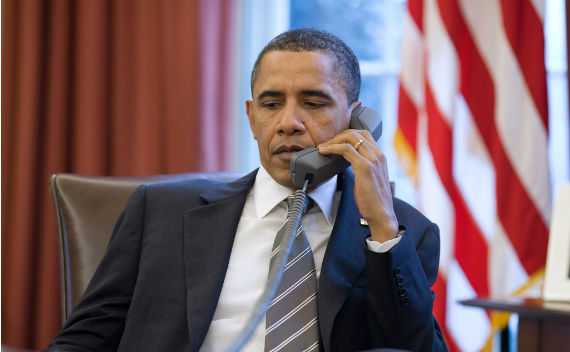
Obama on Phone

How do you know he’s not listening in on your conversations? Answer: you don’t.

 [Photo by Pete Souza, found via the Council on Foreign Relations]

For those of us who believe that the government needs to be more transparent in matters of national security, yesterday was not a very good day. In its first 5-4 opinion of this term, the Supreme Court split along ideological lines and ruled in favor of protecting a wide-ranging international surveillance program from constitutional challenges. Specifically, the Clapper v. Amnesty International opinion makes it much more difficult for lawyers, journalists, and human rights practitioners who suspect the United States of wiretapping their communications with non-Americans abroad to bring suit for such governmental behavior unless they have concrete proof that their correspondence will be intercepted.

At issue in Clapper is the Foreign Intelligence Surveillance Act (FISA), which allows the United States to target the communications of non-citizens on foreign soil. First authorized in 1978, FISA originally limited the Government to instances where it could show probable cause (to a special closed court known as a Foreign Intelligence Surveillance Court) that its individual targets were “foreign powers or the agents of foreign powers.”  In 2008, however, Congress amended FISA to include Section 1881a, a provision which removed the probable cause requirement and greatly expanded both the pool of people and the kinds of communications that could be monitored.

While FISA is aimed at foreign nationals who fall outside the protection of the Fourth Amendment, one effect of the law was the warrantless interception of thousands of international communications between FISA targets and American citizens. Shortly after the passage of 1881a, a group of American legal, labor, media and human rights organizations led by Amnesty International asked the Supreme Court to overturn that provision. Claiming that they frequently communicate with non-American clients, coworkers, witnesses and sources abroad, the challengers argued that this law violated their First and Fourth Amendment rights.

Before they could even get to the constitutionality of 1881a, however, the challengers ran into a practical problem: because of the secrecy involved in such surveillance programs, they couldn’t find any hard evidence that the United States was actually looking at their correspondence. Since Article III of the Constitution requires that you show some “injury” before you can bring a suit, Amnesty International argued that the injury lay in the “objectively reasonable likelihood” their conversations were or might be intercepted. The challengers further claimed that they had suffered numerous economic and professional harms in trying to avoid these interceptions, such as having to fly abroad to speak with clients in-person rather than over phone or email, and the reluctance of sources to disclose information in light of the potential eavesdropping. In response, the United States claimed that no one in this group had standing to bring this lawsuit, because (1) FISA targets only non-Americans, and (2) they simply could not prove that they were being intercepted. After the Second Circuit agreed with Amnesty International, the United States brought an appeal.

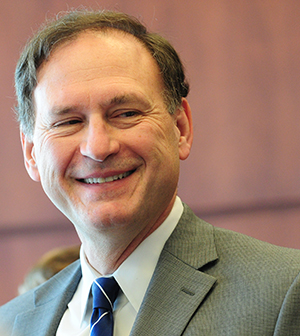
 Justice Alito

Justice Samuel Alito, a huge fan of certainty.

[Photo via Columbia Law School]

Justice Alito’s opinion, which was joined by Chief Justice Roberts and Justices Scalia, Thomas and Kennedy, reverses the Second Circuit ruling by accepting the Government’s stance that the challengers’ claimed injuries were too speculative to allow the suit to continue to trial. Alito found the Second Circuit’s “objectively reasonable likelihood” standard inconsistent with his reading of Supreme Court precedents, which he believes require a (much harder to show) “certainly impending” injury in order to establish standing. Ignoring the fact that it would be nearly impossible for any American to prove that the Government will monitor his correspondence under 1881a, Alito repeatedly emphasized that the challengers’ fears of future surveillance were nothing more than a “highly attenuated chain of possibilities.” Likewise, Alito brushed aside the fact that some of the challengers’ foreign contacts included the friends and family of Guantanamo detainees (including rather high-profile clients like Khalid Sheikh Mohammed and Mohammedou Ould Salahi) whose communications had already been monitored by the United States.

The majority opinion was also quite unsympathetic to the increased economic and professional costs of operating under 1881a, despite the fact that lawyers and journalists have an ethical duty to protect confidential communications with clients and sources:

“[The challengers] cannot manufacture standing merely by inflicting harm on themselves based on their fears of hypothetical future harm that is not certainly impending… Because [they]do not face a threat of certainly impending interception under 1881a, the costs that they have incurred to avoid surveillance are simply the product of their fear of surveillance.”

Naturally, the liberal wing of the Court, which had vociferously questioned the United States at oral argument about the fairness of a law for which virtually no one has standing to challenge, took issue with all parts of the majority opinion. The Justice Breyer-penned dissent also looked to precedent and rejected the majority’s “certainly impending” injury standard in favor of a “reasonable probability” or “high probability” injury standard:

“…[C]ertainty is not, and has never been, the touchstone of standing. The future is inherently uncertain. Yet federal courts frequently entertain actions for injunctions and for declaratory relief aimed at preventing future activities that are reasonably likely or highly likely, but not absolutely certain, to take place. And that degree of certainty is all that is needed to support standing here.”

Breyer went on to list no fewer than 18 cases in which federal courts found standing even where the likelihood of injury was “far less certain than here.” In addition, he argued that under the Supreme Court’s 2010 decision in Monsanto Co. v. Geertson Seed Farms, “reasonable efforts to mitigate the threatened effects of the future injury”–i.e., the economic costs that the 1881a challengers incurred in trying to keep their communications confidential–could constitute an injury sufficient enough for standing. Looking at the Government’s motive, capabilities and previous actions under 1881a and some other “commonsense inferences,” the dissent concluded that the challengers had in fact met the “reasonable probability” of injury standard and should have been allowed to contest 1881a’s constitutionality at trial.

Unfortunately, the dissenting justices were unable to convince a fifth colleague over to their side, meaning that the federal government is now incentivized to take one more step away from transparency. In his opinion, Justice Alito countered this concern by choosing to place his faith in the special Foreign Intelligence Surveillance Courts, which he believes will keep the Government accountable to the Constitution. As Justice Breyer’s dissent pointed out, however, these closed, secret courts (which do not make their hearings or records available to the public) very rarely reject any of the Government’s surveillance plans, and should not be the only safeguard for Americans’ civil liberties.  Nonetheless, the message that the Supreme Court sent yesterday is clear: the more secretive the United States keeps its national security programs, the safer they are from constitutional challenges, and the harder it is for ordinary Americans to vindicate what may be flagrant violations of their rights. We should all be very scared.

Forget Clarence Thomas: In Louisiana, You Can Be Guilty Before Proven Guilty

Why you should care about Boyer v. Louisiana: Criminal defendants without the money to pay for their defense are being imprisoned for years without trial, subverting the basic tenet of “Innocent Before Proven Guilty.” (Picture via: http://www.britannica.com/blogs/wp-content/uploads/2010/06/supreme-court.jpg.)

As the dust settles from Monday’s Boyer v. Louisiana oral argument before the Supreme Court, the major news takeaway is undoubtedly Justice Clarence Thomas’ breaking of a nearly seven-year silence from the bench to crack what may or may not have been a joke about the competence of either Harvard or Yale-trained lawyers (the full transcript of the argument is here).  Much hay has been made in the press over what Thomas’ joke could have meant–see the near-breathless coverage analyzing the Justice’s mindset here, here and here–but the actual arguments behind Boyer, which explores the limits of the state’s obligation to provide a speedy trial for an indigent death penalty defendant, are interesting enough to merit a second glance as well.

Jonathan Boyer and the state of Louisiana disagree over almost every aspect of what happened on the night of February 3, 2002, when Bradlee Marsh was shot three times and killed as he sat in his pickup truck. While Louisiana maintains that Boyer was responsible–a conclusion bolstered by Boyer’s subsequent confession and the testimony of Boyer’s brother–Boyer claims that his “confession” was fake and that someone else was behind the killing. Regardless of the perpetrator’s identity, all sides agree that after his arrest and indictment for first-degree murder, Jonathan Boyer waited over five years in prison for his trial to begin after Louisiana appointed but did not have the money to fund the two requisite attorneys assigned to defend his death penalty case. (The federal Constitution does not mandate two defense lawyers in capital cases, but Louisiana state court rules do.)  It was only after the state decided to drop the first-degree murder charge–a move which took the death penalty off the table and made his case less expensive to defend–in favor of lesser charges that adequate funds were freed up and trial began. By this time, several witnesses had died or otherwise become unavailable. Boyer was convicted of second degree murder and armed robbery and sentenced to life imprisonment without parole. He now argues that Louisiana’s failure to fund his lawyers in the years it spent pursuing the death penalty led to a violation of his Sixth Amendment right to a speedy trial–the remedy for which requires a reversal of his murder conviction.

The Supreme Court outlined in 1972’s Barker v. Wingo a four-factor balancing test for determining whether a Sixth Amendment infringement has taken place: (1) the length of delay, (2) the reason for the delay, (3) whether and how the defendant asserted his right to a speedy trial, and (4) the prejudice that the defendant suffered due to the delay. Depending on the facts of the case, each factor is weighed against either the defendant or the state. In 2009’s Vermont v. Brillon, the Court found that a “systemic breakdown” in the public defender system leading to a delay of trial could be counted against the state. The main question in Boyer is whether a five-year failure to provide funding for the indigent’s appointed defense should similarly be held against the state. A “Yes” to that question doesn’t automatically mean that Boyer’s speedy trial rights were violated, but it does help his case in the Barker balancing.

Unsurprisingly, Louisiana argues that the delay in funding should not be held against the state so long as the state did not purposely withhold the money to avoid trial. Though Louisiana’s prosecutorial offices routinely received surpluses (of hundreds of thousands of dollars) to try cases in the same period of time that Boyer awaited trial from prison, the state maintains that the lack of funds for his defense resulted from other factors beyond its control, like Hurricane Katrina cleanup and the available monies being used up in other capital cases. Louisiana insists that it already dealt Boyer a more-than-fair hand by even bothering to appoint two counsel for him, which was enough to safeguard Boyer’s Constitutional rights.

At Monday’s lively oral argument, the Justices split over whether the delay was actually attributable to Boyer or to the state. Justice Scalia agreed with Louisiana that the state had already been very “generous” in naming multiple Ivy League-educated attorneys for Boyer (which is where Justice Thomas stepped in with his now-infamous four-word joke concerning their competence). Rather than putting the onus on Louisiana to fund the two lawyers required under its own state procedure, Scalia postulated that had Boyer truly cared about getting a speedy trial, he would have waived his state right to two attorneys and proceeded with just the one lawyer required by the federal Sixth Amendment. Justice Ginsburg questioned whether Boyer, a man with an eighth-grade education, knew that this option was available to him. Justice Kagan pointed out that even Louisiana seemed unaware that Boyer could move forward with only one attorney, since it had previously explained the delay by saying it could not “ethically or legally bring [Boyer] to trial” because he had been “without properly funded counsel for so long.” Meanwhile, Justice Sotomayor, who has worked as a prosecutor in New York, repeatedly pressed Louisiana to explain how a state’s choice to fund prosecutors’ investigations (or anything else) over capital defendants’ lawyers could not be attributed to the state.

The Justices also sparred over the scope of the question to be decided. In addition to laying out the four-factor balancing test, Barker v. Wingo holds that speedy trial challenges must be considered on a case-by-case basis, which allows for a far more fact-intensive inquiry than the Supreme Court is used to handling. Several members of the Court, led by Justice Breyer, mentioned repeatedly that the Court’s only job is to consider the general question of whether the failure to fund counsel should weigh against the state in a speedy trial challenge. (If so, they are content to send the case back down to the Louisiana courts for the case-specific reconsideration of whether such a violation occurred.)  Justice Scalia, however, believes the Supreme Court should both answer the general question AND perform the case-specific four-factor reanalysis for Boyer. To that end, Scalia spent a significant part of the oral argument focusing not only on the reason for the delay but on whether Boyer and his legal team properly brought up the speedy trial issue in the lower courts, whether he actually suffered prejudice due to the delay, and whether a reversal of his murder conviction would still leave him with a 99-year concurrent sentence for his armed robbery conviction.

If the oral argument is any indication, Justices Alito, Ginsburg, Sotomayor and Kagan agree with Breyer’s general reading of the question presented. These Justices also seem receptive to the idea that the lack of indigent defense funding is attributable to the state. This would constitute the five-Justice majority needed to remand the case to the state court for re-analysis.  It’s possible that Boyer could still lose his battle there–notwithstanding a SCOTUS ruling that the failure to fund should be weighed against Louisiana, Louisiana could still win the overall Barker balancing back in the lower court. But even if this happens, the Supreme Court will have (at the very least) sent a clear message to the states that if they keep shunting indigent defendants to the back of the line, they will be held responsible for such decisions.

The jovial man. (Picture via: http://www.article-3.com/wp-content/uploads/2013/01/Justice-Thomas.jpg.)

As for Clarence Thomas’ thoughts on the fundamental questions of the case: who really knows? He hasn’t asked a substantive question at oral argument since 2006, and he certainly didn’t start on Monday. (I’m inclined to agree with Tom Goldstein of SCOTUSblog and Andrew Cohen of The Atlantic when they say the hoopla over the joke was a case of much ado about nothing.) Given the issues at stake, it’s too bad that Justice Thomas’ offhand remark ended up overshadowing the interesting points coming from both sides.*  The depressing truth about death penalty cases is that they take an extraordinary amount of effort and resources to defend–money and time must be spent for thorough investigation and expert witnesses, for both the trial and the sentencing phases–and as Justice Sotomayor pointed out, only a very small group of lawyers in this country are even qualified to argue death penalty cases. A defendant with money may be able to hire such a lawyer and pay for the investigation, but the indigent’s court-appointed counsel cannot be expected to pay such expenses out of pocket. And while it’s not unforeseeable that very cash-strapped states acting in good faith may simply not have enough money some years to try or defend all their capital cases, it is brutally unfair to make the indigent defendant bear the brunt of those funding decisions by waiting out that time in prison.

In other words, Louisiana for over five long years subjected an untried Jonathan Boyer to a philosophy of “guilty before proven guilty,” a situation he was powerless to avoid because he had no means of his own to mount a defense and no authority to change the state’s funding decisions. Regardless of Boyer’s culpability for the murder of Bradlee Marsh, the Supreme Court needs to remember that the Constitution guarantees a speedy trial for those found innocent and those ultimately found guilty, for those who can afford to defend themselves and those who cannot. Louisiana needs to be held accountable for its choice.

*I do wonder what Justice Thomas himself thinks of all the media attention surrounding his comment, particularly when he opined publicly in April 2012 that his fellow Justices should listen more and refrain from interrupting lawyers so frequently during oral argument.

The permanent Republican victory

Frank Rich cautions against premature liberal gloating of coming triumphs, demographic or otherwise:

What’s more, the right thinks long-term, and if you look at the long-term, the whole ugly “fiscal cliff” standoff was a win-win for conservatives, no matter what their passing defeats in this week’s deal. The more Washington looks dysfunctional, the more it sows dissatisfaction with the very idea of a Federal government. Yes, Democrats and the White House can argue that polls show that the Republicans would be getting most of the blameif Congress couldn’t reach agreement on the “fiscal cliff.” But that’s short-term liberal wishful thinking. Long-term, this intractable dispute has undermined Americans’ faith in government, period, and the voters’ plague-on-all-your-houses view of Washington is overall a resounding ideological win for a party that wants to dismantle government, the GOP. The conservative movement is no more dead after its 2012 defeat than it was after the Goldwater debacle of 1964.

Silver lining? Social issues, at least, seem to be a winning hand for the Dems:

John Roberts is as political a Chief Justice as I’ve seen — political in the sense of wanting to be well-regarded by mainstream public opinion and posterity. He’s no Scalia-Thomas-Bork right-wing bull in the china shop. Much as I welcomed his upholding of Obamacare, his logic was so tortured that I shared the view of conservative critics that he was holding a finger to the wind and cynically trying to be on the right side of history. His remarks about  the nation’s fiscal impasse are content-free and gratuitous — and irrelevant to his constitutional role — but they do reflect his own desire to maintain a noble public image. It was, one might say, a Howard Schulz PR move. If nothing else, this Chief Justice’s continued obsession with his own profile may bode well for the future of same-sex marriage: Hard to imagine that Roberts will thwart a civil rights breakthrough now enthusiastically supported by an overwhelming majority of the young and even not-so-young Americans who will write the history of the Roberts Court.

Supreme Court to Hear Prop 8, DOMA case

Photo by: J. Emilio Flores for the New York Times

SCOTUSblog is reporting that the Supreme Court has granted certiorari to both Hollingsworth v. Perry, the California Proposition 8 case, and United States v. Windsor, a Defense of Marriage Act challenge. The Court will hear arguments in the two cases when it reconvenes in 2013.

Lyle Denniston has a preliminary breakdown of the order on SCOTUSblog’s live blog:

Prop. 8 is granted on the petition question — whether 14th Am. bars Calif. from defining marriage in traditional way. Plus an added question: Whether the backers of Prop.. 8 have standing in the case under Art. III.

[With regards to United States v. Windsor]: In addition to the petition question — whether Sec. 3 of DOMA violates equal protection under 5th Amendment, there are two other questions: does the fact that government agreed with the [Second Circuit] decision deprive the Court of jurisdiction to hear and decide the case, and whether BLAG (House GOP leaders) has Art. III standing in this case.

There is a good deal of complexity in the marriage orders, but the bottom line is this: the Court has offered to rule on Prop. 8 and on DOMA Section 3, but it also has given itself a way not to decide either case. That probably depends upon how eager the Justices are to get to the merits; if they are having trouble getting to 5 [justices] on the merits, they may just opt out through one of the procedural devices they have offered up as potentials.

More coverage of this development can be found here, here, here and here.

Almost There: Supreme Court to Decide Whether to Hear DOMA, Prop 8 Cases

Karen Golinski, a federal employee in California, and her wife Amy Cunninghis.  Golinski is one of the plaintiffs challenging the Defense of Marriage Act. (Photograph by Jim Wilson/The New York Times.)

Tomorrow, the Supreme Court is expected to decide whether to hear a same-sex marriage case this term. While the Court has an array of petitions to choose from–five Defense of Marriage Act (DOMA) cases, the California Proposition 8 challenge, and an Arizona state benefits case are all on deck–it looks likely that at least one DOMA case will get the nod if it does tackle the issue. (And not just because Justice Ruth Bader Ginsburg predicted it would earlier this year.) The Proposition 8 case, Hollingsworth v. Perry, may be flashier, but it concerns a constitutional amendment that affects only same-sex marriages in California. On the other hand, DOMA creates a conflict between the federal government and any state that recognizes same-sex marriage, a group that has now grown to nine (plus the District of Columbia) and counting. As the number of legally married gay couples continues to climb, it is in the interests of the Supreme Court to decide DOMA’s constitutionality sooner rather than later.

Should the Court hear a DOMA challenge, what will be at stake for both sides? The five DOMA cases all arise from a dispute between state and federal definitions of marriage, which has been steadily brewing since the 1996 passage of the Defense of Marriage Act. While family law has traditionally been left to the states, Section 3 of DOMA defines “marriage” for federal purposes as a legal union between one woman and one man, and a “spouse” as an opposite-sex husband or wife. In the places that have recognized marriages between two women or two men, however, same-sex spouses find themselves caught in a strange limbo where they are legally married in the eyes of the state but not in the eyes of the federal government. They receive all the state benefits and privileges that marriage affords, but DOMA prevents them from enjoying the many federal benefits of marriage* that their heterosexual counterparts receive, including Social Security survivors’ benefits, joint income tax filings, shorter green card waiting times for non-citizen spouses, freedom from estate taxes on a deceased spouse’s assets, and family coverage on federal employer health insurance plans.

The DOMA challengers from Massachusetts (Gill v. Office of Personnel Management, Massachusetts v. U.S. Department of Health and Human Services), New York (Windsor v. United States), Connecticut (Pedersen v. Office of Personnel Management) and California (Golinski v. Office of Personnel Management) are a sympathetic bunch. They include a federal government employee wishing to enroll her family in her health insurance plan, a senior hit with over $300,000 in federal estate taxes for an inheritance left by her wife, and a veteran denied Family Medical Leave Act time off to take a sick spouse to medical treatments. The challengers argue that the differential treatment between opposite-sex and same-sex married couples violates the Equal Protection Clause, and that the federal government impinges on states’ rights by refusing to recognize same-sex marriage where states have chosen to legalize it. In all five cases, the federal appellate circuit courts agreed with them. On the other hand, the supporters of DOMA maintain that the federal government has a right to its own definition of marriage for the purposes of federal funding and programs, and that DOMA merely reaffirms what the executive and judiciary branches have always believed: namely, that marriage can only be between a “traditional male-female couple.”

Less work for Eric Holder. (Photograph by Brendan Smialowski, AFP/Getty Images)

Adding a wrinkle to this scenario is the fact that the executive branch has actually been doing everything in its power to get the judiciary to step in and resolve the issue in favor of the anti-DOMA side. In February 2011, the Obama administration announced that the Department of Justice would no longer defend DOMA in legal challenges, including the five cases before the Supreme Court now, because it believed Section 3 to be unconstitutional. (The Bipartisan Legal Advisory Group from the House of Representatives now defends DOMA in court.) At the same time, the administration signaled its intention to keep enforcing the law (by continuing to reject federal benefits applications from same-sex married couples) until either Congress repealed the law or the Supreme Court decided its constitutionality. While this may seem counterintuitive, this bifurcated method of enforcing but not defending a federal law ensured that all five cases had a chance to keep moving through the federal appeals system and reach the Supreme Court. Granting the plaintiffs their benefits in the middle of a case would have removed their immediate cause for complaint and mooted their lawsuits before an appellate court could find the underlying law unconstitutional. Keeping the plaintiffs’ injury alive, however, kept the cases in play. Now that they have reached the certiorari stage, the DOJ has explicitly asked the Supreme Court to take at least one case and provide a definitive ruling on the constitutionality of Section 3.

The 2010 Census found that 42,000 same-sex couple households resided in states with same-sex marriage.  That figure doesn’t even include the thousands more in Maine, Maryland and Washington, the three states that legalized same-sex marriage this month. Thanks to the bottom-up, state-by-state legalization approach that marriage equality proponents have been using, nearly one-fifth of the states now allow gay and lesbian couples to marry. The more states that join, the higher the number of couples adversely affected by DOMA will be, and the more challenges we will see in the federal courts. Expect the Supreme Court to accept at least one DOMA petition, and expect the arguments to focus not only on equal protection but also on federalism and states’ rights. I’ll be back next time to talk about the Court’s track record on gay rights and the likely concerns of our resident swing vote, Justice Anthony Kennedy.

* In January 2004, the United States General Accounting Office counted 1,138 provisions in federal statutes in which “marital status is a factor in determining or receiving benefits, rights and privileges.”

Victoria Kwan holds a J.D. from Columbia Law School in New York and has just completed a clerkship with a judge in Anchorage, Alaska. She tweets as @nerdmeetsboy and will continue to post here on legal issues.

Highlights from the Fisher v. University of Texas Oral Argument

“Wow, that went really well for the University of Texas!” – No one

Last Wednesday, the Supreme Court held a one-hour oral argument in Fisher v. University of Texas, in which our eight justices (Justice Elena Kagan recused herself) engaged in lively debate over the future of racial affirmative action in state universities. (For more on the case, see my post from last week.) Five highlights from that argument:

  • Predictably, the Justices on the left–Ginsburg, Sotomayor and Breyer–came flying out of the gate with questions for Bert Rein, Abigail Fisher’s attorney. Ginsburg and Sotomayor immediately questioned whether Fisher has suffered the requisite injury she needs to be able to sue, if (as UT claims) she would have been rejected even under a completely race-neutral plan. As is the case with SCOTUS oral arguments in general, a Justice from the other end (Scalia) jumped in not to ask Rein a follow-up question but to provide the answer on his behalf, countering that Fisher’s injury was not the loss of admission but the loss of an opportunity to be considered fairly by UT. Ginsburg, Sotomayor and Breyer seem convinced that the UT admissions scheme satisfies the Grutter test, and Rein certainly received quite a bit of help from Justice Scalia as the liberal justices continued to press him. On the other hand, Justices Alito, Roberts and Scalia hammered Gregory Garre, the attorney for UT, with Sotomayor occasionally stepping in to offer a helping hand.
  • Both lawyers were repeatedly asked what a “critical mass” of underrepresented minority students at UT might be, at which UT would have adequate student body diversity. When asked by Sotomayor when enough was enough, Rein punted and stated that the definition of “critical mass” (a phrase that comes from Grutter) is something that UT and not Fisher needs to prove, declining to say out loud that the critical mass is whatever number of minorities that the top-10% plan captures in any given year. On the other hand, the conservative justices pressed UT hard on its own fuzzy definition of “critical mass,” appearing at points to try and bait the school into admitting that it has a certain number or percentage of minority admits in mind. This, of course, would be an unconstitutional quota forbidden under Grutter, which is exactly what the conservative wing thinks UT is actually using. UT, for the record, thinks of critical mass as the point where minority students do not feel like the spokespeople for their race, which is a nebulous answer most unsatisfactory for Scalia, Alito and Roberts.
  • Justice Roberts asked UT’s lawyer, Gregory Garre, about self-identification of race on UT applications and whether the school had any way of knowing when applicants were lying about their minority status. Roberts also wanted to know whether someone who is 1/4 or 1/8 Latino (or 1/32 Latino, as Scalia added on later) could self-identify as being Latino, or whether that would be violating some kind of honor code. Undoubtedly, Roberts’ point was to question the effectiveness and sincerity of UT’s plan to increase classroom diversity, if it has no way of even figuring out which applicants actually are underrepresented minorities. But the flip side of this question seems to undercut Fisher’s argument: if Roberts is right and applicants are fraudulently self-identifying as minorities, that means UT’s student body has an even lower number of minority students than it currently thinks it does.
  • Justice Alito questioned twice whether it’s fair that affirmative action is being used to help the wrong group of people. Specifically, he wants to know why wealthy African American and Latino students are getting a preference instead of students from underprivileged or even just plain middle-class families. Alito also wants to know how all Asian Americans can be grouped into one category when some ethnic subgroups are more underprivileged and underrepresented than others. UT’s answer is that applicants can state their countries of origin as well, which the school will take into account–but again, Alito doesn’t seem convinced.
  • The big question in all this is what Justice Kennedy thinks, since he is likely to be the deciding vote. Donald Verrilli, arguing for the United States in support of UT, appealed to the swing justice by bringing up his 2007 concurrence in Parents Involved in Community Schools v. Seattle School District No. 1, in which Kennedy spoke of the country’s strength as arising from the fraternizing of different creeds, races and cultures. However, Kennedy seems skeptical of the UT plan, characterizing it at one point as prioritizing “race above all.” At another point, Kennedy calls race a “tie-breaker “ in UT’s admissions scheme, the same term that was used in Parents Involved to describe Seattle’s usage of race in its ultimately-doomed affirmative action plan.

The bottom line is that the justices are likely to rule 5-3 in favor of Fisher and strike down UT’s admissions scheme, which is going to put universities across the country back at square one. (A 4-4 tie would leave the status quo in place, thus allowing UT’s admissions process to continue as is.) The question is how far the Court will go not just in striking down the specifics of the UT plan but in limiting racial affirmative action across the board. Despite the fact that he invited the Court to do so in his brief, Rein maintains that he’s not asking the justices to overrule Grutter. But as Justice Sotomayor stated toward the end of oral argument, “You don’t want to overrule it, but you just want to gut it.” It looks like a gutting of Grutter is exactly what we’re headed toward. Of course, this is far too early for Justices Breyer, Ginsburg and Sotomayor (whose dismay at Fisher’s arguments was palpable)–but for the rest of the Roberts Court, this moment couldn’t come any sooner and is certainly nine years too late.

Victoria Kwan holds a J.D. from Columbia Law School in New York and has just completed a clerkship with a judge in Anchorage, Alaska. She tweets as @nerdmeetsboy and will continue to post periodically here on legal issues. Rumor has it she and Jay Pinho are dating.