Jay is a data journalist and political junkie. He currently writes about domestic politics, foreign affairs, and journalism and continues to make painstakingly slow progress in amateur photography. He would very much like you to check out SCOTUSMap.com and SCOTUSSearch.com if you have the chance.
View all posts by Jay Pinho →
This was too easy, really. (Courtesy of SimCity.com.)
To much fanfare, Electronic Arts (and Maxis) released the latest iteration of its storied franchise on Tuesday, titled simply SimCity. One feature that got a lot of attention prior to the launch day was its “always-on” Internet-connected mode: to prevent piracy, the game was intentionally designed to prohibit playing offline.
Ever since the city management game launched on Tuesday, countless gamers have found themselves battling error messages and random disconnections that prevent them from experiencing what SimCity was supposed to deliver in the first place — fun. In response, publisher Electronic Arts says it’s working around the clock to try to fix the problems and add more servers so people can play without worry.
What you’ve demonstrated with this launch is that our corporate management does not believe in our core values. They are for the unwashed masses, not for the important people who forced this anti-consumer DRM onto the Sim City team. This DRM scheme is not about the consumers or even about piracy. It’s about covering your own asses. It allows you to hand-wave weak sales or bad reviews and blame outside factors like pirates or server failures in the event the game struggles. You are protecting your own jobs at the expense of consumers. I think this violates the Act With Integrity value I’m looking at on my own coffee mug right now.
On behalf of your other employees, I’d like to ask you to fix this. Allow the Sim City team to patch the game to run offline. If Create Quality and Innovation is still a core value that you believe in, then this shouldn’t be a hard decision. Games that gamers can’t play because of server overload or ISP issues are NOT quality. Be Bold by giving the consumers what they want and take accountability for the mistake.
Nick Bilton of The New York Timesrecently noted that, at some point following the implementation of Facebook’s “Sponsored Posts” feature, his non-sponsored posts started receiving far less exposure than before:
Early last year, soon after Facebook instituted a feature that let people subscribe to others’ feeds without being friends, I quickly amassed a healthy “subscriber” list of about 25,000 people…
Since then, my subscribers have grown to number 400,000. Yet now, when I share my column, something different happens. Guess how many people like and reshare the links I post?
If your answer was over two digits, you’re wrong.
From the four columns I shared in January, I have averaged 30 likes and two shares a post. Some attract as few as 11 likes. Photo interaction has plummeted, too. A year ago, pictures would receive thousands of likes each; now, they average 100. I checked the feeds of other tech bloggers, including MG Siegler of TechCrunch and reporters from The New York Times, and the same drop has occurred.
What changed? I recently tried a little experiment. I paid Facebook $7 to promote my column to my friends using the company’s sponsored advertising tool.
To my surprise, I saw a 1,000 percent increase in the interaction on a link I posted, which had 130 likes and 30 reshares in just a few hours. It seems as if Facebook is not only promoting my links on news feeds when I pay for them, but also possibly suppressing the ones I do not pay for.
Following this article, Reuters’ Anthony De Rosa spoke to a Facebook rep and then posted a short list of three misconceptions that he implied Bilton — and/or others like him — had disseminated. Among them:
Misconception #1: Sponsored/Promoted Content is replacing organic content on Facebook I spoke to Vadim Lavrusik, Facebook’s journalism program manager. Here’s what he told me:
“One important thing to understand is that when someone promotes a post in feed and pays to promote it, the stuff that’s getting distribution organically still gets distribution, it doesn’t get replaced from feed. It may get a lower placement, but it doesn’t get replaced. And the placement of the sponsored post or promoted post is also based on the quality of that post (so promoted content still has a quality algorithm attached to it.) If the promoted post isn’t that good, it gets lower placement, but it will get more distribution either way because it’s being paid for, but it’s still takes quality into account.
The claim that I’ve seen explains it as if these paid posts replace organic posts, which isn’t the case. The News Feed algorithm is separate from the advertising algorithm in that we don’t replace the most engaging posts in News Feed with sponsored ones.”
This seems like a distinction without a difference. One can hardly blame Lavrusik for trying to disguise his employer’s tactics with this line of defense, but it’s not very convincing.
Why not? Well, first of all, he states that “when someone promotes a post in feed and pays to promote it, the stuff that’s getting distribution organically still gets distribution, it doesn’t get replaced from feed. It may get a lower placement, but it doesn’t get replaced.” But for all intents and purposes, being bumped to a lower placement is the exact same thing as getting replaced. Lavrusik knows this, of course, but it’s not in his — or Facebook’s — interest to acknowledge it.
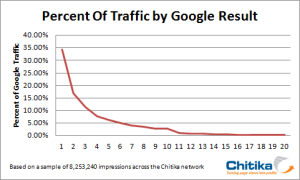
Courtesy of Chitika.
Facebook’s News Feed is infinite: when you scroll down, it loads more posts. In other words, there’s no real estate scarcity going on here. As long as you keep scrolling, Facebook will keep loading. But much like Google’s search rankings, everyone knows that it’s generally the first listings that get by far the most attention. For example, this study demonstrates that just under 95% of all Google clicks come from the first page of search results. All subsequent results pages combined represent barely over 5% of click-throughs.
I’d venture a guess that the Facebook News Feed has a similar-looking curve. Of course, its average time-on-site is going to be a lot higher than Google’s, but the same laws apply — the farther down the page something is, the less likely it is that a user will see it. Sponsored Posts, by definition, push non-sponsored posts farther down the page. Ergo, they are less likely to be seen. So even if it’s technically true, when Lavrusik says a non-sponsored post “doesn’t get replaced,” he’s not saying anything meaningful at all.
My second disagreement with De Rosa on this point has to do with his conclusion:
There’s a few things that make Nick an edge case, someone who uses and experiences Facebook slightly differently than the broader membership. He was one of the privileged few who were “recommended” members to follow, which allowed him to gain a lot of followers early on. Most members have to scratch and claw to get noticed, a recommended user list gives you an opportunity to catapult your following in a less organic fashion. Just like on Twitter, it creates an inauthentic illusion of “influence,” and as much as I loathe that word and the next one I am going to use, “engagement,” the quality of that “engagement” goes down as your artificial following grows.
I also noticed that Nick tends to post a lot of links, instead of photo posts, which tend to get a lot more “likes” “shares” and comments. If they’re not getting that kind of (ugh) “engagement,” then they’re in turn showing up lower organically in your follower’s newsfeed. This is a feature, not a bug.
But as Bilton himself mentioned:
From the four columns I shared in January, I have averaged 30 likes and two shares a post. Some attract as few as 11 likes. Photo interaction has plummeted, too. A year ago, pictures would receive thousands of likes each; now, they average 100. I checked the feeds of other tech bloggers, including MG Siegler of TechCrunch and reporters from The New York Times, and the same drop has occurred.
In other words, Bilton is not comparing apples and oranges. He’s comparing similar posts from before and after Facebook’s methodology change. So De Rosa’s comment on the fact that user engagement differs by the type of content doesn’t apply here.
Anecdotally, I’m a fairly standard Facebook user: I have around 700 friends and I don’t believe I have any subscribers. (To be honest, I can’t remember whether I ever set up my profile to allow it.) And I’ve noticed very similar patterns to Bilton’s regarding engagement on my own posts. I can’t speak for Nick Bilton, but I’m quite sure I’m not an edge case.
Just to be clear, there’s nothing wrong with Facebook’s strategy here. Especially now that it’s public, its responsibility is to make money for its shareholders, and the implementation of Sponsored Posts makes a lot of sense on certain levels. Vadim Lavrusik’s defense is similarly understandable: he works for Facebook, so his slick reasoning is to be expected. But that doesn’t mean any of us should be remotely convinced by it.
change the national anthem to R. Kelly’s 2003 hit “Ignition (Remix).”
We, the undersigned, would like the Obama administration to recognize the need for a new national anthem, one that even a decade after its creation, is still hot and fresh out the kitchen. America has changed since Francis Scott Key penned our current anthem in 1814. Since then, we have realized that after the show, it’s the afterparty, and that after the party, it’s the hotel lobby, and–perhaps most importantly–that ’round about four, you’ve got to clear the lobby, at which point it’s strongly recommended that you take it to the room and freak somebody. President Obama: we ask you to recognize the evolution of this beautiful country and give us an anthem that better suits the glorious nation we have become.
Andrew Sullivan posted some thoughts — titled “Pwning Krugman” — on the above video:
Still, Scarborough came prepared and clearly prevailed over a Nobel laureate in economics. Not bad for a hack. And he’s dead right about Krugman’s contempt for those with whom he disagrees. It actually weakens his case unnecessarily. And I have to say that over the past five years, I think Krugman has been more right than wrong.
Is Sullivan watching the same video I am? Scarborough not only misrepresented the substance of Krugman’s critique (multiple times, via multiple intentional misreadings of Krugman’s older books), but he seems to have done this deliberately. If he “pwned” Krugman, it’s only in the sense that a Nobel Prize-winning economist doesn’t spend most of his time learning to look good while being consistently wrong on TV. (I should know this: I just saw Krugman speak at a TEDx event a few weeks ago, and he wasn’t any more impressive as a speaker from fifteen feet away as he is on TV.)
What Krugman (oddly enough) didn’t emphasize sufficiently in his exchange with Scarborough is that both of the excerpts from his books came from well before the financial crisis era: 1997 and 2005. Instead, he rather admirably admitted that he had “learned a few things” since that time. This is certainly the case — and, it might be said, contrasts with Sullivan’s depiction of “Krugman’s contempt for those with whom he disagrees.”
(Side note: The New Yorker ran a fascinating profile of Krugman and his wife, the economist Robin Wells, in March 2010. One of the great nuggets from that piece was the revelation that it is Wells, and not Krugman, who tends to write with more vitriol: “On the rare occasion when they disagree about something, she will be the one urging him to be more outraged or recalcitrant.”)
But back to the Krugman/Scarborough debate. In both of the Krugman quotes that Scarborough cites, the crisis was years away. (In the case of the first quote, it was an entire decade away.) As Krugman tried to explain, he wrote about the dangers of the deficit back then precisely because the economy was stronger during those periods. But Scarborough consistently ignored the fact that Krugman has, time and time again, emphasized the foolishness of tackling the deficit during a recovery from a recession. To simply ignore this central qualification of Krugman’s deficit critique is to ignore the entire argument. “Pwning” Krugman? Not in the least.
(UPDATE — 10:51 AM EST 3/6/2013): I’m watching the full debate now. Krugman actually did a substantively much better job of making his point clear — that deficit reduction should be contingent upon a healthier economy — than he did in the brief clip shown above. (He continued to stumble when Scarborough brought up his previous quotes, despite the fact that these words were written during healthier economic times.) Indeed, he seems to have performed much better in the full debate than he even did in that short clip.
One person who agrees with Andrew Sullivan’s depiction of the “pwnage?” Well, Paul Krugman (kinda):
Well, we’ll see how it comes out after editing, but I feel that I just had my Denver debate moment: I was tired, cranky, and unready for the blizzard of misleading factoids and diversionary stuff (In 1997 you said that the aging population was a big problem! When Social Security was founded life expectancy was only 62!) Oh, and I wasn’t prepared for Joe Scarborough’s slipperiness about what he actually advocates (he’s for more spending in the near term? Who knew?)
I’ve long mounted a soapbox in defense of two related ideas. The first is that average Americans care less about policy specifics than we give ourselves credit for, and that public perception is defined more by soundbites, rhetoric, and presentation than by substance.
The second idea, which follows from the first, is that liberal politicians could — and should — mount a stronger defense of their policies without fear of reprisals from the conservative end of the spectrum. This is not because such reprisals won’t come — unless you’ve been in hiding since 2009, this has been the position of Congressional Republicans since Day 1 — but because holding to one’s principles in the face of political opposition is quite often perceived as indicative of having a better, more sensible policy.
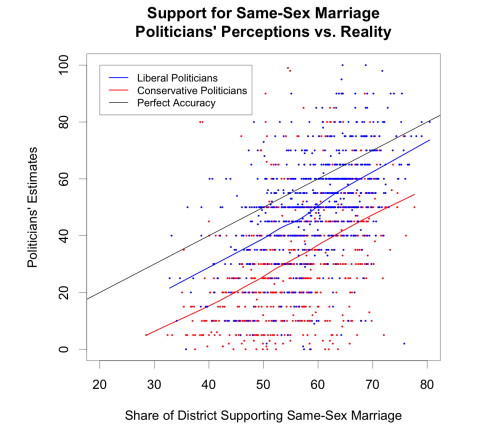
Broockman and Skovron find that legislators consistently believe their constituents are more conservative than they actually are. This includes Republicans and Democrats, liberals and conservatives. But conservative legislators generally overestimate the conservatism of their constituents by 20 points. “This difference is so large that nearly half of conservative politicians appear to believe that they represent a district that is more conservative on these issues than is the most conservative district in the entire country,” Broockman and Skovron write. This finding held up across a range of issues.
The authors conclude:
For those interested in strengthening democratic responsiveness, one tempting conclusion from this analysis is that alternative means of informing legislators about their constituents’ views need to be devised – democratic campaigns and elections appear to do little to update politicians’ perceptions of their constituents. However, on reflection, the fact that candidates and legislators know so little about their constituents and learn so little about them from campaigns and elections is perhaps indicative of a deeper and more basic problem of elite motivation. When Miller and Stokes (1963) conducted their authoritative study of information flows between representatives and their constituencies it was less clear how representatives might ascertain their constituencies’ views with a great deal of precision even if they so desired – reliable district-level opinion surveys were still relatively rare. However, if today’s elites viewed congruence with majority opinion as a primary goal we would expect considerably more knowledge of this opinion in our sample than we observe; such knowledge is quite inexpensive to obtain relative to the cost of modern campaigns. As with voters’ typically low level of motivation to learn about their representatives (Downs 1957, ch. 13), it thus appears that our respondents must have found little desire to accurately ascertain public opinion on political issues of the very highest salience. Politicians clearly do respond to cues about the political consequences of their actions when taking political positions (e.g. Kollman 1998; Bergan 2009), but accurately ascertaining the state of constituency opinion does not appear to rank fairly highly on their priorities necessary for gaining and maintaining access to political authority.
It’s simply too bad that there’s no institution designed to elucidate the opinions held by both the electorate and their chosen political representatives. An institution that could widely disseminate publicly relevant information on the vital policy issues of the day. An institution that would strip away the gratuitous sideshows, celebrity gossip, and tabloid fare, and focus instead on investigative reporting to enlighten its readers both within and without the halls of power.
We should build such an institution. And I propose we call it The Media.
As you may have noticed, I’ve finally brought The First Casualty into the 21st century. By this I mean, of course, that I’ve finally gotten rid of the old WordPress Like button and replaced it with a Facebook Like button (see above, if you’ve been living under a rock for about a decade or so). You may have also noticed that my posts now use Facebook’s commenting system as well. (Posts with pre-existing comments under the WordPress system will retain those comments, but you’ll now be able to add Facebook comments to them as well. However, the little comment counter under the headline for each post now only counts comments written using the Facebook system.)
These changes make sense on a bunch of levels. But the main reason — and the most obvious one as well — is that everyone’s on Facebook. Thus, by integrating its functionality into my site, I’ll be able to reach a broader audience and have a larger conversation this way. The Facebook-style comments and the Like button will work exactly the same way on The First Casualty as they would on any other blog or site.
Hope you enjoy, and don’t forget to Like and comment whenever the urge hits! Which should be often, of course.
I’ll admit it: I’m procrastinating again. But what of it?
So here’s what I’ve done. I took the game logs for the 2012 season and removed all intra-divisional matches. So out of the 2,430 games played last season, this left 1,358 games — all of them played between teams from different divisions.
Then I totaled up the collective wins for all teams within each division — again, excluding games played against each other — and came up with winning percentages for each of the six divisions. Here’s how it panned out:
AL West: 237-183 (.564)
AL East: 240-210 (.533)
NL East: 236-214 (.524)
NL West: 221-229 (.491)
NL Central: 225-271 (.454)
AL Central: 199-251 (.442)
I have yet to look into these figures on a historical continuum, but I’m guessing it’s a rarity for the AL East (traditionally thought of as the toughest division in baseball, at least for some time now) to be knocked off its perch at the top.
Anyone have a better way of measuring division strength? I’ve seen some articles written over the past few years that count all postseason series won (or even participated in) by teams from the various divisions. But since postseason success is partially determined by how a team performs within its own division, I’m not convinced that counting postseason series is the best way to measure division strength — especially given baseball’s disproportionately intra-division game schedules. Team performances against division rivals should be discounted from evaluations of overall division strength.