Do I even remember how to do this anymore? I guess we’ll find out:
Vapour – Vancouver Sleep Clinic

Do I even remember how to do this anymore? I guess we’ll find out:
Vapour – Vancouver Sleep Clinic
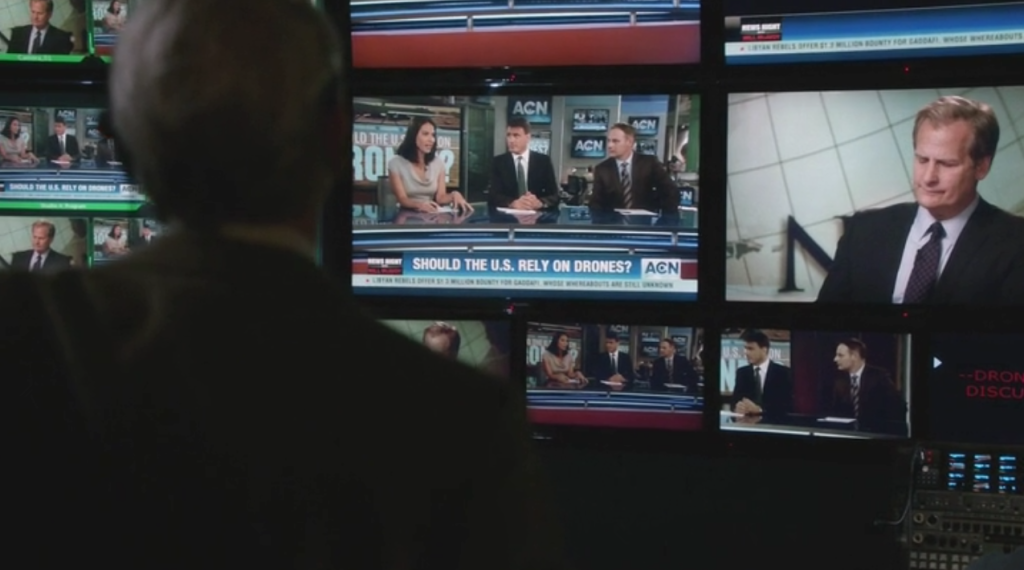
HBO’s The Newsroom returned to television last night, and it was borderline obsessive about drone strikes. (As for the storytelling itself, there is, so far, no sign of improvement since the conclusion of Season 1.) In the midst of the rhetorical maelstrom — this is an Aaron Sorkin show, after all — I couldn’t help but notice that Sloan Sabbith (Olivia Munn) had this to say about drone strikes during an on-air panel:
We don’t know exactly what that collateral damage is because of the lack of any transparency or accountability. Now factor in that the B.D.A. — the bomb damage assessment — counts all military-age males as militants.
The show depicted this particular airing of News Night as having taken place on August 24th, 2011. The only problem? The New York Times actually broke the story about all military-age males being counted as combatants nearly a full year later, in an article published on May 29, 2012:
It is also because Mr. Obama embraced a disputed method for counting civilian casualties that did little to box him in. It in effect counts all military-age males in a strike zone as combatants, according to several administration officials, unless there is explicit intelligence posthumously proving them innocent.
…
But in interviews, three former senior intelligence officials expressed disbelief that the number could be so low. The C.I.A. accounting has so troubled some administration officials outside the agency that they have brought their concerns to the White House. One called it “guilt by association” that has led to “deceptive” estimates of civilian casualties.
“It bothers me when they say there were seven guys, so they must all be militants,” the official said. “They count the corpses and they’re not really sure who they are.”
As far as I know, the closest that most of the mainstream media came to openly contesting the administration’s counting policy before the night of August 24th, 2011 was in another New York Times article from August 11th of that year:
The civilian toll of the C.I.A.’s drone campaign, which is widely credited with disrupting Al Qaeda and its allies in Pakistan’s tribal area, has been in bitter dispute since the strikes were accelerated in 2008. Accounts of strike after strike from official and unofficial sources are so at odds that they often seem to describe different events.
The debate has intensified since President Obama’s top counterterrorism adviser, John O. Brennan, clearly referring to the classified drone program, said in June that for almost a year, “there hasn’t been a single collateral death because of the exceptional proficiency, precision of the capabilities we’ve been able to develop.” Other officials say that extraordinary claim still holds: since May 2010, C.I.A. officers believe, the drones have killed more than 600 militants — including at least 20 in a strike reported Wednesday — and not a single noncombatant.
But that article is a far cry from the definitive declaration made by Sloan Sabbith on last night’s episode of The Newsroom. I suppose this is just one more trademark of Aaron Sorkin. It’s not just his depiction of women that’s anachronistic: even his series on news reporting can’t get the story in the right order.


I’m still here. But I’ll be here more…soon.

From yesterday’s online New York Times comes a story titled “As Social Media Swirl Around It, Supreme Court Sticks to Its Analog Ways:”
The Web is ready, too. On Thursday, after the justices once again did not issue rulings in any of the biggest cases, news organizations blared the “news” to their followers. “BREAKING NEWS: No major decisions from Supreme Court today,” the Yahoo News site announced on its Twitter feed. Another Twitter user wryly observed: “Clearly all Supreme Court judges were unpopular kids in high school and, excited by all the attention now, are gonna drag this out.”
A year ago, in the minutes before the court announced its decision on President Obama’s health care law, Twitter users posted more than 13,000 messages a minute about the court. (By comparison, there were 160,000 a minute at the height of the presidential debate in Denver last year.)
And then today, another story headlined “A Panda Escapes From the Zoo, and Social Media Swoop In With the Net:”
To help find Rusty, a raccoon-size mammal with a striped tail and moon-shaped face, the zoo turned to social media, and suddenly half of official Washington broke from Serious Events to tune in to the saga of the runaway panda.
On Twitter and Facebook, the hunt for 11-month-old Rusty, whom the zoo acquired three weeks ago as a partner to a female panda named Shama, exploded in a mix of concern, humor and, this being Washington, the goring of political oxen.
“Rusty the Red Panda eats shoots and leaves,” Jake Tapper, CNN’s chief Washington correspondent, filed to Twitter.
Doug Stafford, a senior aide to Senator Rand Paul, Republican of Kentucky, called the escape a cautionary tale. “If we don’t use drones to spy on everyone, the pandas will win,” he wrote.
The zoo announced Rusty’s disappearance to its thousands of Twitter followers in a message at 11:51 a.m, which was retweeted nearly 3,000 times in an hour.
At midday, mentions of “Rusty” on Twitter nearly equaled those of “Obama.” ABC News started a blog with “live coverage” of the search.
“Please help us find Rusty,” the zoo pleaded on Twitter, explaining that he was last seen at 6 p.m. on Sunday and might be nearby “hiding in a tree.”
On its Facebook page, the zoo said keepers were combing the Asia Trail habitat, whereRusty and Shama live between the Japanese giant salamander and the small-clawed otter, since 8 a.m. But in an ominous note, the zoo said it was possible Rusty had been stolen.
Look, I get it. The New York Times has discovered social media, and it is on it. But please, please — stop with the constant stories devoted to people who…tweet. Or who post the occasional snarky Facebook post.
This is not news. This is actually rather mundane, and is best replaced by an article on almost anything else.
And yes, I realize I have just made the problem worse.



Fast Company takes note of a beer glass innovation at Salve Jorge Bar in São Paulo:
The Offline Glass, by Mauricio Perussi, Melissa Pottker, and Fischer&Friends, is a low-fi way to stop any friend from using their phone. It’s essentially just a glass with half a bottom, so if your iPhone isn’t laying on the counter, perfectly wedged in its gap, your beer will spill all over the bar.
Of course, for the clever drinkers amongst you, there are probably conceivable workarounds. Wedge a cocktail napkin in there. Just hold your phone and beer at the same time. “We do not intend to [actually] solve the problem,” clarifies Art Director Mauricio Perussi. “The Offline Glass is just a funny way to annoy friends who only have eyes for their cellphones.”

Joshua Foust posted an article on Medium today, titled “A Catalogue of Journalistic Malfeasance.” In it, he castigated the work of The Guardian‘s Glenn Greenwald for allegedly misstating all sorts of facts in the rush to get Edward Snowden’s story to the public:
So what’s the solution? For one, stop assuming the first version of the “facts” is correct. So much of the initial round of NSA reporting has turned out to be false or misleading that it’s a wonder such misreporting hasn’t become its own scandal. The speed with which false information propagates in the public (and worse, in commentaries) is dismaying to those of us who’d prefer public debates be based in fact rather than fiction.
Yet so long as breaking news dominates the coverage, there will continue to be frenzied periods of rushed reporting and eventual retractions or clarifications. Until we as people change our media consumption habits, the news organizations that continue to rush poorly researched information into the public record will have no reason to change their ways.
But even a cursory perusal of Foust’s piece reveals the same tenuous grasp of basic facts for which he passionately condemns The Guardian and The Washington Post (among others). In order, starting from near the beginning of his article:
1) Foust writes:
For one, there is still no evidence about how many other phone companies have been compelled to hand over their records. On Twitter, Greenwald wrote, “The program we exposed is the collection of all American’s [sic] phone records.” That isn’t true — he exposed the collection of Verizon’s records. The only evidence that this is an ongoing, long-standing program involving other telecos is a statement by Senate Intelligence Committee chairwoman Diane Feinstein and various anonymous leaks to national security reporters.
Let’s get the obvious point out of the way: if the chairwoman of the Senate Intelligence Committee confirms the existence of an “ongoing, long-standing program involving other telcos,” then how can Foust write that “there is still no evidence about how many other phone companies have been compelled to hand over their records?” (Unless, of course, he means that there could be even more than those already uncovered.) Feinstein has made it painfully clear what she thinks of Snowden — “I don’t look at this as being a whistle-blower,” she said at one point, “I think it’s an act of treason” — and so she has absolutely no incentive to lie about the existence of the programs he uncovered (certainly not, at least, in the direction of making him look more truthful).
Secondly, Foust’s link to Feinstein’s alleged statement goes, bizarrely, to a Huffington Post article that makes no mention of other telecom companies at all. But based on its content, Foust seems to be referring to a Feinstein statement reported in a Politico article from the same morning, in which Feinstein not only did not state that similar operations were taking place at other phone companies, but specifically said she could not confirm that that was happening:
Feinstein said she could not answer whether other phone companies have had their records sifted through as Verizon has.
“I know that people are trying to get to us,” she said. “This is the reason why the FBI now has 10,000 people doing intelligence on counterterrorism. This is the reason for the national counterterrorism center that’s been set up in the time we’ve been active. its to ferret this out before it happens. “It’s called protecting America.”
The same incongruence holds true for the “various anonymous links to national security reporters.” The Wall Street Journal reported the following on June 7th:
The disclosure this week of an order by a secret U.S. court for Verizon Communications Inc.’s phone records set off the latest public discussion of the program. But people familiar with the NSA’s operations said the initiative also encompasses phone-call data from AT&T Inc. and Sprint Nextel Corp., records from Internet-service providers and purchase information from credit-card providers.
This, a prominently reported article by an internationally prominent newspaper, is also evidence. So it is decidedly unclear what Foust means when he writes, “There is still no evidence about how many other phone companies have been compelled to hand over their records.” That’s at least three in total, right there.
Finally, Foust claims that Greenwald only “exposed the collection of Verizon’s records,” not those of all American customers — as Greenwald had claimed in his Twitter feed. But Foust appears to be wrong on this count too (as is Greenwald). The secret court order published by The Guardian demands the following material from Verizon:
…all call detail records or “telephony metadata” created by Verizon for communications (i) between the United States and abroad; or (ii) wholly within the United States, including local telephone calls…Telephony metadata includes comprehensive communications routing information, including but not limited to session identifying information (e.g., originating and terminating telephone number, International Mobile Subscriber Identity (IMSI) number, International Mobile station Equipment Identity (IMEI) number, etc.), trunk identifier, telephone calling card numbers, and time and duration of call.
Nowhere in the above order does it specify that this information be restricted to Verizon customers only. In other words, if an American Verizon customer calls — or receives a call from — someone abroad (or even locally) who is not a Verizon customer, this order appears to obtain at least the phone number of the non-Verizon customer and perhaps more. (My low level of telecom technical expertise is not sufficient to speculate about the IMSI and IMEI numbers.)
2) Foust continues:
The next leak Greenwald published, with veteran national security reporter Ewan MacAskill, made an even more eyepopping claim: “The National Security Agency has obtained direct access to the systems of Google, Facebook, Apple and other US internet giants.” That report also turned out to be largely exaggerated. Experienced tech journalists immediately seized on the description of the PRISM program (which accesses the data of internet companies) and poked it full of holes. Despite being described as “data-mining,” PRISM is really “nothing of the sort,” according to journalists who have covered the NSA in detail.
Foust is correct that the early descriptions of PRISM as a program of direct, real-time access to huge tech companies’ servers has since been walked back, in part. In retrospect, it’s become clear that The Guardian displayed an insufficient level of technical savvy — and perhaps even a spate of wishful thinking — in describing the program. Nevertheless, the above quote that Foust extracts from the article, written by Glenn Greenwald and Ewen MacAskill, leaves out a crucial qualifier that immediately follows the words he excerpted:
The National Security Agency has obtained direct access to the systems of Google, Facebook, Apple and other US internet giants, according to a top secret document obtained by the Guardian.
The NSA access is part of a previously undisclosed program called Prism, which allows officials to collect material including search history, the content of emails, file transfers and live chats, the document says.
“…according to a top secret document obtained by the Guardian.” And then, in the next paragraph, “the document says.” Now I’m not justifying Greenwald’s and MacAskill’s carelessness with words: the difference between direct access and, say, submitting individual requests for data is enormous and should be treated as such. But despite its obvious flaws, the article does make clear its reliance on the secret document — which itself, according to The Guardian, claimed “collection directly from the servers” of large American technology companies. It would, therefore, appear that at least some of the blame for the “exaggeration” rests with whatever NSA employee or contractor created the PowerPoint, not solely with The Guardian.
3) Foust writes, “IT work is not spying, even if it’s classified.” OK? Is there some new dictionary edict from on high about this, of which I’m not aware? “IT work” can refer to almost anything — and “anything” absolutely, positively includes spying. To be honest, I’m not confident I understood what Foust was trying to get across here, because reading the above sentence at face value makes no sense at all.
4) Contra Edward Snowden, Foust writes that “Robert Deitz, a former top lawyer at the NSA and CIA, told the L.A. Times that claim [that Snowden could ‘access any CIA station in the world’] was a ‘complete and utter’ falsehood.”
To his credit, Foust admits the obvious reality that this is hardly proof of Snowden’s lying. (Consider the source, to put it lightly.) But Foust again errs when he quotes Snowden as saying he could “access any CIA station in the world.” That phrase has been repeated elsewhere as well. But Snowden never said it. Here is what he actually said:
I had access to, you know the full rosters of everyone working at the NSA, the entire intelligence community, and undercover assets all around the world, the locations of every station we have, what their missions are, and so forth.
It’s a very similar statement. But it’s not identical. Even more concerning than the misquoted phrase, however, is the fact that Snowden refers to “every station” immediately after referencing the NSA, not the CIA — as Foust incorrectly wrote. Yes, it is still likely that Snowden was implicitly referring to the CIA in his above statement about “the locations of every station we have,” but the quote Foust excerpts simply doesn’t exist.
5) Foust writes:
Snowden said he participated in a CIA operation to “recruit” a Swiss banker in Geneva through a manufactured drunk driving arrest. Swiss President Ueli Maurer over the weekend said that such a claim “does not seem to me that it… played out as it has been described by Snowden and by the media.”
But much like the quote above by Robert Deitz, Ueli Maurer has quite the incentive to downplay the incident. Switzerland would rather not get into a diplomatic tussle with the United States. Moreover, it would be embarrassing for a president to admit to the bumbling incompetence of one of his own countrymen in the face of the crudest spook tactics. (Getting a banker drunk and then encouraging him to drive? Not a good look for the banker, his president, or his country.)
6) Foust quotes NSA head Keith Alexander — of all people — as rebutting Snowden’s claims. Well, then…that settles it?
7) Foust writes:
The rush to be first out of the gate with explosive new details of anything — or, in the Guardian’s case, the rush to publish before Snowden could be located and arrested — created perverse incentives to publish without verification. Washington Post freelancer Barton Gellman even said that his attempts to verify some of Snowden’s claims led to Snowden pushing the same documents to the Guardian because they would publish faster.
Once again, the Gellman article to which Foust links says no such thing. Here is the actual excerpt to which Foust appears to be referring:
To effect his plan, Snowden asked for a guarantee that The Washington Post would publish — within 72 hours — the full text of a PowerPoint presentation describing PRISM, a top-secret surveillance program that gathered intelligence from Microsoft, Facebook, Google and other Silicon Valley giants. He also asked that The Post publish online a cryptographic key that he could use to prove to a foreign embassy that he was the document’s source.
I told him we would not make any guarantee about what we published or when. (The Post broke the story two weeks later, on Thursday. The Post sought the views of government officials about the potential harm to national security prior to publication and decided to reproduce only four of the 41 slides.)
Snowden replied succinctly, “I regret that we weren’t able to keep this project unilateral.” Shortly afterward he made contact with Glenn Greenwald of the British newspaper the Guardian.
And then further on down, Gellman refers to his “dispute [with Snowden] about publishing the PRISM document in full.” In other words, Snowden’s decision to go to The Guardian was apparently based on The Washington Post‘s unwillingness to accept certain conditions, not because The Guardian had sloppier fact-checking or looser editorial standards.
At the end, Foust laments the barrage of misleading and inaccurate news. He is right: the mainstream American press has had a rocky few months. (In reality, it’s been rocky for far longer than that.) Twitter and other real-time social networks have certainly contributed to the proliferation of these deceptions at ever-faster speeds, although they fact-check just as fast. I actually agree with the general thrust of Joshua Foust’s analysis of The Guardian‘s hasty reporting that appears to have cut corners in dangerous ways. But sometimes even the fact-checker needs a fact-checker.
