Category Archives: Media

House of Cards: Welcome to the spectacle

Screen Shot 2014-02-19 at 10.31.45 PM

By its very nature, House of Cards invites discussion. It entire first season was foisted upon us all at once last February as an early Valentine’s Day present: a tale of escalating palace intrigue that culminated, in Episode 11, with the shocking (and somewhat absurd) murder of Congressman Peter Russo. Season 2, which was released — en masse, once again — to much fanfare on Friday, provoked even larger ripples online, eliciting the ritual thinkpieces, interviews, and meta-analyses.

You’ll forgive me, then, for wading in myself. As a binge-watcher of Season 2 (I finished the finale sometime after midnight on Monday), I fell prey, like so many others, to the seductive guile of Frank Underwood as he marched his way straight into the Oval Office.

Let’s leave plot contrivances aside for a moment. House of Cards may fancy itself pop culture’s sharpest purveyor of political realism, but its broad narrative brushstrokes are nothing if not impressionistic. (Either that or I’m not nearly paranoid enough about my elected officials.)

Much of the conversation sandwiching the release of the second season centered on House of Cards‘ innate cynicism. Ian Crouch, writing for The New Yorker, for example, explained the show’s ethos thusly:

“House of Cards,” back now with its entire second season streaming on Netflix, is a show about contempt. There is contempt in the general, interpersonal sense: the politicians, operatives, journalists, and various other D.C. types all hold one another in especially expressive disregard. (Last season, Francis Underwood, played by Kevin Spacey, explained his relationship to his colleagues like this: “They talk while I sit quietly and imagine their lightly salted faces frying in a skillet.”) And there is contempt in the legal sense—the plots turn on the subversion and manipulation of rules and regulations, and the breaking of laws (murder, etc.) for personal gain and professional advancement. Ethics, like feelings, are obstacles, and beneath consideration.

Crouch goes on to claim, rather convincingly, that the series saves its most ferocious contempt for its own audience: “We are the ones, after all, who tolerate and thus perpetuate the real-life theatre of venality and aggression from which ‘House of Cards’ derives its plausibility.”

As a description of the political status quo, this is certainly true. Crouch, however, clouds his thesis by emphasizing the cockiness of Beau Willimon, the showrunner whose elimination of yet another principal character in the Season 2 premiere showcased, Crouch reports, “a power trip in which the show and its main character assume parallel roles as bullies.”

While this is a perfectly defensible interpretation of the relationship between House of Cards and its enraptured fan base, it is not, I think, the most accurate one. Contempt implies strength of feeling: it is, after all, one of the telltale signs of a marriage in dissolution. Admittedly, it is often a sign of power inequality as well: the strong feel contemptuous of the weak, not vice versa. Nevertheless, contempt connotes a vigorous degree of hostility.

But it is this precise feature — red-faced rage and its emotionally-charged cousins — that is almost entirely absent from House of Cards‘ dalliance with its viewership. On this, Todd VanDerWerff of A.V. Club hits the right note:

Midway through the season-two finale of House Of Cards, Kevin Spacey’s Francis Underwood confronts one of the many people incredibly pissed off at him backstage at the opera. (It has to be the opera, for House Of Cards does not do subtlety.) The conversation is interrupted by a patron who exits the auditorium, presumably looking for a bathroom. They look over at her as she walks through—both seemingly miffed that she even exists. It’s a scene that summarizes House Of Cards’ relationship to the average American citizen: Everybody in this country is grist for the mill for politicians like Frank, who serve only themselves and carry out their real deal-making far behind the scenes of what’s available to the press and C-SPAN. And don’t you think you have the right to know about it. At best, you’re an irritating inconvenience. At worst, you’re dead.

Contempt is for threats; rivals, even. Contempt is what drove Frank Underwood to send Peter Russo to his makeshift gas chamber in Season 1 and Zoe Barnes to her early demise in Season 2. It is, as a general rule, the principal sentiment vaulting Underwood’s entire career past those of his peers in the House of Representatives and beyond.

But a clear line separates the contempt pervading nearly all of House of Cards‘ interpersonal relationships from its most crucial one by far: that of Frank Underwood’s with the audience. When, in the new season’s premiere, Kevin Spacey at last addresses the viewer, he gazes not directly into the camera, as is his wont, but through a bathroom mirror. As he speaks, the camera pulls in slowly until the frame edging the glass is almost completely obscured: Frank Underwood has met his reflection, and it is us.

Did you think I’d forgotten you? Perhaps you hoped I had. Don’t waste a breath mourning Miss Barnes. Every kitten grows up to be a cat. They seem so harmless at first—small, quiet, lapping up their saucer of milk. But once their claws get long enough, they draw blood. Sometimes from the hand that feeds them. For those of us climbing to the top of the food chain, there can be no mercy. There is but one rule: hunt or be hunted. Welcome back.

Ian Crouch views this parting scene as evidence of Willimon’s arrogance:

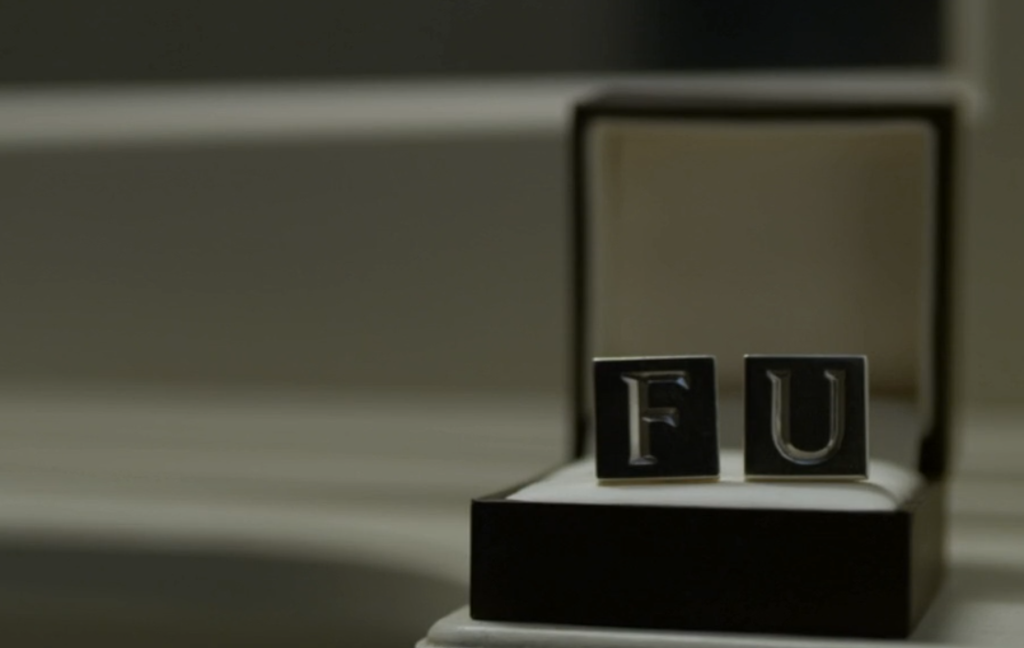
And then there is one last shot, in case there was any confusion as to the message: a pair of silver cufflinks bearing Frank’s initials. They’d been mentioned before—a birthday gift from his body man—and, called back, they make for a funny visual gag: “F.U.” … We’ve been told, as the Times likes to say, to “commit a physically impossible act.” Frank despises most everybody—why should we be an exception?

But here Crouch misunderstands Underwood and, by extension, Willimon. “F.U.” is the precise opposite of a “power trip:” it is, rather, the ultimate invitation to an insiders’ club. It is a joke so obvious it begs to be understood, a wink that demands a knowing nod. As a sophomoric sight gag, “F.U.” is a souvenir to its audience. But as an epithet, “F.U.” is decidedly not a message to those of us who watch House of Cards: it’s a contemptuous insult for everyone who doesn’t.

From this perspective, the message of House of Cards is remarkably consistent. It is no accident that an unsubtle version of Politico — an online-only publication dubbed Slugline — serves as the most formidable opponent of Underwood as he rapidly scales the Washington political ladder. Indeed, it is only the murder of its most intrepid reporter that reestablishes Underwood’s control over his own destiny, an objective that could only be derailed by a consummate insider such as Zoe Barnes. In a two-season narrative arc dedicated to highlighting Frank Underwood’s utter mastery of his domain, the single common thread uniting him to all of his peers in House of Cards is their overwhelming collective insulation from life outside the Mall.

Indeed, the fiercest contempt in the series is reserved for all of The Others: those who believe in a democratic politics, the power of representative elections, education reform, foreign policy initiatives, the national interest. People who didn’t catch “F.U.” Simpletons, one and all.

Is anyone really supposed to care about any of the particular policy battles waged throughout the first two seasons? Do we even remember what they were? Of course not: we’re here for the spectacle. We’re here, in short, to become insiders too. It is in this arena that House of Cards excels: it masterfully inhabits the universe populated by our politicians and the hordes of journalists who mob their every prepackaged press conference and giggle over their every wayward tweet. Contempt for the real world goes without saying. We are all complicit in trading away accountability journalism for tabloid-style coverage of the daily political grind, and House of Cards is our soma.

Todd VanDerWerff neatly captures this addiction to irrelevance towards the end of his review:

Yet House Of Cards is also weirdly perfect when it comes to what it’s meant to do, which is keep viewers plowing through episodes, regardless of time spent doing so. There are just enough flourishes around the edges…that it’s possible to feel like House Of Cards has something deeper on its mind, even when it’s all but clear it doesn’t. This is sleight of hand that works much better in the middle of the binge, rather than a few hours later, when contemplating whether the plot made any sense.

VanDerWerff appears, at first glance, to be damning House of Cards with faint praise. But it is really quite the opposite: in portraying Washington as a city full of sound and fury, signifying nothing, House of Cards has in fact perfectly captured the reality of modern politics in the era of horse-race journalism.

Enhanced by Zemanta

Market failure

Proof that supply and demand are not always in perfect equilibrium, at least in the realm of quality journalism:

What a contrast. Silicon Valley: where ideas come to launch. Washington, D.C., where ideas go to die. Silicon Valley: where there are no limits on your imagination and failure in the service of experimentation is a virtue. Washington: where the “imagination” to try something new is now a treatable mental illness covered by Obamacare and failure in the service of experimentation is a crime. Silicon Valley: smart as we can be. Washington: dumb as we wanna be.

Tom Friedman is the most embarrassing of a truly amateur-hour op-ed operation at the Times.

On “Planet Hillary,” no one has a name

In tomorrow’s New York Times Magazine, Amy Chozick delves into the political intrigue surrounding Hillary Clinton’s presidential ambitions. The online hubbub over the article, titled “Planet Hillary,” actually began on Thursday, when the magazine cover art was released, to widespread bewilderment:

Anyway, I got around to reading the piece today and couldn’t escape an uneasy feeling about it. It took me a few minutes to realize that “Planet Hillary” was a vintage Politico-esque creation. It deals almost entirely in political maneuvering and the “who’s-in-who’s-out” hysteria endemic to public figures and their extensive entourages. More damningly, it is almost completely devoid of policy discussion.

Granted, there is a place in political journalism for fluffy, narrative-driven, gossip-heavy recaps of the Washington social ladder. But generally speaking, The New York Times has not been that place. (The reliability of that axiom is one major reason I’m a subscriber.) In fact, it is perhaps because of the Times’ historical reticence to portray the constant power shuffling within American politics as equivalent to its counterpart in a typical high-school cafeteria that “Planet Hillary” seemed to meander so aimlessly and conclude in such a random way: the Times simply isn’t good at this kind of thing. Which is itself a good thing.

But after several further minutes of reflection, I noticed a much more specific problem with the piece: it is utterly stacked with anonymous statements and characterizations. To quantitatively confirm my suspicions, I re-read the article, this time marking every statement by any source (including quotes, paraphrases, and descriptions) that met the following criteria:

  • It was made to Amy Chozick in the course of her reporting for the article (so “James Carville has compared the Clinton world, perhaps not so originally, to an onion” doesn’t count, because that statement happened outside of Chozick’s reporting)
  • It was attributable to one person only (so “Several people close to Clinton have already discussed installing someone to play the role of ‘chief listener'” doesn’t count either, since it represents an aggregate of multiple conversations)
  • It was explicitly attributed, whether anonymously or otherwise, to a person (so “When Ready for Hillary held a seminar for donors at Le Parker Meridien hotel last fall to discuss what it would take to win in 2016, Bill Clinton personally checked in with an attendee to ask what was being discussed and who was there” doesn’t count because the anecdote wasn’t directly attributed to any particular source)

Keep in mind that these are extremely conservative criteria. There are, for example, multiple statements attributed to “several people close to Clinton,” “several people close to the Clintons,” “several others,” and “others,” to name a few examples. These I did not count, as it is conceivable that the sources’ collective anonymity was more a function of Chozick’s concision than her sources’ desire for discretion.

I was also, of course, careful to include all instances of named (that is, not anonymous) sources. Consider the following passage from the article:

A few months later, over lunch near the White House, Reines laughed as a couple of meddlesome emails popped up on his BlackBerry from two older Clinton loyalists who had re-emerged since she left State. In between bites of a shrimp cocktail, he called these noodges “space cowboys,” referring to the 2000 film in which Clint Eastwood, Tommy Lee Jones and Donald Sutherland play aging pilots who reunite to disarm a Soviet-era satellite on one last mission.

I counted this as a named statement, despite the fact that it’s only two words long (“space cowboys”). I’m also counting it as a separate named statement from another quote earlier in the same paragraph by the same source, solely because the statements occurred at different times chronologically. (Elsewhere, I counted him again in an innocuous comment about the names of his kittens.)

Despite all of these precautions, 18 of the 36 statements — exactly 50% — that were made to Chozick in the course of “Planet Hillary” were anonymous (19 of 37 if I’d counted “a foundation spokesman,” which didn’t seem designed to provide discretion, but rather to avoid introducing too many irrelevant names). Here were a few representative examples:

  • “Legally she could not participate in fund-raising or political activity, and so the period, noted one staff member, seemed like a quiet four-year pause.”
  • “Until recently, her seven personal aides worked out of a tiny Washington office (‘smaller than my first N.Y.C. apartment,’ one aide said in an email) on Connecticut Avenue.”
  • “She ‘inspires loyalty, and she’s loyal back,’ another person close to the inner circle says.”

(Emphases mine. You can check my count by viewing my spreadsheet here. Yellow-highlighted rows represent anonymous statements.)

The “Guidelines on Integrity” document available from The New York Times Company’s web site has this to say about anonymous sources:

Anonymity and Its Devices. The use of unidentified sources is reserved for situations in which the newspaper could not otherwise print information it considers newsworthy and reliable. When possible, reporter and editor should discuss any promise of anonymity before it is made, or before the reporting begins on a story that may result in such a commitment. (Some beats, like criminal justice or national security, may carry standing authorization for the reporter to grant anonymity.) The stylebook discusses the forms of attribution for such cases: the general rule is to tell readers as much as we can about the placement and known motivation of the source. While we avoid automatic phrases about a source’s having “insisted on anonymity,” we should try to state tersely what kind of understanding was actually reached by reporter and source, especially when we can shed light on the source’s reasons. The Times does not dissemble about its sources does not, for example, refer to a single person as “sources” and does not say “other officials” when quoting someone who has already been cited by name. There can be no prescribed formula for such attribution, but it should be literally truthful, and not coy.

Similarly, The New York Times Manual of Style and Usage states:

[A]nonymity is a last resort, for situations in which the newspaper could not otherwise print information it considers newsworthy and reliable. Reporters should not offer a news source anonymity without first pressing to use a name or other helpful identification…

If concealment proves necessary, writers should avoid automatic references to sources who “insisted on anonymity” or “demanded anonymity”; rote phrases offer the reader no help. When possible, though, articles should tersely explain what kind of understanding was actually reached by reporter and source, and should shed light on the reasons. Anonymity should not shield a press officer whose job is to be publicly accountable. And, given the requirements of newsworthiness and substance, it should not be invoked for a trivial comment: “The party ended after midnight,” said a doorman who demanded anonymity. (If the doorman simply refused to give his name, that is a less grandiose matter, and the article should just say so.)

Anonymity must not become a cloak for attacks on people, institutions or policies. If pejorative remarks are worth reporting and cannot be specifically attributed, they may be paraphrased or described after thorough discussion between writer and editor. The vivid language of direct quotation confers an unfair advantage on a speaker or writer who hides behind the newspaper, and turns of phrase are valueless to a reader who cannot assess the source.

It is quite clear that the three nameless quotes I excerpted above, as well as others like them, fail to meet the Times‘ threshold for granting anonymity. In some cases, Chozick’s usage is directly contradictory to policy. If anonymity “should not be invoked for a trivial comment,” then the statement by the “one aide” (quoted above) on the size of Hillary Clinton’s Washington office, for example, is certainly a violation of the rule.

Anonymous statements have long been a source of contention with readers, a point Times public editor Margaret Sullivan has raised multiple times. (A 2009 article by a previous public editor for the Times, Clark Hoyt, cited a study finding that almost 80 percent of anonymous statements in the newspaper failed to meet the official New York Times standard.)

“Planet Hillary” seemed to me to be an especially egregious case, as the underlying substance of the article was already paper-thin. The anonymous statements simply added to the puffy feel of the piece itself and contributed to an overall sense of (mostly banal) palace intrigue. Here’s hoping to see less of this in the future.

Short-circuited journalism

Almost alone among the professions, journalism is not rooted in a body of substantive knowledge. The claim is not that journalists lack knowledge or skill, for that is far from true. Nor is the claim an entry into the perennial but ultimately fruitless debate over whether journalism is a craft rather than a profession. The claim instead is a precise one: Journalism is not grounded in a systematic body of substantive knowledge that would protect its practitioners’ autonomy and inform their judgment.

The above passage was penned by Thomas E. Patterson in his recent book, Informing the News: The Need for Knowledge-Based Journalism. I was reminded of it today after reading this on GigaOm:

If you were reading some of the major tech-news sites on Wednesday — including the New York Times and Washington Post tech blogs — you might have gotten the impression that a huge proportion of the Chinese internet somehow got redirected to a small house in Wyoming on Tuesday. Why? Because that’s what a lot of the headlines said. The truth is almost as strange, but a Chinese technical glitch plays the starring role in the story, not a small house in Wyoming.

The house that captured everyone’s attention is a tiny brick home on what looks like a well-manicured street in Cheyenne, Wyoming. It showed up in photos on Gizmodo and The Verge, under headlines like “Most of China’s Web Traffic Wound Up at a Tiny Wyoming House Yesterday” and “Chinese Internet Traffic Redirected to Small Wyoming House” (that one was the New York Times tech blog). The Washington Post said that “thousands if not millions of Chinese Internet users were being dumped at the door of a tiny, brick-front house.”

In fact, the small house is just the company’s registered business address, one that is used by thousands of shell companies and other corporations who want to remain relatively anonymous (and the company that registered it has actually moved to a different address in Wyoming). The traffic actually went to wherever Sophidea’s servers are located, which is hard to say with any precision.

Among many other things, the Edward Snowden story helped expose a woeful shortage of technical savvy among our national press corps. As the next generation heads to the blogosphere, here’s hoping these mistakes become fewer and further between.

Enhanced by Zemanta

A broken Constitution, and a few misplaced facts

Jeffrey Toobin’s latest piece for The New Yorker, “Our Broken Constitution” (paywalled), is an illuminating stroll through a myriad of justifiable complaints about the American founding document. But I couldn’t help but notice several questionable (and, in some cases, completely inaccurate) statements.

The essay opens thusly: “If there is a single point of consensus in this heated political moment, it’s that everyone loves the Constitution.” In the next paragraph, Toobin continues: “The Constitution, and the structure of government that it established, provides the backdrop, but never the subject, for every controversy.”

Skip ahead two paragraphs, however, and you’ll find the exact opposite: “Outside Washington,” Toobin explains, “discontent with the founding document is bipartisan and widespread…On the left and the right, [critics] are asking whether the pervasive dysfunction in Washington is in spite of the Constitution or because of it.” How can both be true simultaneously?

That’s not the only problem. Toobin’s opening statement, even if evaluated in the absence of his self-rebuttal a few lines down, is demonstrably inaccurate. Of course, there’s a certain futility to disproving any theory that includes the phrase “everyone loves” — which, to his credit, Toobin couldn’t possibly have meant literally. Nevertheless, even if afforded an ostensibly looser interpretation of “everyone,” his argument simply doesn’t work.

In fact, Toobin’s essay is itself just the latest in a series, all of which harp on the same general theme (a mostly justified one, to my eyes) that the Constitution is — to put it simply — overrated. A July 2012 Slate piece titled “Fixing the U.S. Constitution” invited readers and experts to amend the venerable document, introducing the effort thusly: “Politicians talk about the Constitution as if it were as sacrosanct as the Ten Commandments. But the document itself invites change and revision.”

In December of that same year, The New York Times ran an op-ed piece by Louis Michael Seidman, a constitutional law professor at Georgetown, headlined “Let’s Give Up on the Constitution.” In it, Seidman laments “our insistence on obedience to the Constitution, with all its archaic, idiosyncratic and downright evil provisions.” He also points out the long history of constitutional dissent: “Constitutional disobedience may seem radical, but it is as old as the Republic. In fact, the Constitution itself was born of constitutional disobedience…No sooner was the Constitution in place than our leaders began ignoring it.”

Less than three months ago, in September, Kevin R.C. Gutzman asked in The American Conservative: “Do We Need a New Constitutional Convention?” Perhaps more to the point, a National Journal article the following month by Alex Seitz-Wald was self-explanatorily titled, “A How-To Guide to Blowing Up the Constitution.” And these are just a few representative samples in a long canon of disenchantment with the output of “We the People” (or, rather, of their aristocratic appointees to the constitutional convention).

A second problem crops up soon enough. A little further along, but still on the article’s first page (p. 64 in the print edition), Toobin writes: “Implicitly but unmistakably, the 1787 Constitution allowed for the continuation of slavery.”

There is nothing implicit about the Constitution’s allowance for slavery. In the very first Article, Section 2, Clause 3 states, in part:

Representatives and direct Taxes shall be apportioned among the several States which may be included within this Union, according to their respective Numbers, which shall be determined by adding to the whole Number of free Persons, including those bound to Service for a Term of Years, and excluding Indians not taxed, three fifths of all other Persons.

Later on, in Article I, Section 9, Clause 1, the Constitution explicitly allows for the slave trade’s continuation until at least 1808:

The Migration or Importation of such Persons as any of the States now existing shall think proper to admit, shall not be prohibited by the Congress prior to the Year one thousand eight hundred and eight, but a Tax or duty may be imposed on such Importation, not exceeding ten dollars for each Person.

Article IV, Section 2, Clause 3 states:

No Person held to Service or Labour in one State, under the Laws thereof, escaping into another, shall, in Consequence of any Law or Regulation therein, be discharged from such Service or Labour, but shall be delivered up on Claim of the Party to whom such Service or Labour may be due.

And finally, Article V reaffirms the impossibility of eliminating the slave trade until at least 1808:

The Congress, whenever two thirds of both Houses shall deem it necessary, shall propose Amendments to this Constitution, or, on the Application of the Legislatures of two thirds of the several States, shall call a Convention for proposing Amendments, which, in either Case, shall be valid to all Intents and Purposes, as Part of this Constitution, when ratified by the Legislatures of three fourths of the several States, or by Conventions in three fourths thereof, as the one or the other Mode of Ratification may be proposed by the Congress; Provided that no Amendment which may be made prior to the Year One thousand eight hundred and eight shall in any Manner affect the first and fourth Clauses in the Ninth Section of the first Article; and that no State, without its Consent, shall be deprived of its equal Suffrage in the Senate.

Midway through Toobin’s piece, a third flaw emerges. Speaking of President Obama, Toobin writes:

Though he will spend eight years in office, his tenure as the actual leader of the national government lasted about a year and a half. On July 7, 2009, Al Franken was seated, after a recount, as the sixtieth Democratic senator. (Sixty votes are needed to overcome a filibuster.)…In the midterm elections of 2010, Obama’s party lost control of the House and fell below the filibuster threshold in the Senate.

But as has been well-documented (here, and here, and here, to name a few places) — and especially visible, one would imagine, to a political junkie such as Toobin — Obama’s actual filibuster-proof Senate majority lasted only four months in reality. Rachel Maddow’s blog explains:

In January 2009, there were 56 Senate Democrats and two independents who caucused with Democrats. This combined total of 58 included Sen. Ted Kennedy (D-Mass.), whose health was failing and was unable to serve. As a practical matter, in the early months of Obama’s presidency, the Senate Democratic caucus had 57 members on the floor for day-to-day legislating.

In April 2009, Pennsylvania’s Arlen Specter switched parties. This meant there were 57 Democrats, and two independents who caucused with Democrats, for a caucus of 59. But with Kennedy ailing, there were still “only” 58 Democratic caucus members in the chamber.

In May 2009, Sen. Robert Byrd (D-W.Va.) was hospitalized, bringing the number of Senate Dems in the chamber down to 57.

In July 2009, Sen. Al Franken (D-Minn.) was finally seated after a lengthy recount/legal fight. At that point, the Democratic caucus reached 60, but two of its members, Kennedy and Byrd, were unavailable for votes.

In August 2009, Kennedy died, and Democratic caucus again stood at 59.

In September 2009, Sen. Paul Kirk (D-Mass.) filled Kennedy’s vacancy, bringing the caucus back to 60, though Byrd’s health continued to deteriorate.

In January 2010, Sen. Scott Brown (R-Mass.) replaced Kirk, bringing the Democratic caucus back to 59 again.

Thus Obama’s supermajority, for all practical purposes, lasted only from September 24, 2009 until February 4, 2010, when Scott Brown took Kennedy’s old seat in the Senate.

Finally, towards the end of his article Toobin notes the undemocratic nature of the House of Representatives: “In 2012, House Democratic candidates across the country won about half a million more votes than their Republican opponents, but the G.O.P. emerged with thirty-three more seats than the Democrats.”

Toobin is correct on the seat differential, but significantly off on the vote gap. According to analysis performed by the Cook Political Report’s U.S. House editor, Dave Wasserman (and briefly explained by Talking Points Memo editor Josh Marshall), House Democrats actually won 1,365,157 more votes than Republicans in 2012 — a differential nearly three times that cited by Toobin.

Out of an abundance of caution — since Toobin had specifically compared the Democrats’ vote totals to those of their Republican opponents (emphasis mine) — I copied Wasserman’s Google spreadsheet and eliminated all House races in which either the Democrat or Republican candidate received 0 votes. This, I believe, should serve as a reasonably good proxy for uncontested races — in other words, those with no opponents. When only contested races are counted, the Democrats’ vote advantage over the GOP extends to 2,444,369. This is nearly five times as high as Toobin’s count.

I bring all this up not to rag on Toobin, who is obviously an astute legal mind. I enjoyed his article and am generally sympathetic to the complaints registered by the progressive movement regarding the Constitution’s many inadequacies. But several passages somehow slipped past The New Yorker‘s legendary fact-checking desk.

Enhanced by Zemanta

To Blame Everything, Read Here: The Folly of Technological Defeatism

My inner cynic was pleased to discover that the back cover of Evgeny Morozov’s latest book, To Save Everything, Click Here, included a blurb from noted war journalist and scholar David Rieff. The curmudgeonly critic was a professor of mine at Sciences Po in Paris two years ago, and his class was a weekly tour de force of disillusionment with the modern human rights-industrial complex.

In praise of Morozov’s latest effort, Rieff wrote, “Against the reigning consensus — that there is a digital fix for every social and political problem, and that thanks to the technologies that we group together for convenience’s sake as the Internet, the brave new world of the future will be one of endless, limitless improvement in every realm of life — Morozov offers a sophisticated, eloquent, and definitive rebuttal.” This was the Rieff I remembered from my time in grad school, as I heard him wearily repudiate the moralist cri de coeur of peers like Michael Ignatieff and even Bernard Kouchner. It’s the same Rieff I read with great interest in the virtual pages of Foreign Policy, where he took a moment between excoriations of “Kony 2012” and the Singularity movement to dub Morozov “cyber-utopianism’s severest and most eloquent critic.”

That may not be inaccurate. But it is hardly the whole story. A mid-sized hamlet’s worth of straw men make brief cameos in To Save Everything, Click Here, only to be set ablaze by Morozov’s rapid-fire denunciations. Intellectual broadsides are not innately problematic, of course. But like fellow fire-breather Glenn Greenwald — whom Morozov, in his book, dubs “a terrific polemicist…[with] a tendency to overstate his case” — the Belarusian-born author often employs scorched-earth rhetoric against stunning illogic. Continue reading To Blame Everything, Read Here: The Folly of Technological Defeatism

Playing the blame game

Courtesy of The New York Times.

Much ink has been spilled over the relative blame that should be assigned to various parties in the current government shutdown / impending debt-ceiling fiasco from hell. (About that spilled ink, I’m speaking virtually, of course: no one still publishes on physical paper anymore, do they?)

Aside from the predictable litany of “both sides need to compromise” bullshit from the zombie lords of political commentary — which The Atlantic‘s James Fallows, Al Jazeera‘s Dan Froomkin, and NYU professor Jay Rosen continue to eviscerate brilliantly — perhaps most distressing still are the results of today’s Gallup poll:

Americans are now more likely to name dysfunctional government as the most important problem facing the country than to name any other specific problem. Thirty-three percent of Americans cite dissatisfaction with government and elected representatives as the nation’s top issue, the highest such percentage in Gallup’s trend dating back to 1939. Dysfunctional government now eclipses the economy (19%), unemployment (12%), the deficit (12%), and healthcare (12%) as the nation’s top problem.

This is, in its own way, tantamount to a Republican victory — and one that could have more profound long-term implications than whatever short-term turbulence the GOP has inflicted upon itself courtesy of its decreasingly fringe-y “wacko bird” fringe. Indeed, although early indications suggest that House Republicans may suffer for their intransigence in next year’s midterms, there are plenty of reasons to bet against the Democrats’ chances of retaking the lower chamber in 2014.

Meanwhile, the broader national disgust with governmental dysfunction plays directly into Republicans’ hands: in fact, it could be argued that the GOP will always have a home-field advantage of sorts over the Democrats when the two parties are at loggerheads over just about anything of consequence. When bitterly contested policy issues cause Americans to blame government generally (even if, as is the case now, one side is clearly precipitating the immediate crisis), Republican ideology wins the day. Time will tell if this triumph is more durable than the Democrats’ current advantage in generic horse-race Congressional polling.

But there is yet another component to this struggle that’s extremely apparent but is somehow not gaining the traction I’d expect, especially from left-leaning media outlets. And that is the direct line connecting President Obama’s decision to negotiate the debt-ceiling increase in the summer of 2011 with the current crisis. While there is no question that Republican lunacy is the immediate cause of the budgetary and debt-ceiling impasses, much longer-term blame rests directly on the shoulders of Barack Obama.

Today’s manufactured crisis was an entirely foreseeable outcome of Obama’s capitulation two years ago. In fact, Paul Krugman predicted exactly this sort of future as soon as the 2011 deal with Republicans was announced. In an August 1, 2011 column titled “The President Surrenders,” Krugman wrote:

For the deal itself, given the available information, is a disaster, and not just for President Obama and his party. It will damage an already depressed economy; it will probably make America’s long-run deficit problem worse, not better; and most important, by demonstrating that raw extortion works and carries no political cost, it will take America a long way down the road to banana-republic status.

Republicans will supposedly have an incentive to make concessions the next time around, because defense spending will be among the areas cut. But the G.O.P. has just demonstrated its willingness to risk financial collapse unless it gets everything its most extreme members want. Why expect it to be more reasonable in the next round?

In fact, Republicans will surely be emboldened by the way Mr. Obama keeps folding in the face of their threats. He surrendered last December, extending all the Bush tax cuts; he surrendered in the spring when they threatened to shut down the government; and he has now surrendered on a grand scale to raw extortion over the debt ceiling.

And this is exactly what ended up happening. Two days ago, Jonathan Chait explained this very phenomenon:

They see the debt-ceiling fight as being mainly about the long-term question of whether Congress will cement into place the practice of using the debt ceiling to extort concessions from the president. The price of buying off a debt-ceiling hike would surely be less than the risk of a default. But doing so would enshrine debt-ceiling extortion as a normal congressional practice. This both skews the Constitutional relationship between branches — allowing an unscrupulous Congress to demand unilateral concessions at gunpoint rather than having to compromise — and creates endless brinksmanship that would eventually lead to a default.

The administration’s stance, then, is that submitting to ransom now creates the certainty of default eventually.

The primary quibble I have with Chait’s explanation — as I do with most analyses I’ve read of the situation thus far — is that the time to establish this stance was two years ago, not now. Of course, now is better than never, but the risk of actual default does appear to be greater now than it was back in 2011, and this is primarily due to Republicans’ increased confidence — based on very recent history — that the White House and Congressional Democrats would simply capitulate once again. And this very expectation, paradoxically enough, made it more dangerous for the Democrats to actually stand firm and demand that the Republicans raise the debt limit without preconditions — precisely because the overly-confident Republicans had virtually locked themselves into a rhetorical corner over raising the debt ceiling.

So what’s the point? Aside from the fact that President Obama is quite clearly a disastrous negotiator, the primary point is that — contrary to “centrist” notions of endless compromise that are entirely unmoored from the empirical reality of each party’s ideological flexibility — giving away the bank to a party steered by radicals absolutely does not guarantee healthy compromises or even engender good-faith efforts in the future. To the contrary, when confronted head-on with the awesome incoherence of Tea Party rage, the worst possible weapon is the one President Obama wielded back in 2011: procrastination.

Professor McCain

There’s a veritable feast of things to love in this video. First, it’s hard not to appreciate FOX‘s Brian Kilmeade delivering his profound commentary: “I have a problem helping those people out if they’re screaming that after a hit.” (Yelling “Allahu akbar” is, presumably, more offensive than stating, “Oh, yeah, look at those dead bastards.” Or openly rooting for an injured enemy soldier to pick up a weapon so you have a right to open fire on him. Or saying, while discussing a child wounded by your side’s gunfire, “Well[,] it’s their fault for bringing their kids into a battle.”)

But it only gets better from there, when John McCain gets all professorial:

Would you have a problem with Americans and Christians saying, “Thank God, thank God?” That’s what they’re saying. Come on! Of course they’re Muslims, but they are moderates. And I guarantee you that they are moderates. I know them, and I’ve been with them. For someone to say “Allah akbar” is about as offensive as someone saying “thank God.”

Aside from the fact that it’s funny to see John McCain suddenly realize that Muslims are human too, it’s even more hilarious to hear him say “I know them, and I’ve been with them.” Indeed he does, and has: unfortunately, it appears he couldn’t tell the moderates apart from the terrorist kidnappers. (Don’t you hate when that happens?)

Enhanced by Zemanta

Justifying the unjustifiable in Syria

Let’s start with the premise that some wars are justifiable. I’m with Jonathan Chait there. But he loses me very shortly thereafter in his piece from Tuesday:

The merits of intervening in Syria strike me as both a closer call and a lower-stakes matter than what we think of as “major wars.” The apparently forthcoming operation has much more modest ends than the intervention in Libya, which I supported and that succeeded in its aim. We will not be toppling a brutal regime or preventing an imminent massacre. The purpose of air strikes is to impose a cost on regimes that deploy chemical weapons against civilians. Attacking the Syrian regime won’t stop all future massacres of civilians, or even all chemical attacks on civilians, but it does strike, on balance, as better than doing nothing at all.

Essentially every line of this paragraph is inaccurate or incoherent. First, what, exactly, constitutes a “major war?” If a two-year-old civil war with a death toll exceeding 100,000 and displaced totals in the millions doesn’t count as one, then I’m not certain what it would take to persuade Chait of the war’s significance. (Like Mitt Romney’s conception of the upper class as households earning over $250,000 annually, it appears that Chait’s dataset of “major wars” is restricted to ones in which Americans die in sufficiently large numbers.)

I get what he’s trying to say: war may be devastating Syria, but an American intervention would pose little risk to the United States. To illustrate this point, he compares the proposed military action in Syria to that in Libya and concludes that the former actually represents the safer course of action.

This is, of course, absurd. Libya was led by Muammar Qaddafi, an increasingly isolated autocrat whose idiosyncrasies even his authoritarian Arab brothers despised, and they were only too happy to be rid of him. Virtually no one felt threatened, or was even particularly bothered, by what transpired in Libya: only a duped Russia (sign up for the no-fly zone, stay for regime change!) and a coterie of jittery Middle Eastern despots showed much concern. It was quite clear, in the end, that Qaddafi had no real leverage with anyone.

Contrast that with the situation in Syria today. Assad has the support of both Hezbollah and Iran. Oh, and Russia, which has already warned of the “catastrophic consequences” of an intervention in the Middle East. Meanwhile, Israel is standing ready to respond in case of retaliation in the event of an American-led strike in Syria. In short, it is really quite easy to imagine a scenario in which at least six nations (Syria, Lebanon, Russia, Iran, Israel, and the United States — and this doesn’t even include likely NATO partners such as the U.K.) are pulled into an increasingly intractable conflict. Syria is intricately woven into the political fabric of the Middle East in a way that Qaddafi’s Libya could only dream of being.

But Chait doesn’t stop there. He also insists, echoing a persistent journalistic theme that bears little resemblance to reality, that the Libya operation was a success. It is unclear whether he is referring to the prevention of a massacre in Benghazi or regime change itself as barometers of victory. In this failure, however, he is at least joined by the initial proponents of the Libya intervention, none of whom seemed to know the true objective either. In a preemptive rebuttal of his critics, he writes:

The argument for intervening in Libya was not that doing so would turn the country into a peaceful, Westernized democracy moving rapidly up the OECD rankings. It was that it would prevent an immediate, enormous massacre of civilians. Libya remains an ugly place; it would have been so regardless of whether NATO intervened. But the narrow, humanitarian goal that drove the U.S. to act was unambiguously accomplished without the larger dangers of mission creep that foes warned against.

Again, this is sheer madness. The “narrow, humanitarian goal” to which Libya intervention advocates staked their early justifications was to prevent a massacre in Benghazi by establishing a no-fly zone, and not regime change. Of course, we never had any definitive proof that such a massacre would take place, only the histrionics of a famously melodramatic leader. So was the intervention a success? Only if measured against the presumed alternative of a guaranteed massacre, an event that — by definition — we can never know for certain would have happened in the first place. The goal was far from “unambiguously accomplished.”

What really gets me, though, is this part: “…without the larger dangers of mission creep that foes warned against.” This is a truly astounding declaration. Here is a White House statement from March 22, 2011:

Ben Rhodes, a deputy national security adviser, issued a statement acknowledging that President Obama would like to see a democratic government in Libya, but explained that the aim of the U.S. military’s intervention there is not to enact regime change.

“We’re clarifying, as we’ve said repeatedly, that the effort of our military operation is not regime change, that as we actually say in this readout, it’s the Libyan people who are going to make their determinations about the future,” Rhodes said. “We support their aspirations, their democratic aspirations, and have stated that Gadhafi should go because he’s lost their confidence.”

This “narrow, humanitarian” NATO campaign to prevent a massacre eventually lasted seven months, included nearly 8,000 bombs and missiles, and played a decisive role in the rebels’ eventual capture of Qaddafi — long after he possessed any capacity to massacre anyone.

And yet even this incongruence is hardly the worst aspect of Chait’s argument. That prize is awarded to this sentence: “Libya remains an ugly place; it would have been so regardless of whether NATO intervened.”

Exactly. That’s just the point.

And so here we are again, pondering a supposedly limited engagement in Syria. Once again, the White House has explicitly denied that the goal of the (decreasingly hypothetical) intervention in Syria would be regime change. Once again, the objective is muddy: murkier, even, than the Libya strikes — which were at least superficially described, at the outset, as a response to an impending massacre. In Syria, the massacre has already taken place, and Obama has seemingly settled on the phrase “strong signal” (against the use of chemical weapons) as ample justification for a potential military mission.

And, once again, Syria will remain an ugly place with or without external intervention.

Chait concludes thusly:

But I continue to be amazed that some of my younger liberal friends find it so easy to dismiss any weighing of pros and cons by venturing arguments structurally identical to ones that, in a domestic context, they recognize as absurd.

I, in turn, continue to be amazed that Jonathan Chait finds war so casually justifiable. In the first quote I excerpted in this post, he wrote: “Attacking the Syrian regime won’t stop all future massacres of civilians, or even all chemical attacks on civilians, but it does strike, on balance, as better than doing nothing at all.”

That’s right: an intervention strikes him as better than doing nothing. That’s only slightly worse than going to war to send a “strong signal.” And yet, “doing nothing at all” isn’t even an option on the table. (For one, the U.S. has already promised to supply the rebels with arms, even if that vow has not necessarily been fulfilled yet.)

Indeed, this is the principal victory that the national security hawks have wrested from their dovish foes in the American political sphere: the idea that ever deciding not to intervene somewhere is a form of cowardice and isolationism. It’s why Rand Paul is consistently portrayed as a hermetic isolationist for the sole crime of opposing thoughtless military adventurism. (He’s rightly portrayed as a “wacko bird” for many other things, however.) And it’s why the decision to go to war is consistently portrayed as a garden-variety policy decision, like raising taxes or modifying vehicle emissions standards.

But it’s not. John Adams once said that “great is the guilt of an unnecessary war.” After a string of them — initiated via flawed reasoning and later feted for their imaginary victories — it appears that war remorse, like John Adams, is history.

Enhanced by Zemanta

Journalistic civil war

David Carr has really hit the nail on the head with his latest:

The larger sense I get from the criticism directed at Mr. Assange and Mr. Greenwald is one of distaste — that they aren’t what we think of as real journalists. Instead, they represent an emerging Fifth Estate composed of leakers, activists and bloggers who threaten those of us in traditional media. They are, as one says, not like us.

“By no means was I treated as a hero when I first came forward. I was indicted and spent two years in court,” Mr. Ellsberg said in an interview. “But in those days, journalists were not turning on journalists. With Snowden in particular, you have a split between truly independent journalists and those who are tools — and I mean that in every sense of the term — of the government. Toobin and Grunwald are doing the work of the government to maintain relationships and access.”

Enhanced by Zemanta