Category Archives: Politics

Some people never change

Bill Clinton’s still in the hunt:

They — there are only two countries I’m eligible to run for the leadership position is if I move to Ireland and buy a house, I can — I can run for president of Ireland, because of my Irish heritage.

And because I was born in Arkansas, which is part of the Louisiana Purchase, any person anywhere in the world that was born in a place that ever was part of the French empire, if you move to — if you live in France for six months and speak French, you can run for president…

However, I once polled very well in a French presidential race. And I said, you know, this is great, but that’s the best I’d ever do because once they heard my broken French with a Southern accent, I would drop into single digits within a week and I’d be toast. I just don’t think — that’s what I think. I think the system we have may have some opportunity costs.

[youtube http://www.youtube.com/watch?v=vSKfOH7GOKY]

“Unskewed” polling?

In light of recent attempts by Republicans to soften the blow of polling showing a solid Obama lead (attempts which have been widely mocked), I highly recommend this very detailed analysis by Mark Blumenthal from three months ago on how polling methodologies differ, and why these differences are so crucial this election year:

As a Pew Research Center study recently demonstrated, random-sample surveys continue to provide accurate data on most measures — but only when their samples of telephone numbers include both landline and mobile phones, and only when the completed interviews are weighted to match the demographic composition of the population. That means the weighting procedures that pollsters use are critical to producing accurate results.

The need to weight accurately by race and ancestry is particularly significant when it comes to evaluating the contest between Obama and Romney. As Gallup itself reported in early May, Romney led Obama among non-Hispanic white voters by 54 to 37 percent, while the president had the support of more than three-quarters of non-white registered voters (77 percent). Obama’s support among African Americans on Gallup’s tracking poll stood at 90 percent.

That gap makes the way pollsters account for race hugely important. When pollsters weight their samples to match population demographics, every percentage point increase in black representation translates into a nearly one-point improvement in Obama’s margin against Romney. The difference of just a few percentage points in the non-white composition of a poll can produce a significant skew in its horse race results.

Interestingly, many analysts — Andrew Sullivan, perhaps most notably — are very skeptical of Rasmussen’s polls, which consistently show much better numbers for Romney. Aaron Blake at The Fix has more on the firm’s historical record:

Rasmussen has had both good years and bad years, according to various pollster ratings. While its track record was pretty good in the middle of last decade (2004 and 2006) and average in 2008, after the 2010 election the New York Times’ Nate Silver labeled Rasmussen “biased and inaccurate.” Silver calculated that Rasmussen missed the final margin of the races it polled in the 2010 midterms by an average of 5.8 percentage points.

But Republicans note that Rasmussen did just fine in the last presidential race in 2008. They also note that Gallup, while its top-line number is different from Rasmussen, has shown similar movement in its daily tracking poll in recent days.

“Rasmussen’s track record (’08 and ’10) makes it a very credible polling source in this year’s election,” Romney pollster Neil Newhouse told The Fix in an e-mail.

If there continues to be a disparity between Rasmussen and other polls, expect to hear plenty more about Rasmussen’s numbers — along with the continuing debate about how reliable they are.

Bill Clinton’s worrisome economics

Note from Jay Pinho: Below is the second guest post (as well as the second guest contributor) on The First Casualty.

Bill Clinton’s speech at the Democratic National Convention nearly three weeks ago was hailed as one of the great speeches of our time. Chris Matthews was in rare form describing Mr Clinton’s speech as “one of the greatest in convention history.” Indeed, Mr. Matthews was so impressed by the former President’s rhetoric that he not only felt confident asserting 42’s ability to reproduce on Mars, but reproducing with actual Martians. (Unfortunately, it is not yet clear whether a speech evoking the possibility of Clintonian-Martian reproduction tops a speech resulting in thrills up one’s leg.)

Jon Stewart, arguably the most powerful man in American news, lauded the President for his “amazing display of actually saying stuff.”

And it was to Stewart’s Daily Show that Mr. Clinton–a frequent guest–returned on Thursday night, doubling down on the economic principles he had espoused in Charlotte. Paramount among his economic principles is the belief that government and business should partner and work together in determining economic policy.

Mr. Clinton’s argument, of course, is nothing new. In fact, it was on the same show just last year that he provided a concrete example of a good partnership between government and business, namely Germany’s government support for the solar energy industry. Mr. Clinton proudly asserted that a country where the sun hardly ever shines–on that he’s right!–was a global leader in the production of solar energy.

Yet it should come as no surprise that Mr. Clinton no longer uses that example when advocating for partnerships between the public and private sectors. Why? Since Mr. Clinton was on the Daily Show in November 2011, four German solar companies have filed for bankruptcy–in spite of government subsidies in the industry in excess of €100 billion.

In pursuing industrial policy, governments support particular goals they deem worthwhile. But therein lies the problem. For when domestic producers cannot compete with foreign competition–as is the case with Germany’s solar industry–or when there is too little demand for products from subsidized industries, the socialization of monetary losses is finalized.

Even when support for particular industries does not fail in the ordinary sense, however, government support for particular industries distorts the market. (The nature of the market, unfortunately, is too often poorly understood, as evidenced by Mr. Stewart’s mocking of the non-existent “market fairy.” The market does not have an independent mind or will in the way a fairy might; rather, the market is merely an aggregation of individuals’ valuations about goods in society. To attack the market is to attack individuals’ valuations.)

Following, government subsidies are meant to change consumer behavior by pretending to lower the cost of goods which are not valued highly enough by individuals to be self-sustaining. (They do not lower actual costs, however, as subsidies must be paid for through tax revenues.) Or subsidies are put in place to protect national industry from competition from abroad. It goes without saying that this alleged protection also “protects” consumers from cheaper imports.

Now, steadfast opposition to market interventions–i.e. to influencing prices–does not imply that government does not have a role in creating the market framework. In fact, a capitalist economy can only function with a proper economic constitution. On the one hand, this may imply government provision of public goods, i.e. goods wherein one’s consumption neither reduces another’s consumption, nor where it is possible to exclude individuals from consuming goods. On the other hand, this also includes a functioning legal system, antitrust laws, and even state regulation. As ordoliberals like to point out: government should set up the rules for the game, it should not actively play the game.

If this were what Mr. Clinton was talking about when he advocated on behalf of a partnership between the public and private sectors, all would be well. Unfortunately, his view of public-private partnership implies government actively playing the game of the market. Indeed, America would do well to reject 42’s economic philosophy.

Mark McAdam is a football guru. When he’s not writing about the Bundesliga, he advocates on behalf of free societies. He has a Master’s degree in “Politics, Economics & Philosophy” and studied at the University of Hamburg’s Institute for Economic Systems, the History of Economic Thought and the History of Ideas.

“Will Romney go for the Hail Mary in the debates?” and other thoughts

Almost all the recent polling updates are looking bad for Mitt Romney. As the election inches ever nearer — only 46 days away now — the debates are looking like the last, best chance for him to pull even with Barack Obama — barring some sort of cataclysmic presidential gaffe or paradigm-shifting world event, although I can’t really imagine many international affairs crises that could pull the polls in Romney’s favor these days.

What this means is that Romney, who’s been preparing for the debates by using Rob Portman as a stand-in for Obama, is under enormous pressure to do some serious damage right from the start of the first presidential debate. And this brings me to yesterday evening’s Massachusetts senatorial debate between the incumbent Republican Scott Brown and Democratic challenger Elizabeth Warren.

Brown, who recent polls have shown trailing Warren, opened up with a sharp attack on Warren’s professed Native American roots, which were the subject of much controversy earlier this year. The intensity and repetitive nature of Brown’s accusations — especially contrasted to his “nice guy” persona — raise the specter of a campaign running in just-short-of-panic mode: as some noted, his internal polls may be showing a dire situation. Otherwise, his outburst would have been out of step with the tenor usually used in such an apparently close race.

And speaking of that debate — I only watched the first third or so, and was surprised at how ill-prepared and out of breath Brown looked — I couldn’t help but appreciate this pre-debate message from the debate’s moderator, the healthily mustachioed Jon Keller of WBZ Boston:

I will be asking each candidate to respond to the same question, but unless they totally ignore the actual question, I won’t be cross-examining them. That will be up to their opponent.

And it will be up to you to determine how well or poorly each candidate handled the question, how evasive they were or weren’t.

Sometimes when I see the political garbage some voters gladly swallow like it was hearty beef stew, I wonder at their ability to question authority and think for themselves.

But I digress. Going back to Romney, his significant polling deficits — while concerning for him — should serve as a major red flag to Obama’s debate prep team as well. Losing by several percentage points this late in the campaign season means Romney is desperate for a game-changer, and the only events he has significant control over are the debates. A reasonably solid but otherwise unmemorable performance will likely not tip the scales enough to get him to the Promised Land, so he’ll have to come out swinging.

Paradoxically, this leaves Obama in a somewhat vulnerable position. While his mandate in the debates will be to maintain a calm, presidential aura and avoid any costly gaffes, he’ll have to be ready for a virtually infinite number of potential surprises Romney might spring on him. The key for Romney’s camp will be to pick a line of attack that A) catches Obama off-guard and B) comes off as a credible line of attack and not desperate flailing. It’s going to be a fine line, which should make what might otherwise be a relatively boring 90 minutes or two hours of platitudes into something far more interesting.

The gold-plated rock worth billions

Note from Jay Pinho: Below is the inaugural guest post on The First Casualty, with many more to come. Erik Landstrom is a master’s degree candidate in International Affairs at the School of International and Public Affairs (SIPA) at Columbia University in New York. His studies concentrate on Energy and Environment, which he blogs about at his new site, Erik Landstrom on Energy. This post is adapted from one on his site.

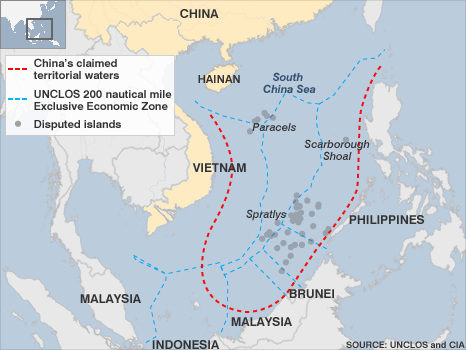
If you weren’t aware of it, I will try to update you on a little-known fact that has, strangely enough, avoided much media attention, crowded out by “You didn’t build that” and most recently the “47%.” Right now the second- and third-largest economies in the world, Japan and China, are engaged in a territorial dispute that has a significant probability of getting worse before it gets better. They are fighting over a seemingly worthless rock formation in the South China Sea (the same one that figured in the 2010 fishing boat incident, if you remember).

The Senkaku (Japan), Diaoyu (China), or Tiaoyutai (Taiwan) islands

So why are they fighting about these seemingly worthless rocks? Most of you probably know the answer: potential mineral and hydrocarbon resources that exist in the area, as well as fishing rights. Both countries are signatories to the UNCLOS, or in plain-speak “Law of the Sea,” which stipulates that any state might claim an Exclusive Economic Zone (EEZ) 200 nautical miles (nm) out to sea. Inhabitable islands have the right to claim this as well; however, the above island should by all rights be classified as an uninhabitable rock, reducing its ability to claim significant surrounding space. China does not take this stance. (I will return to talk about UNCLOS in other posts, specifically why the U.S. has not signed it.)

In other words, this rock is not worthless. It is potentially more expensive per gram/ounce than had it been made out of pure gold! Prove that it is inhabitable and you win the jackpot.

So the rock formation has become the center of attention for world power politics and is a likely stage for many future skirmishes and standoffs. Especially taking into account China’s current build-up of naval capabilities coupled with its claim (see below) to basically the entire contested area, the entire region is slightly worried. Leon Panetta, the US Defense Secretary, is in the region to continue talks on a regional ballistic missile system that will protect Japan from attacks by North Korea, but as we can all see from the timing it will probably serve a dual purpose. China’s response was to launch a major naval exercise involving around 40 missiles.

No one knows how much oil or gas exists in the South China Sea as no exploration data exists (only estimations). The estimations of oil resources have ranged between ~20bn barrels and ~200 barrels, and gas reserves are said to be around 900tcf (trillion cubic feet). For those of you that have a hard time putting the numbers in perspective, the U.S., which is the 3rd-largest oil producer in the world, has between 22-30bn barrels of P90 (90% probability) oil reserves. And Qatar, which has the 3rd-largest gas reserves, has 884tcf. How much exists around this specific rock formation is unknown.

Soledad O’Brien is a truth vigilante

Jay Rosen noted an encouraging development from CNN’s Soledad O’Brien, seen below (on Monday’s show) challenging reigning Republican doofus (and U.S. Representative from New York) Peter King on his “Obama’s apology tour” lies.

O’Brien is on somewhat of a roll, as she managed to reduce another Romney surrogate to flailing ad hominem attacks last month when his “reality” simply refused to match up with, well, Reality’s reality.

This is exactly the type of journalism we need to see more often if the infamous “post-truth” trend in American campaign seasons is to be stopped. It’s going to take aggressive but fair questioning, backed with judiciously researched data and facts. And it’s going to require a journalistic courage not to back down in the face of screaming old white men (or black men, or white women, or anyone else).

Over time, these confrontations could even become less necessary as campaigns readjust, knowing they won’t get away with telling lies on a national TV channel devoted to journalism. It goes without saying that journalists must be aggressive with lies told by both sides, but it doesn’t take a Ph.D. in political science to see that the vast majority of bald-faced lies, distortions, and half-truths is coming from the right wing these days. It’s time to remind them we’re not all as stupid as they clearly think we are.