All posts by Jay Pinho

About Jay Pinho

Jay is a data journalist and political junkie. He currently writes about domestic politics, foreign affairs, and journalism and continues to make painstakingly slow progress in amateur photography. He would very much like you to check out SCOTUSMap.com and SCOTUSSearch.com if you have the chance.

#31: One Day

Serves me right for taking the existence of a New York Times book review as an affirmation of the author’s grasp on plot. Or, for that matter, the English language. David Nicholls’ One Day was so clearly written with the inevitable feature-film in mind that I’m genuinely perplexed as to why he didn’t save himself some time and pen it in screenplay format from the start.
Never mind. He already did. It hits theaters next year, with Anne Hathaway starring. But back to the Times review. Liesl Schillinger wrote, “You may want to take care where you lay this book down,” ostensibly to avoid being burglarized, although I can hardly imagine why anyone would risk incarceration for such a microscopic reward.

Nicholls’ style of choice is italics, as in, “…and a silence followed while both of them thought oh God, oh God, oh God, oh God.” In this case the exaggerated emotions were owed to the tingling sensation reverberating down Emma Morley’s spine as Dexter Mayhew rubbed suntan lotion onto her back. Fittingly enough, I was spouting similar mental interjections by the time I reached chapter three of One Day — only in agony, not ecstasy. This overt sexual tension, by the way, is a prominent motif in Nicholls’ novel, which is always a bad sign, as are the expository thought-bubbles muddying the action everywhere. It’s as if the author couldn’t formulate a vehicle for conveying his creations’ intentions without spelling them out in their entirety.

Unfortunately for his readers, Nicholls’ characters do quite a lot of thinking — 435 pages of it, in fact, interspersed with the requisite bursts of campy dialogue. Come to think of it, One Day could spawn some terrific drinking games. For example, take a shot every time you read “Dex and Em, Em and Dex” — a tired literary trope that, according to Google Books, David Nicholls trotted out five times. It’s almost as if he is trying to tell us something, that fox.

On the bright side, one need never fear having neglected to catch some symbolism here or conceit there: One Day hardly traffics in ambiguity. It goes without saying — perhaps the only case in which Nicholls recognizes the value of omission — that Dexter and Emma are meant to be together. Consequently, there is a definite sense that their eventual conjoining is a matter of “when,” and not “if.” Subtlety, in One Day, entails merely implying, instead of actually describing, what takes place once two lovers remove some clothing and climb into bed together. Actually — “his hand was on the base of her spine, his leg slipping between hers,” I read on page 7 — even this is a bit generous.

But first, the requisite false hopes, punctured dreams, and the like. As this is a romantic comedy in book form, both Dexter and Emma must date their fair share of red herrings. And thus Chapter Twelve opens: “Then, without quite knowing how it happened, Dexter finds that he has fallen in love, and suddenly life is one long mini-break.” Her name is Sylvie and, in Dexter’s smitten vocabulary, “she is great, just great, just…amazing! She is beautiful of course, but in a different way from the others…” And here I will spare you the rest, for the sake of brevity and the prevention of mental decay.

Of course, Emma needs a worthwhile distraction to pass the time while Dexter dates his procession of disreputable women. To this end, she meets Ian at the restaurant where she works, Loco Caliente, and is beset with the vague notion that his is “a face that made her think of tractors.” No explanation is supplied or, frankly, possible. Nicholls alternates buoyantly between bountiful exclamations on one page and perplexing similes on another; gradually, all words lose their meaning, buried under a cascade of childlike emotion punctuated by frequent bouts of excessive capitalization.

It is said that movies are almost universally poor representations of the books from which they were adapted. For the sake of future moviegoers everywhere, I sincerely hope David Nicholls is a better screenwriter than novelist.

#30: The Ghosts of Martyrs Square

In my junior year of college, I spent a semester studying in the Middle East. My program was based in Cairo but we traveled throughout the region. By the end of the spring, we’d made it to Turkey, Syria, Jordan, and Israel. Even so, if I could change any one aspect of that semester, it would be to visit Lebanon.

As detailed in Michael Young’s The Ghosts of Martyrs Square: An Eyewitness Account of Lebanon’s Life Struggle, the nation has an irregular heartbeat and constantly appears under threat of cardiac arrest. And yet somehow, democracy, or some semblance of it, insists on habitual self-resurrection in the area of the world seemingly most hostile to the democratizing impulse. History and the present, the liberal and the traditional, even the nation’s dual languages, Arabic and French, serve as constant reminders of democracy’s promise in a culturally diverse populace. Young, in recounting Lebanon’s recent history (2005-present), writes, “What makes Lebanon relatively free in an unfree Middle East is that the country’s sectarian system, its faults notwithstanding, has ensured that the society’s parts are stronger than the state; and where the state is weak, individuals are usually freer to function.”

In this interpretation, the same national character that so infuriates international observers is actually responsible for Lebanon’s fragile peace. As the Sunnis bedevil the Shiites, the Christians ally themselves with the power of the moment, and the Druze follow suit, the collective political incoherence renders centralized governing nearly impossible.

Not that Syria didn’t give it the old college try. On February 14, 2005, former Lebanese prime minister Rafiq al-Hariri was assassinated via a truck-bomb in Beirut. The Syrians were widely viewed as the perpetrators, and thus was launched the Cedar Revolution, a series of protests against Syrian intervention that eventually led to its expulsion from Lebanon.

This is, roughly, where Michael Young’s national history begins. He recounts how, merely one year after the impossible became reality as Syria left Lebanon, the war with Israel threatened to reverse the year of progress; Hezbollah, acting in compliance with its Syrian and Iranian patrons, destabilized a country still reeling in the aftermath of al-Hariri’s untimely death. Interestingly, Young takes this opportunity to chide progressive Western journalists and observers for their embrace, however tentative, of the self-described Party of God: “Lebanon loved the resistance, the statistics proved it, and the good word was beamed out to an unquestioning world,” he writes, sarcastically describing the West’s perception of Hezbollah’s domestic standing during the 2006 war against Israel.

Young can be forgiven his zeal; as a Lebanese citizen he is justifiably nonplussed by incomplete international characterizations of his country. And yet, like many journalists dipping their toes into full-length books, he proffers a smorgasbord of ideas and counterpoints without progressing between themes in a cohesive manner. At times, The Ghosts of Martyrs Square reads like a 254-page op-ed column; I suppose that’s the point. But in regards to this country that defies all description, I was hoping for a little less theorizing and a little more substance.

#29: Tinkers

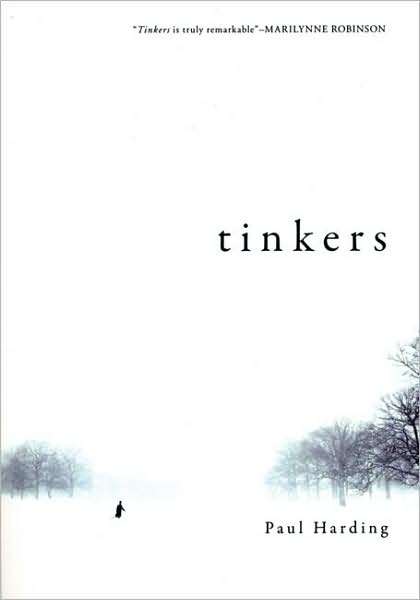
Tinkers gave me pause as to judging a book by its awards. My edition of Paul Harding’s short novel, his first, sports a “Winner of the Pulitzer Prize” label on the front cover; I will think twice before purchasing a book based solely on such public acclaim.

This book is a classic example of the type of writing that one either embraces or shrugs at, likely with little gray area comprising the remainder. Harding has a way with words, and particularly with describing intricate details of pedestrian items. “The hair on my neck prickled from nape to crown, as if a current were passing through it, and as the current leapt off of the top of my head and if I had my back to the trees, I would feel the actual wind start up the back of my neck and ruffle my hair and the water and the grass and spin the swallows in its choral voice stirring all of the old unnamable sorrows in our throats, where our voices caught and failed on the scales of the old forgotten songs.”

If you’re thinking this sounds like another recent Pulitzer Prize winner, Cormac McCarthy, it’s because it does. In All the Pretty Horses and The Road, McCarthy takes special delight in the bending of the grass, the hue of the twilight sky, and the trembling manes of all those pretty horses. Harding follows suit here, although to his credit he hasn’t entirely neglected his punctuation or the rules of grammar in the process.

In this case, as in The Road, the central relationship is that between a father and son, although this, for the most part, is where the similarities end. Tinkers is less apocalyptic than introspective, and its setting is as mundane as The Road‘s is grandiose. Beginning with the simple sentence, “George Washington Crosby began to hallucinate eight days before he died,” Harding paints a dreary image of creeping death, interspersed with winding memories of a childhood past. As George drifts in and out of consciousness, it is his father he recalls: Howard, a man tortured by sudden seizures, who, after years of indignity and humiliation, walks away from his family for Philadelphia, and a new start.

Paradoxically, while Harding takes special care to paint elaborate portrayals of material items, it is the conspicuous absence of explicitly denoted thoughts that affords the understated Tinkers its emotive impact. However, the plodding cadence of the writing gradually renders the novel viscerally unappealing. Perhaps this is to be expected of a book whose main character specializes in repairing clocks: the tick-tock of passing time is more celebrated here than dreaded. But as it pertains to reading a novel, award-winning or otherwise, I prefer my time to fly by unnoticed.

#28: The Lotus Eaters

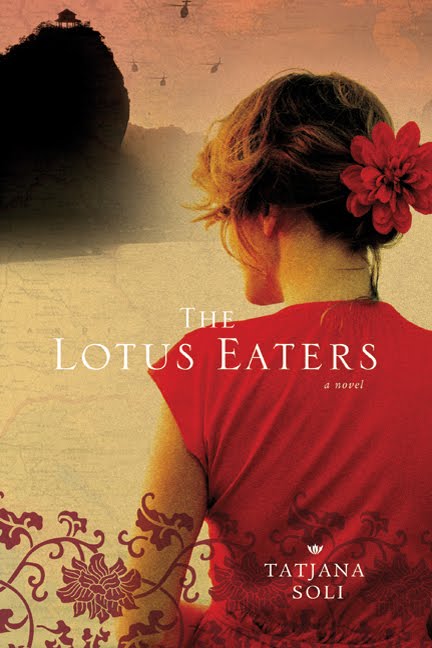
The Lotus Eaters is Tatjana Soli’s first novel, but you wouldn’t know that from reading it. Much like her protagonist, the American photojournalist Helen Adams, Soli possesses a rare survival instinct in perhaps the only area as treacherous as Vietnam in the 1970s: the world of publishing in the digital age. For the most part, she even manages to steer clear of the worst authorial minefields — there’s little in the way of deus ex machinas here — a feat made all the more impressive by the pervasive cliches endemic to war novels.

It is not just Soli that deftly avoids danger. Her creations do much the same. Adams, her colleague and lover, Linh, and even, well, her other colleague and lover, Sam Darrow, specialize as much in danger as they do in photography, a fact that hardly goes unnoticed by any of them. “We’re in the business of war,” Darrow boasts at a dinner of photojournalists one night. “The cool thing for us is that when this one’s done, there’s always another one…The war doesn’t ever have to end for us.”

And, mostly, it does not. The country and the war, working in tandem, swallow up countless people; they are all Vietnam’s involuntary subjects, even as they struggle to maintain the rapidly disintegrating notion of self-determination. At the end, as Saigon fell to the Viet Cong, the pungent odor of finality was more terrifying to Adams than the inexorable violence itself: “Ten years ago it had seemed the war would never end, and now all she could think was, More time, give us more time.”

The conflict’s pornographic hold on Adams was but a reflection of the same transformation, years before, in Darrow. “Welcome to our splendid little war,” he had said upon meeting Adams, but by then he had long since forfeited the right to use the possessive to describe a force that so clearly controlled him. His obsession with the perfect shot — shooting for hours in blazing heat, or wandering, seemingly oblivious, into the line of fire with camera in tow — became an all-consuming object. With his biological family back home relegated to a bit role, Darrow found camaraderie and even intimacy in the words and passions of people who, if not inheriting his fate, at least shared his proximity to history.

Helen Adams was just such a person. As a female war correspondent, with each word and action eliciting a close scrutiny to which her male counterparts were never subjected, she found herself simultaneously navigating the darkest recesses of human destruction and repeatedly proving her mettle in a man’s world. Eventually, with the North Vietnamese closing in, these two paths coalesce in increasingly desperate attempts to satisfy the addiction to violence, even as its manifestation spills over the nation’s borders into Cambodia. For Helen, as for Darrow and Linh, war was an end unto itself. “‘The good ol’ days are gone,'” a soldier tells her, just two months after she arrives in Vietnam. But it was not until the war’s waning moments an eternity later, with those “good ol’ days” tucked well into the past, that the wreckage of this incomprehensible human tragedy reached its long-awaited hour of reflection.

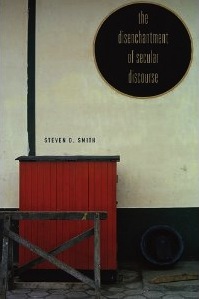
#27: The Disenchantment of Secular Discourse

In The Disenchantment of Secular Discourse, author Steven D. Smith discusses a practice he dubs “smuggling.” He explains the term thusly: “Our modern secular vocabulary purports to render inadmissible notions such as those that animated premodern moral discourse…But if our deepest convictions rely on such notions, and if these convictions lose their sense and substance when divorced from such notions, then perhaps we have little choice except to smuggle such notions in the conversation — to introduce them incognito under some sort of secular disguise.”

Smith then purports to debunk classic modern examples of jurisprudence or governing philosophy as embodying just this sort of intellectual hijacking, or smuggling. Stating that “conversations in the secular cage could not proceed very far without smuggling,” Smith then attempts to display how these logical implications play out in real-life applications.

Shining an inquisitive light on some of our more revered (e.g. the harm principle) and controversial (e.g. end-of-life decisions) principles, Smith works to show the ways in which their public expression has been abbreviated by the conspicuous lack of transcendental foundations (be they religiously based or otherwise). Unfortunately, while these embodiments of his theory are convincing at times, Smith is noticeably reticent to provide any neat solutions. In the book’s last paragraph, he alludes to their absence, writing, “And so, in the end, it seems that the only general prescription that can be offered is, once again, the seemingly bland recommendation of…openness.”

Openness in the lexicon of Smith means to allow those “inadmissible notions” to join their logical conclusions in the realm of public dialogue. However, even as he argues for their inclusion, he appears reluctant to embrace this broader conversation wholeheartedly. “There is a risk that a more open conversation may be acrimonious,” Smith acknowledges. “Even so, that sort of conversation is ultimately more respectful of the participants. More respectful and also, potentially, more productive and substantial: that is because we will be talking about what we really believe.”

Whether Smith is right remains to be seen. The left and the right appear to be diverging more quickly now than ever before, and this political dichotomy is only one of many fault lines dotting the mottled landscape of public conversation. Openness as a societal antibiotic, or as an unnecessarily opened can of worms? Let the debate begin, Smith would say, but at the very least let us be honest about how we choose our sides.

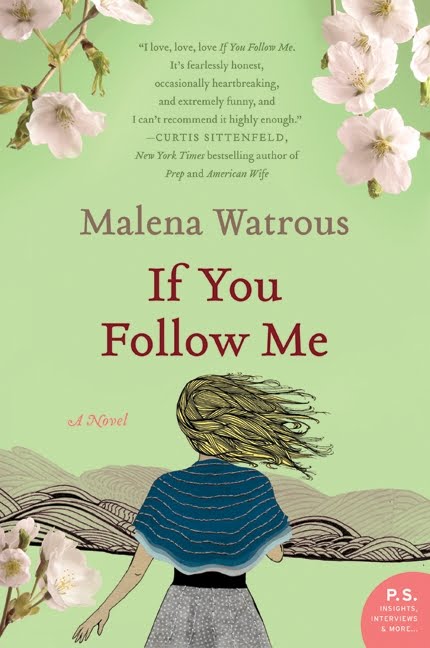
#26: If You Follow Me

There’s plenty of internalizing taking place within the pages of Malena Watrous’ If You Follow Me. Some of it is explicit, and at other times implied. But it’s always there, lurking beneath the placid surface. If this is already starting to sound like a lifeless addition to the all-is-not-bliss-in-domestic-paradise genre, take a deeper look. In fact, all is not bliss here either — the rare worthwhile novel is — but the cast, a twenty-something lesbian couple, and the setting, rural Japan, help Watrous avoid fiction’s most egregious cliches.

Marina is a twenty-something recent wanderer who, on something suspiciously like a lark, decided to follow her lover to East Asia for a year of teaching abroad. Her father’s suicide, looming like an omnipresent monster in her recent past, was the catalyst that brought her and Carolyn together: they met in a bereavement group during senior year in college, where Marina mentally characterized her soon-to-be girlfriend as “tough and spiky, with a rod in her tongue and buzzed hair that moved through a Kool-Aid spectrum.” Carolyn, for her part, was still grieving her loss, at age twelve, of her mother to cancer, and had been attending the bereavement group since freshman year.

The two were an unlikely pair to begin with; a year of living abroad together, then, was a monumental risk. And yet, Marina remembers, “when she asked if I’d consider moving to Japan with her, I didn’t hesitate before saying yes…I couldn’t go back to San Francisco,” with all its childhood memories of her fading father and the stark reality of a mother trying desperately to move on.

Marina’s sojourn in Japan is kicked off with a letter from her mentor, Hiroshi Miyoshi, a native son who has been handed the unfortunate task of keeping a close eye on the two Americans and facilitating their acclimation to Japanese social mores. Succumbing to bouts of self-consciousness, Miyoshi prefers to communicate disapproval of Marina’s (frequent and unintentional) breaches of etiquette through handwritten letters written in rudimentary English; these missives provide the bulk of the laughs in what is often a deeply introspective story.

Miyoshi’s inaugural letter scolds Marina on her ignorance of “gomi law,” that maddeningly esoteric set of rules governing trash disposal. “Dear Miss Marina how are you? I’m fine thank you. A reason for this letter is: recently you attempt to throw away battery and jar and some kind of mushroom spaghetti and so forth, all together in one bin. Please don’t try ‘it wasn’t me.’ We Japanese seldom eat  Gorgonzola cheese!”

Time passes. The clock ticks and tocks. First, there is Marina and Carolyn fighting. Then there is Joe, a cheeky British fellow and the only person in Japan who knows that his two female acquaintances are not just friends, but intimate as well. Throw in a minor television celebrity, a unique cast of small-town Japanese friends (notably Noriko and Keiko), and a shifting relationship with Miyoshi, and one can see that Marina is due for some noticeable life changes.

What those changes entail impacts different people in different ways. Some of these changes are gradual, and others more sudden. Frustratingly, many of them fail to grab the reader’s attention (at least mine) and hold it for the time necessary to make these metamorphoses feel significant. It is not so much that If You Follow Me is not a tale worth reading, but one gets the sense that it could have been shortened without much loss. Malena Watrous hits high marks for complexity, but mostly forgets the value of brevity.

Subway culture and the panhandler

I lived for nine years in Boston, Massachusetts. It is a town of crooked one-way streets, Irish bars, and, perhaps most ubiquitously, innumerable homeless people. Living in and amongst those same streets and watering holes, Boston’s displaced roam freely, their casual insouciance unperturbed by the occasional disapproving policeman or irritable bench neighbor. The city, while perhaps not embracing them, at least affords them a generous measure of nomadic self-determination, and for that reason Boston remains a favorite sanctuary for the housing-challenged.

This is not to say these hardy men and women are without want. When their cash flow devolves into a steady trickle downstream, our homeless friends take to the subway — the T, as it is known — and, in the spirit of of the First Amendment, brazenly wield their vocal chords to great effect in pursuit of, if not happiness itself, its closest approximation as embodied by a fast-food meal or a bottle of Jim Beam. This commonly takes the form of a bleating voice in which the plaintive tones of defeat can clearly be heard: “Can you spare some change?”

It is more a statement than a question, even as its last syllable hangs desperately in the air, an unresolved dissonance calling for resolution. The sincerity is as evident as the tact is lacking: money is needed. Whether for drugs or food, alcohol or medicine, we neither know nor care; they are here, among us, and the choice is ours. We toss a bill or two their way, or we do not. We look away, avert our eyes. We do not remember them, nor they us; strangers passing in the night, all.

New York’s subway system is home to investment bankers, Mexican accordion players, and apathetic Upper West Siders. Broadway houses the nation’s finest productions, but the real theater, unfolding in stuttered moments, performs for free somewhere between 96th Street and Park Place on the 2 line. Here the homeless traipse through subway cars, plying their craft as they wedge their way through the tired ranks of the gainfully employed.

The last time I shared a New York subway car with a panhandler, I felt as if I were listening to a sales pitch. I was. While a bit melodramatic for my taste, one cannot argue with the $2.25 price of admission. Words such as “interim” and “requisite” filled the air, as New Yorkers turned back to their New Yorker in silence. One is constantly under the impression of having seen this particular solicitor before, perhaps on the same train line. The pleas for money are theatrical (and thus memorable), recalling a failed actor blandly reciting lines that have long since lost all meaning. They inevitably begin with some variation of “I’m sorry, and I don’t mean to disturb you,” but of course they do. Trust has left the building, or at the very least the subway car, and empathy along with it. I do not drop money into the hat.

I’m not sure why Boston and New York diverge in this way, nor will I ever, most likely. It is merely one of the myriad aspects in which the compressed millions that comprise our modern cities coalesce into collective entities of their own. Somehow, these cities of random individuals gain distinctive, differentiated, holistic identities; somehow homeless culture becomes but one among countless mirrors reflecting these. Personally, I can respect the Bostonian directness, a challenge to the general public to lend a helping hand. I feel no such affinity for the New Yorker, who, borrowing the cadence of a stage voice and the persuasive technique of a politician, alienates me before completing a sentence. Like everything related to Boston and New York (especially as felt by a Bostonian), one of the two must be superior. Somewhere, a master panhandler is crafting the perfect pitch, and waiting for its debut in the city.

The midpoint recap

Twenty-five books down, twenty-five to go. (This excludes the two bonuses: xkcd and The Bro Code.) Right now I’m a little ahead of schedule but my pace is slowing, so the second half of the year will be interesting. I’m having nightmares about hunkering down in a dank basement, reading some horribly written novel, while the rest of the world celebrates New Year’s Eve. I’m determined not to let this happen. Finished by Christmas would be nice.

Anyway, since halfway point summaries (or retrospectives, or recaps) seem to work so well for sports seasons (e.g. the All-Star break report cards that always have baseball journalists salivating), I suppose it’s worth a try on a book blog, too. So without further ado, here are my thoughts on the first half of book-worming, 2010-style.

But first, some stats (in keeping with my love of baseball, of course). Leading off, my gender ratio was a bit lopsided: nineteen books written by men, and only six by women. The writers’ nationalities tell a similar story: eighteen Americans and seven of everyone else (only one nation, Great Britain, had multiple authors, with two). Fifteen books fell into the non-fiction category, with ten in fiction. All but four books were published in 2007 or later. Three books were under 200 pages, fifteen were between 200 and 300, five were between 300 and 400, and two were over 400 pages. In summary, the average book was a non-fiction work spanning 274 pages, published in 2008, and authored by an American male. (My girlfriend has ever so gently reminded me to include more women and authors of color in the second half; luckily for me, her English literature degree is, contrary to her lamentations, quite relevant when it comes time for book recommendations.)

And now, onto the 50BF2010 awards:

Best Non-Fiction Book: The Big Short, by Michael Lewis

When I reviewed The Big Short on April 18, I described it as a “very, very entertaining book.” Relative to the seven books I’ve read since then, this has only become even truer. This is not due to any shortcomings of those books as much as it is a further ringing endorsement of The Big Short. Michael Lewis takes an incredibly complex and arcane set of circumstances and transforms it into a suspenseful narrative with an uncomfortably ambiguous approach to morality. (Were his characters the good guys, or villains? I think it’s a bit of both.) His insider story of the outsiders who prophesied the coming Great Recession is almost beyond belief; but then, never more so than the financial collapse itself, which Lewis captures vividly with intimate portraits of the people who, after watching in shock as it unfolded, proceeded to cash in on the subsequent implosion. Most of the time I feel ambivalent about the term “must-read;” but if ever the expression had an appropriate usage, The Big Short undoubtedly qualifies.

Honorable mention: SuperFreakonomics, by Steven Levitt and Stephen Dubner; and Freefall, by Joseph Stiglitz

Best Fiction Book: The Dream Life of Sukhanov, by Olga Grushin

This story, of a Soviet art critic whose fragile political stature is threatened by the dawn of glasnost, is a delicately woven tale of the zeitgeist of the U.S.S.R. in the 1980s, and a brilliant depiction of one man’s struggle with self-identity in the face of previously unimaginable national transformation. Anatoly Pavlovich Sukhanov’s sojourns through his past and present gradually coalesce into one time-blurred journey, with surrealism as both its guide and genre, realism as its omnipresent companion, and metamorphosis as the destination. That Olga Grushin managed to pen this novel in a non-native tongue is a testament to the boundless nature of her literary imagination, and an apt metaphor for Sukhanov’s own disorientation in a world not his own.

Honorable mention: The Disappeared, by Kim Echlin; and The Informers, by Juan Gabriel Vásquez

Worst Non-Fiction Book: Reality Hunger, by David Shields

It’s officially filed under “Literary Criticism,” according to its ISBN categorization. But I remain unconvinced that Reality Hunger is actually anything of the sort, and even less so that it amounts to much more than self-aggrandizement. David Shields opens his book with epigraphs by Picasso, Walter Benjamin, and Graham Greene, and then proceeds, for the next 205 pages, to steal and plunder from authors, thinkers, and entertainers both near and far, past and present. The intention, he implies, is to revolutionize the commonly held platitudes that have defined and separated the worlds of fiction and non-fiction and, in the meantime, to decimate international standards of intellectual property rights. Why this is so urgent is never made entirely clear. To be fair, it is difficult to concoct a cogent argument out of 618 literary scraps from authors who, strangely enough, write their own material. But this is no deterrent to the inexorable Shields, whose campaign to throw open the doors to appropriation of others’ creativity fails to appreciate the very real line between ideas and their expression. His literary remix, unsurprisingly, dissolves into cognitive dissonance.

Dishonorable mention: The Flight of the Intellectuals, by Paul Berman; and The Orchid Thief, by Susan Orlean

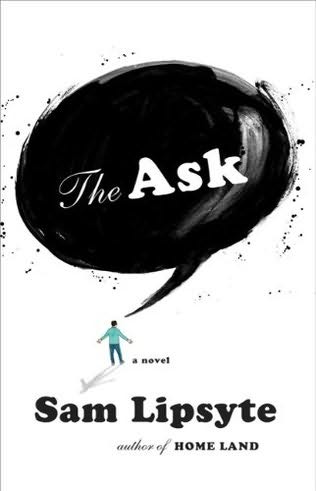
Worst Fiction Book: The Ask, by Sam Lipsyte

Q: What do you get when you start with a disenchanted development officer, add in a newly rediscovered friendship with an old college buddy, and, for good measure, throw in a subplot involving his wife’s potential infidelity?

A: A terrible novel. One online reviewer noted, with a beautiful sense of irony, a bit of dialogue late in the book in which Milo, the book’s utterly forgettable antihero, asks a colleague, “…If I were the protagonist of a book or a movie, it would be hard to like me, to identify with me, right?” Her reply: “I would never read a book like that, Milo. I can’t think of anyone who would.” Well said. It seemed as if author Sam Lipsyte neglected to decide whether he was writing comedy or tragedy until, at the end, he eventually gave up and decided, rather arbitrarily, to stop writing. Fortunately, it was as good a point as any to stop reading.

Dishonorable mention: Family Album, by Penelope Lively

Onward march to the next twenty-five!

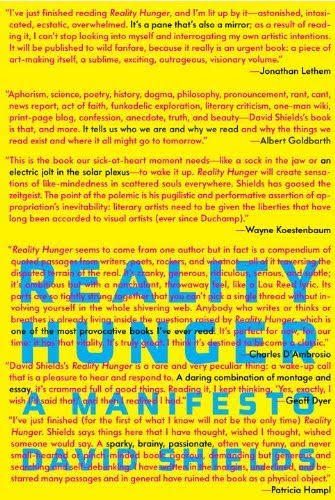
#25: Reality Hunger

I really need to stop reading manifestos. First it was The Communist Manifesto. Then, earlier this year, it was You Are Not a Gadget: A Manifesto, by Jaron Lanier. “Workers of the world, unite!” yielded to much ado about the “hive mind.” Like any manifesto, both were distinctly aware of their characterization as such; hence, the grandiose language and sweeping world vision. (I suppose Karl Marx’s received a bit more attention than Jaron Lanier’s, however.)

Reality Hunger: A Manifesto, by virtue of its self-descriptive subtitle, belongs to this same (decreasingly exclusive) club. However, David Shields, whose other books have titles like The Thing About Life Is That One Day You’ll Be Dead, hardly looks like a kindred spirit of the communist revolutionary or the cautious Internet pioneer (based on his photograph on the book’s back flap, at least). The bald and bespectacled author appears better suited for a dignified study of poetry, or perhaps as a caption writer for a nature-themed daily calendar.

Neither of these subjects is what Shields is interested in writing about, however. In what the author describes as “twenty-six chapters; 618 mini-sections,” a case is made for an emerging writing form. “An artistic movement, albeit an organic and as-yet-unstated one, is forming,” Shields writes. “What are its key components? A deliberate unartiness: ‘raw’ material, seemingly unprocessed, unfiltered, uncensored, and unprofessional.”

Or did Shields actually write this? Aha, he would reply, but that’s just the point: who cares? Each of these hundreds of fragmentary “mini-sections” operates as a unique thought, yet also as an integral part of the whole. What if section three were written by David Shields? Or what if it were David Mamet, or David Carr, or David Markson (all of whom are also quoted in Reality Hunger)? Does knowing the identity of the author — or, for that matter, evaluating the authenticity of the text itself — alter the experience of reading the work? And if so, is this for the better or the worse? In short, why the big fuss over intellectual property?

Well, for one, most writers struggle to scrape together the requisite means to make a living out of their dreams. When someone else comes along and irreverently plucks a quote here and a passage there wholesale, a drop in royalties is the result. This would appear to be an understandable reason for approximately 618 authors, speakers, and public figures to be very angry with David Shields. Thanks to the lawyers at Random House, however, the author was generously spared this fate. Lamenting the loss of a “freedom that writers from Montaigne to Burroughs took for granted,” Shields explains, in a brief note following the main text, that his publisher’s dutiful attorneys “determined that it was necessary for me to provide a complete list of citations,” but that readers may easily “restore this book to the form in which I intended it to be read” by cutting out these very citations with a pair of scissors.

“Reality cannot be copyrighted,” Shields declares. He is right, it cannot; but its various expressions can, and do, warrant legal protection. The author, in an online defense of his book, claims that “numerous bloggers appear to think I’m the anti-Christ because I don’t genuflect at the twin altars of the novel and intellectual property.” But I suspect theirs is merely a case of disenchantment, not stupefaction. The starving masses may be hungering for reality, but it is doubtful that a hardcover compendium of reprocessed ideas will provide the necessary protein. The last sentence of Reality Hunger reads, “Stop; don’t read any farther.” I’m assuming it was David Shields who wrote this line; regardless of the author, this advice would have been far more useful in the book’s earlier pages. Even reality hunger disappears when confronted with enough junk food.

#24: The Flight of the Intellectuals

In March 2009, Paul Berman sat down for an interview with Z Word, a self-described “editorially independent” project of the American Jewish Committee. Topics discussed included the recent Israeli invasion of Gaza and Berman’s thoughts on President Barack Obama’s track record in his first few months in office. In regards to the latter, Berman stated, “I’m enthused by Obama. And, in my enthusiasm, I find myself thinking: this election has been the most inspiring event in American history.”

These are unsurprising words, spoken as they were by a leftist writer. And yet they are key, I think, to uncovering one of the major errors Berman makes in his latest book, The Flight of the Intellectuals, which hit bookstores just over a month ago. To understand what Berman’s comment illustrates about the weaknesses in his own writings, it is necessary to revisit a rather notorious episode in Barack Obama’s presidential campaign.

As inevitably befalls every presidential candidate at some point, Obama fell victim to the occasional campaign gaffe (though he had fewer than most). Most notable among these blips was the Reverend Jeremiah Wright imbroglio. The president’s former pastor, in various comments and sermons, referred to the September 11 attacks as “America’s chickens…coming home to roost” and, during the course of an anti-government rant, proclaimed, “God damn America — that’s in the Bible — for killing innocent people. God damn America, for treating our citizens as less than human. God damn America, as long as she tries to act like she is God, and she is supreme.”

Initially, while repudiating Wright’s most politically dangerous stances, Obama refused to entirely abandon the pastor, arguing that “it’s as if we took the five dumbest things that I ever said or you ever said…in our lives and compressed them, and put them out there, you know, I think that people’s reaction would be understandably upset.” Later, after Obama had further distanced himself from the pastor, Wright was quoted by the Daily Press castigating the White House staff for preventing him from contacting the president: “Them Jews ain’t going to let him talk to me.” In the same interview he commented on the perceived influence of the American Israel Public Affairs Committee (AIPAC), a prominent Jewish lobbying organization, over Obama’s public stances, saying, “Ethnic cleansing is going on in Gaza. Ethnic cleansing (by) the Zionist is a sin and a crime against humanity, and they don’t want Barack talking like that because that’s anti-Israel.” Obama once again publicly rejected Wright’s inflammatory statements, this time with more severity: “[Reverend Wright’s comments] certainly don’t portray accurately my values and beliefs. And if Reverend Wright thinks that that’s political posturing, as he put it, then he doesn’t know me very well.”

And yet therein lay the problem: Wright did know Obama, and quite well, in fact. They had been friends, or at the very least acquaintances, since meeting in 1985 — a moment Obama described in his memoir, Dreams from My Father. In that same book, Obama fondly recalls a sermon in which Wright proclaimed, “It is this world…where white folks’ greed runs a world in need, apartheid in one hemisphere, apathy in another hemisphere…That’s the world!” (Obama titled his later, more famous, book, The Audacity of Hope, after a sermon delivered by the reverend.) The pastor had performed Barack and Michelle Obama’s marriage and their children’s baptisms, and the Obamas were members of his church. According to the Chicago Tribune, as recently as 2007, Obama said of Wright, “He’s…a sounding board for me to make sure that I am speaking as truthfully about what I believe as possible and that I’m not losing myself in some of the hype and hoopla and stress that’s involved in national politics.” In short, Wright was as much Barack Obama’s mentor and friend as he was his pastor.

Why does this matter? Or why, furthermore, do the forty-fourth president’s (very thin) ties to William Ayers, co-founder of the violent Weather Underground, matter? The answer, for many (though not all) rational observers, is that they do not. Barack Obama’s firm disavowal of their radical ideas and even, at times, the very people espousing them obviated the need for concern as to his own ideology. Since taking office, Obama’s decisions could be criticized (or defended) on a variety of fronts, but few would seriously argue that his policies reflect radical or racist beliefs.

Given Paul Berman’s own unequivocal enthusiasm for Barack Obama, it would seem clear that the Terror and Liberalism author understands this principle well. And yet he just as easily discards it when confronting the personage, and persona, of Muslim intellectual Tariq Ramadan. The Flight of the Intellectuals is, in essence, a 299-page crusade (and I do not use this word lightly) against a man that many consider a symbol of the future of moderate Islam.

As a disclaimer, I admit that, prior to reading Berman’s book, I knew nothing of Tariq Ramadan. I am thus unqualified to debate most finer points of substantive critiques of his ideology. Instead, I take issue with Paul Berman’s methodology. The Flight of the Intellectuals circumscribes, with lengthy digressions liberally scattered, a single feature article on Tariq Ramadan, written in 2007 by Dutch journalist Ian Buruma for The New York Times Magazine. From the outset of Berman’s book, it became readily apparent that generous assumptions and tenuous affiliations would happily substitute for logical proof of wrongdoing. Even before the end of the first chapter, Berman had already stated, curiously, “It is not obvious to me that Buruma…had read very much by Ramadan, nor that [Stéphanie Giry, who favorably reviewed a Ramadan book]…had read more than a single book, though she had met the man. As for Garton Ash [who wrote positively of Ramadan], he intimated…that he based his estimation of Ramadan on having heard him speak at Oxford, where Garton Ash and Ramadan have been colleagues — which suggests that Garton Ash may have read nothing at all.”

My initial reaction, having also previously read nothing by Paul Berman, was surprise at what seemed to me an illogical progression. A journalist who had worked alongside Ramadan and praised him in writing was unlikely to have read any of the latter man’s books? This, however, was merely the first volley in a prolonged onslaught of perplexing statements by Berman, who is either incapable of or disinterested in producing anything other than circumstantial evidence incriminating Ramadan as a dangerous radical. Just pages after his bizarre comments on Buruma, Giry, and Ash, Berman launched into a history of Hassan al-Banna, Ramadan’s grandfather and the Egyptian founder of the Muslim Brotherhood, in which he emphasized his ties to the Palestinian, pro-Nazi Grand Mufti of Jerusalem, Haj Amin al-Husseini. Then, immediately segueing into an account of Ramadan’s doctoral dissertation on al-Banna, which only passed after a second review (the committee felt it was too obsequious to his grandfather), Berman implies that Ramadan’s thesis was unworthy of academic recognition, writing, “Even then, his thesis barely passed — accepted without honors. The dispute…was an academic quarrel, but also more than academic — a dispute, ultimately, over the meaning of al-Banna’s Islamic renewal movement in the past and its legacy for today.”

The next sentence states, simply, “I have not read Ramadan’s thesis.” Berman quickly follows up by announcing that he has, however, read one of Ramadan’s books, The Roots of the Muslim Renewal, which includes (in Berman’s estimation) a 200-page “gusher of adulation” for Hassan al-Banna. “Does the portrait of al-Banna in The Roots of the Muslim Renewal resemble in any significant way Ramadan’s university dissertation? Then I can understand why the academic committee would have balked.” Unfortunately for his readers, Berman failed to conduct this most basic tenet of research, consulting the text itself, to actually evaluate its objectivity.

Interspersed throughout Berman’s dissection of Tariq Ramadan are frequent history lessons on Hassan al-Banna, his ties to Haj Amin al-Husseini, al-Husseini’s ties to the Nazis, and so on. These forays are usually followed by an abrupt and unannounced return to a discussion of Ramadan in the present day. As a writer, Berman has to know that the effect of juxtaposing these journeys into the past against portrayals of Tariq Ramadan today is to implicitly link the Muslim intellectual to far more extremist Islamists of yore. And yet he does not caution against subconsciously drawing these connecting lines; instead he facilitates the practice by continually jumping back and forth, establishing a mental footpath that ever expands with each round trip between Tariq Ramadan of today and Hassan al-Banna and his Nazi sympathizers of the past.

One of Berman’s favorite contemporary targets is Yusuf al-Qaradawi, a Muslim sheikh and author whose works Ramadan frequently cites. Al-Qaradawi’s speeches on Al Jazeera TV are unapologetically political; unfortunately, they have also been known to be anti-Semitic. “Throughout history, Allah has imposed upon the [Jews] people who would punish them for their corruption,” al-Qaradawi declared early last year. “The last punishment was carried out by Hitler. By means of all the things he did to them — even though they exaggerated this issue — he managed to put them in their place.” Berman makes great hay of al-Qaradawi’s virulent racism in an attempt to portray Ramadan as in league with him. Ramadan himself, in a disturbing essay, once singled out several Jewish intellectuals (and one other besides, whom he mistakenly identified as Jewish) for what he deemed a heavily biased support of Israel. Aside from that uncharacteristic moment, however, Ramadan has made himself clear in regards to his own stance on anti-Semitism. In 2005, he wrote, “In the name of their faith and their conscience, Muslims must take a clear position so that a pernicious atmosphere does not take hold in the Western countries. Nothing in Islam can legitimize xenophobia or the rejection of a human being due to his/her religious creed or ethnicity. One must say unequivocally, with force, that anti-Semitism is unacceptable and indefensible.” 

Berman, undeterred, presses on. He lambasts Ramadan for downplaying or bypassing his grandfather’s unsavory contemporaries, as if by neglecting to detail every last particle of al-Banna’s transgressions, Ramadan himself is implicated in his ancestor’s sins. Berman also takes issue with Ramadan’s claim that al-Banna and Sayyid Qutb, the much more famous — and more radical — Muslim thinker, did not know each other, insinuating that this was merely semantics on Ramadan’s part; al-Banna’s assassination, Berman insists, “interrupted a developing mutual interest. It stands to reason that, but for the assassination, Qutb and al-Banna would have ended up comrades and, at least, acquaintances.” Strangely, Berman considers pure speculation a preferable alternative to stated fact, a tendency he exhibits throughout The Flight of the Intellectuals. 

This is where the lesson of Barack Obama and Reverend Jeremiah Wright comes into play. Paul Berman was somehow able to disregard decades of friendship between an anti-Semitic, politically radical minister and the future leader of the free world, based largely on public denunciations made (only reluctantly) by Obama. And yet Berman refuses to extend to Tariq Ramadan the same benefit of the doubt; “Ramadan worships Qaradawi,” he says. Pankaj Mishra, in the June 7 edition of The New Yorker, aptly captures the absurdity of Berman’s use of that verb, writing, “But Berman reads volumes into Ramadan’s silences and pursues him with inquisitorial zeal…He says that Ramadan not just ‘admires’ but ‘worships’ Qaradawi, although the citations of Ramadan that he produces to illustrate this claim reveal nothing more fervent than the standard lexicon of scholarly attribution.” 

In his desperate attempts to equate the beliefs of others to those of Tariq Ramadan, Paul Berman failed to notice his own inconsistencies. Guilt by affiliation cannot be applied randomly. If Ramadan’s “scholarly attribution” of Yusuf al-Qaradawi, as viewed through Berman’s prejudicial prism, constitutes “worship,” then certainly Barack Obama, who for years counted a racist and anti-American radical among his friends, is a dangerous subversive unfit to govern the United States. And Obama’s is only one saga among countless others, in which a prominent public figure is discovered to have had some connection or even friendship with unsavory individuals. It is not that these linkages should be ignored, but neither should they be perceived as all-encompassing indictments of one’s character.

And yet, incomprehensibly, Berman views Ramadan’s acquaintances as sufficient damning evidence of the intellectual’s innate radicalism. At times, Berman’s tone — which, though difficult to pin down, effectively hovers between academic and journalistic — betrays a callous distaste not only for Ramadan, but for a Muslim audience overall. In describing Ramadan’s biography of the Prophet Muhammad, Berman writes, “The Prophet himself is presented as a nice person. Muhammad adores his first wife: ‘He loved her so much.’ Also his other wives.” Elsewhere, in delineating Ramadan’s views on terrorism, Berman lists four primary points, and then adds, “And perhaps his message contains yet another element, which is not hard to detect in some of his writings, to the effect that: 5) who are you to question Tariq Ramadan about terrorism? Are you a racist? A notorious Zionist? An enemy of Islam? And Hassan al-Banna was the greatest figure of the last one hundred fifty years, and Said Ramadan [Tariq’s father] was a pious and heroic Muslim, and long live Sheikh Qaradawi, the mufti of martyrdom operations!” This is shameful writing, and even worse investigative work. At this point, it probably goes without saying that Berman makes no attempt to identify which of “some of his writings” demonstrate such hysterical sentiments. As Dwight Garner of The New York Times noted, “[Paul Berman is] self-congratulatory about his coups of reading and synthesis, his turning up of important details in other people’s footnotes. Yet his own book has no foot- or endnotes at all.”

In fact, Berman’s inexplicably laserlike antipathy towards Ramadan begs the question of what motivations may be lurking behind his own pen. Of especial importance to Berman are unresolved questions as to Ramadan’s comportment towards Jewish peoples. This is understandable, given militant Islamism’s tendency to cast its political struggles with Israel in an ethnic (and thus, often racist) light. But Ramadan is no militant; and while he is firmly anti-Zionist, with the glaring exception of his essay calling out Jewish thinkers, Ramadan appears to see this label as a political statement against Israeli policies towards Arabs, not a racial statement against the Jewish people themselves. To this end, he has written, “The respect that we have towards Judaism should not be subject to suspicion once we denounce the unjust policies of the state of Israel.” 

But let us return to Paul Berman. Why is he so eager to implicate Ramadan as a member of the anti-Semitic Islamist right-wing? Perhaps this is due to his own boundaries with regards to criticism of the state of Israel. To be clear, Berman has explicitly condemned Israeli actions at times (e.g. “I’ve never had any patience for West Bank settlements,” he says at one point; elsewhere, “The Israelis have committed all kinds of crimes and have done all kinds of terrible things. And when the Israelis have done something terrible we should condemn it. I condemn it.”), but he is not so keen on others doing the same; and this reluctance extends to many varieties of criticism. In his interview with Z Word, Berman commented extensively on the Gaza incursion that winter and, in the process, revealed a paradigm of thinking that was notably sympathetic to the Israeli government, at a time when its actions were the recipient of near-universal condemnation. 

Berman was asked, “Do you think Israel used disproportionate force against Hamas?” Not only did he refuse to answer the question directly (confusingly, he claimed it represented “something of a logical bind”), he then launched into a long tangent about Israeli policies that ultimately put the onus on the nation’s enemies for all of its foreign policy crises: “An Iran without a nuclear program would be in no danger of Israeli attack. Here is an impending war that rests on a single variable. Why not alter the variable? Equally obvious: Israel is not going to launch a war against any of the groups on its own borders that remain at peace. Why not do everything possible to disarm those groups?” Then, foreshadowing the embrace of assumptive reasoning that would become a staple of The Flight of the Intellectuals, Berman attempted to link a century-old, notorious anti-Semitic forgery with a contemporary study by respected academics. “The Protocols of the Elders of Zion is not a sophisticated document,” Berman states. “But Walt and Mearsheimer’s book ‘The Israel Lobby’ is (in some people’s view) a sophisticated document. And the sophisticated document makes the unsophisticated one seem like it is on to something.”

But perhaps most enlightening was Berman’s answer to the question, “Are you suggesting that human rights activists are now acting in the service of an antisemitic agenda?” He immediately refutes anti-Semitism as a possibility, but then proceeds to hew to the official Israeli state line on human rights organizations in general. “I do think that, in some of the human rights reports on Israeli military action in the past, you could see a kind of in-built analytic distortion. The human rights investigators work up analyses of what they ascertain to be facts; but their notion of facts excludes political motivations. And yet, if you ignore the political reasoning behind certain kinds of violent acts, you really cannot account for what has happened.” It would be interesting to discover what sort of jurisdiction human rights organizations could be expected to exert if politics were taken out of the equation. The Darfur conflict, after all, is a civil war and, as such, is subject to the same sort of “political motivations” that, in Berman’s rendering, preclude human rights groups from objective evaluations of facts — or not even facts, necessarily, but “analyses of what they ascertain to be facts,” which appears to be a euphemism for facts that make Paul Berman uncomfortable.

In light of Berman’s stated willingness to criticize Israel and yet his visible hesitance to actually do so when given an obvious platform, it is virtually impossible not to see his critique of Tariq Ramadan’s allegedly wobbly denunciation of terrorism in an ironic light. Of Ramadan, Berman writes (in The Flight of the Intellectuals): “1) Ramadan condemns terrorism. 2) He wants to understand terrorism, though not to justify it. 3) He understands terrorism so tenderly that he ends up justifying it. 4) He justifies it so thoroughly that he ends up defending it.” This is almost precisely the path Paul Berman takes in criticizing, but not quite criticizing, and then actually defending, Israel’s actions.

This is not to say that Tariq Ramadan does not espouse some rather disturbing views. In perhaps his most controversial moment, during a debate with Nicolas Sarkozy in 2003, he refused to completely reject the stoning of female adulterers, instead calling for a “moratorium” of the practice until a proper committee could be formed to discuss the practice. This is an absurd statement, even if (as is probably the case) Ramadan only said this in order not to lose credibility with the most conservative elements of his own constituency. At some point, firm stances must be taken, and the elimination of stoning, for any reason, is a logical place to start. That Ramadan took a pass instead is certainly worthy of Paul Berman’s withering denunciations.

Similarly, Berman’s frustration with Western intellectuals for failing to embrace Ayaan Hirsi Ali, a Somalian and former Muslim whose renunciation of Islam has proved uniquely polarizing, is entirely understandable. Of Ali, he angrily points out that “a more classic example of a persecuted dissident intellectual does not exist,” and to a great extent he is correct. He compiles a convincing case that the very same Western thinkers that admire Tariq Ramadan are remarkably unimpressed with Ayaan Hirsi Ali, perhaps due to their oversensitivity to allegations of Islamophobia. To Berman, their actions indicate that they consider an embrace of a man with possibly murky views on terrorism safer than a similar alliance with the militantly anti-Islamic Ali. (In a recent appearance on The Colbert Report, Ali explained, “In America, but also in Europe, you’re told, ‘Do not judge. If you judge, you are an Islamophobe, you are a racist.’ And I think we need to shed that inhibition. I judge. I would like us to judge. I would like us to say, ‘One religion is better than the other. One culture is better than the other. One idea is better than the other.'”) But here it would seem that Berman has made the fatal error of conflating Ali’s authenticity as a survivor of Islamism’s worst practices with her usefulness as a bridge connecting Muslims and the West.

Berman posits the idea that Westerners’ often instinctual welcoming of Ramadan, despite some of his questionable or even opaque beliefs, may be due to a phenomenon, studied by French writer Pascal Bruckner, termed “Third Worldism.” According to Berman, this paradigm amounts to artificially romanticizing foreign cultures. “…Under a Third Worldist influence,” he explains, “even the most brilliant of Western intellects had proved to be absurdly incapable of recognizing everyday people in faraway places as everyday people. It was as if, in gazing at faraway parts of the world, the Western intellectuals could hardly do anything more than blink, and fall into reveries. People in exotic parts of the world were deemed to be spiritually loftier than people near at hand. They were immune to greed. They were selfless. Intuitive, instead of analytic. Sexually more at ease, or even indifferent to sexual urges. Capable of sagacious insights not accessible to the rigid and inhibited Western mind. Materially poor, but morally wealthy…They were Noble Savages. Fantasies, in short.”

While the theory is worth exploring in certain contexts, the same is not true in the case of Tariq Ramadan. Nothing particularly otherworldly seems to have been attributed to him; indeed, if anything, it is Paul Berman who, in his indignant state, appears to have transformed Ramadan into a godlike caricature, complete with seductive charm and guile.

Pankaj Mishra, in her review of The Flight of the Intellectuals for The New Yorker, aptly notes that, for all his righteous anger, Berman manages only to prove that “a Muslim with a political subjectivity shaped by decades of imperial conquest, humiliation, and postcolonial failure does not share the world view of a liberal from Brooklyn.” That Paul Berman has labored so painstakingly towards such a pedestrian end says much about the Western author, and very little about the Muslim intellectual.