All posts by Jay Pinho

About Jay Pinho

Jay is a data journalist and political junkie. He currently writes about domestic politics, foreign affairs, and journalism and continues to make painstakingly slow progress in amateur photography. He would very much like you to check out SCOTUSMap.com and SCOTUSSearch.com if you have the chance.

#10: Notes from the Cracked Ceiling

Anne E. Kornblut, a White House reporter for the Washington Post, is impatient to see a woman in the White House — and not another First Lady, either. Her book, Notes from the Cracked Ceiling: Hillary Clinton, Sarah Palin, and What It Will Take for a Woman to Win, is easy (yet purposeful) reading. But lest her novelistic tone deceive you, let it be clear that her views on the necessity of recruiting more female political candidates are never in question. Having personally followed the two aforementioned presidential hopefuls during their campaigns, Kornblut has seen firsthand the unique abuse lavished upon female candidates. In her introduction, she argues that Clinton and Palin “may not have lost because they were women…but their sex played an outsize role in the year’s events.” She then closes that section with the observation that “the glass ceiling may be cracked…but it is far from broken.”

What, then, is keeping women from breaking through that glass? History is an obvious culprit, but Kornblut is disinclined to let the present off the hook so easily. More specifically, she faults the candidates and their large teams of handlers, who often waged behind-the-scenes battles over their candidates’ public self-portrayal. Should Hillary exude toughness, or feminine restraint? How about a combination of the two? Would it help if her daughter, Chelsea, campaigned along with her? In one potent example of poor decision-making, Kornblut details the various Christmas commercials the presidential candidates aired in December 2007. While Obama focused on his home and family, Clinton devoted her airtime to wrapping Christmas presents with labels such as “universal health care” and “bring troops home.” “It was hard,” Kornblut wryly notes, “to quit being tough.”

Of course, Hillary Clinton eventually lost the Democratic nomination, but not without some help from the national media. Was their constant bombardment indicative of sexism, or simply a reaction to the Clinton camp’s preexisting ambivalence towards the press corps? Kornblut seems to think there is some of both, but the mass public’s embrace of some of the more vicious ad hominem attacks on Clinton lend credence to allegations that it was more the former than the latter.

Clinton’s demise was soon overshadowed by the meteoric rise of Sarah Palin, the governor of Alaska. Kornblut does an admirable job retracing Palin’s time on the campaign trail, especially in noting how quickly the high praise was overtaken by vitriolic condemnation. And while it is true that public commentary on Palin soon reflected sexist undertones, Kornblut at times seems unable to completely separate these attacks from the legitimate criticisms, most prominent of which was Palin’s lack of a grasp on even basic domestic and foreign policy issues and her disastrous performances in network interviews. That Palin became a favorite target of the Democratic base was undeniable, but that this was largely due to her gender is much less apparent.

Furthermore, Kornblut missed a golden opportunity to delve deeper into one of the more fascinating subplots of Palin’s candidacy — namely, that of her role within the historical feminist movement. Traditionally, feminists were assumed to adhere to more liberal ideology, which in its most common incarnation usually included a pro-choice stance and a general alignment with the Democratic Party. So when Palin, a mother of five with strong pro-life views, became the vice presidential nominee, it seemed almost as if the modern feminist movement had reached a fork in the road. Kornblut had noted earlier how many women in their twenties had voted for Obama over Clinton in the Democratic primaries, confident in their belief that voting based on competence and ideology over gender politics epitomized a more authentic form of gender equality. With Palin, older models of feminism were once again being strained: was Palin’s candidacy, given her conservative views (especially on abortion), a betrayal of feminist ideals, or was it reflective of a new wave of female ascendancy representing all points on the political spectrum?

Kornblut gives this tension a brief nod when she notes that “if Clinton had epitomized the feminist movement’s dream, Palin was in many ways its worst nightmare.” Entire volumes could be written on this subject, and in that Kornblut’s book was ostensibly intended to ask these and similar questions, the fact that she devoted just several pages to Palin’s role within feminism was disappointing. Similarly glaring in its absence was any discussion of female minority voters who faced the difficult and historic choice between Barack Obama and Hillary Clinton in the Democratic presidential primaries. The question of which identity holds strongest — race or gender — was ignored in Kornblut’s analysis, a surprising omission in an election for which identity took center stage.

Towards the end of the book, Kornblut contrasts the American political experience for women with that of other countries. The comparison is not flattering to the United States. For Kornblut, however, the upside to the disappointment of two women narrowly losing out in the 2008 elections is that countless lessons can be taken from their failures — shortcomings that were as much the fault of their advisers, the media, and an unpredictable electorate as they were of the candidates themselves. With shrewd recruitment and well-planned campaigns, women will continue to challenge the gender status quo in politics. It remains to be seen when this will happen, but the shattering of the glass ceiling is long overdue.

#9: The Unnamed

About halfway through reading The Unnamed by Joshua Ferris, I found myself perusing its review online at the New York Times. Jay McInerney was less than glowing in his evaluation, deeming Ferris’ first novel, Then We Came to the End, a “masterly debut,” before lamenting that “it’s difficult to believe that ‘The Unnamed’ and ‘Then We Came to the End’ come from the same laptop.” The review concludes on a wistful note, with McInerney willing the author to “return to the kind of thing at which he excels.”

So then, perhaps he’d like a sequel? It is true that The Unnamed marks a sharp departure from Then We Came to the End, which was a highly comical yet ultimately shallow plunge into office hijinks and melodrama. (In fact, Ferris’ first book was probably a closer — and slightly older — cousin to Jonathan Tropper’s This Is Where I Leave You, which arrived on bookshelves late last summer, than it is to The Unnamed. Both books awkwardly mingle frivolity with heavier matters of the soul, with many passages leaving readers simultaneously laughing and yet unsure of whether that was an appropriate response to, say, the protagonist sleeping with his brother’s wife. I’ve seen Adam Sandler movies with more emotional verve.) But these differences are hardly a knock on Ferris’ progression as an author. In fact, while I was contemplating buying The Unnamed on Amazon.com, I noticed that the book’s page featured a video conversation between Ferris and David Sedaris. At the time, this meeting of the minds seemed apt, but the congruency disappeared upon completing The Unnamed.

Unlike Jay McInerney, I do not find it unthinkable that Joshua Ferris’ two novels share the same author. In both books he displays his keenness for irony and wit, and in both books his characters seem ever so slightly unbelievable, even while their antics compel you — inevitably and without hesitation — to keep turning the pages. In the case of The Unnamed, the main character is Tim Farnsworth, a partner at a prestigious Manhattan law firm. Farnsworth has a mysterious condition: at times and without warning, he starts walking. And doesn’t stop. Or at least not for several hours, until his body gives way and the enigmatic force propelling him forward suddenly yields its mastery over his limbs. By the time he finally regains control over his forward motion, he is overtaken by an otherworldly slumber and often finds himself in unlikely places, such as crumpled in a heap by the East River, or even somewhere in New Jersey (which, I’ve learned, is so much farther away for a self-respecting Manhattanite than the actual geographical distance traversed).

Tim’s wife, Jane, has been his stalwart ally throughout his ordeals, which, as the story opens, have surfaced for the third time. While desperate for a cure, in his darker moments Tim knows he would almost be content just to find someone else with the same affliction, as vindication, proof that his is a purely physical aberration and not reflective of mental vulnerability. In despair, Tim tells his wife, “I’m the only one, Jane. No one else on record. That’s crazy.” However, the couple’s daughter, Becka, a maladjusted teenager with delicate weight issues, is skeptical of her father’s illness. In one exchange with her mother, she asks, “Have you ever Googled it? Google it and see what comes up.” “Google what?” Jane asks. “Exactly,” Becka replies, and it is immediately clear that Ferris has his finger on the pulse of filial dynamics.

Read simply, The Unnamed is a compelling love story — not in the traditional sense, but in an arguably purer form. There is nothing remotely sexy or alluring about Jane’s tireless efforts to rescue her husband (more from himself than from his illness), nor are Tim’s attempts to break free from his family to prevent their self-destruction at all representative of popular romantic themes. As a family, the Farnsworths are failures in many respects — Tim’s illness persists, Jane succumbs to alcoholism, and even Becka resigns herself to living with the body she has. Disappointment permeates every part of their lives, yet there is always the potential for a miracle, a reversal; and it is this paradox that characterizes their predicament. Joshua Ferris has combined his talent for lively dialogue and quirky characters and infused his narrative with a profound emotional depth and complexity that was simply not present in Then We Came to the End. That earlier novel claimed the hearts of legions of new fans, and The Unnamed has since broken them. Given the ease with which Ferris has already transported us through these two distinct worlds, it seems safe to expect more pleasant surprises down the road.

#8: Freefall

“As the United States entered the first Gulf War in 1990, General Colin Powell articulated what came to be called the Powell Doctrine, one element of which included attacking with decisive force. There should be something analogous in economics, perhaps the Krugman-Stiglitz doctrine.”

Yes, Joseph Stiglitz, the author of Freefall: America, Free Markets, and the Sinking of the World Economy, has a fan. This ardent devotee is not, as one might suspect, a fellow academic scrawling her mark of approval onto the book’s cover, nor a book reviewer writing for a newspaper or magazine. It’s not even Paul Krugman, although presumably he too has fallen victim to the spell of his fellow Nobel laureate.

No, the fan is Joseph Stiglitz himself, the author of both the book Freefall and the above quote, found in its second chapter. And as self-aggrandizing as he can tend to be — he joins the litany of economists, politicians, and pundits who vociferously trumpet their early predictions of the current financial crisis — his words are bolstered by an undeniably credible resumé. As the former chairman of President Clinton’s Council of Economic Advisers, the senior vice president and chief economist at the World Bank, and the 2001 Nobel Prize winner in economics, Stiglitz has combined his enviable pedigree as a top-notch economist with the political savvy gained through spending many years in the halls of power.

In the course of reading Freefall, it soon becomes abundantly clear that Stiglitz is not especially fond of deregulation. However, in a departure from the current American zeitgeist, he does not embrace populist rhetoric or condemn bankers unduly for their greed. (In writing this last sentence, I vacillated between enclosing greed in quotes or not; either choice seems equally prejudiced, so I arbitrarily chose not to.) “Bankers acted greedily because they had incentives and opportunities to do so, and that is what has to be changed,” Stiglitz writes. “Besides, the basis of capitalism is the pursuit of profit: should we blame the bankers for doing (perhaps a little better) what everyone in the market economy is supposed to be doing?”

This is an interesting question, and one that is not normally asked in today’s politically charged environment. And yet Stiglitz is just about the furthest thing from an apologist for the banking industry. Responding to central bankers’ claims that allowing inflation hurts those with low incomes, Stiglitz deadpans, “One should be suspicious when one hears bankers take up the cause of the poor.” Elsewhere, he states that “there is an obvious solution to the too-big-to-fail banks: break them up. If they are too big to fail, they are too big to exist.”

Obviously, large-scale problems in the financial sector led to the collapse of the markets and the economy at large, but Freefall is not content to stop at causes. The responses by both the Bush and Obama administrations come under heavy fire too: the former for not recognizing the severity of the crisis or forming a coherent rescue, and the latter for choosing the politically safest responses (tellingly, the author dubs this the “muddling through” approach). A key problem, if Stiglitz is to be believed, is the misalignment of private and social benefits. When banking executives’ compensation is based upon short-term stock price gains instead of long-term profitability, when regulators and top government officials at the Federal Reserve and the Treasury turn a blind eye to the mounting risks in the housing bubble to avoid slowing perceived economic growth, when financial innovations that produce high fees and low efficiency are encouraged instead of fined or prohibited, eventually there will be hell to pay, and we as taxpayers will be the ones paying it.

Indeed, this is exactly what we’re doing right now. Regardless of one’s feelings on Stiglitz’s policy prescriptions — some of which, not unlike those of his earlier book, Making Globalization Work, appear more grounded in political idealism than in reality — the fact remains that it has fallen to the taxpaying public to bear the risk created by the masterminds of Big Finance’s increasingly complex securities and other derivatives. To Stiglitz, this is ample reason to hit the reset button on the American financial industry — or perhaps more accurately, the reformat button. His vision is of a world of free markets, yes, but not completely unfettered and left to their own whimsies.

Instead, President Stiglitz would beef up the regulatory framework: ensuring that banks’ leverage ratios do not stray too high, that conflicts of interest (such as banks running their own real estate appraisal subdivisions) cannot occur, that predatory lending is prohibited (or at least heavily restricted), etc. Furthermore, Keynesian economics would experience a renaissance. (Stiglitz has little patience with the Chicago school, which he finds too theoretical and based on fallacious assumptions anyway. In one of the author’s weakest moments, he shamelessly deconstructs a straw man only vaguely resembling actual conservative ideology.) A global reserve currency would be created, similar (but not identical) to the International Monetary Fund’s Special Drawing Rights (SDR), to prevent the contagion of a worldwide crisis started by one currency’s downward spiral.

By the time one has finished this book, it seems that there is not much to look forward to in Joseph Stiglitz’s version of world events. He sees a financial market in disarray, being slowly rebuilt by the same hands that led to its destruction and leading inevitably to another instance of the same shortsightedness followed by more devastation. This is a hard pill to swallow, but it sheds light on why Joseph Stiglitz chose to write this book so soon after the financial earthquake. An undesirable future can be prevented, and we’re in the ideal scenario to start again from the rubble. By the time the economy begins showing serious signs of recovery, all resolve to change course will have evaporated. And so the gods of irony may be leaving us a silver lining after all in this prolonged economic massacre: the longer we suffer from the effects of past miscalculations and neglect, the more time we have to formulate a new, healthy, and safe framework to avoid a recurrence.

#7: Me Talk Pretty One Day

Without much in the way of proof, I submit that Me Talk Pretty One Day is best enjoyed under the influence of serious narcotics. This is an admittedly uncertain proposal and one I have failed to test firsthand, but really not so harebrained upon deeper reflection. David Sedaris, the “author” of this “book,” appeared to be in just such a state for the entirety of its writing. (I enclose “author” and “book” in quotes because I’m not convinced either moniker really describes its respective object.)

Where do I get this idea? Perhaps from his track record. “After a few months in my parents’ basement, I took an apartment near the state university, where I discovered both crystal methamphetamine and conceptual art,” Sedaris muses. “Either one of these things is dangerous, but in combination they have the potential to destroy entire civilizations.” Later, a chapter begins with the simple declaration, “I’m thinking of making a little jacket for my clock radio.” In the chapter entitled “I Almost Saw This Girl Get Killed” (situated toward the end of Part Deux, directly succeeding Part One), a bemused Sedaris living in France grapples with the idiocy of an event organizer coordinating a show in which young men taunt an enraged cow. “I’m willing to bet that he had some outstanding drug connections,” the author deadpans. “How else could a person come up with this stuff?” Twenty bucks says readers will speak similarly of David Sedaris.

In fact, it is hard to say with any certainty which parts of this book are true and which are figments of Sedaris’ hyperactive imagination. To this end, clues may be found in the chapter “The Late Show,” which consists of various autobiographical fantasies involving saving the world from cancer and bestowing youthful features upon everyone but the ruthless editors of fashion magazines. (“Here are people who have spent their lives promoting youthful beauty, making everyone over the age of thirty feel like an open sore. Now, too late, they’ll attempt to promote liver spots as the season’s most sophisticated accessory. ‘Old is the new young,’ they’ll say, but nobody will listen to them.”) But Me Talk Pretty One Day is as concerned with its own veracity as Animal Farm is with mutinous livestock. To debate its accuracy is meaningless; the point lies decidedly elsewhere.

This memoir, if the genre can stomach this latest addition to its ranks, embraces black humor with a strange ease, as Sedaris channels Robert Downey, Jr.’s Harry Lockhart in Kiss Kiss Bang Bang. In short, Me Talk Pretty One Day is clearly more style than substance. Or is it? The author’s sardonic send-ups of everything from Americans traveling abroad to the laughable pretension at art exhibitions are riddled with jolting allusions to a less comic reality. After concluding his lengthy digression into juvenile daydreams of worldly super-stardom while living in Paris, Sedaris quietly notes that all of his fantasies revolve around impressing only fellow Americans. “…It doesn’t interest me to manipulate the French. I’m not keyed into their value system. Because they are not my people, their imagined praise or condemnation means nothing to me. Paris, it seems, is where I’ve come to dream about America.” Such words arrive unexpectedly, sandwiched as they are between a longing for an affair with President Clinton and a story of the author’s father ingesting a hat.

It is in these similarly contrasting tones of irony and sobriety that Sedaris tackles his first spells with drugs and the displacement he felt as he coped with his sexual identity in a traditional childhood. Self-pity is never considered, and self-deprecation never remitted. His writing prompts sudden, inappropriate laughter as well as eyebrows scrunched together in perplexity. Both reactions feel natural, given the text. In the strange and beautiful world of David Sedaris, Me Talk Pretty One Day probably makes some sense. Fortunately for the rest of us to whom it does not, he doesn’t seem to mind much either way.

#6: Family Album

There are so many things one could say about Penelope Lively’s Family Album. (For one, it has nothing to do with the book of the same title by Danielle Steel.) Here, I will quote a few: “a haunting new novel” (Dominique Brown, New York Times); “another winning demonstration of [Lively’s] wit” (Ron Charles, Washington Post); “one of her most impressive works” (Joanna Briscoe, The Guardian).

To this could be added “thoroughly underwhelming,” or — perhaps less generously — “a meandering tale lacking a protagonist, an antagonist, a plot, a progression, character development, and, while we’re at it, a point.” To varying degrees, completing the journey that is reading a book generally elicits the self-satisfaction of literary accomplishment; at the conclusion of Family Album, that feeling was something closer to relief.

To be fair, the story isn’t awful, just repetitive and needlessly preoccupied with trifles. (Yes, trifles. If you’re neither familiar with nor amused by English idioms, you’ve one more reason to cross this novel off the reading list. On the other hand, Lively appears to have appropriated a decent portion of vocabulary words from GRE prep courses. This would seem rather jejune if not for her literary fecundity.)

In a genuine attempt to cut the author some slack, I frequently reminded myself that there is much — everything? — about the intricacies of English middle-class existence about which I know nothing. (The term “Edwardian” is bandied about with alarming frequency, for example.) If that is the extent of it, then I apologize to Lively’s loyal readers across the pond and respectfully retreat to lighter American fare. Perhaps Danielle Steel? The characters populating her Family Album are said to “face the greatest challenges and harshest test a family can endure, to emerge stronger, bound forever by loyalty and love.” But then, those words were written by her publisher; and besides, as guilty pleasures go, I remain unwaveringly yours, John Grisham.

But I find it unlikely that cultural ignorance alone can explain the yawning gap between Family Album‘s aspirations and its reality. Maybe familial experience, then? I have as many siblings as Alison Harper has children (six), and perhaps that’s just the problem: none of these dark, festering secrets and tensions strike me as extraordinary, or imbued with any larger meaning. Loud, rambunctious dinner conversations cut short by an ill-timed outburst? Self-imposed emotional detachment from the less pleasurable aspects of childhood? Par for the course, methinks. (Doesn’t everyone do that?)

And now I’m starting to sound like Gina, the second child who, in an email to her siblings, agrees with her older brother that “all families screwed up, more or less.” I just wish Penelope Lively’s editor had kindly informed her of the same. Even the looming family secret, revealed midway through the book, is a letdown, almost a cliché as these things go, and both central and irrelevant to the story at the same time. Making matters worse is the grating redundancy; each sibling marvels, in a never-ending revolving door of memories, at how the formative years stubbornly retain their familiarity while growing increasingly foreign. The children themselves, from infancy through adulthood, are too numerous to animate with believable personalities, and so become terribly one-dimensional. Sandra can do nothing other than shop for clothes and look elegant. Paul must always drink heavily and display utter disregard for social etiquette. Clare just dances, and that is all. Even the interweaving style with which Lively travels through time and space to indulge her characters’ collective nostalgia is arbitrary, with just enough proximity to Kazuo Ishiguro’s similar tendencies to bring him to mind while silently reprimanding her for trying on his shoes.

There are, disappointments notwithstanding, some highlights amidst the unimpressive remainder. Strewn among the unremarkable hiccups of nostalgia are poignant touches that strike a chord with anyone who has grown up, left home, and returned, astonished at the changes. “Goodness,” Katie exclaims in an email to her brother, Roger. “A married Gina, who’d have thought it.” Similarly, towards the end, as Alison recounts the glory days of her motherhood at Allersmead, it would require an inhuman imperviousness to pain for the tragedy of her existence not to weigh heavily on the spirit of the reader. (And once again, specters of Ishiguro’s Remains of the Day haunt Alison’s pitifully denialist closing reflections.) It’s just that the characters themselves seem to cope more serenely — and authentically so — with their upbringing than their creator does, and that, generally speaking, should not be the case. Chalk it up to big-family cynicism, but this is one family album I won’t be flipping through again any time soon.

#5: The Disappeared

Read it and weep. Literally. The Disappeared is a quick, meaningful punch to the gut. In 228 short pages, author Kim Echlin wastes not a word or phrase in this despairing depiction of love and loss in war-torn Cambodia. Spanning decades and continents, from the dingy blues clubs of Montreal to the killing fields outside Phnom Penh, Anne Greves weaves a mournful path of despondency and courage as she follows her lover into the darkest recesses of human depravity.

Almost immediately upon opening this book, I knew I was going to enjoy it. Of course, “enjoy” is perhaps an inappropriate term given the subject. But a book’s value is not measured in tidy narratives so much as in an ability to immerse its readers wholly into the world of its characters’ lives. This holds true even when dialogue between characters is written intentionally dreamily, as if the protagonist’s memory has decayed and dissolved over time, leaving only mystical moments where reality once breathed.

Strangely, I couldn’t escape a familiar feeling for the first several chapters: the author’s literary style reminded me of something else I’d read previously. Then it suddenly occurred to me: The English Patient. “The light in Mau’s eyes was a pinprick through black paper,” Echlin writes of Anne’s first meeting with a new friend. “…I chose him because when he stepped forward, the others fell back…The light of his eyes twisted into mine.” One entire chapter reads: “I can still see a particle of dust hanging in a sunbeam near your cheek as you slept.” In very short order, it becomes all too clear that The Disappeared resembles Michael Ondaatje’s masterpiece in little other than descriptive syntax, however. This is not dream-sequence-turned-real; it’s a living nightmare, stretched and tortured into over thirty years of searching and loving and waiting and finding and searching all over again.

It is impossible not to empathize with Anne. Her naivete, her persistent belief in a justice, or karma, that will transform wrong into right, is as admirable as it is devastating. When she asks of her captor, “How can people move on without knowing what happens to their families? How can they move on without truth?” we want to laugh at her simplicity even as we cry for her faith in humanity. It is her ever-burning fire that ignites this story and affords us all the unique opportunity, if only for a moment, of believing again with her.

#4: The Unlikely Disciple

As someone quite familiar with American evangelical culture — encompassing a smattering of endearing qualities and a host of ugly ones — I had already formed some preconceived notions before embarking on my latest read, The Unlikely Disciple: A Sinner’s Semester at America’s Holiest University. The book chronicles the journey of Kevin Roose, the youthful author and aspiring guerrilla journalist, as he transitions into a semester at Liberty University, the late Reverend Jerry Falwell’s brainchild and a “conservative Christian utopia,” from an undergraduate program at Brown University (“a notch or two above Sodom and Gomorrah”). Warily, I predicted that Roose’s reflections would fit neatly into one of two know-thy-enemy categories. Either he would feign empathy with his new classmates and faculty while cloaking all observations in a thinly veiled stream of sarcasm and condescension, or he would overly humanize them, anthropologist-style, like one might see in a probing wildebeest documentary on the Discovery Channel. Even the cover art and various other promotional photographs — the author in a Liberty University t-shirt with Falwell’s books scattered around, sitting alone in a large grassy area directly in front of a spotless white church, etc. — hinted strongly at satire.

In the end — spoiler alert — neither prediction was entirely accurate. Roose’s memoir lacked a fatal flaw; perhaps his greatest sin was engaging in a bit of self-indulgent melodrama, but — and unlike the denizens of Sodom and Gomorrah — his iniquities are easily forgivable. In fact, if Roose weren’t so unnervingly honest in his evaluations of both the school and his own shifting perspectives, his brief jabs of alarmism could easily come off as irony. True, he has a slightly grating tendency to close chapters with sentences like “All semester, I’ve been worried about getting in over my head at Liberty, but what if it’s too late?” And true, it is these passages that ring the least authentically — a lifelong secular student from an Ivy League school stands on the precipice of conversion while studying at the epicenter of American religious anti-intellectualism? — but it seems that Roose nevertheless wrote them out of a sincere desire to express his rapidly expanding gray areas.

On the other hand, the author’s continuing revulsion with the institutionalized homophobia that he finds at Liberty provides a periodic gut check, both for himself and his readers, against growing too comfortable with the notion of right-wing fundamentalism as warm and fuzzy. This book is thus potent because it illustrates the fragile disconnect between abstract disgust and visceral, well, something approaching fraternité. No, it is not a call to ecumenism. It is also not primarily a repudiation of some of the more disturbing facets of the evangelical lifestyle or, more specifically, of Falwell’s most appalling public statements. What this book undoubtedly is, however, is a gentle nudge away from demonization and towards, if not empathy, at least toleration. And although conservative Christian readers may be unlikely to agree, Roose’s message applies to their anachronistic edicts on the “outside world” as much as it does to the ill-informed heathens who mock them.

#3: Both Ways Is the Only Way I Want It

Maile Meloy’s 2009 short story collection, Both Ways Is the Only Way I Want It, is, on the surface, a teeming, raging vat of tension. Much of the time, this tension is overtly sexual; elsewhere it manifests itself in, say, “a smile that gave Aaron a twinge of jealousy” (a line from “Spy vs. Spy,” a story chronicling, among other things, a fraternal grudge match). The author’s eleven narratives, in their entirety, take place within cocoons of solitude, but of the kind that can — and do — occur in a crowded nuclear plant as easily as at a lonely lakeside campfire. Strangely, the characters in these stories, as many reviewers have already noted, never seem to have clear ideas of what they’re looking for, or what should come after the Right Now. This way sounds good, but so does that one. In other words, both ways is really, truly the only way they want it.

When dealing with something as disconcerting and yet as fundamental to the human experience as loneliness, authors frequently take one of two paths. They either become the protagonist’s apologist, explaining in undue detail the reasoning and emotions animating his actions in an effort to woo the reader’s sympathy, or they write with callousness, an almost academic detachment. Maile Meloy dips her toes into both practices without fully embracing either. In “Nine,” for example, the story is told in the third person but from a child’s perspective. At times the visceral pain felt by the girl’s mother is related casually, as in: “Valentine and her mother shared a room with two single beds, where Gwen sometimes cried without warning. There were sweat pea blossoms from the garden on the night table. They all went for a hike to a clear, cold lake. Then they said goodbye.” Elsewhere, the author allows her creations moments of utter vulnerability: “The thought that she would never see Jake again — not in the same way —  made her sadder than the ruined garden or the missing things.”

Unsurprisingly, there is a lot of infidelity going on here too: in the distant past, in the same time frame as the story, as something looked forward to in the very near future with dread determinism. But this unfaithfulness is not simply a sin visited by one wretched soul upon another; it’s just as often a betrayal of oneself. “Now he had settled back into the habit of his marriage…,” Meloy writes of a man agonizing over whether to leave his wife for another woman. “He tried to determine if he was paralyzed with indecision or only mired in comfort.” It takes a gifted (not to mention generous and perhaps morally suspect) writer to empathize with a man’s struggle to be true to himself when that truth takes the form of a younger woman.

The quirky thing about these stories is that, notwithstanding the hovering cloud of depression and gloom that will inevitably follow their reading, one can’t quite evade the sense that these characters are real, that it might be pleasant to meet some of them, that it may help to re-read some of the stories to gain some added insights. I’m not sure I’m ready to let all these lonely people disappear between the pages just yet.

At the conclusion of “Spy vs. Spy,” a middle-aged man muses on the strenuous skiing expedition he’s just taken with his elder brother. “We should do this next year,” he says. “We should do this every year.” He may have been referring to skiing, but I like to think he secretly meant reading Meloy’s book.

#2: Let the Great World Spin

Adorning the front cover of Colum McCann’s latest novel, Let the Great World Spin, is a circular insignia with the caption “National Book Award Winner.” Dave Eggers, in a review excerpt, promises the reader (s)he will be “giddy, dizzy, overwhelmed,” and on the back cover Frank McCourt frets about the impossibility of a comparable followup for McCann.

These are all good signs. And fortunately for the author and his loyal readers, they ring (mostly) true. His is a tale of grief, loss, hope, codependency, death, rebirth, and a host of other themes and narratives, all interwoven with fragility. However, it is this very fragility that at times seems forced, even summoning to mind — in what is possibly a sacrilegious comparison, though I’m not certain to whose detriment — Paul Haggis’ 2004 film Crash. Both works attempt to gather together the broken pieces of human lives in an urban metropolis and make sense of them in a way that accounts for their similarities and their differences.

And yet in so doing, McCann occasionally undermines the realism of his otherwise gritty, up-close-and-personal feel. Reading this book can sometimes feel like walking down the street while tethered to a helium balloon; one is mostly on the ground but is periodically compelled to float up and into the clouds. This may appear to be an appropriate metaphor for a novel in which a tightrope walker hops, skips, and dances between the World Trade Center towers, soaring above the city and its inhabitants, but the execution felt a tad incredible, if not cheap.

For example, one of the novel’s characters presides in a courtroom in which four other people central to the story are present. It’s not that this is abnormal — aren’t interconnected stories a staple of many modern novels, especially ones set in a city like New York? — but McCann sneaks these facts up on you as if his salary is measured in “ohhh”s and ”hmm”s: “The bridge stepped away and cleared her throat. Docket ending six-eight-seven, she said. The People versus Tillie Henderson and Jazzlyn Henderson. Step up, please.” (Hmm, so Tillie was tried in Soderberg’s courtroom. Now it’s all coming together.)

Is there a better way to tell these stories? Honestly, I’m not sure. Perhaps McCann could’ve simply begun the story with scenes making explicit the connections among the main characters. Or maybe I’m just inherently skeptical of any book with an ensemble cast that must magically coalesce over the course of three hundred-plus pages. Complicating matters further is the way in which McCann slides in and out of voices, often with a strange affection for racial and class stereotypes, from a young graffiti enthusiast snapping photos on the subway to an upper-class wife grieving over her perished son to Tillie Henderson, a prostitute from the Bronx, all while skipping from the first-person voice to the third and back again. Expounds Tillie: “I was the first nigger absolute regular on that stroll. They called me Rosa Parks. They used to say I was a chewing-gum spot. Black. And on the pavement. That’s how it is in the life, word. You joke a lot.” Hmm indeed.

And yet, if asked if Let the Great World Spin were a thumbs-up or a thumbs-down, I’d place it (and not too reluctantly) into the former category. If the reader focuses less on the chance intersections of the characters and more on the individuality of each of their stories, the novel is strangely more complete. Let the Great World Spin hovers in that gray area between a collection of thematic vignettes and a cohesive novel. In the end, I suppose it is a little of both, which is quite possibly exactly what Colum McCann had in mind in the first place. In which case: Well done, sir. You’ve written a fine novel, word.

#1: SuperFreakonomics

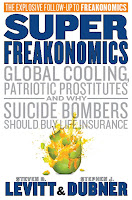
So, the front cover of my first conquest of 2010 already almost broke the only rule I’d set for myself. It’s a shiny white cover with the authors’ names in slightly raised lettering. However, it’s also hardcover and doesn’t have any glossy color photos (unless that’s a real picture of an exploding fruit on the bottom of the cover, but I’m 84% certain it’s not), so I think I’m safe.

On the other hand, it has a laughably long subtitle: Global Cooling, Patriotic Prostitutes and Why Suicide Bombers Should Buy Life Insurance. Hmm, a shiny hardcover with an exploding fruit, long subtitle, and raised lettering. Not exactly a recipe for success, right? Well, I suppose this is why one should never judge a book by its cover, because this is going into the record as a Recommended Reading.

Actually, let me take that back. You can judge a book by its cover, somewhat. As if the graphic design doesn’t scream “Please Pay Attention” loudly enough, the content itself immediately continues the theme. The first two sentences of the book proclaim, “The time has come to admit that in our first book [Freakonomics], we lied. Twice.” Pages later, we read that “as you leave your friend’s party [in an intoxicated state], the decision should be clear: driving is safer than walking.” (One wonders if that last line will eventually provoke a second admission of lying in the next installment, which must inevitably be titled SuperDuperFreakonomics: Funny Wars, Political PMS, and Why Rapists Make the Best Babysitters.)

But don’t let the hyperbole fool you: authors Steven Levitt (a professor at the University of Chicago) and Stephen Dubner (a former editor for The New York Times Magazine) are no lightweights, and they pack plenty of legitimate punches to keep readers scratching their heads for a considerably long time. (I’m still scratching mine.) For example, did you know that a Chicago prostitute is statistically more likely to have sex with a police officer than to be arrested by one? (The undercover beat is just brutal.) Or that many hospital infections could be prevented by doctors washing their hands? Alright, alright, so you already knew that one. But what you probably didn’t know — unless you happen to work at a hospital — is that, amidst a sea of failed attempts to compel doctors to comply with basic hygienic standards, simply installing a computer screensaver at one hospital depicting the swarms of bacteria on a human hand brought health compliance up to an almost perfect score.

As does its predecessor, SuperFreakonomics deals in human behavior and how various incentives, executed intelligently, can pretty much get human beings to do anything. Hence, the 1961 Milgram Experiment — except that Levitt and Dubner wave breezily at this landmark psychological study, deeming it a prime exemplar in the crowded field of How to Make Any Experiment Confirm Your Findings by Conducting it in a Lab. And somehow, this actually makes sense (the experiment’s mild repudiation, not the study itself). You see, the authors gently intone, human beings are little more than self-interested machines; remove the carrot and stick, and you’ve got yourself a rabbit with nowhere to go.

This pleasantly short 216-page book is replete with observations, projections, and muses that will gnaw at you. They will make you wonder how you didn’t think of these ideas first, even while mentally flogging yourself for allowing a modicum of gullibility to seep into your otherwise cynical worldview. Combating hurricanes with a small army of large rings centered around pipes leading into the depths? Kissing global warming goodbye by shooting sulfur dioxide eighteen miles into the air? Yes, Levitt and Dubner respond gleely, yes, we can.

What was perhaps most fascinating in this book were the many ways in which data was collected on unpredictable and uncontrollable events. In economics, as well as in politics and other social science fields, it is quite difficult to achieve exactness in the same sense as the other, “hard” sciences (i.e. chemistry, physics, etc.). This is primarily because, unlike those other areas of study, economists and political scientists are not able to conduct controlled experiments comparing one set to another.

However, these limitations can be mitigated to near-miraculous degrees at times. For example, in a section on global warming, Dubner and Levitt note that in the first several days following September 11th in the U.S. (when all civilian flights were grounded), the ground temperature increased fairly dramatically due to less sun shielding from aircraft exhaust trails. Using the aftermath of a domestic tragedy to produce quantifiable research that would never have been available via testing, the authors make it quite clear that virtually anything can be studied scientifically if you dig deeply enough.

Of course, the digging of Dubner and Levitt is accompanied by their own giggling soundtrack, as the machinations of their own nerdiness are readily translated into annoyingly cute barbs at fellow economists and so forth. And now that I’m a little older and wiser than when I’d read the prequel, I’m more than a little shocked that I had never before caught on to Levitt and Dubner’s obvious ideological leanings bubbling beneath these pages’ surfaces. (Hint: Chicago school of economics.) That said, readers from both sides of the aisle will have no problem enjoying this idiosyncratic tour through the intersection of the human mind and the free market.