Without a dramatic turnaround in advertising income, there are only two strategies – neither mutually exclusive – for the continued existence of newspapers, in digital or any other form:
• Having established the paywall model, the goal, in a race against time, is to extend it to a greater and greater part of the user base. Like the paywall itself, this is unchartered territory. Rupert Murdoch’s more absolute paywalls having worked significantly less well than the New York Times’ porous wall. The Times, however, counting on its brand power and on the gradual change in consumer behavior, is trying to up the ante, recently cutting its free take from 20 to ten articles.
• Re-orient the cost basis of the business, still largely modeled on advertising income, to the much smaller subscription revenue base. That is, fire a lot of people.
This is, actually, good news, if not necessarily for shareholders or for many employees. Some newspapers can continue to exist, albeit as vastly smaller and less profitable businesses.
I have a few points in response. First, Wolff characterizes newspapers’ plummeting revenue in the following terms: “A digital advertising environment on the web – one even more pronounced in mobile – that relentlessly increases the amount of advertising space available and lowers the value of all space overall.”
Wolff is mostly right, for now. But that’s only because advertisers have yet to figure out what’s valuable. I worked in online advertising for two years (including one year for a behavioral targeting firm), and I can say with some confidence that we still don’t have adequate metrics to measure advertising success online — hence the degradation of online real estate. But soon enough, the advertising landscape will have to revert to form.
Why? Well, because advertisers don’t like paying for something that provides no value. It’s astonishing just how little advertisers still know about their own data in 2013 — that is, the audiences on their own web sites, the customers buying their products, and so on. The problem is even worse when it comes to connecting with new audiences, also known as advertising. Not only do the companies themselves not understand the data, but many of the online advertising firms that these companies have hired know little about what they’re selling as well. (Take a look at the above headache-inducing graphic of the online media landscape to understand why.) Continue reading Are online paywalls too little, too late?→
Light at the end of the tunnel? One can only hope. But whatever the reason — political expediency, acknowledgment of a battle lost, cynical opportunism, or something else entirely — it’s an encouraging development nonetheless. Considering that the foundation of Obama’s healthcare law was a Heritage Foundation proposal, it’s about damn time.
Jay: Wow, I think I can safely say that this was the best episode all season. Normally, I’m against using plot twists for the sake of using plot twists, but in this case I think they actually got it almost perfectly right. Agent Gadd is one of those characters who the show never even slightly hinted might be a villain, and yet here we are.
The best part about this surprise is that it puts a lot of central characters into some very vulnerable positions. Most obviously, Nina is screwed. But the genius of this scenario is that Gadd can’t move too quickly to eliminate her, because Stan’s a savvy veteran (having been undercover with white supremacists for years) and might catch on to anything strange happening to Nina — especially considering his romantic/sexual attachment to her, which Gadd obviously knows about. At the same time, Gadd himself is on thin ice, precisely because Stan is such a consummate professional (minus the small detail of his affair with a confidential informant) and may be quick to catch on to Gadd’s double-crossing of his own agency.
I also loved Amador’s creepy stakeout of Martha’s place when Phil came over again. I do have a slight beef here, as usual: there’s absolutely no way Phil would take off his mustache, wig, and everything in his car right after leaving Martha’s place, even if he thinks there’s no way anyone could see him. Relatedly, it’s highly unlikely Amador could actually see anything in the dark of night like that, even with his binoculars. But OK, I’ll let those small details slide. Whatever the realism or lack thereof, the fact that Amador now knows A) Martha is sleeping with someone else and B) this guy is clearly not whoever he tells Martha he is, the stage is definitely set for some big surprises. Continue reading Strangers passing “In the Dark:” Sam Lim and I discuss Episode 9 of The Americans→
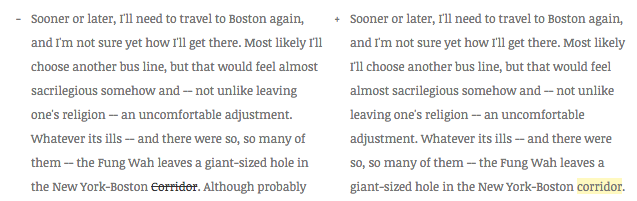
An example comparison of different versions of the same post.
One of the oft-noted pitfalls of online journalism — whether conducted by online-only publications or by traditional print/media outfits that have migrated online — is the lack of transparency over changes made to posts and articles after they’ve already been published. Many, for example, have observed The New York Times change headlines and even article text after posting them online, even after people have read the original version.
It is, in fact, this problem of unmarked revisions that gave rise to the truly stellar site NewsDiffs.org, which explains: “For better or worse, readers can now view ‘the making of the sausage’ that historically was discreetly tucked away from view with dead-tree editions.” The site scrapes the articles appearing on home pages of news organizations (currently The New York Times, CNN, Politico, and BBC) and archives each iteration of the ones that change after publication, so visitors can see what was revised.
Fast forward to yesterday. Blog post revisions have been an ongoing internal question for me: I try not to change a post after publishing it if at all possible, but obviously I have to break this rule for a variety of reasons from time to time. If it’s something small, such as a grammatical error or a typo, I change it as soon as I see it, without noting the correction. If it’s significant, I usually add the word CORRECTION or UPDATE to the bottom of the post, to note the change. Inevitably, there are gray areas.
But I have yet to come up with a red-line rule on when to note a correction and when not to. Nor have I settled on a hard-and-fast point at which a post becomes “non-updatable.” (Generally, once I’ve written a subsequent post, I don’t update previous ones. But even on that, I’m not sure I’ve followed this rule 100% of the time: I’ve been blogging for over three years and am closing in on 700 posts, so I haven’t kept close track.)
Enter Scott Carpenter’s handy plugin. (Thanks, Scott!) I just read about it for the first time yesterday, and I immediately realized it would work perfectly for my purposes. Now, on all posts going forward and on every one that’s already been posted since the beginning of the blog, every published revision is publicly viewable. To take a look, go to any single post’s perma-linked page (just click on the post headline from the home page), scroll to the bottom of the post, and you’ll see a list of all post revisions, complete with links. If you click on an older version of a post, it will load it — and you can even scroll to the bottom again to see a side-by-side comparison of what has changed since then.
If you notice any problems or bugs, please let me know!
…Even though the world might be a better place with Sotomayor reaction GIFs. Picture via TheAtlantic.com.
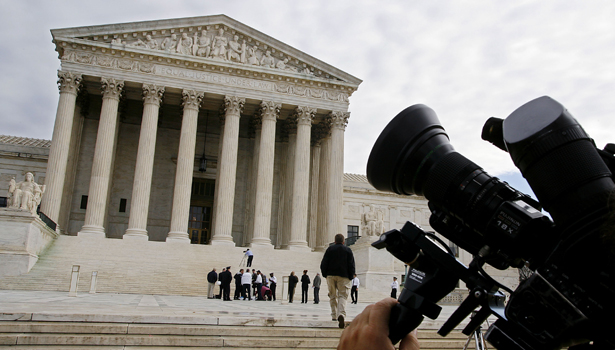
I’m of two minds about Al Tompkins’ Poynter piece (excerpted below) advocating cameras in the Supreme Court, which Andrew Sullivan highlighted on The Dish yesterday:
This is at the heart of what courts do every day in America; they hear the people’s business. It’s not entertainment, like Judge Judy. It is a living civics lesson, and exactly what the public should be able to see.
Live coverage would give the people unfettered access to the words the justices say, and would make it harder for journalists to add their own spin. Live coverage would also help us visualize what’s going on much more than words can.
My thoughts can be divided into roughly two camps: (1) SCOTUS’ Problem with Embracing Technology (or, Why I Think We Will See Live Video of Arguments In the Future), and (2) SCOTUS’ Problem with Protecting Court Integrity (Why Cameras are Both Good and Bad). Continue reading The Supreme Court decision will (not) be televised→
Last week in Egypt, a group of Russian photographers apparently climbed the Great Pyramid of Giza—hiding from guards for four hours after closing time before beginning the ascent. Climbing the pyramid, one of the photographers claims, carries a punishment of one to three years. But it was worth it. “I was speechless,” one wrote. “I felt a chilling delight, absolute happiness.”
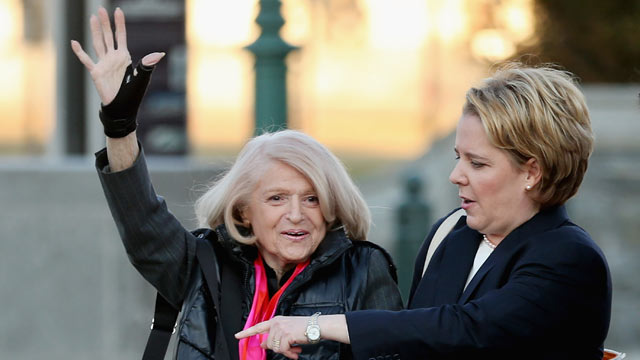
Edith Windsor, the 83-year-old plaintiff challenging the Defense of Marriage Act, arrives at Court with attorney Roberta Kaplan. Picture by Chip Somodevilla/Getty Images, found via ABC News.
Justice Anthony Kennedy had a choice to make this morning. In deciding the fate of the Defense of Marriage Act, should he go with a theory of federalism that emphasizes respect for states’ rights, or a wider-ranging theory of equality that might result in heightened legal protections for gays and lesbians across the United States?
Kennedy picked the former route and clung tightly to it today in a 110-minute oral argument for United States v. Windsor that put the swing Justice on firmer jurisprudential ground than yesterday’s Proposition 8 case. While the facts of Hollingsworth v. Perry pitted states’ rights and equal protection for gays directly against one another, leaving Kennedy confused as to which of a variety of unpalatable options he should choose, the legal issues in the Windsor case presented no such conflict. Rather, the state’s voters and the law’s challengers aligned in Windsor, where they merely asked the federal government to respect nine states’ decisions to recognize same-sex marriages. Here, the principles of federalism and equal protection both point to the unconstitutionality of DOMA.
Assuming that the Court doesn’t decide the case based on standing grounds, Justice Kennedy seemed perfectly content on Wednesday to limit any eventual ruling to the first question about states’ rights. He repeatedly reminded Paul Clement–the attorney tasked by the House of Representatives to argue in support of DOMA, since the Obama administration refused to defend it–that the right to define marriage (and the rest of family law) is “the essence of the State police power.” Kennedy also expressed concern over the sheer number of federal benefits provided based on marital status–1,100 and counting–noting that this means “the Federal government is intertwined with the citizens’ day-to-day life,” interfering with the state’s traditional “prerogative.”
Despite earlier rulings on gay rights cases that indicated a willingness to extend heightened judicial protections to gays and lesbians under the Fourteenth Amendment–an equality-based argument that would have far greater reach and be far more potent against discriminatory laws than a states’ rights takedown of DOMA–Kennedy appeared very hesitant to reconsider equal protection principles today (an issue on which he had also shown confusion at the Proposition 8 discussion yesterday). Several times during the oral argument, a fellow Justice or attorney would bring up Fourteenth Amendment considerations, and Kennedy would immediately steer them back to the federalism issues.
Sensing that its crucial fifth vote was reluctant to revisit arguments about equality, the liberal wing of the Court was happy to run with Kennedy’s line of thinking and echoed many of his concerns in follow-up questions. (One of the many perks of being a swing justice must be getting to set the tone for the oral argument and watching the rest of your colleagues follow along.) Justice Sotomayor asserted that the states, and not the federal government, control the institution of marriage, Kagan made reference to “historic State prerogatives,” and Ginsburg reiterated Kennedy’s sentiment that DOMA touches “every aspect of life” in a “pervasive” manner.
Kennedy’s hesitation notwithstanding, Justice Kagan in particular seemed intent on exploring heightened legal protection for gays and exposing DOMA as outdated legislation impermissibly based on animus. At one point, she dismantled Paul Clement’s arguments about legitimate government purposes for DOMA–he’d insisted that the federal government passed the law for purposes of uniformity across the states–by reading to him the 1996 House Report that clearly states that DOMA sprang from “moral disapproval” of homosexuality. While this rationale was once constitutional, basing discriminatory laws on disapproval toward a particular group has since been prohibited in 2003’s Lawrence v. Texas, the majority opinion for which was authored by–you guessed it–Anthony Kennedy himself. Clement was forced to backpedal and say that while some legislators may have had “improper motives” for DOMA, not all 84 of the Senators who voted for the law bore animus toward gays and lesbians.
Just as the liberal justices tailored their questions toward Kennedy’s views, the conservative Justices, led by Chief Justice John Roberts and Justice Scalia, tried to assuage Kennedy’s concerns by pressing Solicitor General Donald Verrilli, Jr. and Edie Windsor’s lawyer, Roberta Kaplan, on states’ rights. Roberts repeatedly asked both parties if there was truly a federalism problem–a bit of a trap for Verrilli in particular, who as the representative of the United States federal government has no interest in ceding too much power to the states–and became audibly annoyed whenever Kaplan or Verrilli attempted to tie their answers to an equal protection argument. While Roberts and Scalia tried to compel the DOMA challengers to say that federal overreach was not really an issue here, Justice Alito brought up the practical point that a DOMA defeat would mean that gay couples could be treated differently whenever they moved across state lines–and therefore, that the equal protection problem is ultimately unavoidable.
Of course, Justice Alito is spot on here. Regardless of how Anthony Kennedy decides to decide this case, marriage equality is spreading throughout the United States, and the Supreme Court will eventually have to decide what level of judicial protection gays and lesbians deserve. As the swing vote firmly in control of the wheel, however, Kennedy has the luxury of slowing down the train if he wants to, and it looks like he’s going to do just that in the name of federalism. It won’t be as big of a step as many had hoped for, but come June we will likely be one tiny step closer to a more perfect union.
Shaul Arieli, an Israeli negotiator with the Palestinians under several prime ministers, had much to say in an illuminating interview with +972 Magazine‘s Noam Sheizaf. A few of the many interesting passages are below.
On whether the Palestinians rejected a peace plan under Ehud Olmert:
I will quote Olmert himself: the Palestinians never refused. They didn’t accept some of our proposals, just as we didn’t accept some of theirs. Israelis think that Olmert gave “a generous offer” to the Palestinians. But the Palestinians would say the same. Mahmoud Abbas was ready for land swaps that would leave 75 percent of the settlers under Israeli authority, including in neighborhoods in East Jerusalem. Abbas went a long way toward Israel on every issue.
On Benjamin Netanyahu’s goals:
Then Netanyahu came, and he had tremendous experience and knowledge on these issues. After all, he took pride once in his ability to kill the Oslo process. I served under Netanyahu and I think he still believes in what he wrote in his book in 1995 – that ‘placing a PLO state 15 km from the beach of Tel Aviv poses an existential threat to the state of Israel.’
Netanyahu, when he came back to office in 2009, didn’t try to introduce his own demands. He went to changing the terms of reference. He declared that 1967 borders won’t serve as basis for the negotiations, and if he accepts land swaps, it will never be in a 1:1 ratio. He wants to annex 10 percent of the West Bank and give the Palestinians 1 percent in return. The same goes for Jerusalem. As long as he continues to speak about a united Jerusalem, anything he might say about the two-state solution is meaningless.
Bibi is the one who moved back from what was agreed upon. There is no reason to enter negotiations without the principles that were agreed upon, without the framework.
Netanyahu wants the process, not the agreement. Bibi doesn’t care about the Palestinians. He is interested in the way Israel is treated by the world. So he will take his time, and as far as he is concerned it [the talks] can take forever.”
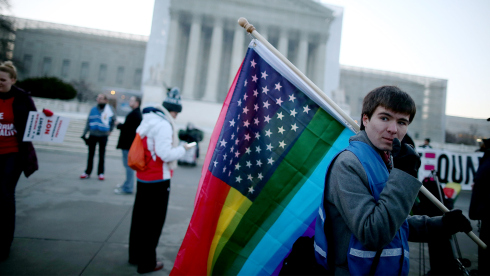
Today, the Supreme Court heard two hours of arguments in United States v. Windsor, with fifty minutes allotted on the technical question of standing–namely, whether the DOMA case should even be before the Supreme Court at all–and sixty minutes on the merits. Though the Prop 8 case on Tuesday seemed to get the lion’s share of media attention–pictures of the line and the protests outside the Courthouse this morning show a smaller audience than yesterday’s–initial reactions and reports indicate that the DOMA argument and subsequent press conference from plaintiff Edie Windsor are 10,000% more quotable. A collection of tweets recapping the day’s events:
When all was said and done, there weren’t any major revelations in Tuesday’s oral argument for Hollingsworth v. Perry, but it did set the stage for an interesting two hours of arguments on the Defense of Marriage Act that the Supreme Court will hear today.
Chief Justice John Roberts looked for ways to dispose of the Proposition 8 challenge based on the procedural question of standing–as he has done in so many other cases during his tenure–and at least four of his fellow Justices seemed receptive to that option, dissatisfied with the alternatives that the attorneys before them were offering.
The Prop 8 challengers and the United States government framed this fight as the latest in a long line of struggles for equality, appealing to the liberal wing of the Court as we thought they might. They drew parallels to Brown v. Board of Education and Loving v. Virginia, the 1967 case that outlawed state bans on interracial marriages. Justice Ruth Bader Ginsburg–a civil rights pioneer in her own right–reminded Charles Cooper, the lawyer defending Proposition 8, that it was unsound to rely on the Constitutional reasoning of a thirty-year-old Supreme Court decision unfavorable to gay marriage (Baker v. Nelson), given that gender discrimination was barely even recognized back then. Justice Sonia Sotomayor questioned Cooper about whether the government had any rational basis to deny gays and lesbians benefits other than marriage, and Justice Elena Kagan repeatedly pressed Cooper to specify the harm that same-sex marriage causes.
And, as expected, Justices Samuel Alito and Antonin Scalia did not take kindly to the arguments of the Prop 8 challengers. Scalia managed not to emit any overly damaging sound bites this time–the worst thing he said concerned potential “deleterious effects” of same-sex parenting on children–but got into a testy exchange with anti-Prop 8 attorney Ted Olson. Seeking to make a point about America’s long and treasured history of discriminating against gays, he interrogated Olson on when exactly gay marriage bans became unconstitutional, berating him when Olson attempted to answer with a rhetorical question about interracial marriage prohibitions, and responding triumphantly when Olson admitted that he could not provide a specific day: “Well, how am I supposed to decide the case, then–if you can’t give me a date when the Constitution changes?”
Debates that the public has been having for years spilled over into the courtroom as the Justices extended each side’s arguments to their logical conclusions. They grilled Cooper on why, if procreation is the main point of marriage, the state hasn’t banned marriages between infertile, elderly or incarcerated couples. They asked Olson whether a state could prohibit polygamy or incestuous marriages if marriage is in fact a fundamental right under the Constitution. Neither of the answers that the attorneys provided–a convoluted riff about preventing the evils of infidelity from Cooper, and a muddy distinction drawn by Olson between status and conduct–seemed to satisfy a clear majority of the Justices.
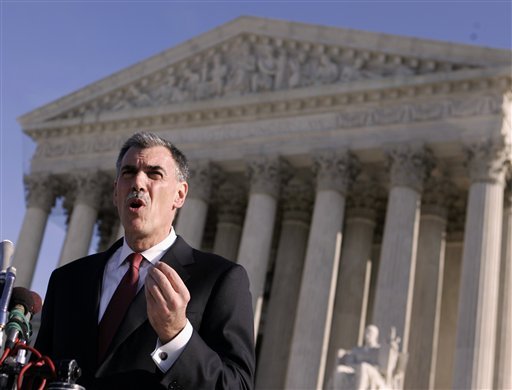
Solicitor General Donald Verrilli in 2008. Picture by the Associated Press, via Cleveland.com.
Though none of the questions came out of left field, there weren’t any obvious winners or losers, as each of the lawyers’ arguments had holes that made several Justices uncomfortable. Solicitor General Donald Verrilli, Jr., arguing the federal government’s position in support of the Prop 8 challengers, probably fared the worst out of the three attorneys. He took a verbal beating from both liberal and conservative justices over the Obama administration’s dubious stance that states offering civil unions must be made to offer same-sex marriage as well, while states that have never allowed the civil union option should not be required to legalize same-sex marriage. Wouldn’t such an “all or nothing” approach incentivize states to grant their gay citizens no rights instead of some rights, Breyer asked? Verrilli didn’t have a good answer. Then again, as last year’s oral arguments for the Affordable Care Act showed, he doesn’t have to be on his A game for the Justices to find in his favor. Even if the Justices are loath to accept the federal government’s preferred “eight state” course of action, the Obama administration would still celebrate any California-specific result that leaves intact federal district judge Vaughn Walker’s ruling against Prop 8 (or the Ninth Circuit affirmation of that decision).
In the end, it all comes down to Anthony Kennedy, as it has many times before and will again in the future. Justice Kennedy did quite not tip his hand at yesterday’s argument, asking probing questions of both sides. He showed concern over what would happen to the 40,000 children in California with same-sex parents if their fathers and mothers were denied the right to marry, yet balked at the thought of finding a fundamental right to same-sex marriage, warning that the Court was wandering into “uncharted waters.” Kennedy pushed Cooper to concede that he couldn’t think of any specific ways in which same-sex marriage injures society, but also suggested that the case might have been improvidently granted in the first place and should be thrown out based on standing rules. Basically, he appeared to be searching for a rationale to justify a limited rather than broad ruling. Hence, it’s unlikely that the Court will uphold Proposition 8 or make same-sex marriage constitutional across all 50 states–but beyond that, it is unclear what the exact decision is going to be.
Prior to Tuesday’s oral argument, David Boies, Ted Olson’s partner in Hollingsworth v. Perry, had confidently predicted that the Proposition 8 challengers would win the case by at least a 6-3 margin. Emerging from the courthouse into the sunshine yesterday afternoon, however, Olson didn’t sound so sure. “Based on the questions the Justices asked, I have no idea” what the Supreme Court will rule, he said. Most court-watchers don’t, either, but it will be very interesting to see how the Prop 8 arguments over standing, states’ rights and respect for the legislative process play out when the Justices tackle similar questions in the United States v. Windsor DOMA challenge today.