Late Night – Foals
This one is NSFW.
Late Night – Foals
This one is NSFW.
Oral argument for the California Proposition 8 case has ended in Washington, D.C., and the Supreme Court audio and transcript are now up. It’s pretty inconclusive from today’s session what kind of ruling the Justices are going to come up with, but that didn’t stop the Twittersphere from exploding into varying degrees of rage, joy and punditry. Here is a brief recap in tweet form, culled from legal commentators, journalists and the rest of the peanut gallery:
Daybreak over the Supreme Court. Hundreds now in line. twitter.com/jwpetersNYT/st…
— Jeremy W. Peters (@jwpetersNYT) March 26, 2013
Best sign at the Supreme Court today: “Dear Scalia: Y.O.L.O.” twitter.com/chuckwestover/… #scotusyolo
— ThinkProgress (@thinkprogress) March 26, 2013
It seems like the standing issue will have a bigger role than most thought in the #SCOTUS #Prop8 case… hmm.
— Waymon Hudson (@WaymonHudson) March 26, 2013
#SCOTUS finding a lack of standing on #Prop8 would be like Congress punting on a major spending issue. Oh yeah, they do that all the time.
— Ryan Teague Beckwith (@ryanbeckwith) March 26, 2013
That beautiful moment when J. Kagan essentially forces the pet. to admit there is no harm to the state from #SSM.#SCOTUS #Prop8
— OutrSpaceBonobo (@OutrSpaceBonobo) March 26, 2013
Sotomayor: is any ‘rational basis’ for the state to treat homosexual couples differently Cooper: I DO NOT HAVE ANYTHING TO OFFER YOU
— NewYork,ILoveU (@NYCiLOVEu) March 26, 2013
Kennedy says it’s a close question whether Prop 8 makes a gender classification. Maybe suggests he doubts it could pass heightened scrutiny.
— Marco Lopez (@maloprop) March 26, 2013
Supreme Ct update: J. Kennedy asks about 40,000 CA kids in LGBT families.“The voices of those children is important in this case, isn’t it?”
— Adam Winkler (@adamwinkler) March 26, 2013
If someone is using the corny phrase “the voice of these children” it’s gotta be Kennedy.
— Irin Carmon (@irincarmon) March 26, 2013
Battle of the Titans: Scalia to Olson: When did become unconstitutional to ban gay marriage? 1791? 1868? on.wsj.com/15PZjJH
— JamesVGrimaldi (@JamesVGrimaldi) March 26, 2013
Scalia: “When did it become unconstitutional to exclude gays?” Olson: “When did it become unconstitutional to exclude interracial couples?”
— Patrick O’Neil (@PaddyoNeilio) March 26, 2013
J. Kennedy emphasized uncharted waters; indicated that Loving was new here, but not everywhere, ie, Loving not terribly persuasive to him.
— Michelle Olsen (@AppellateDaily) March 26, 2013
Aren’t “uncharted waters” the waters for which the Supreme Court is supposed to be crafting the charts? #StraightedgeCompassandConstitution
— George Wallace (@foolintheforest) March 26, 2013
Olson quotes Ginsburg: “The history of our Constitution is the story of the extension of con rights to ppl once ignored or excluded.” #prop8
— Samantha Ames (@StealThisTweet) March 26, 2013
Maybe the most awkward moment in today’s gay marriage arguments: Scalia name-dropping Strom Thurmond, regarding old, fertile people.
— David Ingram (@David_Ingram) March 26, 2013
These Supreme Court arguments are inspring in me a musical-comedy about a devoutly Christian couple that learn they’re infertile.#prop8
— John Miranda (@John_Miranda) March 26, 2013
Verrilli: When states allow civil unions, the Equal Protection Clause forbids the exclusion of #ssm. #Time4Marriage #Prop8
— Adam L. Barr (@adamlbarr) March 26, 2013
One issue for Justices, incl Breyer: Would ruling that says states w/ civil unions must offer marriage discourage states from civil unions?
— Michael Crowley (@CrowleyTIME) March 26, 2013
One more takeaway from #scotus argument: Obama administration’s position came in for sharp criticism from left and right alike
— John Gramlich (@johngramlich) March 26, 2013
You mean allowing them to own automatic weapons isn’t enough to satisfy gay people?
— Paul Todd (@ptodd62) March 26, 2013
How could Alito rule on Obamacare when it’s younger than cell phones or the Internet? #justwondering
— AdamSerwer (@AdamSerwer) March 26, 2013
It’s worth nothing that Cooper’s rebuttal focused almost exclusively on Verrilli’s (weaker) argument rather than Olson’s.
— Charles Crain (@charlescrain) March 26, 2013
Arguments done. #scotus won’t uphold or strike down #prop8 bc Kennedy thinks it is too soon to rule on #ssm. #prop8 will stay invalidated.
— SCOTUSblog (@SCOTUSblog) March 26, 2013
Seems Judge Walker’s broad ruling has little chance of surviving. And Justice Kennedy didn’t think much of #prop8 trial evidence.
— Dan Levine (@FedcourtJunkie) March 26, 2013
No majority apparent at #SCOTUS for any particular outcome in Calif. #gay marriage ban case, says @shermancourt: apne.ws/10b995C
— AP Courtside Seat (@AP_Courtside) March 26, 2013
Totally baffled after hearing today”s #ssm args. No clear winner. #scotus
— Jeffrey Toobin (@JeffreyToobin) March 26, 2013
SCOTUS doesn’t rule immediately after oral arguments. First they carefully review and discuss all your blog comments and tweets.
— pourmecoffee (@pourmecoffee) March 26, 2013
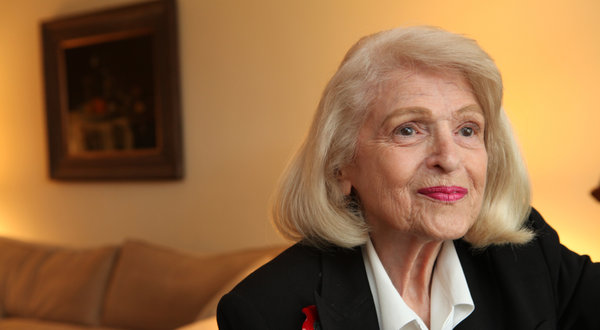
Edie Windsor. Picture courtesy of the New York Times.
All eyes are on the Supreme Court this morning as it prepares to finally hear two cases on same-sex marriage, the civil rights issue of our time. Starting shortly after 10 a.m. today, a 60-minute oral argument will be held for Hollingsworth v. Perry, which questions the constitutionality of California’s Proposition 8 restricting the definition of marriage to one woman and one man. Tomorrow morning, the Justices will hold a 110-minute argument for United States v. Windsor, in which the Supreme Court could strike down the 17-year-old Defense Of Marriage Act (DOMA) that denies federal benefits to same-sex couples even if their marriages are recognized by the state. (The Court is expected to release the audio recording and transcript for each argument shortly after it ends.)
Given the historical significance of these two cases, it’s not surprising that the Internet has lit up with a maelstrom of commentary on just about everyone and anyone who is even remotely connected to either suit. From current Chief Justice John Roberts to former Justice Harry Blackmun, the marquee duo of lawyers challenging Proposition 8 to the people who have been paid to wait in line since Thursday night for the chance to score seats at the oral arguments, everything SCOTUS-related has come under increasing scrutiny as March 26, 10 a.m. draws near. Lest you are feeling overwhelmed by this deluge of information or just looking to do a little bit of last-minute reading as we wait for the Court to wrap up the day’s oral argument, I’ve compiled some of what I think are the most helpful and informative articles for understanding who’s who and what’s going on:
The Overview: Hundreds of articles have picked apart the individual issues and key players before the Court. For one centralized, concise summary of all the legal issues at stake in Hollingsworth and Windsor, the inimitable SCOTUSblog has two primers from Amy Howe. For a quick-hits list of things to watch for at the arguments, go to CNN’s Matt Smith or Slate’s Emily Bazelon, both of whom have highlighted the most important things to know.
The Plaintiffs of Proposition 8: Unsurprisingly, the media has made much hay of the human interest stories behind these cases. The two couples handpicked from California to challenge Prop 8–Kris Perry and Sandy Stier, Paul Katami and Jeff Zarrillo–are profiled in USA Today as “workaday couples living the American Dream, with one exception–they can’t marry their partners.” Perry and Stier also recently gave an interview to the Associated Press (found via the Huffington Post) in which they recall how they’ve lived the last four years in a “pins-and-needles way” while litigating their case up to the nation’s highest court.
The Lawyers Challenging Proposition 8: One of the most dramatic storylines in a case chock-full of them has to be the partnership of superstar lawyers David Boies and Ted Olson, who were famously opponents in Bush v. Gore. The conservative Olson, a former Solicitor General for the U.S. under President George W. Bush, was initially met with some skepticism when he announced that he would be joining Boies in the fight against Prop 8; the Los Angeles Times profiles him here. David Boies, for his part, gave an interview to USA Today two weeks ago stating his belief that Hollingsworth v. Perry will be decided in their favor with more than five votes.
The Plaintiffs of DOMA: “I came to New York to let myself be gay.” Edie Windsor, an 83-year-old widow and former IBM engineer who was engaged to Thea Spyer for 40 years and married for two before Spyer’s death, is the subject of an illuminating New York Times piece about her reasons for challenging the federal government. New York Magazine recently compiled a slideshow of pictures from Windsor and Spyer’s life together.
The Lawyer Challenging DOMA: Though Windsor–with her winsome personality, elegant looks and her compelling love story–now looks like what civil rights lawyers would call the perfect plaintiff for same-sex marriage, her case was rejected by a major gay rights organization before being picked up by Roberta Kaplan, an attorney with Paul, Weiss, Rifkind, Wharton & Garrison. Kaplan, who has said that it took her all of five seconds to decide that she wanted to litigate Windsor’s case, explains her reasoning to Advocate.
Justice Anthony Kennedy: The current swing vote on an increasingly polarized Court, Justice Kennedy’s jurisprudence isn’t always easy to pin down, but he has been sympathetic to gay rights in the past. Famously, he cast the deciding vote (and wrote the opinions) in both Romer v. Evans, which threw out a Colorado law barring anti-gay discrimination laws, and Lawrence v. Texas, in which the Court overturned a Texas sodomy law that was used to prosecute a gay couple for consensual sexual activity. Back in December, when the cases were first granted, Jeffrey Rosen of The New Republic considered whether Kennedy would go for a broad constitutional ruling or a narrow one in light of his previous rulings. Garrett Epps of The Atlantic writes here that we can expect Kennedy to stick to his record of defending both states’ rights and gay rights.
Justice Antonin Scalia: Just as Kennedy is known for leaning libertarian on gay rights issues, Scalia is quite well-known for his moral opposition to same-sex marriage. The big question going into today and tomorrow’s arguments is what he will say this time about gay marriage, and how offensive it will be. Mother Jones and ABC News have both compiled some of Justice Scalia’s thoughts on same-sex marriage over the years, including pieces of his dissents in Romer and Lawrence, and his now-infamous comments comparing disapproval of homosexuality to disapproval of murder, made during a speech at Princeton in 2012.
The Families of the Supreme Court: Robert Barnes of the Washington Post discusses the love lives and marriages of the Justices, noting that many of them have not chosen the “traditional” marriage or childbearing arrangements that Prop 8 and DOMA supporters trumpet. The Los Angeles Times also brings up the fact that Chief Justice John Roberts has a gay cousin, Jean Podrasky, who will be in attendance at the oral arguments this week in the ‘families and friends of SCOTUS’ section. Podrasky told the LA Times: “I believe he sees where the tide is going… I absolutely trust that he will go in a good direction.”
The Shadow of Roe v. Wade: When the DOMA and Prop 8 suits were first filed, many wondered whether pushing same-sex marriage through the courts rather than the state-by-state legislative process was a mistake, pointing to the cautionary tale of Roe v. Wade, which polarized the debate on abortion. The New York Times writes on the shadow of Roe here.
The Forerunners: Linda Greenhouse of the NYT delves into the notes of the late Justice Harry Blackmun (the author of Roe v. Wade) to ascertain his thoughts on same-sex marriage, an issue that the Supreme Court wouldn’t even touch while Blackmun was on the bench in the 1970’s. Greenhouse also highlights the story of Jack Baker and James McConnell, a Minnesota couple who took their state to court in 1970 for their right to marry each other, and reflects on how much public opinion has changed since then.
The Public: Public support for same-sex marriage has snowballed in the last year, and it’s impossible to think that the Justices haven’t noticed. The Pew Research Center found in a March 2013 poll that support had swelled to a high of 48% (versus 43% of respondents who were opposed to same-sex marriage). NPR has created a timeline tracking same-sex marriage in the courts and in pop culture here. Meanwhile, sensing this change in the air, members of Congress have been tripping over each other to announce their support for same-sex marriage before the Supreme Court speaks, as TIME reports. Mother Jones has compiled a timeline of politicians’ about-faces on this issue.
The People Standing in Line: SCOTUSblog reported last week that people were lining up outside of the courthouse for oral argument seats as early as Thursday night, and the media promptly descended. One man tells the National Journal that he has conducted over 200 interviews while waiting in line. Meanwhile, Adam Liptak and SCOTUSblog trade barbs over the fact that at least some of those in line were paid to stand (or, sit) there by wealthier lawyers who want a seat at the historic hearings but not the five-day wait.
The Possible Outcomes: Finally, the New York Times has a very helpful infographic here about the possible ways in which the Supreme Court could decide both cases, and what states each outcome would affect.
Festival – Sigur Rós
I took this video tonight at the Sigur Rós concert at Madison Square Garden in New York, the band’s largest ever venue as a headliner. As always, an experience worth having.
Stephen Walt, repeating much of what I wrote last week, reminds his readers what really happened during Obama’s much-heralded tour of Israel:
Obama also offered rhetorical support for Palestinian aspirations, and his speech went further than any of his predecessors. He spoke openly of their “right to self-determination and justice” and invited his Israeli listeners “to look at the world through their eyes.” He also told them “neither occupation nor expulsion is the answer” and said “Palestinians have a right to be a free people in their own land.” He reiterated his call for direct negotiations — though he no longer suggests that Israel stop building more settlements — and he called upon his youthful audience to “create the change that you want to see.”
But that’s all he did. He did not say that a Palestinian state would have to be fully sovereign (i.e., entitled to have its defense forces). He did not give any indication of where he thought the borders of such a state might lie, or whether illegal settlements like Ariel (whose presence cuts the West Bank in two) would have to be abandoned. He did not say that future American support for Israel would be conditional on its taking concrete steps to end the occupation and allow for the creation of a viable state (i.e. not just a bunch of vulnerable Bantustans). On the contrary, his every move and phrase made it clear that Israelis could count on the United States providing generous and unconditional support to the vastly stronger of the two parties. He made no mention of a special envoy or an “Obama plan.” In short, he did not announce a single concrete policy initiative designed to advance the vision of “two states for two peoples” that he first laid out in the almost-forgotten Cairo speech of June 2009.
Walt’s conclusion:
For realists like me, in short, halting a colonial enterprise that has been underway for over forty years will require a lot more than wise and well-intentioned words. Instead, it would require the exercise of power. Just as raw power eventually convinced most Palestinians that Israel’s creation was not going to be reversed, Israelis must come to realize that denying Palestinians a state of their own is going to have real consequences. Although Obama warned that the occupation was preventing Israel from gaining full acceptance in the world, he also made it clear that Israelis could count on the United States to insulate them as much as possible from the negative effects of their own choices. Even at the purely rhetorical level, in short, Obama’s eloquent words sent a decidedly mixed message.
Because power is more important than mere rhetoric, it won’t take long before Obama’s visit is just another memory. The settlements will keep expanding, East Jerusalem will be cut off from the rest of the West Bank, the Palestinians will remain stateless, and Israel will continue on its self-chosen path to apartheid. And in the end, Obama will have proven to be no better a friend to Israel or the Palestinians than any of his predecessors.

There’s an interesting discussion taking place on Corey Robin’s blog regarding Ezra Klein’s apology for supporting the Iraq War:
Like many people who supported the Iraq War, Ezra Klein has written his apologia.
But he fails to identify—indeed, repeats—his biggest mistake in supporting the war: When thinking of the US government, he thinks “we.”
Iraq, [Kenneth Pollack] said, shouldn’t be America’s top priority. We should first focus on destroying al-Qaeda. We should then work on the Israeli- Palestinian conflict. Only then should we turn to Hussein. Moreover, when and if we did invade Iraq, we should do so only as part of a coordinated, multilateral operation…
…
After all, what other chance would we get to topple Hussein?
…
It wasn’t worth doing precisely because the odds were high that we couldn’t do it “right.”
Klein doesn’t think a state invaded another state; he thinks “we” went to war. He identifies with the state. Whether he’s supporting or dissenting from a policy, he sees himself as part of it. He sees himself on the jeeps with the troops. That’s why his calls for skepticism, for not taking things on authority, ring so hollow. In the end, he’s on the team. Or the jeep.
I’ve learned a lot from reading the comments. (Now there’s a sentence you rarely see on the Internet these days.) One commenter, Justin, replied:
Maybe I’m too naive, but isn’t the problem that more people DON’T identify with the government? If we identify with the government, then its failings are our failings and there’s more motivation to change things because they’re being done in our names. If we don’t identify with it, then it’s just this abstract entity that we can have nothing to do with, which leads to the government abusing its power because none of us feel responsible for it.
I guess I don’t think it’s a problem that Klein is “on the team” – it’s that most of us aren’t on it and thus don’t have any say on what’s happening.
Another commenter, Ned Ludd, raised a different point:
Because he supported the stablishment position on Iraq, Ezra Klein was able to rise into the ranks of the establishment. Back in January 2007, Jebediah Reed of the now-defunct Radar Magazine took a look at some of the career trajectories of pundits who supported the war (Tom Friedman, Peter Beinart, Fareed Zakaria, Jeffrey Goldberg) and the subsequent careers of vocal opponents of the invasion (Robert Scheer, William. S. Lind, Jonathan Schell, Scott Ritter). If Klein had been against the war, he never would have been promoted from obscurity to the pages of the Washington Post.
All of these points raise the question of how such a calamity as Iraq can be avoided in the future. As The Atlantic‘s Elspeth Reeve has ably demonstrated, the 10-year anniversary edition of self-flagellation for supporting the Iraq War has blossomed so ubiquitously as to necessitate a taxonomy of apology bullet points: “I was but a lowly worm,” “I was fooled by bad intelligence,” and so on.
However, what many such Iraq War apologists and (much later) apologizers seem to have in common is an inability to grasp their deeper failing for directing much of their vitriol at the anti-war crowd and castigating those people (who turned out to be very right in the end) as a bunch of hippies. Freddie deBoer remembers this specifically:
You know, I’m reading all of the Iraq mea culpas, some good, some bad. But they are all systematically ignoring one of the most obvious and salient aspects of the run up to the war: the incredible power of personal resentment against antiwar people, or what antiwar people were perceived to be. As someone who was involved in day-to-day antiwar activism at the time, the visceral hatred of those opposing the war, and particularly the activists, was impossible to miss. It wasn’t opposition. It wasn’t disagreement. It was pure, irrational hatred, frequently devolving into accusations of antiwar activists being effectively part of the enemy. Yet for as visible and important as this distaste was for the debate, it’s missing from the postmortems.
Ta-Nehisi Coates has similar memories:
I am not a radical. But more than anything the Iraq War taught me the folly of mocking radicalism. It seemed, back then, that every “sensible” and “serious” person you knew — left or right — was for the war. And they were all wrong. Never forget that they were all wrong. And never forget that the radicals with their drum circles and their wild hair were right.
And Conor Friedersdorf compiles a roundup of mockery aimed at anti-war protesters before and during the war.
It’s enough to make one wonder if we ever learn anything, at all, from history.

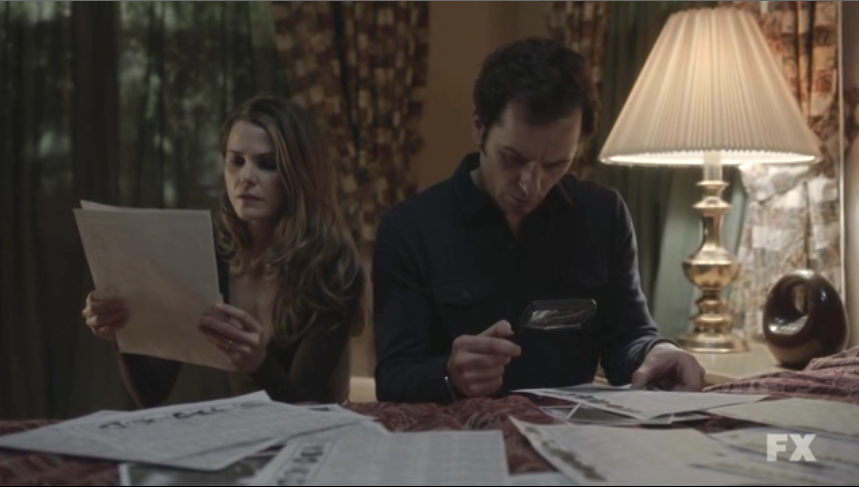
Jay: Ho hum. Another episode of The Americans, another sigh of disappointment. This is getting to become a ritual weekly event.
This time we have Granny telling Elizabeth the truth about Phil and Irina. We have Stan and Amador’s colleagues getting blown to smithereens. We have Amador himself starting to suspect his former girlfriend…of something. And we have a West German loose cannon on the prowl until he, too, gets blown to smithereens.
What a lot of these moments have in common, or how they tie together, is not always clear. Why, for instance, did Granny feel it necessary to sabotage Elizabeth’s marriage? Was this her backhanded way of exacting revenge for the beating she received at Elizabeth’s hands: a ruined marriage for a bruised face? Or was there some larger strategic calculation at play? My first thought was that this could set up a situation in which Elizabeth sells out Phil to her bosses for his lack of commitment, as revenge for his infidelity. But by the end of the episode, their tension had mostly dissipated into familiar marital discord.
Nina’s conversation with Stan at the end, meanwhile, was certainly bizarre. What exactly is going on at the embassy? Is she really being promoted, or is Arkady moving her up to keep a closer eye on her? Something about that situation seemed funky.
Also, it was never explained why the West German hired hand would have a problem with following directions from the KGB. What’s it to him whether or not a scientist lives or dies? As with so many aspects of The Americans, this is left unexplained.
Also, I guess I’m supposed to care that Phil’s and Elizabeth’s marriage is falling apart, right? Well, I don’t.
Do you? Continue reading “Mutually Assured Destruction” on The Americans: Sam Lim and I discuss Episode 8
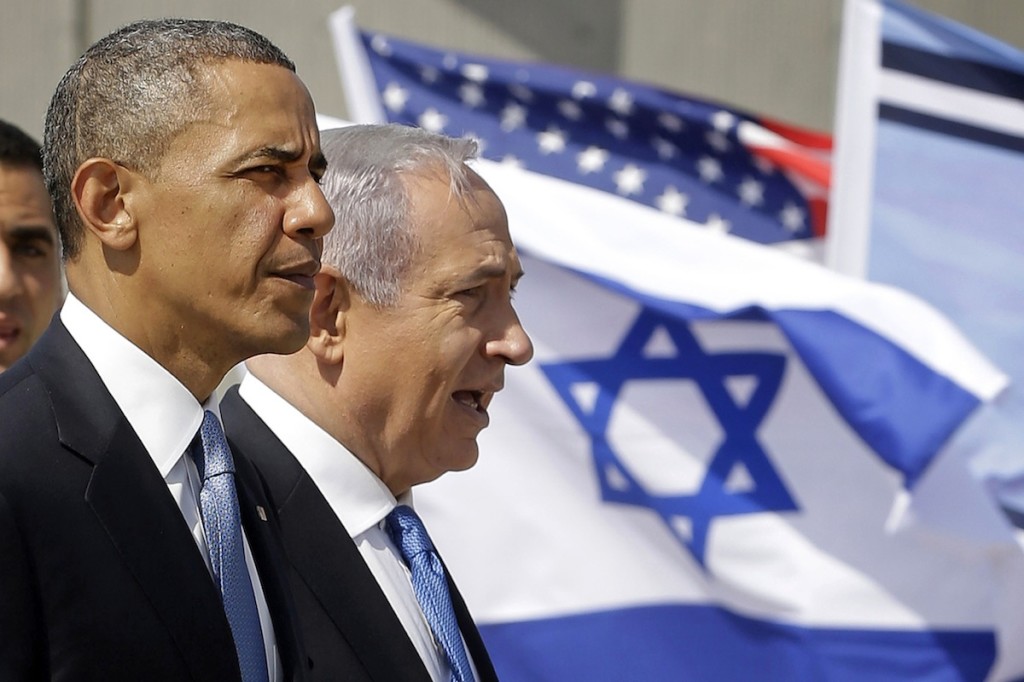
My piece for The Morningside Post is up:
Indeed, Obama was right to decry the injustice of the occupation. But much of the blame for the perpetuation of what he termed the “grinding status quo” should rest squarely upon the president himself. Lacking from tonight’s speech was any semblance of a serious framework for peace talks, never mind for peace. A settlement freeze, once the centerpiece of Obama’s roadmap for peace negotiations, was never even timidly mentioned in passing.
Thus the cycle of endless backtracking is completed. Under Jimmy Carter, settlements were illegal. Under Ronald Reagan, they became an “obstacle to peace.” Now, as per Obama’s speech tonight, they are simply “counterproductive.” The progressively more muted rhetoric matches the devolution of the peace process from actual negotiation into something resembling kabuki theater.
And theater is precisely what it is: the continued half-hearted affirmations of the two-state solution by successive American presidents belie their rapidly vanishing interest in taking the steps necessary to achieve it.
The Fold – Ivan & Alyosha
I took this video last night (as in, Tuesday) at The Echo in Los Angeles. They sound even better live than on their album. Definitely worth seeing if you get the chance. (The audio is a bit dicey when the bass kicks in, but it’ll have to do.)


