What is the strongest division in Major League Baseball in 2013?

I’ll admit it: I’m procrastinating again. But what of it?

So here’s what I’ve done. I took the game logs for the 2012 season and removed all intra-divisional matches. So out of the 2,430 games played last season, this left 1,358 games — all of them played between teams from different divisions.

Then I totaled up the collective wins for all teams within each division — again, excluding games played against each other — and came up with winning percentages for each of the six divisions. Here’s how it panned out:

AL West: 237-183 (.564)

AL East: 240-210 (.533)

NL East: 236-214 (.524)

NL West: 221-229 (.491)

NL Central: 225-271 (.454)

AL Central: 199-251 (.442)

I have yet to look into these figures on a historical continuum, but I’m guessing it’s a rarity for the AL East (traditionally thought of as the toughest division in baseball, at least for some time now) to be knocked off its perch at the top.

Anyone have a better way of measuring division strength? I’ve seen some articles written over the past few years that count all postseason series won (or even participated in) by teams from the various divisions. But since postseason success is partially determined by how a team performs within its own division, I’m not convinced that counting postseason series is the best way to measure division strength — especially given baseball’s disproportionately intra-division game schedules. Team performances against division rivals should be discounted from evaluations of overall division strength.

Unless I’m missing something?

Enhanced by Zemanta

Wandering aimlessly with The Americans: Sam Lim and I discuss Episode 5, “COMINT”

Sam: This will be somewhat interesting, given that we just watched this episode together a few hours ago. Perhaps it was because I was watching it at your place, but I actually didn’t think the episode was too bad. It was certainly confusing, and it took me a bit to piece things together (that’s perhaps what I get from hating on the show so much that I forget to keep track of who’s who). But, overall, it was an ehh episode. That, on my The Americans rating scale, is pretty good.

To the details: if the KGB director at the Soviet embassy couldn’t talk to his guy at the Defense Department, but Elizabeth could just walk right in and question him (and Elizabeth can connect with the KGB director, I assume), why doesn’t the director just pass a message to the guy through Elizabeth? I suppose, if they did that, we wouldn’t have this episode, would we?

elizabethI didn’t feel like that storyline was told or developed very well as far as the Defense Department guy’s wife dying and its impact on him. In hindsight, they did say it clearly, but it got so lost in the confusing details of who’s who that I was left wondering who his wife was and why that was important. This probably betrays my lack of paying close attention to previous episodes, but I was just lost for a few sequences in this episode.

One aspect I particularly enjoy, though, is the costumes Phil and Elizabeth change into when they go on their missions. They’re so clearly fake that it’s funny. Phil’s fake hair is the best. Oh, and as I mentioned when we watched the episode during Elizabeth’s little romp in the hotel room with the encryptor dude, how did her wig not just fall off?

Admittedly, given that this episode confused me a bit because of the details, I read up on it, and I really thought Karen Fratti’s recap was spot on, particularly her very last question (why does Beeman insist on studying Russian instead of going to bed with his wife??). What were your thoughts on this episode? Continue reading Wandering aimlessly with The Americans: Sam Lim and I discuss Episode 5, “COMINT”

The topsy-turvy American League East

The topsy-turvy American League East.
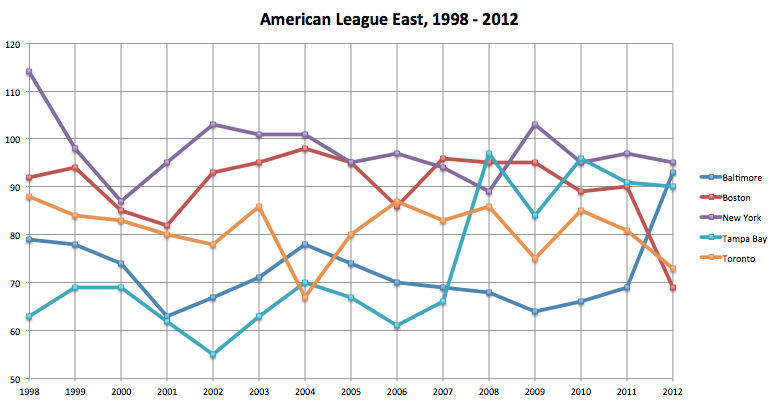
Over the past 15 years, the American League East has become decreasingly predictable. Above: win totals from 1998 to 2012 by team.

Matthew Leach, writing for MLB.com, notes the recently emerging unpredictability of the American League East:

The division that set the standard for sameness is virtually unrecognizable these days.

Just a decade ago, the American League East race was the most predictable competition in sports. From 1998 through 2003, the five East teams finished in exactly the same order, every single year. Six straight seasons with the Yankees on top, the (Devil) Rays on the bottom, and the Red Sox, Blue Jays and Orioles in order in between. It was baseball’s version of a caste system…

As the 2013 campaign approaches, though, that predictability is gone. Last year offered a taste, but this year might bring full-on chaos. And that’s great news — unless you’re a Yankees fan.

All five teams could finish in different positions than they did a year ago. Every club in the division has reason to think it can finish first. Every team in the division has reason to fear a flop. You want wide-open? You’ve got it.

Chris Lund, who wrote about this same phenomenon last December for The Hardball Times, was on the same page:

The Yankees and Red Sox both appear to be very expensive, mortal teams. The Tampa Bay Rays have several question marks on their roster. The Toronto Blue Jays have completely overhauled their roster, though how it will play out on the field remains to be seen. The Baltimore Orioles have stood pat thus far after a dream season one year ago.

The AL East seems as wide open as ever. Five teams are roughly capable of competing with one another, though many would score the Rays, Jays and Yankees as the favorites to come away with the division crown. Yet, with so much parity in the “toughest division in sports”, there has never been more reason to feel that the AL East has wandered into vulnerability.

The graph above tells the story. The biggest season-over-season improvement for any one team in the AL East over that 15-year period was that of the Tampa Bay Rays from 2007 to 2008. Not only did they improve from 66 to 97 wins — an astounding 31-win jump — but they literally changed their name as well. (In 2007, they were the Tampa Bay Devil Rays. The next year they became the Tampa Bay Rays.)

As for the single biggest drop, that dubious distinction belongs to my beloved Boston Red Sox, whose collapse this past year — 69 wins, versus 90 in 2011 — was really just a continuation of the disaster begun in September 2011.

Zooming out to include all Major League Baseball teams, I’ve analyzed every year-over-year win differential since 1996/1997. (Although the current divisional format began in 1994, both that season and the subsequent one were shortened by the infamous strike.) The largest change in win total from one year to the next took place from 1997 to 1998, when the Florida Marlins’ record plummeted from 92-70 in their sophomore year to 54-108 the next season. Going in the other direction, the 1999 Arizona Diamondbacks improved on their 1998 total by 35 wins, jumping from an abysmal 65-97 record in their inaugural year to 100-62 in the followup.

The 2007/2008 jump of 31 wins for the Tampa Bay (Devil) Rays is second only to that leap by the Diamondbacks, going all the way back to 1996/1997 (a period that encompasses 506 entire team-seasons). Conversely, it provides me only a modicum of relief to note that the 2012 Red Sox’ 21-win dip is only bad enough to tie for 16th-worst year-over-year decline in that period — along with the 2002 Chicago Cubs (2001: 88-74; 2002: 67-95) and 2012 Philadelphia Phillies (2011: 102-60; 2012: 81-81).

Let’s just say I’m looking forward to putting all of this behind us for 2013. Oh, and go Red Sox.

Enhanced by Zemanta

The thrill of human flight?

airfare
Graph courtesy of Boston.com, TheAtlantic.com, and AEI-Ideas.org. Take your pick.

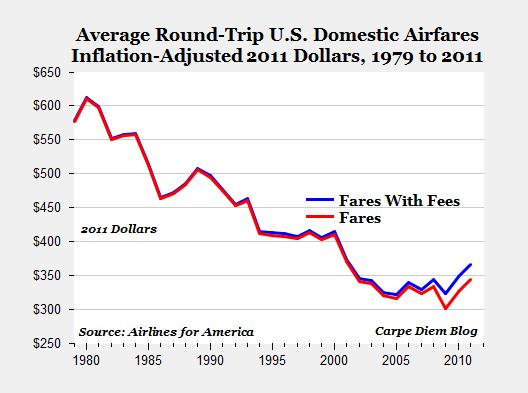
Patrick Smith, a pilot, flags the above chart — which has been floating around the Internet today — as a means to illustrate his point that flying is actually, on balance, a much better experience now than it was in the past:

Whenever I take the time to remind people of just how inexpensive flying has become, my inbox gets socked with hate mail. People simply hate flying, and the level of anti-airline contempt is so high that it has become almost impossible to say anything positive about the experience without being called a shill, a lackey, or worse.

It’s only in the past 30 years or so that flying as we know it — as an affordable form of mass transit — has come to exist.

I’ll remind you too that roughly 83 percent of flights arrive on time.

However, this last sentence is not entirely accurate. As the Times of India and others have reported, airlines routinely engage in “schedule padding:”

Industry insiders are aware that airlines often fudge flight block timings to show a good on-time performance record. This is why the journey time on tickets varies even if the sector (Mumbai-Jaipur, for instance) is the same. For instance, the actual flying time-or block time-from Mumbai to Jaipur is an hour and 30 minutes. However, one airline may give the block time as an hour and 35 minutes, while another may have a more inflated schedule of an hour and 50 minutes.

“Airlines do this to create a buffer for delays. So, even if they are delayed, a higher block time on paper gives them room to land a bit late and still be on time,” an airport official said. “However, most of them arrive early and ask for landing when other scheduled flights are already waiting,” he added.

The result (at least in this case)?

Early arrival of flights at Mumbai is causing massive congestion. What’s equally worrying is that though the Directorate General of Civil Aviation (DGCA) has issued a standardised block time for all flights, airlines continue to manipulate timings to maintain an untainted on-time performance record.

Data submitted to the civil aviation ministry shows that in October [2011], 1,435 flights arrived more than 15 minutes before the scheduled time. In November [2011], 1,239 flights arrived early.

Enhanced by Zemanta

Let’s Make Sure Financial Aid Actually Aids Students

If Congress doesn’t get its act together and pass legislation to avoid the 5% across-the-board cuts to the federal budget (aka the “sequester”), the higher education world will suffer through even more painful rounds of budget cuts. The Chronicle of Higher Education has this story covered:

“Thousands of researchers will lose their jobs, thousands of students will lose their financial aid, and thousands of unemployed workers will be turned away from college work-force programs.”

At a time when it seems like having a college degree is necessary for even the lowest-level jobs, these are troubling developments indeed:

“Though Pell Grants would be exempt from the sequester this year, Federal Work Study and Supplemental Educational Opportunity Grants would not. Arne Duncan, the secretary of education, has told lawmakers his department will make 33,000 fewer work-study awards and 71,000 fewer supplemental grants next year if the cuts take effect.”

US Capitol
There might be some late nights here coming up…
[Photo via U.S. House of Representatives]
Besides this whole fiasco with the sequester though, Congress has some other higher ed-related legislative business to take care of in 2013: The Higher Education Act of 1965 is up for reauthorization. Judging by the sluggish pace at which the last reauthorization was passed (the 2003 reauthorization finally got passed…in 2008), we might be seeing the 2013 HEA reauthorization get pushed back for a while.

Let’s imagine, though, that the 113th Congress will actually do its job and reauthorize the HEA on time (ok, sorry, I didn’t mean to make you laugh there). But before it does, there are a few ideas Congress needs to hear first about overhauling the federal student financial aid system.

It could start with what I would consider “low-hanging fruit”: Continue reading Let’s Make Sure Financial Aid Actually Aids Students

Old American dignitaries speaking French

The series continues tonight with shiny new Secretary of State — and longtime francophile — John Kerry in Paris:

[youtube http://www.youtube.com/watch?v=YVcI50YBnLg]

New York Magazine explains more:

In Paris today, Kerry chose to speak in French unprompted, but the press conference in which he refused a direct request to speak in French took place in Washington. Kerry was famously mocked for his Francophilia during the 2004 presidential race, and perhaps, in his mind, speaking French in the Treaty Room of the White House — the very seat of American power — would open him up to the same kind of right-wing derision more so than would speaking French in France, which is really just good manners. It’s a theory based on a small sample size, admittedly.

The other possibility is that Kerry, justifiably, just hates Canada.

And here is the video of Kerry refusing to speak French in Washington:

[youtube http://www.youtube.com/watch?v=q3AF_8w1VsQ]
Enhanced by Zemanta

SCOTUS Opinion Alert: In Which Transparency is Dealt a Body Blow

Obama on Phone

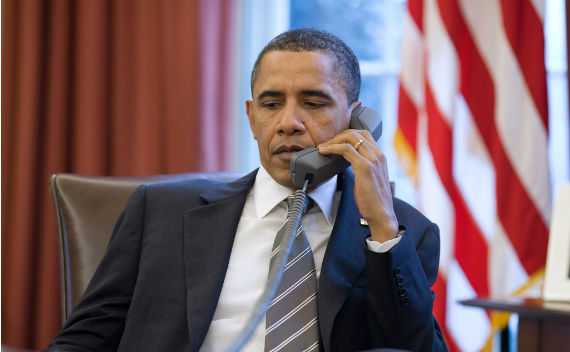
How do you know he’s not listening in on your conversations? Answer: you don’t.

 [Photo by Pete Souza, found via the Council on Foreign Relations]

For those of us who believe that the government needs to be more transparent in matters of national security, yesterday was not a very good day. In its first 5-4 opinion of this term, the Supreme Court split along ideological lines and ruled in favor of protecting a wide-ranging international surveillance program from constitutional challenges. Specifically, the Clapper v. Amnesty International opinion makes it much more difficult for lawyers, journalists, and human rights practitioners who suspect the United States of wiretapping their communications with non-Americans abroad to bring suit for such governmental behavior unless they have concrete proof that their correspondence will be intercepted.

At issue in Clapper is the Foreign Intelligence Surveillance Act (FISA), which allows the United States to target the communications of non-citizens on foreign soil. First authorized in 1978, FISA originally limited the Government to instances where it could show probable cause (to a special closed court known as a Foreign Intelligence Surveillance Court) that its individual targets were “foreign powers or the agents of foreign powers.”  In 2008, however, Congress amended FISA to include Section 1881a, a provision which removed the probable cause requirement and greatly expanded both the pool of people and the kinds of communications that could be monitored.

While FISA is aimed at foreign nationals who fall outside the protection of the Fourth Amendment, one effect of the law was the warrantless interception of thousands of international communications between FISA targets and American citizens. Shortly after the passage of 1881a, a group of American legal, labor, media and human rights organizations led by Amnesty International asked the Supreme Court to overturn that provision. Claiming that they frequently communicate with non-American clients, coworkers, witnesses and sources abroad, the challengers argued that this law violated their First and Fourth Amendment rights.

Before they could even get to the constitutionality of 1881a, however, the challengers ran into a practical problem: because of the secrecy involved in such surveillance programs, they couldn’t find any hard evidence that the United States was actually looking at their correspondence. Since Article III of the Constitution requires that you show some “injury” before you can bring a suit, Amnesty International argued that the injury lay in the “objectively reasonable likelihood” their conversations were or might be intercepted. The challengers further claimed that they had suffered numerous economic and professional harms in trying to avoid these interceptions, such as having to fly abroad to speak with clients in-person rather than over phone or email, and the reluctance of sources to disclose information in light of the potential eavesdropping. In response, the United States claimed that no one in this group had standing to bring this lawsuit, because (1) FISA targets only non-Americans, and (2) they simply could not prove that they were being intercepted. After the Second Circuit agreed with Amnesty International, the United States brought an appeal.

 Justice Alito

Justice Samuel Alito, a huge fan of certainty.

[Photo via Columbia Law School]

Justice Alito’s opinion, which was joined by Chief Justice Roberts and Justices Scalia, Thomas and Kennedy, reverses the Second Circuit ruling by accepting the Government’s stance that the challengers’ claimed injuries were too speculative to allow the suit to continue to trial. Alito found the Second Circuit’s “objectively reasonable likelihood” standard inconsistent with his reading of Supreme Court precedents, which he believes require a (much harder to show) “certainly impending” injury in order to establish standing. Ignoring the fact that it would be nearly impossible for any American to prove that the Government will monitor his correspondence under 1881a, Alito repeatedly emphasized that the challengers’ fears of future surveillance were nothing more than a “highly attenuated chain of possibilities.” Likewise, Alito brushed aside the fact that some of the challengers’ foreign contacts included the friends and family of Guantanamo detainees (including rather high-profile clients like Khalid Sheikh Mohammed and Mohammedou Ould Salahi) whose communications had already been monitored by the United States.

The majority opinion was also quite unsympathetic to the increased economic and professional costs of operating under 1881a, despite the fact that lawyers and journalists have an ethical duty to protect confidential communications with clients and sources:

“[The challengers] cannot manufacture standing merely by inflicting harm on themselves based on their fears of hypothetical future harm that is not certainly impending… Because [they]do not face a threat of certainly impending interception under 1881a, the costs that they have incurred to avoid surveillance are simply the product of their fear of surveillance.”

Naturally, the liberal wing of the Court, which had vociferously questioned the United States at oral argument about the fairness of a law for which virtually no one has standing to challenge, took issue with all parts of the majority opinion. The Justice Breyer-penned dissent also looked to precedent and rejected the majority’s “certainly impending” injury standard in favor of a “reasonable probability” or “high probability” injury standard:

“…[C]ertainty is not, and has never been, the touchstone of standing. The future is inherently uncertain. Yet federal courts frequently entertain actions for injunctions and for declaratory relief aimed at preventing future activities that are reasonably likely or highly likely, but not absolutely certain, to take place. And that degree of certainty is all that is needed to support standing here.”

Breyer went on to list no fewer than 18 cases in which federal courts found standing even where the likelihood of injury was “far less certain than here.” In addition, he argued that under the Supreme Court’s 2010 decision in Monsanto Co. v. Geertson Seed Farms, “reasonable efforts to mitigate the threatened effects of the future injury”–i.e., the economic costs that the 1881a challengers incurred in trying to keep their communications confidential–could constitute an injury sufficient enough for standing. Looking at the Government’s motive, capabilities and previous actions under 1881a and some other “commonsense inferences,” the dissent concluded that the challengers had in fact met the “reasonable probability” of injury standard and should have been allowed to contest 1881a’s constitutionality at trial.

Unfortunately, the dissenting justices were unable to convince a fifth colleague over to their side, meaning that the federal government is now incentivized to take one more step away from transparency. In his opinion, Justice Alito countered this concern by choosing to place his faith in the special Foreign Intelligence Surveillance Courts, which he believes will keep the Government accountable to the Constitution. As Justice Breyer’s dissent pointed out, however, these closed, secret courts (which do not make their hearings or records available to the public) very rarely reject any of the Government’s surveillance plans, and should not be the only safeguard for Americans’ civil liberties.  Nonetheless, the message that the Supreme Court sent yesterday is clear: the more secretive the United States keeps its national security programs, the safer they are from constitutional challenges, and the harder it is for ordinary Americans to vindicate what may be flagrant violations of their rights. We should all be very scared.

A win for gun control, perhaps not for democracy

Robin Kelly, a Democratic candidate in the Illinois special election to replace Jesse Jackson, Jr. in Congress, just won her primary today — and is now a shoe-in to win the seat. The Times explains part of how this happened:

Riding a wave of “super PAC” spending that helped catapult her to the front of a crowded Democratic field, Robin Kelly, whose campaign called for tougher national gun laws, clinched her party’s nomination Tuesday in a special primary election for the House seat vacated by Representative Jesse L. Jackson Jr.

The outcome of the contest, which had been unexpectedly cast into the center of the national gun debate, was welcome news for Michael R. Bloomberg, the mayor of New York and a staunch gun-control advocate. He poured more than $2.2 million into attacking Ms. Kelly’s chief opponent, Debbie Halvorson, this month.

Flooding Chicago airwaves, Mr. Bloomberg’s super PAC, Independence USA, ran a series of advertisements criticizing Ms. Halvorson for opposing certain gun control measures and endorsing Ms. Kelly as the alternative candidate.

The advertising campaign, a huge amount for a single House race, set up Ms. Halvorson’s defeat on Tuesday as a shot across the bow to other Democrats supporting gun rights, a sign of what could await future candidates who do not align with Mr. Bloomberg’s quest to change firearm laws across the country.

Last October, I examined Bloomberg’s strategy and came away disappointed:

In the face of this frontal assault on our democratic ideal of “one person, one vote,” Mayor Bloomberg’s attempt to launch political moderates back into the halls of power amounts to little more than a bandage. And it is the worst kind, because it confuses the symptom for the underlying illness: by using the very same funding tactics that helped drive the fringe into the mainstream American political landscape in the first place, Bloomberg’s efforts constitute an implicit endorsement of the post-Citizens United world. But accelerating the funding arms race is not the right long-term approach.

Enhanced by Zemanta

Baseball Prospectus figure of the day

From Baseball Prospectus 2013, page 53:

[The 2012 Boston Red Sox] missed 1,587 man-games to injury, second most of any team since 2007, as far back as our data goes. We estimate those injuries cost Boston 7.9 WARP [Wins Above Replacement Player], the most in baseball by 1.4.

Over at the web site, guest writer John Paschal takes a crack at why baseball players get injured so often, and in such bizarre fashion:

So, given the fact that objective math provides only an incomplete answer, we must turn to the subtle art of subjective guessing, with each of us hazarding a sound hypothesis as to why baseball players seem to suffer a disproportionate number of very odd mishaps—the sort that saw former infielder Chris Brown miss time because he “slept on (his) eye funny” and former infielder Geoff Blum land on the DL with an elbow injury he sustained while putting on a shirt. And let’s not forget the time All-Star Ron Gant, just a week after signing the largest single-season contract in history, broke a leg in an off-season motorcycle accident, or the day All-Star Larry Walker separated his shoulder while fishing.

“I’d say the reason baseball players injure themselves in weird ways is because they (a) have a lot of free time; and (b) they have a lot of money,” posits baseball writer Craig Calcaterra, of the NBC Sports website Hardball Talk, in an emailed response. “This allows them to fill that free time with all manner of fun and, occasionally, dangerous activities. Helping things along is that, as elite athletes, they have never had a particularly hard time doing things most people can’t do. I have this feeling a lot of them think they’re going to be immediately and effortlessly successful in other pursuits as well. Which, unfortunately, isn’t always the case.”

John Thorn, the Official Historian of Major League Baseball, is considerably more succinct.

“Randomness,” he writes.

Yes, it’s that time of year: I’m geeking out about baseball again.

Enhanced by Zemanta