This is bad reporting.

Let’s assume you’re a normal person. And let’s propose a scenario in which, after years of gridlock between Republicans and Democrats in Washington, the GOP finally seems to be willing to give a little — now that they’ve definitively lost the last two presidential elections and polling appears to be mostly on the side of Democratic policies.

In such a situation, you’d probably welcome the prospect of a Republican thaw and assume it may help produce actual bipartisan legislation for once, no?

Well, no. Not if you’re the New York Times:

But the politics of one core dispute between Democrats and Republicans — what to do about Medicare — are changing. And some of those changes complicate President Obama’s agenda, even as he continues to flex his postelection muscle.

One shift is the shrinking magnitude of the Medicare spending problem — a consequence, at least for now, of a recent slowdown in the rise of health care costs. That diminishes the willingness of Congressional Democrats, and perhaps the administration, too, to accept the sort of Medicare curbs that Mr. Obama has indicated that he favors.

Another is a moderation in the public stance of Republican leaders. In recent weeks, they have advocated smaller changes to Medicare than the “premium support” or voucher plan that Mitt Romney advocated and that Mr. Obama denounced in last year’s presidential campaign.

As a result, Mr. Obama’s ability to deliver a bipartisan compromise on entitlement spending may be waning even as Republicans edge closer to one.

That’s right: Republican moderation is partly why President Obama may be unable to “deliver a bipartisan compromise.” If that sounds ridiculously counterintuitive, it’s because it is.

Yes, I realize the point of the article: that Obama and the Democrats now feel they have the upper hand, which might make them likelier to press their advantage while they have it — thus derailing the hope of a deal. (Never mind the fact that there is virtually no historical/empirical basis to support the notion that the Democrats have taken, or will ever take, advantage of whatever leverage they have.)

But this contorted logic only makes any sense in the context of the conventional wisdom that major media players like the New York Times help create. Mainstream journalists love to mock bloggy sites like Politico for their seeming giddiness in reporting on Washington insider politics, and yet this article — appearing in the Paper of Record, no less — is Beltway cynicism at its worst.

Maybe if the Times focused less on creating counter-incentives that don’t yet exist and exerted more effort instead on sensible reporting of actual political developments, we wouldn’t have so many of these manufactured crises in the first place.

Delusion of the day

Jennifer Rubin in the Washington Post:

Israeli Prime Minister Benjamin Netanyahu sounded the alarm that Iran was approaching “a red line.” Did the U.S. president even mention any of this? No, he was running around the country crying wolf and catastrophizing about an invented crisis. The real international threats go unremarked upon. For all intents and purposes Netanyahu is now the West’s protector.

What they said:

http://twitter.com/ggreenwald/statuses/305764175563591681

Enhanced by Zemanta

TEDx SIPA revisited

[youtube http://www.youtube.com/watch?v=VAz0bOtfVfE]

Last Sunday, I posted a not entirely positive review of TEDx SIPA. At one point, I took issue with a speaker’s depiction of the Peace Corps:

Later, a SIPA student passionately critiqued the Peace Corps model, declaring, “Grateful as I am for my experience in the Peace Corps, I recognize that the developing world cannot just be a training ground for young, idealistic Americans. The problems in communities like the one I lived in are far too serious for that.” And yet he was speaking at a conference created entirely for young, idealistic (and often inexperienced) Americans interested in solving enormous global problems — the type whose very presence at TEDx signalled their personal enthusiasm for the brand of fifteen-minute bursts of inspiration in which the speaker was participating himself. Indeed, his extrapolation of his own disillusionment with his two-year volunteering effort in South Africa into an ardent condemnation of the entire Peace Corps’ allegedly flawed practices was itself a case study in misplaced idealism.

It appears I wasn’t the only one. Today, SIPA’s student-run newspaper The Morningside Post (disclosure: I am its opinion editor) ran a piece by Audrey Huse that zeroed in on the Peace Corps talk’s flaws:

I’m surprised Mr. Kortava finished his two years, and I commend him for it. But it seems he thought he was going to South Africa to singlehandedly halt the HIV epidemic, and such high expectations can lead to disillusion and disappointment. The TEDx event did not seem an appropriate venue to vent his frustrations. The TEDx  platform is intended to present innovative ideas worth spreading. If there was one in Kortava’s talk, I missed it.

Granted, Kortava’s is hardly the first critique of the Peace Corps, nor will it be the last. (It’s also not the first time he’s done it himself, either.) But I wasn’t primarily interested in discussing the specific merits of the Peace Corps in my previous post. I was bothered more by Kortava’s overly simplistic take on it, and the way in which that “quick fix” attitude permeated so many of the speeches I heard during the TEDx conference that day.

Anyway, my friend and flatmate Andres Lizcano Rodriguez — who, incidentally, runs a very cool blog of his own — took issue with some of my comments. With his permission, I’ve reproduced portions of his response here:

I think you’re being a big, arrogant ass. Of course there’s a problem in fitting everything into a 17-minute presentation. The fact is, most of the world does not consist of Ivy League grad students, and not everyone can simply digest complicated critiques or fact-based lectures and policy analysis.

I’m not sure those Krugman graphs would be for everyone. I think your critique is in large part a critique of the ascendant pop-intellectual craze, but what is the problem with making intellectuality a popular thing? TEDx conferences will never be intellectual activities, but that isn’t their goal in the first place. (I think…and I hope.) They’re meant to motivate you to start considering something that you might not have known about, or seen in the same way, before. All the “goddamn assholes” that already know all this stuff aren’t representative of the broader population.

(By the way, the Peruvian author Mario Vargas Llosa makes a similar point to yours — not about TED talks but about culture. He keeps whining about the fact that everybody can be an artist or writer now, and that that has diminished the quality….all because he seems to feel that the intellectual aristocracy is threatened.)

Additionally, I think you’re underestimating the importance of passion and empowerment. Granted, it’s a big US-American cliché — I also despise all this “OMG that was so inspiring” stuff — but it’s not like that everywhere in the world.

You said:

There is a clear line connecting the type of thinking exemplified by TEDx and that of similarly grandiose but ill-informed ventures like the “Kony 2012” campaign. It’s not passion that’s lacking. But passion is dangerous in the hands of an institution that encourages superficial speech-giving and a daylong mutual back-scratch with an adoring audience.

But passion and self-esteem actually lack in many places. In my college in Bogotá — an elite university — we were not told all the time, like we are here, that we would be the future leaders of our country, that we could do everything we wanted, etc. etc. And thus I was often surrounded by many people — who were much smarter and more competent than I was — who didn’t dare to do anything because they didn’t feel they could actually achieve their goals. Most people had never actually considered that they could “dream big.”

Essentially, here are my points:

1. I think you’re misinterpreting the objective of a TED talk and, if interpreted differently, it could actually be of greater value to a broad audience than you’ve given it credit for.

2. I think you’re underestimating the importance of inspiration, empowerment, and passion.

After watching the above video, he summarized:

While we all agree on his points, nothing is being done about them. And I think part of the reason for this is that there are not enough people reminding us of his points. Meanwhile, there are tons of people (such as our own Office of Career Services) telling us all day long (in other formats) that we need to find a job at Goldman Sachs or the World Bank. Maybe it would be more efficient if TED opened offices at the big schools and scared the hell out of people so that they started behaving correctly. The point is that people need to be reminded of these big ideas, even if they already know them.

Enhanced by Zemanta

Are the writers still “In Control?” Sam Lim and I tackle Episode 4 of The Americans

Jay: After last week, this episode felt a bit like a letdown. The action was good, the tension was decent, but the dialogue basically muddled through and the plot was weaker than it was in “Gregory.”

First, though, I have to get a pet peeve off my chest. Stan’s boss says of the attempted assassin, “[If] this guy’s said ‘Nyet’ once in the past ten years, we’re gonna find out when and where.” Why do so many TV shows and movies have lines like that? No one talks in such melodramatic phrases.

But even aside from a few campy moments — another one is when Elizabeth is arguing with Phil about staying committed to the Soviet Union: that debate is already getting old for me, and Elizabeth still hasn’t looked convincing while doing it yet — the plot got into weird territory at times.

claudia

First, why are Phil, Elizabeth, and “Claudia” all so willing to talk in their car openly (and even somewhat loudly)? They drop bugs all over the place — I’m guessing one was in the pin Phil gave to that nurse, most recently — but they’re not even remotely nervous that they’re being watched? Even after Phil knows for certain Stan was suspicious enough to snoop around their garage and check out their car?

Speaking of cars, it was never explained how they got rid of the security guard’s car. Dumping a body is one thing, but making a car disappear is another matter entirely. Maybe that’ll get brought up in a later episode.

Another thing: why would Nina’s boss tell her colleague to follow her? Once again, there’s really no explanation given for why all the right people are wary of all the other right people. It’s too uncanny, and too much like network TV.

Which brings me to my next complaint: remember how Nina was recruited in the first place? Because she got caught stealing caviar from the embassy. If you were her, wouldn’t you rather just confess the theft and try to find a new job, instead of risking your life running around every time the FBI calls? In defense of the show, I suppose it’s feasible that she feels it’s now too late, that even if she stopped working for the FBI they’d ruin her life (or end it) anyway. But her risk/reward calculations don’t seem that smart right now.

Side note: I don’t get what took place when Phil called that guy with a bunch of phones and asked to get to the vice president’s office. Was he figuring out who the nurse was? And who was that dude with all the phones?

One last thing: I couldn’t help but notice that when Paige went over her friend’s house to apologize, she was playing with her hands in the exact same way Dana does all the time on Homeland. Is that the universal TV representation of “awkward teenager?”

Sam: I couldn’t agree more with everything you pointed out! My biggest mistake this week: raising my expectations. Before I watched the episode, I read that this week’s episode would cover the assassination attempt on President Reagan, and for some reason, I thought it would make for an interesting episode, to say the least. I was wrong. Continue reading Are the writers still “In Control?” Sam Lim and I tackle Episode 4 of The Americans

Reviving the art of the online conversation

Sarah Perez at TechCrunch brings up a point I’ve been thinking about myself lately:

Blog commenting systems are bizarre, broken and dated. TechCrunch recently switched from Facebook Comments to Livefyre – a change that, for the record, I had no say in. I’m not sure I see value. I don’t agree with some of the sentiment expressed here, which almost makes it sound like this site, and all its authors, missed the trolling days of TechCrunch Past. We don’t.

What was really missing, at least in my opinion, was the sense of community that blog comments once provided. But there’s no system alive that can bring that back, because that era of the web is over. And it has been for a long, long time…

The problem, which the Internet hasn’t solved at all, and has in fact even made worse, is that opinions are not created equal and therefore shouldn’t be considered in equal measure. The Internet has put people on such an even playing field that we now have to create entirely new systems to verify who’s worth listening to. From Google rankings to Techmeme headlines to retweets and number of followers, we’re still struggling to figure out who deserves to be heard.

I’ve been considering this problem on somewhat different terms: for me, the question is mostly how to best stimulate online conversation on my own blog. Should I switch to Facebook commenting? Use another system entirely? In general, the dropoff between number of people who’ve read a post and number who’ve commented is enormous. I’m still thinking of ways to make that engagement easier for people — and if you have any ideas, let ’em fly in the comments!

Enhanced by Zemanta

Double talk on the sequester

Jamelle Bouie cries foul on Republican attempts to portray the looming sequester as the Democrats’ fault:

A key part of the GOP’s strategy on the sequester is to blame President Obama for the fact it exists at all. One good example is House Speaker John Boehner’s op-ed in today’s Wall Street Journal:

With the debt limit set to be hit in a matter of hours, Republicans and Democrats in Congress reluctantly accepted the president’s demand for the sequester, and a revised version of the Budget Control Act was passed on a bipartisan basis.

Ultimately, the super committee failed to find an agreement, despite Republicans offering a balanced mix of spending cuts and new revenue through tax reform. As a result, the president’s sequester is now imminent.

The big problem with this narrative is that it directly contradicts Boehner’s rhetoric at the time. After the deal was crafted, in July 2011, Boehner told GOP House members that “There was nothing in this framework that violates our principles.” Later, in an interview with CBS News following the House vote on the bill, he described the deal as such: “When you look at this final agreement that we came to with the White House, I got 98 percent of what I wanted. I’m pretty happy.” And, as a whole, the House GOP was fine with the deal too—it passed 269-161, with 174 Republicans voting in favor.

Enhanced by Zemanta

Editor in Chief

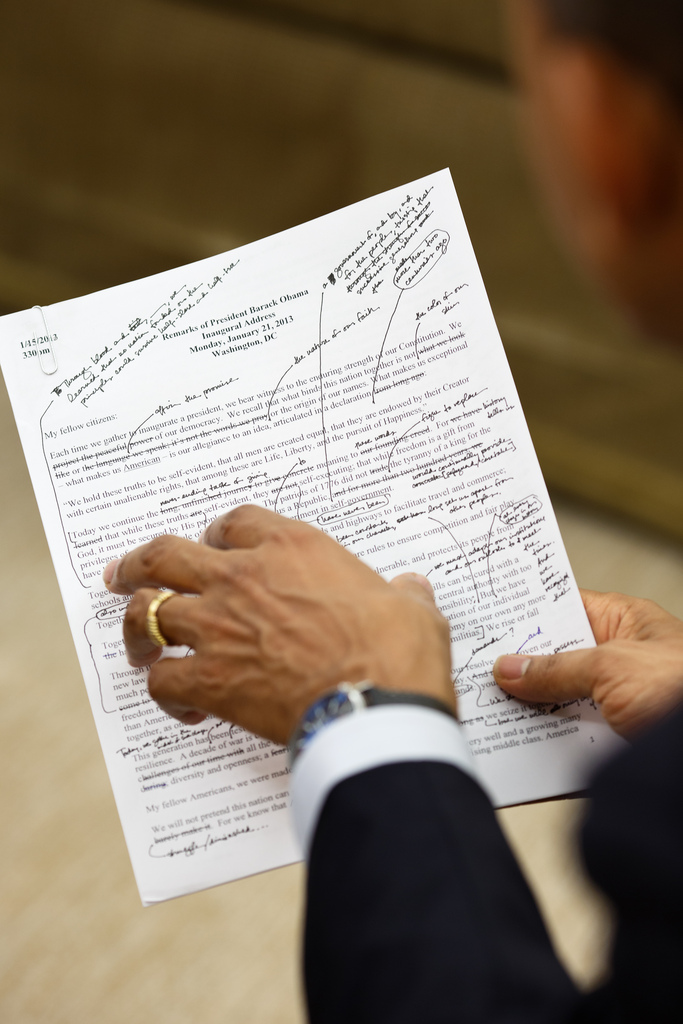
President Barack Obama works on his inaugural address with Jon Favreau, Director of Speechwriting, not pictured, in the Oval Office, Jan. 16, 2013. (Official White House Photo by Pete Souza)

Slate highlights this photo from White House photographer Pete Souza:

The photo shows only a portion of the first page of what was a rather lengthy speech, but what we can see nonetheless largely confirms previous anecdotes that Obama prefers to take an active role in shaping his remarks, particularly for major events like an inauguration or State of the Union address…The changes you can make out if you zoom in on this particular photo range from minor grammar tweaks to some relatively heavy rewrites.