Big data has trouble with big problems. If you are trying to figure out which e-mail produces the most campaign contributions, you can do a randomized control experiment. But let’s say you are trying to stimulate an economy in a recession. You don’t have an alternate society to use as a control group. For example, we’ve had huge debates over the best economic stimulus, with mountains of data, and as far as I know not a single major player in this debate has been persuaded by data to switch sides.
Paul Krugman takes a look and says, “Waittt a minute here:”
It would be lovely to live in a world in which the failure of interest rates to soar as predicted would lead Brian Riedl of Heritage and Niall Ferguson to concede that their anti-stimulus critiques of 2009 were based on a completely wrong model; in which the economic downturns that have followed austerity policies almost everywhere they have been applied would lead Alberto Alesina to concede that his work on expansionary austerity was probably flawed, and lead George Osborne to proclaim publicly that he led Britain down the wrong path. But such things very rarely happen, and the fact that they don’t happen has nothing to do with the limitations of data…
So yes, it has been disappointing to see so many people sticking to their positions on fiscal policy despite overwhelming evidence that those positions are wrong. But the fault lies not in our data, but in ourselves.
A week ago, I took a look at Andrew Sullivan’s blog, The Dish, in order to see how the implementation of a “Read On” meter had affected the content structure of his blog. I found the following:
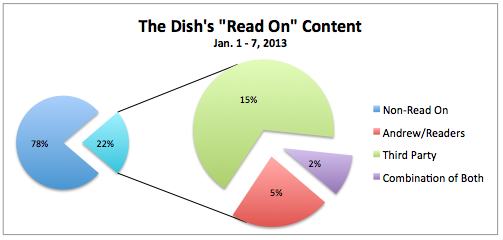
Bottom line: Andrew Sullivan has almost perfectly inverted his “Read On” content from before to after the implementation of the meter. From January 1 to 7, he posted 231 times; of those, only 52 (22.5%) included “Read On” buttons. Of those 52 “Read On” sections, 35 consisted primarily of third-party content (67.3%), 12 mostly contained material produced by Andrew and his readers (23.1%), and the remaining 5 were a combination of Andrew/readers and third-party content (9.6%).
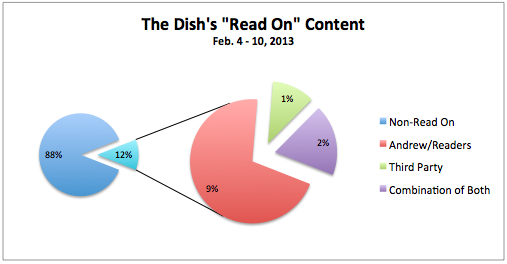
From February 4 to 10, however, several things changed. The number of total posts was almost identical to the January period (227), but — as he promised — there were significantly fewer “Read On” posts in the first week of the new meter (27, or only 11.9% of the total). Of those 27, 19 contained content primarily contributed by Andrew and his readers (70.4%), 5 contained a combination (18.5%), and only 3 “Read On” sections during the entire week contained content mostly attributable to third parties (11.1%, or 1.3% of the entire population of posts this past week).
For more on the methodology of exactly how I categorized Sullivan’s various posts, see the original post. The first graph below depicts the stats for January 1 – 7, a week I chose as the control group for The Dish‘s content structure before the meter:
Before the meter.
This second graph portrays the composition of The Dish‘s content from the very first full week that the meter was in effect, February 4 – 10:
The first week of the meter.
As Sullivan pointed out, The Dish rolled out the meter slowly in its first week: compared to the control week in January, when 22% of all posts contained “Read On” buttons, only 12% of all posts had the button in the first week of the meter. Furthermore, the type of content behind the meter was quite different: whereas the control period was dominated by third-party content beyond the “Read On” button, in the first week of the meter the majority of “Read On” sections primarily contained content produced by Andrew Sullivan and his readers.
Because that first week under the new meter was intended to be a bit of a test run, it remained to be seen how the stats would change (or stay the same) once the “Read On” button began to be used at a more normal frequency. So as a follow-up, I’ve now conducted an identical study of the very next week, February 11 – 17.
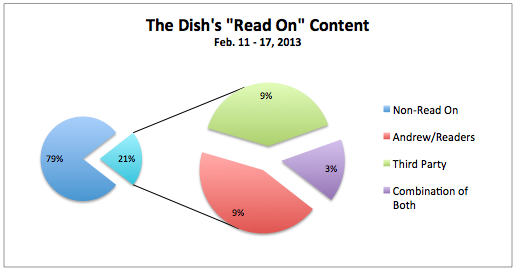
The total number of posts was similar to that of the previous two periods (237). Of those posts, 50 (21.1%) contained a “Read On” button: note that this is almost exactly the same percentage as in the control week (22.5%). Of those 50 sections located after the “Read On” button, 22 (44.0%) contained content primarily produced by Andrew and his readers, 20 (40.0%) contained content mostly taken from third-party sources, and the remaining 8 (16.0%) contained a combination of both. See the graph below:
The second week of the meter.
Again, I have shared the entire Excel spreadsheet here, in case anyone wishes to contest my methodology or categorization. As I mentioned in my original post:
Obviously, there is a small subjective element to the endeavor. However, this is probably much less significant than one might think: the vast majority of posts on The Dish – and this applies equally to the “Read On” and non-”Read On” sections of each post – quite clearly fall into one of the three categories specified above: content produced primarily by Andrew and/or his readers, content produced primarily by third parties, and content containing a mixture of both.
So after a pretty significant dip in “Read On” posts in the first week of the meter — while the kinks were being ironed out — The Dish‘s content has since returned to its pre-meter ratio of non-“Read On” to “Read On” posts. However, what lies beyond the meter has shifted: whereas 67.3% of all “Read On” sections before the meter contained mostly third-party content, now the plurality of “Read Ons” (44.0%) consist of content provided by Andrew and his readers (from analysis to letters to views from people’s windows). The proportion composed of third-party content has fallen to 40.0%, with the remaining 16.0% of all “Read On” sections comprised of material that contains both.
What this likely means is that Sullivan and his team have taken to heart the precautions of readers and commentators who noted that, to charge for content, the part that’s hidden to non-subscribers should tend to be more original — as opposed to a curation of third-party material.
One thing I didn’t touch on in my original post, but which I did measure, is the composition of every post before the “Read On” button — that is, the portion of each post one can see whether or not one is a subscriber. (This includes posts without a “Read On” button at all.) In the January 1 – 7 period, content was divided thusly: 67.5% of pre-“Read On” sections were primarily third-party content, 21.6% were content produced by Andrew Sullivan and his readers, and the remaining 10.8% were a mixture of both. (This was an almost identical proportion to the composition of the material after the “Read On” button during the same period.)
For the February 4 – 10 period, these numbers were: 64.8% = third-party content, 22.5% = Andrew/readers, and 12.8% = a combination. (I’m rounding to one decimal point here, so that’s why it doesn’t add up to exactly 100.0%.)
And for this last week (February 11 – 17), here are the proportions: 63.7% = third-party content, 21.5% = Andrew/readers, and 14.8% = a combination. Considering the fact that all three time periods had almost identical compositions of material before the “Read On” button, the significant changes in material beyond the button present an even starker contrast.
I believe Sullivan mentioned recently that if the pace of subscribers didn’t pick up, he may “nudge” them towards paying their dues. This could happen in one of two ways. Either he could reduce the number of monthly “Read On” clicks it takes to trigger the meter (it’s currently at seven), or he could introduce more “Read On” posts as a percentage of his total posts. As an early subscriber, it doesn’t really matter to me which one he chooses. But so far at least, the content lying beyond the “Read On” button certainly seems to justify the annual fee.
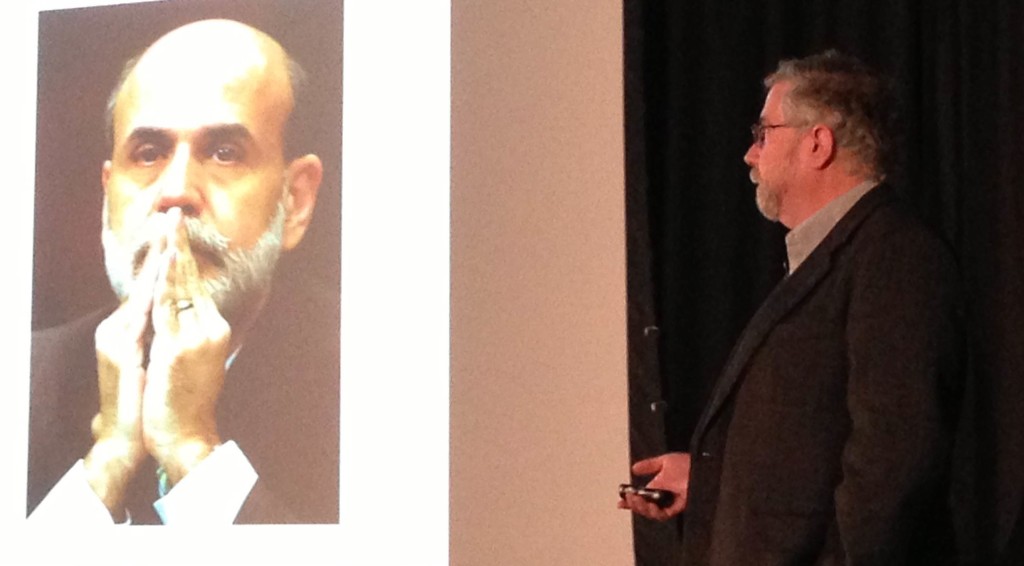
Battle of the Beards: Paul Krugman eyes his sometime bête noire, Ben Bernanke. TEDx talk at Columbia University’s School of International and Public Affairs. Friday, February 15, 2013.)
It wasn’t until after all the speeches had ended and everyone was mingling around the makeshift bar outside that I finally made the connection: TEDx is just like church.
I can’t remember the first time I heard about TED, the conference series that emerged into the spotlight rather suddenly several years ago and has become a staple of the socially conscious set ever since. But I distinctly recall feeling mounting skepticism with each new mention of the organization, which was often expressed in near-mythic terms and was almost always unqualifiedly positive.
The first full talk I recall actually watching myself was Dutch General and then-Chief of Defence Peter van Uhm’s TEDx speech in the Netherlands in 2011. I’d been assigned the video for a graduate class in January of last year. The course was on the American military, and the TEDx talk I’d been instructed to watch was titled “Why I Chose the Gun.” Here’s how it started:
Well, ladies and gentlemen, first of all, thank you for giving me an applause before I even started. As the highest military commander of the Netherlands, with troops stationed around the world, I’m really honored to be here today. When I look around this TEDx Amsterdam venue, I see a very special audience: you are the reason why I said yes to the invitation to come here today. When I look around, I see people who want to make a contribution. I see people who want to make a better world — by doing groundbreaking scientific work, by creating impressive works of art, by writing critical articles or inspiring books, by starting up sustainable businesses. And you all have chosen your own instruments to fulfill this mission of creating a better world.
This, as I would soon discover, was as perfect a microcosm of the TED experience (TEDxperience?) as one could find. First, the establishment of his credentials; then, the obligatory salute to the audience; and, finally, the ode to the transcendent ideal of “a better world.” Continue reading My problem with TEDx→
Sam: I almost liked this whole episode. But even with managed expectations this week, I still couldn’t buy it all. Allow me to explain.
On the whole, I thought this episode was perhaps the best one so far. The whole scene with Gregory’s guys moving Joyce, Robert’s wife that no one knew about, off the street was pretty smooth. The story lines, for the most part, weren’t tangential.
But, I still found myself not liking the show any more than I did after episode one. I’m realizing that perhaps my dislike of this series has more to do with my dislike for mushy family-ness than the show itself. I find myself wanting to just skip the scenes between Philip and Elizabeth working out their wacky relationship problems, and perhaps because the non-relationship parts of the show are not on par with that of Homeland‘s, the show seems ehh to me.
But, my own realizations aside, let me now point out the parts I found strange. Did it seem strange to you that Elizabeth had such a deep contact in Philly? The way she explained it she must have met Gregory shortly after she and Philip moved to the US. For such a loyal KGB agent, she seemed unusually chatty about her ties with him when they first met. Sure, she fell for the dude, but wouldn’t she have been even more steely and committed to her cause than she is now? I just found this story line to be a bit of a stretch.
Also, the way Granny was introduced in the restaurant where Philip and his daughter were having breakfast just seemed weird. Who interrupts other people’s conversations from the bar? Maybe no one bothers me from across restaurants I go to, but that seemed strange to me. Finally, Stan must be quick at tying his shoelaces, because he didn’t look like he’d finished tying it when we started running after the dude “in the hood.”
President Obama has been busy in the last few days rousing thousands of early childhood practitioners and advocates with his call for high-quality pre-k for all low- and moderate-income families. The administration has clarified parts of the plan, which have answered some questions and opened some new ones. The proposal is the biggest push for early childhood services since Head Start in the 1960s, a federally funded pre-k program to serve low-income families.
The plan, which I will henceforth refer to as “Obama-garten” (you’re welcome), proposes a four-pronged approach to supporting the development of young children through the expansion of high-quality pre-k access, full-day kindergarten, Early Head Start for infants to 3-year-olds, and a home visiting initiative. Many are pleased that the plan involves the under-three crowd, which is often neglected in U.S. policy. The details of the “new federal-state partnership” to expand high-quality pre-k to children up to 200% of the poverty line and incentivize states to “broaden participation in their public preschool program for additional middle-class families” have yet to be fully explained, but my guess is that some pretty tasty looking carrots will be dangled in front of states in order for them to participate. And participate they should. In fact, a handful of states, both red and blue, have already pledged some kind of commitment to supporting young children and their families in the last few months, signaling increased readiness to beef-up their early childhood services.
This video of Senator Elizabeth Warren putting the hurt on a bunch of regulators in her first hearing on the Senate Banking Committee is pretty amusing. I’m a big fan of the clip that starts at about 2:30, when Warren asks Tom Curry, who heads a little regulatory agency called the Office of the Comptroller of the Currency, why the OCC hasn’t taken more Wall Street banks to trial, rather than settling out of court and getting them to pay a penalty when they break the law, and Curry hems and haws and can’t really answer, so he basically goes full Milton from Office Space and then just kind of trails off and sulks.
Even though Wall Street bankers weren’t the target of Warren’s interrogation yesterday — the regulators who oversee them were — the financial industry is apparently freaking out about the hearing, on the theory that it augurs a tough road for them ahead in dealing with Warren as a senator. Ben White got some quotes from scared financial industry executives who called her performance “shameless grandstanding” and accused her of competing with Ted Cruz for the title of “most extreme fringe freshman senator.”
Which raises the question: Are these people kidding?
Max Blumenthal was monitoring a police scanner during the standoff between alleged cop killer Christopher Dorner and the police who had surrounded the cabin where he was staying:
In an initial dispatch, a deputy reported seeing “blood spatter” inside the cabins. Dorner, who had just engaged in a firefight with deputies that killed one officer and wounded another, may have been wounded in the exchange. There was no sign of his presence, let alone his resistance, according to police dispatches.
It was then that the deputies decided to burn the cabin down.
“We’re gonna go ahead with the plan with the burner,” one sheriff’s deputy told another. “Like we talked about.” Minutes later, another deputy’s voice crackled across the radio: “The burner’s deployed and we have a fire…”
Over the course of the next hour, I listened as the sheriffs carefully managed the fire, ensuring that it burned the cabin thoroughly. Dorner, a former member of the LAPD who had accused his ex-colleagues of abuse and racism in a lengthy, detailed manifesto, was inside. The cops seemed to have little interest in taking him alive.
“Burn that fucking house down!” shouted a deputy through a scanner transmission inadvertently broadcast on the Los Angeles local news channel, KCAL 9. “Fucking burn this motherfucker!” another cop could be heard exclaiming.
This fact hardly registered in the media, however:
At the time that I am writing this, some online media outlets are beginning to entertain the possibility that San Bernardino County Sheriff’s deliberately set the fire that killed Dorner – a fact that I reported on Twitter as soon the sheriff’s department order came down. If there is any doubt about the authenticity of theYouTube clip containing audio of the sheriff deputies’ orders to burn the cabin down, I can verify that it is the real thing. I was listening to the same transmissions when they first blared across the police scanners.
In the hours after the standoff, however, the police cover-up remained unchallenged thanks largely to local media complicity. An initialLos Angeles Times report recounted the incident in a passive voice, claiming “flames began to spread through the structure, and gunshots, probably set off by the fire, were heard.” Similarly, LA’s ABC affiliate, KABC, quoted Bachman’s vague comment about “that cabin that caught fire,” failing to explore why it was aflame or who torched it.
Today, the Los Angeles Times reported claims by anonymous “law enforcement sources” that the sheriffs used “incendiary tear gas” to flush Dorner out of the cabin. The sources claimed the deputies who had besieged the cabin were under a “constant barrage of gunfire” and that, “There weren’t a lot of options.”
The Verge is reporting that the entire Criterion Collection of films will be available to stream for free via Hulu — from today through the weekend. Happy Valentine’s Day!
The company has routinely offered up selections from its catalog — normally exclusive to paying Hulu Plus subscribers — for complimentary viewing, but now it’s opening up the floodgates and making hundreds of classic motion pictures available at no cost. If you’re spending Valentine’s Day alone, at least you can now spend your evening lost in the timeless treasures of cinema.
My personal favorites are from the thirties and forties. In February of 1942, The New Yorker reported on “the saddest Valentine’s Day story” of the year:
[It’s] an enormously involved affair which starts with a young lady named Therese telephoning Western Union and asking that Valentine Greeting 242 be delivered to a certain young man. Valentine Greeting 242 might be criticized as kind of silly, but it’s definitely harmless; it reads, “Hens cackle, Roosters crow, You’re my Valentine, Don’t cha know.” Western Union, however, sent out Valentine Greeting 241, which reads, “Be my Valentine, Be my honey, We’ll live on Love and Daddy’s money.” Daddy got hold of it, inevitably, and while he is probably no more suspicious than other daddies, there was a lot of explaining to be done. Western Union, we’re glad to report, wrote a manly, straight-forward letter accepting all the blame, which was considerable.




 Sam: I almost liked this whole episode. But even with managed expectations this week, I still couldn’t buy it all. Allow me to explain.