Category Archives: Miscellaneous

The thrill of human flight?

airfare
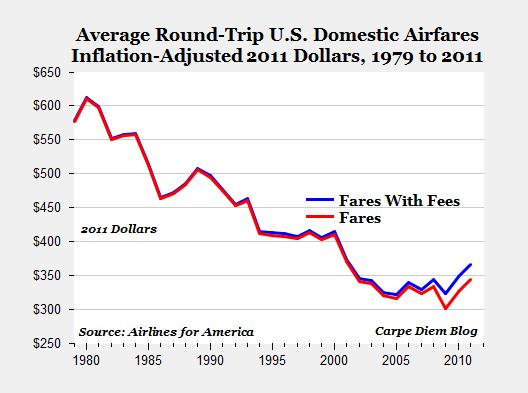
Graph courtesy of Boston.com, TheAtlantic.com, and AEI-Ideas.org. Take your pick.

Patrick Smith, a pilot, flags the above chart — which has been floating around the Internet today — as a means to illustrate his point that flying is actually, on balance, a much better experience now than it was in the past:

Whenever I take the time to remind people of just how inexpensive flying has become, my inbox gets socked with hate mail. People simply hate flying, and the level of anti-airline contempt is so high that it has become almost impossible to say anything positive about the experience without being called a shill, a lackey, or worse.

It’s only in the past 30 years or so that flying as we know it — as an affordable form of mass transit — has come to exist.

I’ll remind you too that roughly 83 percent of flights arrive on time.

However, this last sentence is not entirely accurate. As the Times of India and others have reported, airlines routinely engage in “schedule padding:”

Industry insiders are aware that airlines often fudge flight block timings to show a good on-time performance record. This is why the journey time on tickets varies even if the sector (Mumbai-Jaipur, for instance) is the same. For instance, the actual flying time-or block time-from Mumbai to Jaipur is an hour and 30 minutes. However, one airline may give the block time as an hour and 35 minutes, while another may have a more inflated schedule of an hour and 50 minutes.

“Airlines do this to create a buffer for delays. So, even if they are delayed, a higher block time on paper gives them room to land a bit late and still be on time,” an airport official said. “However, most of them arrive early and ask for landing when other scheduled flights are already waiting,” he added.

The result (at least in this case)?

Early arrival of flights at Mumbai is causing massive congestion. What’s equally worrying is that though the Directorate General of Civil Aviation (DGCA) has issued a standardised block time for all flights, airlines continue to manipulate timings to maintain an untainted on-time performance record.

Data submitted to the civil aviation ministry shows that in October [2011], 1,435 flights arrived more than 15 minutes before the scheduled time. In November [2011], 1,239 flights arrived early.

Enhanced by Zemanta

TEDx SIPA revisited

[youtube http://www.youtube.com/watch?v=VAz0bOtfVfE]

Last Sunday, I posted a not entirely positive review of TEDx SIPA. At one point, I took issue with a speaker’s depiction of the Peace Corps:

Later, a SIPA student passionately critiqued the Peace Corps model, declaring, “Grateful as I am for my experience in the Peace Corps, I recognize that the developing world cannot just be a training ground for young, idealistic Americans. The problems in communities like the one I lived in are far too serious for that.” And yet he was speaking at a conference created entirely for young, idealistic (and often inexperienced) Americans interested in solving enormous global problems — the type whose very presence at TEDx signalled their personal enthusiasm for the brand of fifteen-minute bursts of inspiration in which the speaker was participating himself. Indeed, his extrapolation of his own disillusionment with his two-year volunteering effort in South Africa into an ardent condemnation of the entire Peace Corps’ allegedly flawed practices was itself a case study in misplaced idealism.

It appears I wasn’t the only one. Today, SIPA’s student-run newspaper The Morningside Post (disclosure: I am its opinion editor) ran a piece by Audrey Huse that zeroed in on the Peace Corps talk’s flaws:

I’m surprised Mr. Kortava finished his two years, and I commend him for it. But it seems he thought he was going to South Africa to singlehandedly halt the HIV epidemic, and such high expectations can lead to disillusion and disappointment. The TEDx event did not seem an appropriate venue to vent his frustrations. The TEDx  platform is intended to present innovative ideas worth spreading. If there was one in Kortava’s talk, I missed it.

Granted, Kortava’s is hardly the first critique of the Peace Corps, nor will it be the last. (It’s also not the first time he’s done it himself, either.) But I wasn’t primarily interested in discussing the specific merits of the Peace Corps in my previous post. I was bothered more by Kortava’s overly simplistic take on it, and the way in which that “quick fix” attitude permeated so many of the speeches I heard during the TEDx conference that day.

Anyway, my friend and flatmate Andres Lizcano Rodriguez — who, incidentally, runs a very cool blog of his own — took issue with some of my comments. With his permission, I’ve reproduced portions of his response here:

I think you’re being a big, arrogant ass. Of course there’s a problem in fitting everything into a 17-minute presentation. The fact is, most of the world does not consist of Ivy League grad students, and not everyone can simply digest complicated critiques or fact-based lectures and policy analysis.

I’m not sure those Krugman graphs would be for everyone. I think your critique is in large part a critique of the ascendant pop-intellectual craze, but what is the problem with making intellectuality a popular thing? TEDx conferences will never be intellectual activities, but that isn’t their goal in the first place. (I think…and I hope.) They’re meant to motivate you to start considering something that you might not have known about, or seen in the same way, before. All the “goddamn assholes” that already know all this stuff aren’t representative of the broader population.

(By the way, the Peruvian author Mario Vargas Llosa makes a similar point to yours — not about TED talks but about culture. He keeps whining about the fact that everybody can be an artist or writer now, and that that has diminished the quality….all because he seems to feel that the intellectual aristocracy is threatened.)

Additionally, I think you’re underestimating the importance of passion and empowerment. Granted, it’s a big US-American cliché — I also despise all this “OMG that was so inspiring” stuff — but it’s not like that everywhere in the world.

You said:

There is a clear line connecting the type of thinking exemplified by TEDx and that of similarly grandiose but ill-informed ventures like the “Kony 2012” campaign. It’s not passion that’s lacking. But passion is dangerous in the hands of an institution that encourages superficial speech-giving and a daylong mutual back-scratch with an adoring audience.

But passion and self-esteem actually lack in many places. In my college in Bogotá — an elite university — we were not told all the time, like we are here, that we would be the future leaders of our country, that we could do everything we wanted, etc. etc. And thus I was often surrounded by many people — who were much smarter and more competent than I was — who didn’t dare to do anything because they didn’t feel they could actually achieve their goals. Most people had never actually considered that they could “dream big.”

Essentially, here are my points:

1. I think you’re misinterpreting the objective of a TED talk and, if interpreted differently, it could actually be of greater value to a broad audience than you’ve given it credit for.

2. I think you’re underestimating the importance of inspiration, empowerment, and passion.

After watching the above video, he summarized:

While we all agree on his points, nothing is being done about them. And I think part of the reason for this is that there are not enough people reminding us of his points. Meanwhile, there are tons of people (such as our own Office of Career Services) telling us all day long (in other formats) that we need to find a job at Goldman Sachs or the World Bank. Maybe it would be more efficient if TED opened offices at the big schools and scared the hell out of people so that they started behaving correctly. The point is that people need to be reminded of these big ideas, even if they already know them.
Enhanced by Zemanta

Editor in Chief

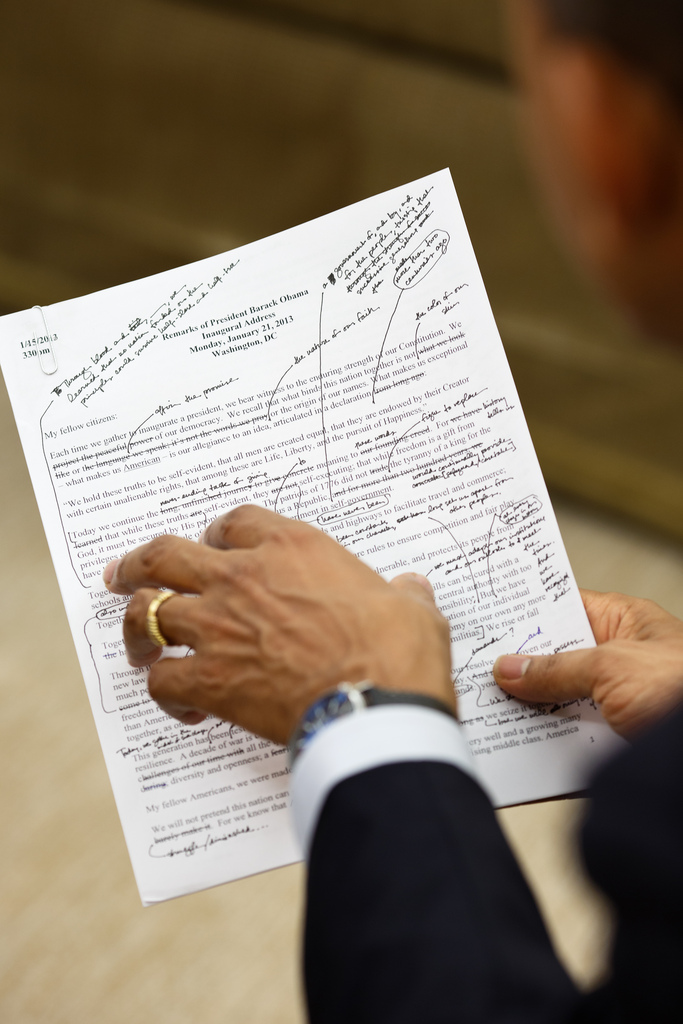
President Barack Obama works on his inaugural address with Jon Favreau, Director of Speechwriting, not pictured, in the Oval Office, Jan. 16, 2013. (Official White House Photo by Pete Souza)

Slate highlights this photo from White House photographer Pete Souza:

The photo shows only a portion of the first page of what was a rather lengthy speech, but what we can see nonetheless largely confirms previous anecdotes that Obama prefers to take an active role in shaping his remarks, particularly for major events like an inauguration or State of the Union address…The changes you can make out if you zoom in on this particular photo range from minor grammar tweaks to some relatively heavy rewrites.

My problem with TEDx

krugman
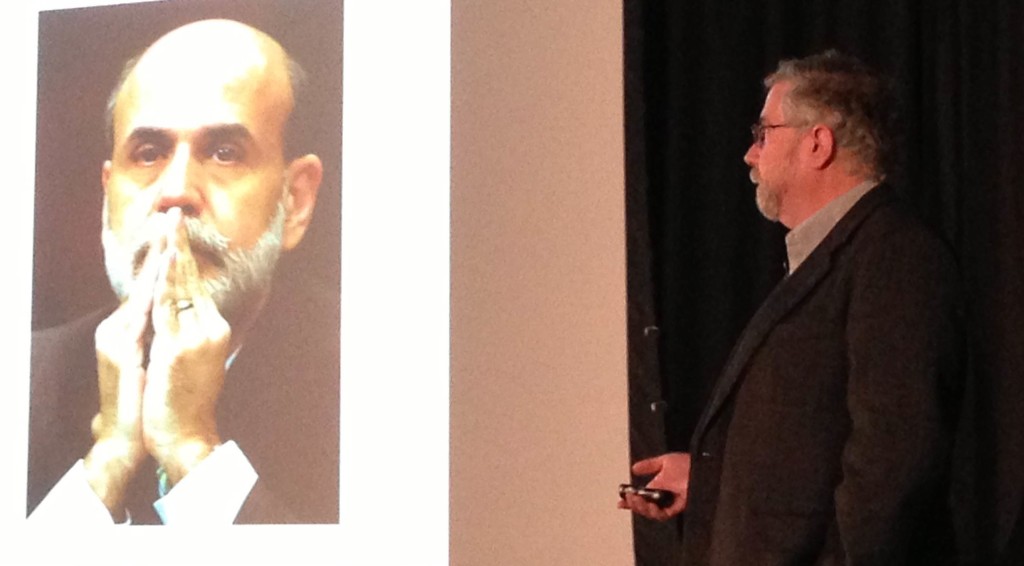
Battle of the Beards: Paul Krugman eyes his sometime bête noire, Ben Bernanke. TEDx talk at Columbia University’s School of International and Public Affairs. Friday, February 15, 2013.)

It wasn’t until after all the speeches had ended and everyone was mingling around the makeshift bar outside that I finally made the connection: TEDx is just like church.

I can’t remember the first time I heard about TED, the conference series that emerged into the spotlight rather suddenly several years ago and has become a staple of the socially conscious set ever since. But I distinctly recall feeling mounting skepticism with each new mention of the organization, which was often expressed in near-mythic terms and was almost always unqualifiedly positive.

The first full talk I recall actually watching myself was Dutch General and then-Chief of Defence Peter van Uhm’s TEDx speech in the Netherlands in 2011. I’d been assigned the video for a graduate class in January of last year. The course was on the American military, and the TEDx talk I’d been instructed to watch was titled “Why I Chose the Gun.” Here’s how it started:

Well, ladies and gentlemen, first of all, thank you for giving me an applause before I even started. As the highest military commander of the Netherlands, with troops stationed around the world, I’m really honored to be here today. When I look around this TEDx Amsterdam venue, I see a very special audience: you are the reason why I said yes to the invitation to come here today. When I look around, I see people who want to make a contribution. I see people who want to make a better world — by doing groundbreaking scientific work, by creating impressive works of art, by writing critical articles or inspiring books, by starting up sustainable businesses. And you all have chosen your own instruments to fulfill this mission of creating a better world.

This, as I would soon discover, was as perfect a microcosm of the TED experience (TEDxperience?) as one could find. First, the establishment of his credentials; then, the obligatory salute to the audience; and, finally, the ode to the transcendent ideal of “a better world.” Continue reading My problem with TEDx

A New Yorker Valentine’s Day

The magazine took a meandering walk through its archives today:

My personal favorites are from the thirties and forties. In February of 1942, The New Yorker reported on “the saddest Valentine’s Day story” of the year:

[It’s] an enormously involved affair which starts with a young lady named Therese telephoning Western Union and asking that Valentine Greeting 242 be delivered to a certain young man. Valentine Greeting 242 might be criticized as kind of silly, but it’s definitely harmless; it reads, “Hens cackle, Roosters crow, You’re my Valentine, Don’t cha know.” Western Union, however, sent out Valentine Greeting 241, which reads, “Be my Valentine, Be my honey, We’ll live on Love and Daddy’s money.” Daddy got hold of it, inevitably, and while he is probably no more suspicious than other daddies, there was a lot of explaining to be done. Western Union, we’re glad to report, wrote a manly, straight-forward letter accepting all the blame, which was considerable.

Enhanced by Zemanta

The new First Casualty

We’ve finally made the switch to an independently hosted site — meaning the blog’s going to be more customizable and will allow for a lot of cool new looks and features going forward. (Case in point: you can now comment via your Facebook or Twitter logins.) Let me know what you think of the new look in the comments section! There will probably be a few glitches here and there, so make sure to keep checking back. Also, if you’d already subscribed to the blog before, please double-check to ensure you still are; I believe everyone’s been transferred over but you can just re-subscribe if not.

And, as always, thanks for reading!

– Jay

Just say no to drugs

Jerry Saltz was taken aback by the new Henri Matisse exhibit at the Met:

Midway through the Metropolitan Museum of Art’s “Matisse: In Search of True Painting,” I ran into the painter Alex Katz. He looked at me, agog, and said, “I thought I was going to faint when I saw these paintings.” He gestured at two Matisse still lifes from 1946. Already in a stunned state of my own, I followed his lead and gulped at the revolutionary pictorial power and radical color radiating off these two powerhouses, one dominated by a celestial red and an arrangement on a table. In the foreground were either a dog and cat chasing each other or a pair of animal-skin rugs.

Then I looked at the painting next to it. I saw the same still life depicted on the same table with the same vase, goblet, and fruit. But this version was totally different. Where the dog and cat were, there’s an ultraflat still life within the still life. It’s so categorically compressed that it looks less than two-­dimensional — maybe one-half-­dimensional. I thought I, like Katz, might pass out.