Category Archives: Technology

We are now fully Facebooked

like

As you may have noticed, I’ve finally brought The First Casualty into the 21st century. By this I mean, of course, that I’ve finally gotten rid of the old WordPress Like button and replaced it with a Facebook Like button (see above, if you’ve been living under a rock for about a decade or so). You may have also noticed that my posts now use Facebook’s commenting system as well. (Posts with pre-existing comments under the WordPress system will retain those comments, but you’ll now be able to add Facebook comments to them as well. However, the little comment counter under the headline for each post now only counts comments written using the Facebook system.)

These changes make sense on a bunch of levels. But the main reason — and the most obvious one as well — is that everyone’s on Facebook. Thus, by integrating its functionality into my site, I’ll be able to reach a broader audience and have a larger conversation this way. The Facebook-style comments and the Like button will work exactly the same way on The First Casualty as they would on any other blog or site.

Hope you enjoy, and don’t forget to Like and comment whenever the urge hits! Which should be often, of course.

Reviving the art of the online conversation

Sarah Perez at TechCrunch brings up a point I’ve been thinking about myself lately:

Blog commenting systems are bizarre, broken and dated. TechCrunch recently switched from Facebook Comments to Livefyre – a change that, for the record, I had no say in. I’m not sure I see value. I don’t agree with some of the sentiment expressed here, which almost makes it sound like this site, and all its authors, missed the trolling days of TechCrunch Past. We don’t.

What was really missing, at least in my opinion, was the sense of community that blog comments once provided. But there’s no system alive that can bring that back, because that era of the web is over. And it has been for a long, long time…

The problem, which the Internet hasn’t solved at all, and has in fact even made worse, is that opinions are not created equal and therefore shouldn’t be considered in equal measure. The Internet has put people on such an even playing field that we now have to create entirely new systems to verify who’s worth listening to. From Google rankings to Techmeme headlines to retweets and number of followers, we’re still struggling to figure out who deserves to be heard.

I’ve been considering this problem on somewhat different terms: for me, the question is mostly how to best stimulate online conversation on my own blog. Should I switch to Facebook commenting? Use another system entirely? In general, the dropoff between number of people who’ve read a post and number who’ve commented is enormous. I’m still thinking of ways to make that engagement easier for people — and if you have any ideas, let ’em fly in the comments!

Enhanced by Zemanta

A Big Data divide at the Times

David Brooks says Big Data matters, but perhaps not as much as people think:

Big data has trouble with big problems. If you are trying to figure out which e-mail produces the most campaign contributions, you can do a randomized control experiment. But let’s say you are trying to stimulate an economy in a recession. You don’t have an alternate society to use as a control group. For example, we’ve had huge debates over the best economic stimulus, with mountains of data, and as far as I know not a single major player in this debate has been persuaded by data to switch sides.

Paul Krugman takes a look and says, “Waittt a minute here:”

It would be lovely to live in a world in which the failure of interest rates to soar as predicted would lead Brian Riedl of Heritage and Niall Ferguson to concede that their anti-stimulus critiques of 2009 were based on a completely wrong model; in which the economic downturns that have followed austerity policies almost everywhere they have been applied would lead Alberto Alesina to concede that his work on expansionary austerity was probably flawed, and lead George Osborne to proclaim publicly that he led Britain down the wrong path. But such things very rarely happen, and the fact that they don’t happen has nothing to do with the limitations of data…

So yes, it has been disappointing to see so many people sticking to their positions on fiscal policy despite overwhelming evidence that those positions are wrong. But the fault lies not in our data, but in ourselves.

It’s a good point from Krugman, who’s also been quite busy dealing with other knuckleheads.

Enhanced by Zemanta

Beyond the Dish meter, part II

A week ago, I took a look at Andrew Sullivan’s blogThe Dish, in order to see how the implementation of a “Read On” meter had affected the content structure of his blog. I found the following:

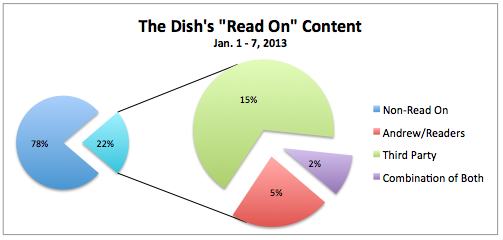
Bottom line: Andrew Sullivan has almost perfectly inverted his “Read On” content from before to after the implementation of the meter. From January 1 to 7, he posted 231 times; of those, only 52 (22.5%) included “Read On” buttons. Of those 52 “Read On” sections, 35 consisted primarily of third-party content (67.3%), 12 mostly contained material produced by Andrew and his readers (23.1%), and the remaining 5 were a combination of Andrew/readers and third-party content (9.6%).
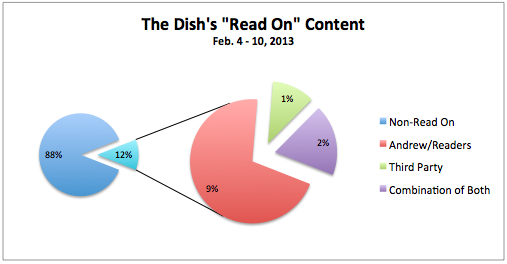
From February 4 to 10, however, several things changed. The number of total posts was almost identical to the January period (227), but — as he promised — there were significantly fewer “Read On” posts in the first week of the new meter (27, or only 11.9% of the total). Of those 27, 19 contained content primarily contributed by Andrew and his readers (70.4%), 5 contained a combination (18.5%), and only 3 “Read On” sections during the entire week contained content mostly attributable to third parties (11.1%, or 1.3% of the entire population of posts this past week).
For more on the methodology of exactly how I categorized Sullivan’s various posts, see the original post. The first graph below depicts the stats for January 1 – 7, a week I chose as the control group for The Dish‘s content structure before the meter:

Before the meter.
Before the meter.

This second graph portrays the composition of The Dish‘s content from the very first full week that the meter was in effect, February 4 – 10:

Just after the meter.
The first week of the meter.

As Sullivan pointed out, The Dish rolled out the meter slowly in its first week: compared to the control week in January, when 22% of all posts contained “Read On” buttons, only 12% of all posts had the button in the first week of the meter. Furthermore, the type of content behind the meter was quite different: whereas the control period was dominated by third-party content beyond the “Read On” button, in the first week of the meter the majority of “Read On” sections primarily contained content produced by Andrew Sullivan and his readers.

Because that first week under the new meter was intended to be a bit of a test run, it remained to be seen how the stats would change (or stay the same) once the “Read On” button began to be used at a more normal frequency. So as a follow-up, I’ve now conducted an identical study of the very next week, February 11 – 17.

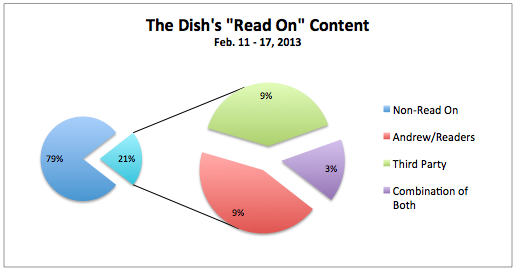
The total number of posts was similar to that of the previous two periods (237). Of those posts, 50 (21.1%) contained a “Read On” button: note that this is almost exactly the same percentage as in the control week (22.5%). Of those 50 sections located after the “Read On” button, 22 (44.0%) contained content primarily produced by Andrew and his readers, 20 (40.0%) contained content mostly taken from third-party sources, and the remaining 8 (16.0%) contained a combination of both. See the graph below:

The second week of the meter.

Again, I have shared the entire Excel spreadsheet here, in case anyone wishes to contest my methodology or categorization. As I mentioned in my original post:

Obviously, there is a small subjective element to the endeavor. However, this is probably much less significant than one might think: the vast majority of posts on The Dish – and this applies equally to the “Read On” and non-”Read On” sections of each post – quite clearly fall into one of the three categories specified above: content produced primarily by Andrew and/or his readers, content produced primarily by third parties, and content containing a mixture of both.

So after a pretty significant dip in “Read On” posts in the first week of the meter — while the kinks were being ironed out — The Dish‘s content has since returned to its pre-meter ratio of non-“Read On” to “Read On” posts. However, what lies beyond the meter has shifted: whereas 67.3% of all “Read On” sections before the meter contained mostly third-party content, now the plurality of “Read Ons” (44.0%) consist of content provided by Andrew and his readers (from analysis to letters to views from people’s windows). The proportion composed of third-party content has fallen to 40.0%, with the remaining 16.0% of all “Read On” sections comprised of material that contains both.

What this likely means is that Sullivan and his team have taken to heart the precautions of readers and commentators who noted that, to charge for content, the part that’s hidden to non-subscribers should tend to be more original — as opposed to a curation of third-party material.

One thing I didn’t touch on in my original post, but which I did measure, is the composition of every post before the “Read On” button — that is, the portion of each post one can see whether or not one is a subscriber. (This includes posts without a “Read On” button at all.) In the January 1 – 7 period, content was divided thusly: 67.5% of pre-“Read On” sections were primarily third-party content, 21.6% were content produced by Andrew Sullivan and his readers, and the remaining 10.8% were a mixture of both. (This was an almost identical proportion to the composition of the material after the “Read On” button during the same period.)

For the February 4 – 10 period, these numbers were: 64.8% = third-party content, 22.5% = Andrew/readers, and 12.8% = a combination. (I’m rounding to one decimal point here, so that’s why it doesn’t add up to exactly 100.0%.)

And for this last week (February 11 – 17), here are the proportions: 63.7% = third-party content, 21.5% = Andrew/readers, and 14.8% = a combination. Considering the fact that all three time periods had almost identical compositions of material before the “Read On” button, the significant changes in material beyond the button present an even starker contrast.

I believe Sullivan mentioned recently that if the pace of subscribers didn’t pick up, he may “nudge” them towards paying their dues. This could happen in one of two ways. Either he could reduce the number of monthly “Read On” clicks it takes to trigger the meter (it’s currently at seven), or he could introduce more “Read On” posts as a percentage of his total posts. As an early subscriber, it doesn’t really matter to me which one he chooses. But so far at least, the content lying beyond the “Read On” button certainly seems to justify the annual fee.

Enhanced by Zemanta

From the Criterion Collection, with love (and for free)

The Verge is reporting that the entire Criterion Collection of films will be available to stream for free via Hulu — from today through the weekend. Happy Valentine’s Day!

The company has routinely offered up selections from its catalog — normally exclusive to paying Hulu Plus subscribers — for complimentary viewing, but now it’s opening up the floodgates and making hundreds of classic motion pictures available at no cost. If you’re spending Valentine’s Day alone, at least you can now spend your evening lost in the timeless treasures of cinema.

Enhanced by Zemanta

Read on and on: The Dish, before and after the meter

dishAs most of the world knows by now — and by that I refer mainly to people like the ones that populate my Twitter feed — Andrew Sullivan has cut himself loose. On Monday, February 4th, The Dish officially switched over from the Daily Beast to Sullivan’s own WordPress-hosted site.

The change comes with a few extra bells and whistles: no ads or clutter, automatic resizing on smartphones (although this has yet to work on my iPhone), infinite scrolling, and so on. Probably my favorite new feature is the search engine — or as Sullivan put it, “I have given a sharp dagger for anyone who wants to make me look foolish.” On the very first day his new site appeared, in fact, I inadvertently stumbled upon this gem from October 2002:

The last phony anti-war argument was that President Bush had yet to “make the case” for war against Iraq, as if grown-ups didn’t have the capacity to make their own minds up on the issue without constant guidance from the commander-in-chief. But that surely must now be in tatters as a point, since the president has made speech after speech in the last year clearly laying out the rationale for the war on terror, a rationale that has always included defanging Saddam.

Oops.

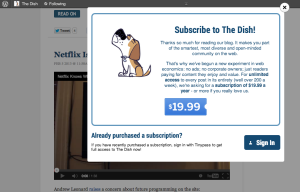
Anyway, the main transformation of The Dish is that it will now charge for its content. More precisely, after seven “Read On” clicks within a 30-day period, readers will be directed to a subscription page, where they’ll be able to sign up for a year of The Dish at the very manageable annual rate of $19.99.

As a medium-intensity Dish obsessive (on the spectrum, I’m somewhere between “regular reader” and “currently tattooing the Dish beagle to my forehead”) and aspiring journalist, I took great interest in Sullivan’s gamble, which basically amounted to throwing off the corporate chains — chains that were accompanied, of course, by a large financial backing — and going it alone. I began to wonder, as did many other readers, how the switch from a principally advertising-supported venture to one backed directly by the readers would affect the content and form of The Dish itself.

This being Andrew Sullivan, he was only too happy to share his readers’ concerns in the days leading up to the switchover. (In fact, Sullivan’s masochistic willingness, rare among bloggers, to frequently publish reader emails excoriating his commentary is one of the main reasons I was so happy to subscribe to the new reader-supported iteration of The Dish.)

After Sullivan published one reader’s blunt adieu to The Dish on January 3rd — “For better or worse I like my Internet free,” (s)he declared, and then, one hopes, enrolled in Microeconomics 101 — he reassured his audience: “A reminder to our reader and others that the vast majority of Dish content will remain free to non-members.”

Two weeks later, in response to more reader reactions, Sullivan again noted: “Even if all of my longer posts are metered, only a portion of my writing will go behind the read-on, thus allowing all readers to get the gist of the post, regardless of subscription.”

Perhaps most interestingly to me, however, was the cautionary point raised by another reader several days earlier:

Another reader worries that “there may be potential copyright issues if it was less than 50% original content/comments by the Dish team with a “charge” being issued by the Dish.” But another writes:

The read-on might actually work to the external sources’ advantage, in that non-payers will then have more reason to follow the link to the original if they’re interested.

The above-mentioned post, in fact, contained a variety of creative suggestions from readers as to how, exactly, Sullivan should handle the “Read On” issue. Now that all content beyond the “Read On” button (after the first seven monthly clicks, that is) requires payment, it would be interesting to see just what type of content Sullivan is placing behind the “paywall” (a term Sullivan himself dislikes but which more or less describes his new model).

Long story short: I’ve just now completed such a study. First, I analyzed every post on The Dish in the one-week period from January 1 to January 7, 2013, in which I categorized each entry by:

A) whether it included a “Read On” button

B) what type of content came before the “Read On” button (as in, the part that is visible without expanding the post): (1) primarily Sullivan and/or reader commentary, (2) primarily third-party content (e.g. excerpts from an article, column, or essay), or (3) a combination of both Sullivan/readers and third-party content (as when Sullivan excerpts articles and then critiques their points, rather than, for example, simply excerpting another article rebutting the first one)

C) what type of content came beyond the “Read On” button (using the same criteria), if there was one

I chose the first week of 2013 (somewhat arbitrarily) as my control group because it preceded the implementation of the meter model. I then performed the same analysis on all posts on The Dish in the week from February 4th (the first full day under the new meter model) to February 10th. (All times are in EST, by the way.)

A few caveats are in order. First, as Andrew Sullivan himself made clear, the opening week of his new site is not exactly a perfect representation of how the “Read On” button will be utilized in the future. On February 6th, in response to a reader who questioned the additional value granted by subscribing, Sullivan noted:

That’s because after two days, we’ve been going easy on the meter. We’ll adjust as we go along. We want to keep the majority of the site free, but the deeper analyses, reader threads, my own writing, and other features will slowly become less accessible to the non-subscriber. It’s a balance, and we’re trying to figure our way forward with it.

As you will see below, so far this formulation has meant a significant departure from Sullivan’s use of “Read On” prior to the advent of the meter. Back then, in my sample, over two-thirds of all “Read On” segments — that is, the portions of his posts that lay beyond the “Read On” button — consisted primarily of third-party content. Now, however, “deeper analyses, reader threads, [his] own writing, and other features” have gained an increasing share of the “Read On” pie. (Again, keep in mind that things are still in flux: it’s only been a week.)

A second caution applies to my criteria for categorizing the posts. Obviously, there is a small subjective element to the endeavor. However, this is probably much less significant than one might think: the vast majority of posts on The Dish — and this applies equally to the “Read On” and non-“Read On” sections of each post — quite clearly fall into one of the three categories specified above: content produced primarily by Andrew and/or his readers, content produced primarily by third parties, and content containing a mixture of both.

To use some of his more popular features as an example, both sections of a typical “View From Your Window” post (both the content before and beyond the “Read On” button, in other words) would obviously fall into the first category. A “Mental Health Break,” which rarely contains a “Read On” button, would usually fit into the second, since these posts generally consist of a video produced by someone else with no more than an accompanying line or two from Sullivan. And an “Yglesias Award Nominee” post, while possibly fitting into the second category, often instead went into the third — as Sullivan frequently added his own commentary to the quote itself (either in the pre- or post-“Read On” sections of the post). Anyway, in the interest of transparency, I have included a link to my full Excel spreadsheet analysis here.

Bottom line: Andrew Sullivan has almost perfectly inverted his “Read On” content from before to after the implementation of the meter. From January 1 to 7, he posted 231 times; of those, only 52 (22.5%) included “Read On” buttons. Of those 52 “Read On” sections, 35 consisted primarily of third-party content (67.3%), 12 mostly contained material produced by Andrew and his readers (23.1%), and the remaining 5 were a combination of Andrew/readers and third-party content (9.6%).

Screen Shot 2013-02-11 at 1.02.23 AM

From February 4 to 10, however, several things changed. The number of total posts was almost identical to the January period (227), but — as he promised — there were significantly fewer “Read On” posts in the first week of the new meter (27, or only 11.9% of the total). Of those 27, 19 contained content primarily contributed by Andrew and his readers (70.4%), 5 contained a combination (18.5%), and only 3 “Read On” sections during the entire week contained content mostly attributable to third parties (11.1%, or 1.3% of the entire population of posts this past week).

Screen Shot 2013-02-11 at 1.03.58 AM

Of course, only time will tell if this trend of more original material after the “Read On” button continues. It would certainly make sense, since this section is now being charged for after seven monthly clicks (which probably took the average Dish reader, what, five minutes to hit on February 4th?). I’d expect the percentage of posts that contain “Read On” buttons to rise pretty soon, because that’s one of the primary added-value propositions of subscribing. But I suppose how quickly this all happens will depend on a number of factors, including how many new subscribers Sullivan is scooping up on a regular basis now that more and more casual readers are starting to hit the meter.

In any case, I’m excited to see a blogger of Sullivan’s caliber jumping into such a bold experiment, and I wish him the best! I certainly don’t always agree with him, but even when he’s wrong, he’s never boring.

The cost of innovation

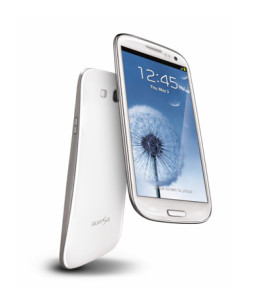
samsung
(Photo credit: Samsung.com.)

Every time a business hits it big — in this case, Samsung with its steady line of state-of-the-art phones and tablets — some intrepid reporter feels the need to explain that a significant portion of its success is attributable to the company’s organizational structure, its ethos, or the number of complimentary amenities available at the headquarter’s on-site gym. The latest exemplar of this approach:

Designers of the Galaxy S III say they drew inspiration from trips to Cambodia and Helsinki, a Salvador Dalí art exhibit and even a balloon ride in an African forest. (It employs 1,000 designers with different backgrounds like psychology, sociology, economy management and engineering.)

“The research process is unimaginable,” said Donghoon Chang, an executive vice president of Samsung who leads the company’s design efforts. “We go through all avenues to make sure we read the trends correctly.” He says that when the company researches markets for any particular product, it is also looking at trends in fashion, automobiles and interior design.

Hangil Song, a Samsung product designer, described a visit to the Marina Bay Sands resort in Singapore, where he said he was amazed by the views of the sky, the cityscape and the water. He wanted to create an effect where water was overflowing from the screen. As a result, taps and swipes on the Galaxy S III’s phone screen create a unique ripple effect.

That’s quite the overhead for a CPU-intensive transition visual.

Lessons in technology for the journalist crowd

The Columbia Journalism Review has some helpful tips for sniffing out hoaxes:

The audience received a thorough primer on forensic image analysis techniques. Recalling doctored images from “superstorm” Sandy and a hoax video of an eagle grabbing a baby that went viral in December, Farid and Clinch walked through methods and tips for quickly identifying phony images. Reflections and shadows in photographs have to line up according to basic optical principals, for instance. Another rule of thumb: Any picture with an unusually placed shark is fake.

Big Brother is watching you, from 17,500 feet up

The Atlantic‘s Alexis Madrigal has more:

One thing to note is that a drone can just hang out at 15,000 feet over a small city-sized area (roughly, half of Manhattan) and provide video surveillance of the whole thing. The other thing to note is that they are running machine vision on the moving objects, which means they are generating structured data out of the video, not just displaying the pictures.

I won’t get completely into the legal details, but what if some branch of government or a corporation (maybe not Google, but maybe Google) set one of these guys up over an American city. They say that Big Data analysis has told them that criminals (or consumers!) display certain types of behavior that can be spotted at that distance, helping them deploy police (or marketing promotions) on the ground more effectively. And the rest of the city’s citizens? Well, they’re collateral data.

An abandoned New Year’s resolution

Kevin Roose apologizes to Codecademy:

Dear Codecademy,

When we first met, just after New Year’s last year, I was inspired. You told me that I could learn how to program in just 365 days through your free “Code Year” lessons, and I believed you. After all, if Mayor Bloomberg was doing it, why couldn’t I? I eagerly signed up, and waited for the day that I, too, would be churning out C++ code like a pro.

That day never came.

Instead, your e-mails piled up, unread, in my in-box, while I attended to more pressing concerns. At first, you came bearing offers of specific lessons:

Code Year Week 4: Primitives in JavaScript

Code Year Week 5: Objects in JavaScript

Code Year Week 7: Loops in JavaScript

Then, as winter turned into spring — and my schedule kept not making room for coding lessons — your e-mails took on the tone of a more general pep talk. Hopeful exclamation points abounded:

Still want to learn to code? We’ll help you catch up!

Get ready for programming good times!

Programming begins here!

You must have known, Codecademy, that by the time July 4th came around, I was a goner. New Year’s resolutions rarely stick, and New Year’s resolutions that suddenly kick in after a six-month delay never do. Still, despite the fact that I had never once logged in to your website, you persisted in your hopes that I would get off my ass, clear my calendar, and make time for you.