All posts by Jay Pinho

About Jay Pinho

Jay is a data journalist and political junkie. He currently writes about domestic politics, foreign affairs, and journalism and continues to make painstakingly slow progress in amateur photography. He would very much like you to check out SCOTUSMap.com and SCOTUSSearch.com if you have the chance.

Underground theater

New York filmmaker Joshua Z Weinstein took an above-average interest in subway dance performers. (By “above-average,” I mean he glanced up from his newspaper long enough to notice them, which is more than can be said for most of us.)

It’s a good thing he did, too, because he deftly managed to elevate what can often seem an irritating (and invariably loud) performance into something approaching art:

After weeks of calls, I managed to book an afternoon shoot with some of the men, who call themselves the W.A.F.F.L.E. (We Are Family for Life Entertainment) crew: J-Black, Goofy, Boy Aero, Lex Aero, John-O and Sonic. I focused my lens on their hands seizing poles and feet fluttering in the air. As I zoomed in, I noticed that these self-taught artists are not just part of an underground subculture; their graceful moves also evoke a classical ballet.

Enhanced by Zemanta

The amorality of economics

In an easily-digestible piece for The New York Review of Books, Paul Krugman explains why economic austerity became so mainstream so fast:

Everyone loves a morality play. “For the wages of sin is death” is a much more satisfying message than “Shit happens.” We all want events to have meaning.

When applied to macroeconomics, this urge to find moral meaning creates in all of us a predisposition toward believing stories that attribute the pain of a slump to the excesses of the boom that precedes it—and, perhaps, also makes it natural to see the pain as necessary, part of an inevitable cleansing process. When Andrew Mellon told Herbert Hoover to let the Depression run its course, so as to “purge the rottenness” from the system, he was offering advice that, however bad it was as economics, resonated psychologically with many people (and still does).

By contrast, Keynesian economics rests fundamentally on the proposition that macroeconomics isn’t a morality play—that depressions are essentially a technical malfunction. As the Great Depression deepened, Keynes famously declared that “we have magneto trouble”—i.e., the economy’s troubles were like those of a car with a small but critical problem in its electrical system, and the job of the economist is to figure out how to repair that technical problem.

Enhanced by Zemanta

“Shall we do this weekly?” A statistical jaunt through View From Your Window history

The daily View From Your Window feature.

If there’s one thing I’ve learned in the two years I’ve just spent in grad school (an all-too-short, intercontinental reprieve from working life that just ended with Thursday’s graduation ceremony), it’s that diversions from studying and writing papers are absolutely crucial in order to stay sane.

Enter The Dish. Longtime readers of my blog (hello, family) will know that I’m a Dish obsessive, and I probably spend more time scrolling through its contents than on most other sites combined. One of the blog’s most popular features is the View From Your Window, which is really two features in one. In the daily version, Andrew Sullivan posts a reader-submitted picture of a view from a window, with a caption revealing where the photo was taken. And in the weekly feature that runs every Saturday, Sullivan posts a view from a window without any caption, inviting readers instead to guess the location. Dish readers are scarily accurate, generally finding the exact window of whatever building the photographer was in when (s)he snapped the photo. (And yes, I will be sending in a guess for Saturday’s View From Your Window contest.)

Since I’ve spent much of the last month or so cramming in last-minute papers, reports, and presentations, the need to escape has become more pronounced as well. And so that is how I came to catalog — sporadically, in fits and starts between bursts of academic inspiration — every daily and weekly View From Your Window post in the “modern era” of VFYW — the honorary category I’ve awarded to the library of posts starting from the very first weekly contest on June 9, 2010. (The source file is available here.) Continue reading “Shall we do this weekly?” A statistical jaunt through View From Your Window history

Like shooting fish in a barrel

[youtube http://www.youtube.com/watch?v=x92OWufIWcU]

Anthony Weiner officially announced his candidacy for mayor of New York City on Wednesday:

The improbable campaign that Mr. Weiner, a Democrat, unveiled on Wednesday hinges on his image as a shunned outsider whose political solitude has unburdened him from coddling New York’s powerful special interests and freed him to speak uncomfortable truths, according to those close to him.

A scrappy political street fighter, never known for forging alliances or sharing the limelight, Mr. Weiner said in an interview that “to some degree, this is my most natural footing.”

Of the endorsements that his rivals are collecting like trophies this year, he said, “I’ve never really structured a campaign that way.”

Instead, after a self-imposed two-year exile, the 48-year-old former congressman will initiate a series of neighborly public outings intended to showcase him interacting with ordinary New Yorkers and send a clear message: The scandal has passed, and a tough city is prepared to hear him out. That process is expected to start on Thursday, when Mr. Weiner visits a subway station in Harlem.

“There may be, or are, many New Yorkers who would never vote for me,” he said. “Even those New Yorkers, I want to have a conversation with.”

Enhanced by Zemanta

I’m not gone, just busy

[youtube http://www.youtube.com/watch?v=qnydFmqHuVo]

I haven’t disappeared. But the combination of final exams for my master’s program, preparations for moving once again (thankfully only within Manhattan this time), and gearing up for a couple graduation ceremonies has taken its toll.

I’ll be back with more shortly.

– Jay

Newt Gingrich is gently ushered into the 21st century

[youtube http://www.youtube.com/watch?v=jmKVRVX4q-k]

Newt Gingrich just won the Internet…again:

Newt Gingrich wants you to know that he is “puzzled” about what to call his cellphone, which can do a whole lot more than simply make calls. I’m puzzled by his entire video on the topic, but mostly by the fact that he hasn’t heard of the term smartphone.

The former House speaker uploaded the above video to YouTube on Friday, although it’s only starting to rack up the views now. In it, Gingrich asks for help coming up with a new name for that fancy black rectangle in his hand, one that will help “explain to people that they carry in their hand literally the potential to have a dramatic revolution in how we get things done.” The best alternative he and his team—yes, he has his best men at Gingrich Productions working on this—have come up with in the “weeks” they’ve spent on the task is: “handheld computer.”

Enhanced by Zemanta

The shorter version

FastCompany describes a new ad campaign aimed — quite literally — at abused children:

Alongside the International Day Against Child Abuse, agency Grey Group España launched an outdoor campaign that uses lenticular printing to mask the poster’s message from adults. People over 5 feet 7 inches tall (reportedly the average height of an adult) would see one ad of a sad but otherwise unhurt child with the message “Sometimes child abuse is only visible to the child suffering it.” For those under 4 feet 3 inches (the average height of children under 10), the child’s face appears bloody and bruised, and the text, “If somebody hurts you, phone us and we’ll help you,” becomes visible.

Bill Keller wants to repeat history, which would make him wrong twice.

Screen Shot 2013-05-06 at 10.20.43 AMScreen Shot 2013-05-06 at 10.21.40 AM


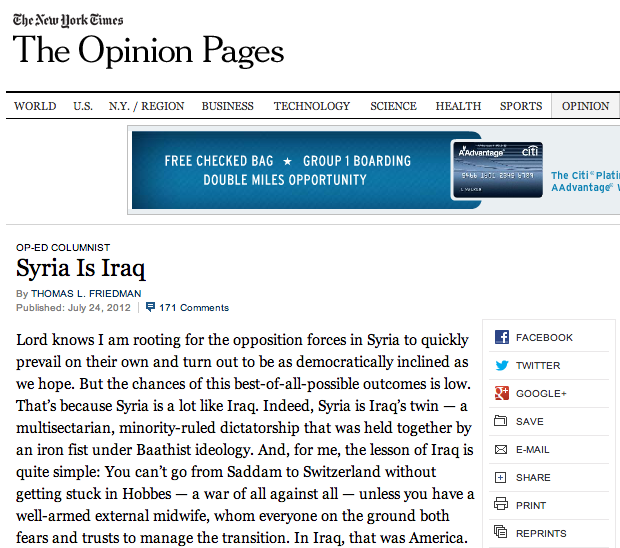
Last night, New York Times columnist (and former executive editor) Bill Keller’s column, “Syria Is Not Iraq,” appeared online. (It’s seen in the above screenshot at right, juxtaposed against equally intellectually-challenged fellow columnist Thomas Friedman’s piece from last year.) As usual, it was a doozy:

As a rule, I admire President Obama’s cool calculation in foreign policy; it is certainly an improvement over the activist hubris of his predecessor. And frankly I’ve shared his hesitation about Syria, in part because, during an earlier column-writing interlude at the outset of the Iraq invasion, I found myself a reluctant hawk. That turned out to be a humbling error of judgment, and it left me gun-shy.

Of course, there are important lessons to be drawn from our sad experience in Iraq: Be clear about America’s national interest. Be skeptical of the intelligence. Be careful whom you trust. Consider the limits of military power. Never go into a crisis, especially one in the Middle East, expecting a cakewalk.

But in Syria, I fear prudence has become fatalism, and our caution has been the father of missed opportunities, diminished credibility and enlarged tragedy.

Keller concludes:

Whatever we decide, getting Syria right starts with getting over Iraq.

No, Keller, it doesn’t. Getting Syria right starts with acknowledging how Iraq happened. But doing that would require directly confronting the central role of Keller’s paper in propagating a flimsy and ultimately disastrous case for war in Iraq. Getting over Iraq, to use Keller’s convenient word choice, is a euphemism for allowing the same source that got everything so wrong in Iraq to make the same case for war in another country — again, with no exit strategy or, even, any strategy at all.

Keller argues that our failure to arm the rebels for fear of assisting al-Qaeda is in fact resulting in the same outcome, by ceding ground to the Saudis and Qataris, who are all too willing to assist radicals on the ground in Syria. But what Keller fails to mention is the fact that, after two years of civil war, an American decision to intervene now would raise more questions than it answers and may very well cause a public opinion backlash in the Arab world. Instead of being lauded as saviors, there is at least an equivalent likelihood of rebels asking, “How many lives could you have saved if you’d been here earlier?”

That alone is not a reason to stay away. But the audacity of the clamor for intervention — led by people like John McCain and, yes, now Bill Keller, the same people who so badly misjudged the prospects for success in Iraq — is that it makes the same characterizations about Syria that it did about Iraq. You’d think once would be enough.

Keller writes:

What you hear from the Obama team is that we know way too little about the internal dynamics of Syria, so we can’t predict how an intervention will play out, except that there is no happy ending; that while the deaths of 70,000 Syrians are tragic, that’s what happens in a civil war; that no one in the opposition can be trusted; and, most important, that we have no vital national interest there. Obama conceded that the use of poison gas would raise the stakes, because we cannot let the world think we tolerate spraying civilians with nerve gas. But even there, the president says he would feel obliged to respond to “systematic” use of chemical weapons, as if something less — incremental use? sporadic use? — would be O.K. This sounds like a president looking for excuses to stand pat.

This is a sickening, absurdist paragraph. “Looking for excuses to stand pat?” In Keller’s conceptualization, then, war is the default option, and Obama is doing somersaults in an attempt to evade his natural obligations. But this is simply not the case. Obama is perfectly right to observe that no vital national interest necessitates an American intervention in Syria (although he is seemingly less confident on this score than previously thought).

Keller’s not done:

In contemplating Syria, it is useful to consider the ways it is not Iraq.

First, we have a genuine, imperiled national interest, not just a fabricated one. A failed Syria creates another haven for terrorists, a danger to neighbors who are all American allies, and the threat of metastasizing Sunni-Shiite sectarian war across a volatile and vital region. “We cannot tolerate a Somalia next door to Israel, Lebanon, Jordan, Iraq and Turkey,” said Vali Nasr, who since leaving the Obama foreign-policy team in 2011 has become one of its most incisive critics. Nor, he adds, can we afford to let the Iranians, the North Koreans and the Chinese conclude from our attitude that we are turning inward, becoming, as the title of Nasr’s new book puts it, “The Dispensable Nation.”

Again, Keller’s historical — and personal — amnesia, combined with his implicit but entirely unsubtle smearing of prudent foreign policy analysts as appeasers, is appalling. There is no “genuine, imperiled national interest.” The primary reason everyone’s suddenly started talking about Syria is that Israel started bombing it. As always, Israel’s security interests take precedence over our own: where two years of civilian death and suffering elicited little more than yawns and sighs of boredom in living rooms throughout America, a few targeted airstrikes by Israel are amazingly effective at focusing the hive mind.

Keller writes:

But, as Joseph Holliday, a Syria analyst at the Institute for the Study of War, points out, what gets lost in these calculations is the potentially dire cost of doing nothing. That includes the danger that if we stay away now, we will get drawn in later (and bigger), when, for example, a desperate Assad drops Sarin on a Damascus suburb, or when Jordan collapses under the weight of Syrian refugees.

Yes, let’s go to war now, risking very real American lives, to prevent a hypothetical outcome that may or may not cause mass fatalities in another country’s civil war.

Here is perhaps my favorite line:

Fourth, in Iraq we had to cajole and bamboozle the world into joining our cause. This time we have allies waiting for us to step up and lead. Israel, out of its own interest, seems to have given up waiting.

Israel?! That’s his example? Israel, he may recall, was perfectly onboard with the American invasion of Iraq as well. And why shouldn’t it be? Any half-conscious human being can see the natural advantage of allowing a foreign country to wage war on another’s behalf — including paying the costs in lives and massive budget deficits. Israel can stand pat and let Americans take the heat again, as we’ve been doing for years.

“Why wait for the next atrocity?” Keller asks. Indeed, why? For neoconservative warmongers like Bill Keller, waiting is for appeasers. The case for intervention in Syria, like that in Iraq, recalls the title of the famous post-financial crisis book, This Time Is Different. Each time, excuses and half-justifications are lazily proffered so as to distinguish one hawkish prophecy from its disastrous predecessors. This time, let’s approach the problem differently, instead of feebly attempting to differentiate this potential foreign policy quagmire from another, very real one from the past.


Enhanced by Zemanta

This one’s for “The Colonel:” Sam Lim and I lament Season 1 of The Americans

Screen Shot 2013-05-03 at 4.47.01 PM

Sam: I will admit that I really did not want to watch this episode, but it actually surprised me with keeping my attention throughout nearly the whole episode. Sad that I couldn’t say the same about just about every other episode, but I’ve beaten that dead horse silly already.

The main part about this episode that kept my interest was obviously the whole double meeting assignment given to Phil and Elizabeth, especially leading up to the moment Phil swoops in his old car and carries Elizabeth away to safety (but not before she apparently gets shot in the stomach).

As interesting as that was, though, there were way too many silly story lines that pulled that together. For one, Nina’s whole double agent bit has just gotten ridiculous. You touched on it from last week’s episode: she basically got off for treason with nothing more than a slap on the wrist. Um…didn’t the KGB take out one of their own they didn’t trust in an earlier episode? She works in the frickin’ US office, so she seems like she’d be an even greater threat.

Screen Shot 2013-05-03 at 4.47.19 PMStan’s character is also interesting, because he plays this stone cold agent on one hand who detects that one dude was “off” so wants to keep him closed up in solitary confinement until he hollers. But on the other hand, he’s not attentive enough to tell that Nina played him? Her reaction to his response that exfiltration would NOT be happening was absolutely absurd. Shouldn’t she have flipped out about 100x more than she actually did? Frankly, he should’ve then been comforting her, not the other way around.

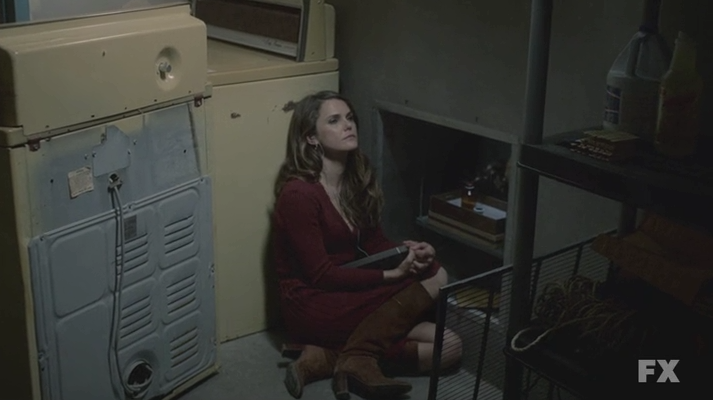
One more major gripe: has Paige really NEVER tried to go to her parents’ room when she’s had a nightmare before? How old is she now? Like 13? NOW she decides to go to her mom’s room? And that whole thing about the laundry room. Good for her for asking Elizabeth why she didn’t hear the washing machine, but that whole last scene of the episode/season was just stupid. Yes, Elizabeth is great about covering her tracks, but the dragged out way in which Paige went downstairs would make you think she’d never seen the basement/laundry room in her own home before.

Oh, and we finally saw the Granny/Arkady in the car scene. After watching that scene, I have to say: they went through a lot of work just to shoot that one scene…

What were your thoughts on this season finale? Continue reading This one’s for “The Colonel:” Sam Lim and I lament Season 1 of The Americans