Jay is a data journalist and political junkie. He currently writes about domestic politics, foreign affairs, and journalism and continues to make painstakingly slow progress in amateur photography. He would very much like you to check out SCOTUSMap.com and SCOTUSSearch.com if you have the chance.
View all posts by Jay Pinho →
In Google’s official announcement of the end of Reader, which it plans to mothball in July, it said the product had a “devoted following who will be very sad to see it go.” But usage had declined, and the company says it wants to focus more energy on fewer products. Reader’s popularity came not just from its innovative tools but from its social aspect, Wired’s Mat Honan points out. “Reader gave users the ability to friend, follow and share stories with others. It let readers share stories with each other, and comment on them too.” But the company removed that function in 2011, replacing it with an option to share on G+. “That was effectively the end of the Reader community.” Now Reader itself follows. But boy was Google right about that devoted following.
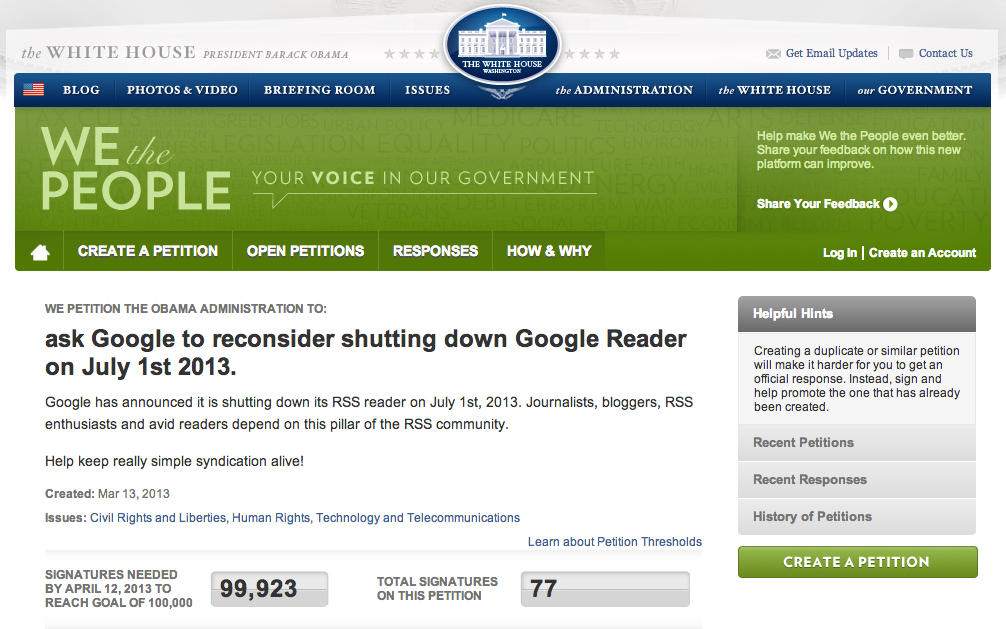
The White House petition can be found here. As is clear from the numerical figures in the above screenshot, the aspirations appear slightly excessive.
If ever there were an indication of the influence exerted by Paul Krugman and his intellectual kin, take a look at this:
One day after Republicans rolled out a detailed proposal aimed at eliminating the federal deficit through steep cuts and repealing many of the president’s accomplishments, Mr. Obama told them pointedly in a rare visit that their highest fiscal priority was not his.
“Our biggest problems in the next 10 years are not deficits,” the president said, according to accounts from the meeting, bluntly rejecting an idea that has become Republican fiscal dogma…
Senator Patty Murray, the Washington Democrat and Senate Budget Committee chairwoman who outlined her budget on Wednesday, summed up her party’s objections to Republican austerity measures, which Democrats have said rob the country of needed investment.
“Deficit reduction at the expense of economic growth is doomed to failure,” she said.
Emphases mine. But mostly, Krugman’s.
Another gem from that piece:
“The president seemed to say, ‘If we’re going to do the areas we agree on, you have to also do some of mine,’ ” said Representative James Lankford of Oklahoma, bristling at Mr. Obama’s suggestion. “If we can find the areas we agree on, why can’t we just do those?”
Indeed, Sir Lankford. Why can’t we just enact all the policies that the party who just lost its second straight presidential election wants to implement? It’s truly a modern-day mystery.
L’Office québécois de la langue française is not happy:
It began, as do many things these days, with a tweet. On February 19th, Massimo Lecas, co-owner of an Italian restaurant, Buonanotte, in Montreal, wrote that he had received a letter from the office warning him that there were too many Italian words (such as “pasta”) on his menu. This was a violation of Quebec’s language charter, he was told, and if they were not changed to the French equivalents (pâtes in the case of pasta) he would face a fine.
Journalists with a sense of the ridiculous quickly piled on. An analysis of international media coverage of Quebec showed the story, quickly dubbed #pastagate on twitter, received 60 times the coverage of a trip by Pauline Marois, the premier, that had been meant to drum up investor interest in the province. Other restaurant owners who had received similar letters—a fish-and-chip-shop owner who was instructed to call his main offering poisson frits et frites, a brasserie owner who was asked to cover the “redial” button on his telephone and the “on/off” button on his microwave—came forward, an indication this was not an isolated incident.
The blowback ultimately proved too great for the office to sustain:
Diane de Courcy, the Quebec minister responsible for language, tried at first to shrug off the pasta stories, saying she was satisfied with the work of the inspectors. When the bad publicity persisted, she announced a review of that particular case. The PQ government is currently attempting to toughen language laws, and pastagate was becoming a distraction. But by March 8th it was clear something more was needed. Quebec was the butt of too many jokes. Ms de Courcy announced that Louise Marchand, president and director-general of the language police, was leaving her post effective immediately. Apparently the move was made at Ms Marchand’s request. It is generally the case with figures of authority that when the masses start laughing at you, you are through.
Travel between Boston and New York may have gotten a little more expensive (and safer) with the recent demise of Fung Wah bus lines, but that doesn’t mean there still doesn’t exist an overwhelming appreciation for the memories the company left behind.
The New Yorker channels these emotions in an ode to Fung Wah, inspired by Bob Dylan’s “Farewell Angelina.” We warn you, it may get misty wherever you may be.
On a more serious note, the shuttering of Fung Wah, whether permanent or otherwise, evokes mixed feelings for me. On the one hand, I’ve had my fair share of rides in which, for hours at a time, I was terrorized by the uncertainty over whether the driver was inebriated, tired, or just a terrible driver.
On the other hand, the 4-6 hour ride (sometimes even longer, especially on holidays) was often a refuge of sorts during various transitory periods of my life. During the summer of 2009, I took the bus from Boston to New York to visit my girlfriend almost every single Friday afternoon, returning on Sunday evening.
Then, once I moved to New York that fall, the process reversed itself: occasionally I’d take the bus back to Boston to visit my family for a weekend before heading back to a stressful job in New York. Throughout all of this, while Bolt Bus and Megabus and Greyhound and Peter Pan were missing scheduled departures, charging higher fares, and arriving late, Fung Wah was surprisingly reliable for me. Missing a weekend bus never mattered that much, because the next one was always just a few minutes behind.
Sooner or later, I’ll need to travel to Boston again, and I’m not sure yet how I’ll get there. Most likely I’ll choose another bus line, but that would feel almost sacrilegious somehow and — not unlike leaving one’s religion — an uncomfortable adjustment. Whatever its ills — and there were so, so many of them — the Fung Wah leaves a giant-sized hole in the New York-Boston corridor. Although probably not quite as big as the holes created by its buses as they plowed into various stationary objects over the years.
I am not ashamed to admit it (nor am I really bragging), but for the last six years I have taken the Fung Wah so frequently that I am sort of like the Wilt Chamberlain of I-95 (though I have never had sex with any other passengers). I have sometimes found myself on the bus twice a day, multiple times a week. I am not exaggerating when I say the times I have ridden the bus are easily in the high hundreds, and I have literally never even been on a single bus that broke down or has been in a mortally dangerous situation, save for the occasional bathroom breakdown…
Fung Wah’s closure will surely fuel debates about the oversight necessary in this now-crucial industry that has benefited scores of tourists, day trippers, workers, sweatpants-wearing scumbags, junkies, and crying babies. Others are wondering why regulators were asleep at the wheel for so long that a licensed company could have 21 of their 28 vehicles declared an “imminent hazard.” While still others, like myself, are asking perhaps the most important question of all: How the fuck am I going to get home?
Courtesy of WashingtonPost.com.Courtesy of MediaMatters.org.
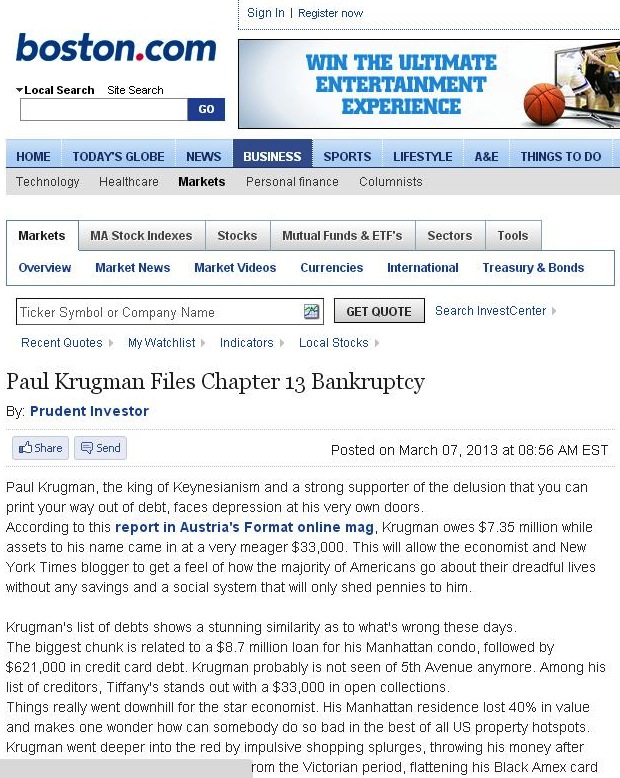
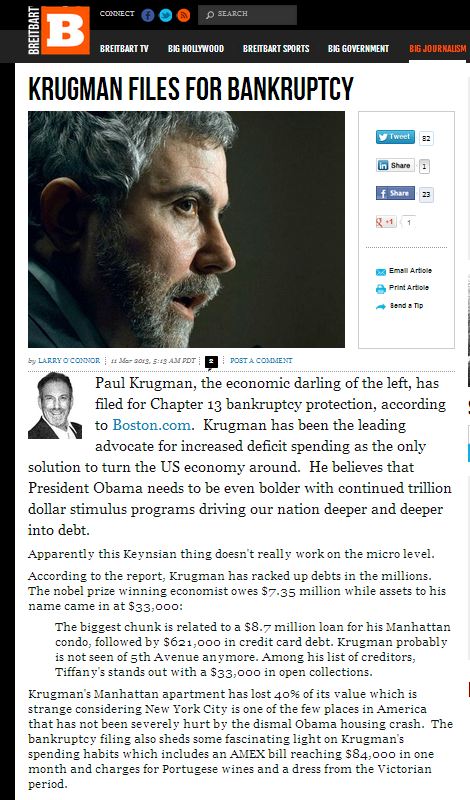
Yesterday, Breitbart.com editor at large Larry O’Connor picked up on a news piece about Nobel Prize-winning economist Paul Krugman:
Breitbart.com ridiculed Paul Krugman for filing for Chapter 13 bankruptcy protection in a since-deleted post whose claims originated with a satire website. Just last month, Breitbart.com castigated a news outlet for running with a story from that same website.
In the March 11 post, Breitbart.com editor at large Larry O’Connor mocked the Nobel Prize winning economist and New York Times columnist for his alleged financial mismanagement. Unfortunately for O’Connor, the report that Krugman went bankrupt is clearly a joke and originated from the satirical website The Daily Currant. O’Connor has since deleted the post without explanation. (Update: O’Connor tweeted, saying he “trusted Boston.com as the source for that Krugman piece, but they were duped by Daily Currant, therefore, so was I!”)
Most of the reaction has predictably zeroed in with glee on Breitbart’s error. Media Matters’ headline for the above article was “Breitbart.com Runs With Satirical Story About Krugman Filing For Bankruptcy.” Slate.com ran a similar piece titled “No Breitbart, Paul Krugman Hasn’t Filed For Bankruptcy.”
Granted, the original satirical article on The Daily Currant is pretty funny. (Krugman thought so too.) Sample segment:
The filing says that Krugman got into credit card trouble in 2004 after racking up $84,000 in a single month on his American Express black card in pursuit of rare Portuguese wines and 19th century English cloth[.]
But to me, it was far more disturbing that a Boston Globe site got the story wrong than that Breitbart’s faux-journalistic outfit did. (Hell, it was just a couple weeks ago that Breitbart got busted for creating the lobbying group “Friends of Hamas” out of thin air.) Media Matters has since run an in-depth analysis of how an Austrian blogger’s mistakenly serious reading of The Daily Currant piece snaked its way onto the Boston.com site, and it’s a bit disturbing:
The bogus story that New York Times columnist Paul Krugman had filed for bankruptcy appeared on Boston.com, the sister website of The Boston Globe, through a third-party content provider that posts content without editorial approval and provides such content to more than 200 web outlets.
That provider, meanwhile, took the story from an Austrian-based blog without any editorial review or fact-checking of its own, a practice that is becoming more and more common in the Internet content sharing world. The blog has since deleted its post and all posts from the author appear to have been removed from Boston.com.
Over at The Washington Post, Erik Wemple got in touch with Globe editor Brian McGrory:
Brian McGrory, the Globe’s editor, explains that no editorial official at his paper ever made a decision to post the piece. “The story arrived deep within our site from a third party vendor who partners on some finance and market pages on our site,” says McGrory. It was never on the Boston.com homepage, says McGrory. “We never knew it was there till we heard about it from outside.” Since the posting went up, McGrory attests to having done “urgent work to get it the hell down,” something that appears to have happened, though not as quickly as McGrory would have liked. “The idea that we’d have a partner on our site is actually news to me,” says McGrory, who vows to “address our relationship with that vendor.”
Granted, McGrory is new on the job. But it’s pretty frightening that even the Globe‘s editor has no idea what appears on its site. Then again, based on the steadily declining quality of Boston.com over the past few years, I guess this shouldn’t be surprising. As Mathew Ingram succinctly put it:
if you need a primer in why editorial oversight of syndicated content is important, look no further: http://t.co/1IInROF137 /via @shoq
The rate has dropped in cities large and small, in suburbs and rural areas and in all regions of the country. It has fallen among households with children, and among those without. It has declined for households that say they are very happy, and for those that say they are not. It is down among churchgoers and those who never sit in pews.
The household gun ownership rate has fallen from an average of 50 percent in the 1970s to 49 percent in the 1980s, 43 percent in the 1990s and 35 percent in the 2000s, according to the survey data, analyzed by The New York Times.
The story, reported by Sabrina Tavernise and Robert Gebeloff, noted the data’s seeming contradiction to prevailing media narratives:
The findings contrast with the impression left by a flurry of news reports about people rushing to buy guns and clearing shop shelves of assault rifles after the massacre last year at an elementary school in Newtown, Conn.
“There are all these claims that gun ownership is going through the roof,” said Daniel Webster, the director of the Johns Hopkins Center for Gun Policy and Research. “But I suspect the increase in gun sales has been limited mostly to current gun owners. The most reputable surveys show a decline over time in the share of households with guns.”
The Times should know a thing or two about the impression left by that “flurry of news reports:” it contributed substantially to creating it. Here is an excerpt from a New York Times article on December 21st of last year, headlined “Shop Owners Report Rise in Firearm Sales as Buyers Fear Possible New Laws:”
With gun-control legislation getting more serious discussion than it has in years, gun sales are spiking as enthusiasts stock up in advance of possible restrictions.
Gun sales have been increasing over the past five years, with marked increases around the 2008 and 2012 elections, and after mass shootings like the one in Aurora, Colo., and now in Newtown, Conn…
There is increasing demands for guns in the United States. Last year, the Federal Bureau of Investigation conducted 16.45 million background checks for firearm sales through the National Instant Criminal Background Check System, a 14 percent jump from the previous year. In the first 11 months of this year, the bureau conducted 16.8 million background checks, a record since the system’s founding in 1998.
The article goes on to check in on various online and brick-and-mortar gun shops, all of whom dutifully trumpet the massive demand at their stores. (Imagine that: a gun shop owner who’s just been given an enormous audience by a global newspaper declares that he is doing brisk business? I don’t know about you, but sounds like an “I’ll take him at his word” situation to me.)
As Washington focuses on what Vice President Joseph R. Biden Jr. will propose next week to curb gun violence, gun and ammunition sales are spiking in the rest of the country as people rush to expand their arsenals in advance of any restrictions that might be imposed…
Gun dealers and buyers alike said that the rapid growth in gun sales — which began climbing significantly after President Obama’s re-election and soared after the Dec. 14 shooting at a school in Newtown, Conn., prompted him to call for new gun laws — shows little sign of abating.
December set a record for the criminal background checks performed before many gun purchases, a strong indication of a big increase in sales, according to an analysis of federal data by the National Shooting Sports Foundation, a gun industry trade group. Adjusting the federal data to try to weed out background checks that were unrelated to firearms sales, the group reported that 2.2 million background checks were performed last month, an increase of 58.6 percent over the same period in 2011. Some gun dealers said in interviews that they had never seen such demand.
And finally, another three weeks and a day later, on February 2nd of this year, the Times struck again, heralding “The Most Wanted Gun in America,” the Bushmaster AR-15:
Before Newtown, the rifles sold for about $1,100, on average. Now some retailers charge twice that. At Pasadena Pawn, on the wall behind glass counters of handguns, are three dozen or so AR-15-style rifles. Dangling from nearly every one is a tag that says “Sold.”
“The AR-15, it’s kind of fashionable,” says Frank Loane Sr., the proprietor. His shop has a revolving waiting list for the rifles, and a handful of people are now on it. “The young generation likes them, the assault-looking guns…”
But despite the headlines, and partly because of them, commercial gun sales are growing. Last year, they were up 16 percent industrywide, according to estimates from the National Shooting Sports Foundation, an industry trade association. Semiautomatic rifles like the AR-15 are responsible for a significant share of that growth.
One can be forgiven for reading The New York Times and leaving with the impression that, yes, the entire country is stampeding its nearest weapons shops and loading up on anything with a trigger. This is just the latest in a long line of examples of the media helping to create a story, then reporting on the fallout from that story from a detached perspective, as if the press had nothing to do with the preceding whirlpool of artificially manufactured “news” in the first place.
Stan and Nina talk it out in Episode 6 of The Americans, “Trust Me.”
Jay: I just don’t know anymore. This show is all over the place, and I don’t really mean that in a good way. We’re about halfway through the season (6 out of 13 episodes), but I’m still unable to get excited about anyone or anything in the show. That’s a problem, right?
There wasn’t anything glaringly wrong with this episode, necessarily. The plot moved along at a decently fast pace, and I couldn’t help but smile at the scene between Elizabeth and Gregory on the steps of Columbia’s School of International and Public Affairs. (I practically live in that building these days.)
But the story with the kids was just…weird. What are the chances that the first person to pick them up would be such a psycho? The reviews I’ve read point to that narrative as a way for The Americans to show how the kids now have secrets of their own, just like their parents. But every kid keeps secrets from his parents. (Am I misremembering my entire childhood?) Even taking into account the danger presented by that freak at the duck pond, hiding something like this from one’s parents is perfectly in line with normal kid behavior. All of that makes me wonder why it’s included in the episode at all.
As for Elizabeth and Phil, it’s gotten to the point where, even if I have trouble identifying specific problem parts, I’m not particularly into the episode anyway. Maybe it’s that their on-again-off-again marital problems are already boring me.
The Stan/Nina dynamic was more interesting. As noted elsewhere, the scene with the projected images flashing on their faces was very well-done, even if Stan seems unable or unwilling to acknowledge just how much danger he’s put Nina in. Side note: I love that he managed to protect her and get rid of her sexual partner, all in one fell swoop.