Category Archives: Media

Fact-checking The Newsroom

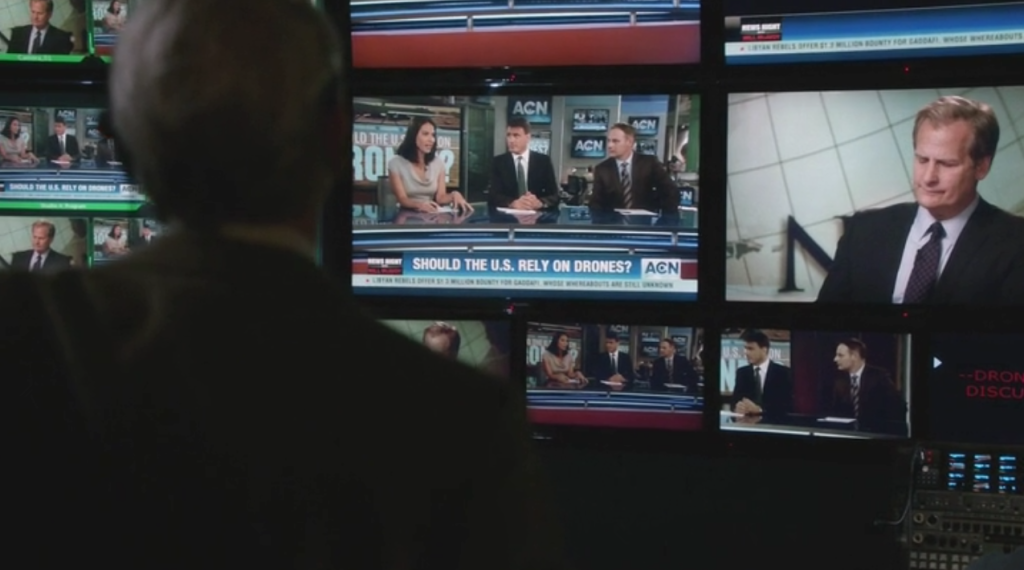
The Season 2 premiere of The Newsroom aired last night.

HBO’s The Newsroom returned to television last night, and it was borderline obsessive about drone strikes. (As for the storytelling itself, there is, so far, no sign of improvement since the conclusion of Season 1.) In the midst of the rhetorical maelstrom — this is an Aaron Sorkin show, after all — I couldn’t help but notice that Sloan Sabbith (Olivia Munn) had this to say about drone strikes during an on-air panel:

We don’t know exactly what that collateral damage is because of the lack of any transparency or accountability. Now factor in that the B.D.A. — the bomb damage assessment — counts all military-age males as militants.

The show depicted this particular airing of News Night as having taken place on August 24th, 2011. The only problem? The New York Times actually broke the story about all military-age males being counted as combatants nearly a full year later, in an article published on May 29, 2012:

It is also because Mr. Obama embraced a disputed method for counting civilian casualties that did little to box him in. It in effect counts all military-age males in a strike zone as combatants, according to several administration officials, unless there is explicit intelligence posthumously proving them innocent.

But in interviews, three former senior intelligence officials expressed disbelief that the number could be so low. The C.I.A. accounting has so troubled some administration officials outside the agency that they have brought their concerns to the White House. One called it “guilt by association” that has led to “deceptive” estimates of civilian casualties.

“It bothers me when they say there were seven guys, so they must all be militants,” the official said. “They count the corpses and they’re not really sure who they are.”

As far as I know, the closest that most of the mainstream media came to openly contesting the administration’s counting policy before the night of August 24th, 2011 was in another New York Times article from August 11th of that year:

The civilian toll of the C.I.A.’s drone campaign, which is widely credited with disrupting Al Qaeda and its allies in Pakistan’s tribal area, has been in bitter dispute since the strikes were accelerated in 2008. Accounts of strike after strike from official and unofficial sources are so at odds that they often seem to describe different events.

The debate has intensified since President Obama’s top counterterrorism adviser, John O. Brennan, clearly referring to the classified drone program, said in June that for almost a year, “there hasn’t been a single collateral death because of the exceptional proficiency, precision of the capabilities we’ve been able to develop.” Other officials say that extraordinary claim still holds: since May 2010, C.I.A. officers believe, the drones have killed more than 600 militants — including at least 20 in a strike reported Wednesday — and not a single noncombatant.

But that article is a far cry from the definitive declaration made by Sloan Sabbith on last night’s episode of The Newsroom. I suppose this is just one more trademark of Aaron Sorkin. It’s not just his depiction of women that’s anachronistic: even his series on news reporting can’t get the story in the right order.

Enhanced by Zemanta

Enough with the social media articles

From yesterday’s online New York Times comes a story titled “As Social Media Swirl Around It, Supreme Court Sticks to Its Analog Ways:”

The Web is ready, too. On Thursday, after the justices once again did not issue rulings in any of the biggest cases, news organizations blared the “news” to their followers. “BREAKING NEWS: No major decisions from Supreme Court today,” the Yahoo News site announced on its Twitter feed. Another Twitter user wryly observed: “Clearly all Supreme Court judges were unpopular kids in high school and, excited by all the attention now, are gonna drag this out.”

A year ago, in the minutes before the court announced its decision on President Obama’s health care law, Twitter users posted more than 13,000 messages a minute about the court. (By comparison, there were 160,000 a minute at the height of the presidential debate in Denver last year.)

And then today, another story headlined “A Panda Escapes From the Zoo, and Social Media Swoop In With the Net:”

To help find Rusty, a raccoon-size mammal with a striped tail and moon-shaped face, the zoo turned to social media, and suddenly half of official Washington broke from Serious Events to tune in to the saga of the runaway panda.

On Twitter and Facebook, the hunt for 11-month-old Rusty, whom the zoo acquired three weeks ago as a partner to a female panda named Shama, exploded in a mix of concern, humor and, this being Washington, the goring of political oxen.

“Rusty the Red Panda eats shoots and leaves,” Jake Tapper, CNN’s chief Washington correspondent, filed to Twitter.

Doug Stafford, a senior aide to Senator Rand Paul, Republican of Kentucky, called the escape a cautionary tale. “If we don’t use drones to spy on everyone, the pandas will win,” he wrote.

The zoo announced Rusty’s disappearance to its thousands of Twitter followers in a message at 11:51 a.m, which was retweeted nearly 3,000 times in an hour.

At midday, mentions of “Rusty” on Twitter nearly equaled those of “Obama.” ABC News started a blog with “live coverage” of the search.

“Please help us find Rusty,” the zoo pleaded on Twitter, explaining that he was last seen at 6 p.m. on Sunday and might be nearby “hiding in a tree.”

On its Facebook page, the zoo said keepers were combing the Asia Trail habitat, whereRusty and Shama live between the Japanese giant salamander and the small-clawed otter, since 8 a.m. But in an ominous note, the zoo said it was possible Rusty had been stolen.

Look, I get it. The New York Times has discovered social media, and it is on it. But please, please — stop with the constant stories devoted to people who…tweet. Or who post the occasional snarky Facebook post.

This is not news. This is actually rather mundane, and is best replaced by an article on almost anything else.

And yes, I realize I have just made the problem worse.

Enhanced by Zemanta

Whose “journalistic malfeasance?” Fact-checking Joshua Foust’s Guardian critique

Joshua Foust posted an article on Medium today, titled “A Catalogue of Journalistic Malfeasance.” In it, he castigated the work of The Guardian‘s Glenn Greenwald for allegedly misstating all sorts of facts in the rush to get Edward Snowden’s story to the public:

So what’s the solution? For one, stop assuming the first version of the “facts” is correct. So much of the initial round of NSA reporting has turned out to be false or misleading that it’s a wonder such misreporting hasn’t become its own scandal. The speed with which false information propagates in the public (and worse, in commentaries) is dismaying to those of us who’d prefer public debates be based in fact rather than fiction.

Yet so long as breaking news dominates the coverage, there will continue to be frenzied periods of rushed reporting and eventual retractions or clarifications. Until we as people change our media consumption habits, the news organizations that continue to rush poorly researched information into the public record will have no reason to change their ways.

But even a cursory perusal of Foust’s piece reveals the same tenuous grasp of basic facts for which he passionately condemns The Guardian and The Washington Post (among others). In order, starting from near the beginning of his article:

1) Foust writes:

For one, there is still no evidence about how many other phone companies have been compelled to hand over their records. On Twitter, Greenwald wrote, “The program we exposed is the collection of all American’s [sic] phone records.” That isn’t true — he exposed the collection of Verizon’s records. The only evidence that this is an ongoing, long-standing program involving other telecos is a statement by Senate Intelligence Committee chairwoman Diane Feinstein and various anonymous leaks to national security reporters.

Let’s get the obvious point out of the way: if the chairwoman of the Senate Intelligence Committee confirms the existence of an “ongoing, long-standing program involving other telcos,” then how can Foust write that “there is still no evidence about how many other phone companies have been compelled to hand over their records?” (Unless, of course, he means that there could be even more than those already uncovered.) Feinstein has made it painfully clear what she thinks of Snowden — “I don’t look at this as being a whistle-blower,” she said at one point, “I think it’s an act of treason” —  and so she has absolutely no incentive to lie about the existence of the programs he uncovered (certainly not, at least, in the direction of making him look more truthful).

Secondly, Foust’s link to Feinstein’s alleged statement goes, bizarrely, to Huffington Post article that makes no mention of other telecom companies at all. But based on its content, Foust seems to be referring to a Feinstein statement reported in a Politico article from the same morning, in which Feinstein not only did not state that similar operations were taking place at other phone companies, but specifically said she could not confirm that that was happening:

Feinstein said she could not answer whether other phone companies have had their records sifted through as Verizon has.

“I know that people are trying to get to us,” she said. “This is the reason why the FBI now has 10,000 people doing intelligence on counterterrorism. This is the reason for the national counterterrorism center that’s been set up in the time we’ve been active. its to ferret this out before it happens. “It’s called protecting America.”

The same incongruence holds true for the “various anonymous links to national security reporters.” The Wall Street Journal reported the following on June 7th:

The disclosure this week of an order by a secret U.S. court for Verizon Communications Inc.’s phone records set off the latest public discussion of the program. But people familiar with the NSA’s operations said the initiative also encompasses phone-call data from AT&T Inc. and Sprint Nextel Corp., records from Internet-service providers and purchase information from credit-card providers.

This, a prominently reported article by an internationally prominent newspaper, is also evidence. So it is decidedly unclear what Foust means when he writes, “There is still no evidence about how many other phone companies have been compelled to hand over their records.” That’s at least three in total, right there.

Finally, Foust claims that Greenwald only “exposed the collection of Verizon’s records,” not those of all American customers — as Greenwald had claimed in his Twitter feed. But Foust appears to be wrong on this count too (as is Greenwald). The secret court order published by The Guardian demands the following material from Verizon:

…all call detail records or “telephony metadata” created by Verizon for communications (i) between the United States and abroad; or (ii) wholly within the United States, including local telephone calls…Telephony metadata includes comprehensive communications routing information, including but not limited to session identifying information (e.g., originating and terminating telephone number, International Mobile Subscriber Identity (IMSI) number, International Mobile station Equipment Identity (IMEI) number, etc.), trunk identifier, telephone calling card numbers, and time and duration of call.

Nowhere in the above order does it specify that this information be restricted to Verizon customers only. In other words, if an American Verizon customer calls — or receives a call from — someone abroad (or even locally) who is not a Verizon customer, this order appears to obtain at least the phone number of the non-Verizon customer and perhaps more. (My low level of telecom technical expertise is not sufficient to speculate about the IMSI and IMEI numbers.)

2) Foust continues:

The next leak Greenwald published, with veteran national security reporter Ewan MacAskill, made an even more eyepopping claim: “The National Security Agency has obtained direct access to the systems of Google, Facebook, Apple and other US internet giants.” That report also turned out to be largely exaggerated. Experienced tech journalists immediately seized on the description of the PRISM program (which accesses the data of internet companies) and poked it full of holes. Despite being described as “data-mining,” PRISM is really “nothing of the sort,” according to journalists who have covered the NSA in detail.

Foust is correct that the early descriptions of PRISM as a program of direct, real-time access to huge tech companies’ servers has since been walked back, in part. In retrospect, it’s become clear that The Guardian displayed an insufficient level of technical savvy — and perhaps even a spate of wishful thinking — in describing the program. Nevertheless, the above quote that Foust extracts from the article, written by Glenn Greenwald and Ewen MacAskill, leaves out a crucial qualifier that immediately follows the words he excerpted:

The National Security Agency has obtained direct access to the systems of Google, Facebook, Apple and other US internet giants, according to a top secret document obtained by the Guardian.

The NSA access is part of a previously undisclosed program called Prism, which allows officials to collect material including search history, the content of emails, file transfers and live chats, the document says.

“…according to a top secret document obtained by the Guardian.” And then, in the next paragraph, “the document says.” Now I’m not justifying Greenwald’s and MacAskill’s carelessness with words: the difference between direct access and, say, submitting individual requests for data is enormous and should be treated as such. But despite its obvious flaws, the article does make clear its reliance on the secret document — which itself, according to The Guardian, claimed “collection directly from the servers” of large American technology companies. It would, therefore, appear that at least some of the blame for the “exaggeration” rests with whatever NSA employee or contractor created the PowerPoint, not solely with The Guardian.

3) Foust writes, “IT work is not spying, even if it’s classified.” OK? Is there some new dictionary edict from on high about this, of which I’m not aware? “IT work” can refer to almost anything — and “anything” absolutely, positively includes spying. To be honest, I’m not confident I understood what Foust was trying to get across here, because reading the above sentence at face value makes no sense at all.

4) Contra Edward Snowden, Foust writes that “Robert Deitz, a former top lawyer at the NSA and CIA, told the L.A. Times that claim [that Snowden could ‘access any CIA station in the world’] was a ‘complete and utter’ falsehood.”

To his credit, Foust admits the obvious reality that this is hardly proof of Snowden’s lying. (Consider the source, to put it lightly.) But Foust again errs when he quotes Snowden as saying he could “access any CIA station in the world.” That phrase has been repeated elsewhere as well. But Snowden never said it. Here is what he actually said:

I had access to, you know the full rosters of everyone working at the NSA, the entire intelligence community, and undercover assets all around the world, the locations of every station we have, what their missions are, and so forth.

It’s a very similar statement. But it’s not identical. Even more concerning than the misquoted phrase, however, is the fact that Snowden refers to “every station” immediately after referencing the NSA, not the CIA — as Foust incorrectly wrote. Yes, it is still likely that Snowden was implicitly referring to the CIA in his above statement about “the locations of every station we have,” but the quote Foust excerpts simply doesn’t exist.

5) Foust writes:

Snowden said he participated in a CIA operation to “recruit” a Swiss banker in Geneva through a manufactured drunk driving arrest. Swiss President Ueli Maurer over the weekend said that such a claim “does not seem to me that it… played out as it has been described by Snowden and by the media.”

But much like the quote above by Robert Deitz, Ueli Maurer has quite the incentive to downplay the incident. Switzerland would rather not get into a diplomatic tussle with the United States. Moreover, it would be embarrassing for a president to admit to the bumbling incompetence of one of his own countrymen in the face of the crudest spook tactics. (Getting a banker drunk and then encouraging him to drive? Not a good look for the banker, his president, or his country.)

6) Foust quotes NSA head Keith Alexander — of all people — as rebutting Snowden’s claims. Well, then…that settles it?

7) Foust writes:

The rush to be first out of the gate with explosive new details of anything — or, in the Guardian’s case, the rush to publish before Snowden could be located and arrested — created perverse incentives to publish without verification. Washington Post freelancer Barton Gellman even said that his attempts to verify some of Snowden’s claims led to Snowden pushing the same documents to the Guardian because they would publish faster.

Once again, the Gellman article to which Foust links says no such thing. Here is the actual excerpt to which Foust appears to be referring:

To effect his plan, Snowden asked for a guarantee that The Washington Post would publish — within 72 hours — the full text of a PowerPoint presentation describing PRISM, a top-secret surveillance program that gathered intelligence from Microsoft, Facebook, Google and other Silicon Valley giants. He also asked that The Post publish online a cryptographic key that he could use to prove to a foreign embassy that he was the document’s source.

I told him we would not make any guarantee about what we published or when. (The Post broke the story two weeks later, on Thursday. The Post sought the views of government officials about the potential harm to national security prior to publication and decided to reproduce only four of the 41 slides.)

Snowden replied succinctly, “I regret that we weren’t able to keep this project unilateral.” Shortly afterward he made contact with Glenn Greenwald of the British newspaper the Guardian.

And then further on down, Gellman refers to his “dispute [with Snowden] about publishing the PRISM document in full.” In other words, Snowden’s decision to go to The Guardian was apparently based on The Washington Post‘s unwillingness to accept certain conditions, not because The Guardian had sloppier fact-checking or looser editorial standards.

At the end, Foust laments the barrage of misleading and inaccurate news. He is right: the mainstream American press has had a rocky few months. (In reality, it’s been rocky for far longer than that.) Twitter and other real-time social networks have certainly contributed to the proliferation of these deceptions at ever-faster speeds, although they fact-check just as fast. I actually agree with the general thrust of Joshua Foust’s analysis of The Guardian‘s hasty reporting that appears to have cut corners in dangerous ways. But sometimes even the fact-checker needs a fact-checker.
Enhanced by Zemanta

Austerity has lost its truthiness

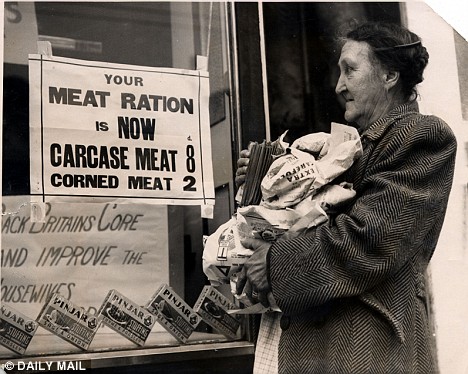
I googled "austerity," and this was the first image that appeared in the results. (Thanks, The Independent.)
I googled “austerity,” and this was the first image that appeared in the results. Seemed appropriate enough. (Thanks, The Independent.)

Back in February, The Washington Post‘s Ezra Klein registered his frustration with the way that deficit reduction was covered in the media:

For reasons I’ve never quite understood, the rules of reportorial neutrality don’t apply when it comes to the deficit. On this one issue, reporters are permitted to openly cheer a particular set of highly controversial policy solutions. At Tuesday’s Playbook breakfast, for instance, Mike Allen, as a straightforward and fair a reporter as you’ll find, asked Simpson and Bowles whether they believed Obama would do “the right thing” on entitlements — with “the right thing” clearly meaning “cut entitlements.”

A few days earlier, Ron Fournier, the editor of the National Journal, wrote that President Obama was giving America “the shaft” by taking an increase in the Medicare age off the table. It is difficult to imagine him using similar language for a situation in which Republicans reject universal health care, or Democrats say no to a tax cut. Over the past couple of weeks, MSNBC’s Joe Scarborough has reacted with evident astonishment to Paul Krugman’s argument that the long-term deficit is not a problem we need to solve right this second.

The secret to the special treatment that deficit reduction enjoys in Washington, I think, is that it’s a rare policy area that lends itself to pox-on-both-their-houses politics. “It’s such fun for me to irritate the AARP and Grover Norquist in equal measure,” Simpson told Allen. “It makes your life worthwhile.” It also makes deficit reduction a safe topic for otherwise strenuously nonpartisan figures to issue strong opinions on. After all, they can’t be accused of being partisan, as both parties are standing in the way!

Klein’s disappointment came, of course, only two months before the ideological underpinnings of austerity itself were subjected to the same remedy they proposed for American and European governments: death by a thousand cuts. And thus, two additional months later, the case for austerity has now been severely damaged.

Which is why yesterday’s article in The New York Times caught my eye. Regarding the newfound optimism of many economists in the expected growth rate of the American economy, reporter Nelson D. Schwarz provides some context:

“It’s better than it looked,” Mr. Cowen said. “Technological progress comes in batches and it’s just a little more rapid than it looked two years ago.” His next book, “Average Is Over: Powering America Beyond the Age of the Great Stagnation,” is due out in September.

Certainly, there are significant headwinds that will not abate anytime soon, including an aging population, government austerity, the worst income inequality in nearly a century and more than four million long-term unemployed workers.

Since when did “government austerity” become an accepted consensus target of criticism, so obviously detrimental to whatever economy it affects that even The New York Times feels safe citing it as a “significant headwind” in a news article?

Well, since mid-April, when the Reinhart-Rogoff paper was in large part dismantled. On a very surface-y level, this can be seen as progress — a sign that the dense fog of austerity has lifted and been replaced with a healthy level of skepticism. But far more concerning is the ease with which “straightforward and fair” reporting incorporates whatever dominant perspective holds sway in government offices at the time, as if it were an uncontested truth.

In other words, if austerity (or rapid deficit reduction, to use the example from Klein’s article) was right back in February — when even the news media’s straight reporting sections treated its efficacy as a foregone conclusion — then it can’t possibly be wrong (or a “significant headwind”) now.

Something’s got to give — and not just the viability of austerity as an economic policy. The entire foundation of traditional journalism — objective reporting — rests on the notion that some sort of absolute truth exists and that reporters are bound to it regardless of prevailing political ideologies. But when such a premise is shown to be so clearly false — as it is here with austerity — then the viability of objective reporting itself appears vanishingly low.

Wynn Resorts confirms financial support of Everett United

I’ve been in Seattle the past couple days, so I hadn’t had a chance to search for Everett United news until today. Now that I have, I’m happy to report that a bit of sunlight has begun to seep into the organization’s inner workings. Two separate articles published last Friday by the Boston Business Journal and The Boston Globe confirmed Wynn’s financial backing of Everett United.

First, The Boston Globe (“Wynn finances ballot drive for Everett casino”):

In the critical campaign to win local support for his $1.2 billion casino resort, Las Vegas developer Steve Wynn has foregone a television or radio advertising blitz and put his faith and money into a street-level, door-to-door campaign, performed by unpaid volunteers under the guidance of professional political consultants he has hired.

“Wynn Resorts financially supports Everett United and its hundreds of volunteers committed to bringing our development to Everett,” said Wynn spokesman Michael Weaver. “They are a dedicated group, and we are grateful for their enthusiasm and support.”

To guide the effort, Wynn has hired Saint Consulting, a Hingham-based political specialist with expertise in winning controversial land-use campaigns, and ML Strategies, the high-powered Boston lobbying firm run by former Massport director Stephen Tocco.

Wynn Resorts did not disclose how much it has spent to support the campaign. The company will disclose campaign spending in a mandatory filing in mid-June, according to Wynn.

And the Boston Business Journal (“In Everett, as in Eastie, casino campaign groups are not what they seem”):

Steve Wynn’s firm isn’t the only one pumping cash into the race to build an Eastern Massachusetts casino. Wynn Resorts is backing Everett United, the pro-casino group disclosed Thursday – but like other developers, Wynn has been loath to disturb the grass-roots illusion that adheres to the groups they fund, and state campaign finance law does little to compel them to do so.

We still don’t know how much Wynn paid Everett United – and we probably won’t, until eight days before the June 22 special election, when municipal ballot question campaign law will require Everett United to file a finance report.

“Wynn Resorts financially supports Everett United and its hundreds of volunteers committed to bringing our development to Everett,” the company informed me in a statement. “We worked this past year to introduce our development plans and to inform the public,” Suffolk Downs chairman Bill Mulrow wrote in a similar statement. Neither addressed questions about how their on-the-ground campaign groups were presented to the public.

Everett United’s “about” page still calls the group “a coalition of local residents and business leaders,” and makes no mention of Wynn’s financial support – other than promoting a “special VIP party” for “Founders Club” supporters, hosted by Wynn.

Interestingly, the Globe article refers to “unpaid volunteers,” suggesting that Wynn’s financial backing extends only to Saint Consulting Group and non-labor expenses incurred by Everett United (such as the ubiquitous yard signs in Everett). This would appear to indicate that Everett United founder and president Sandy Juliano, for example (about whom I wrote in my original piece), is not being paid for her efforts.

Speaking of not being paid, I had a brief, interesting conversation on Twitter with Galen Moore, the author of the above-excerpted Boston Business Journal article, the day before he posted it. He asked me if I’d been paid to write my original piece that exposed Saint Consulting Group’s ties to Everett United. Naively, until he asked me this question, it had never even occurred to me that such a perception might seem plausible.

But I’m glad he asked. So let me be clear here, as I was to Moore: I am not in any way being compensated in monetary form or otherwise, nor have I ever been, by any casino or casino-affiliated group, nor any other group that stands to benefit from opposition to a Wynn casino resort in Everett. Everything I’ve written about Everett United, Saint Consulting Group, and Wynn Resorts (like everything I’ve ever written on my blog) has been done without compensation.

Indeed, if you’ve followed this blog for the past couple years, you’ll quickly notice that a common thread is my passion for transparency — especially as it pertains to financial transactions that affect public policy. This is true not just in content I’ve written for my own blog, but elsewhere as well: my sole Huffington Post article to date, for example, lambasted Michael Bloomberg for attempting to influence Congressional elections via a Super PAC.

Everett United, therefore, captured my attention both for its utter lack of financial transparency and, perhaps more crucially, due to my own longtime connection to the town of Everett. It was a Facebook acquaintance’s Liking of the group’s page that first led to my curiosity about it. And I’m glad to see that, thanks to Galen Moore and Mark Arsenault (the Globe reporter of the above-excerpted piece, with whom I also communicated prior to the publication of his article), Wynn Resorts, Saint Consulting Group, and Everett United are slightly more transparent now than they were just a few weeks ago.

There is still a long way to go. Outside of that one open letter posted last week to Everett United’s Facebook page, I haven’t yet seen any references on the group’s Facebook page or Web site explicitly linking Everett United to Wynn Resorts. Moreover, this continued opacity has taken its toll on casino opponents who lack comparable funding. From the Globe article:

The relentless Everett United campaign has overwhelmed opponents, who lack a sponsor.

“It’s pretty intense from the pro side, Everett United,” said Everett resident Evmorphia Stratis, an opponent who has tried to organize against the development without much luck. “There is so much money behind it, and who am I?”

This is not to say that Wynn Resorts has no right to fund a pro-casino group simply because its opponents lack similar funding. But the secrecy of the coordinated effort certainly contributes to an impression of widespread organic support that may not be quite as unanimous as it currently appears.

Enhanced by Zemanta

“The administration has now lost all credibility.”

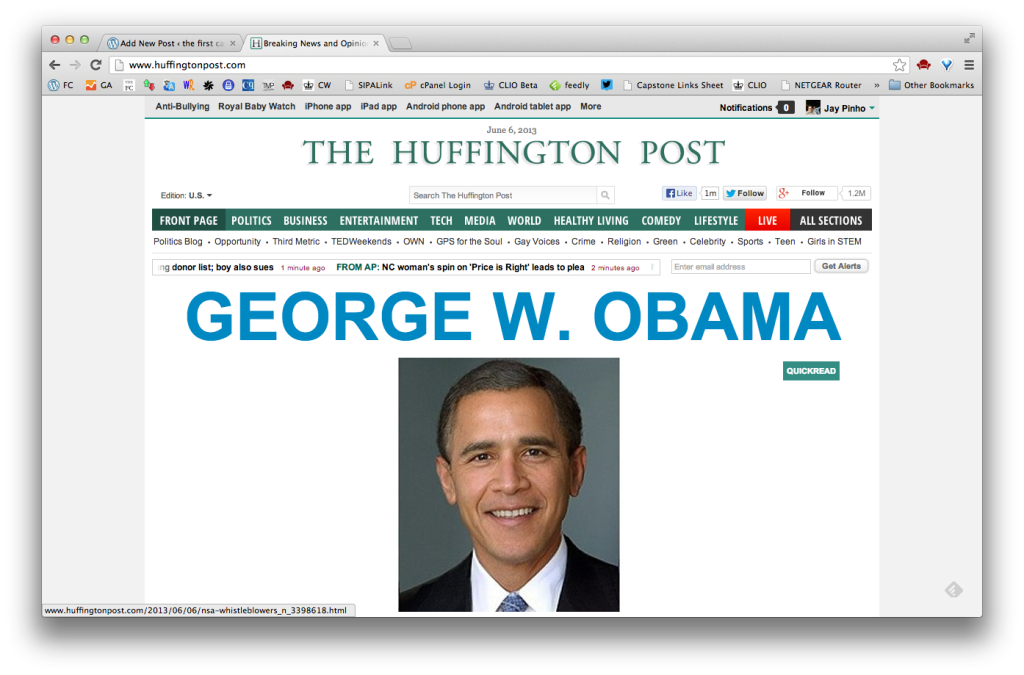
Screen Shot 2013-06-06 at 5.19.16 PM
The Huffington Post, with a typically subtle headline.

When you’re a Democratic president and The New York Times’ editorial board has utterly lost its faith in you, you may have done something wrong:

Within hours of the disclosure that the federal authorities routinely collect data on phone calls Americans make, regardless of whether they have any bearing on a counterterrorism investigation, the Obama administration issued the same platitude it has offered every time President Obama has been caught overreaching in the use of his powers: Terrorists are a real menace and you should just trust us to deal with them because we have internal mechanisms (that we are not going to tell you about) to make sure we do not violate your rights.

Those reassurances have never been persuasive — whether on secret warrants to scoop up a news agency’s phone records or secret orders to kill an American suspected of terrorism — especially coming from a president who once promised transparency and accountability. The administration has now lost all credibility. Mr. Obama is proving the truism that the executive will use any power it is given and very likely abuse it.

Many responses to yesterday’s Guardian bombshell about Verizon call data being scooped up en masse by the NSA have been less than furious. Notably, the chair of the Senate intelligence committee, Senator Dianne Feinstein, said, “This is called protecting America. People want the homeland kept safe.” She also helpfully pointed out, without a trace of concern, that this secret court order is apparently just one in a long string of them dating back consecutively to 2006. She also made sure to explain: “This is just metadata. There is no content involved. In other words, no content of a communication.”

Andrew Sullivan likewise joined the quickly swelling ranks of those that are mostly unbothered by the revelation:

I’m neither shocked nor that outraged. Meta-data is not the content of our phone records.

On that front, this kind of meta-data gathering hasn’t outraged me too much under either administration. This kind of technology is one of the US’ only competitive advantages against Jihadists. Yes, its abuses could be terrible. But so could the consequences of its absence.

But Sullivan and his cohorts are completely wrong on this point — and they’re wrong in three crucial but different ways: technically, logistically, and philosophically.

First, metadata — even when it excludes the subscriber’s name, as the secret court order claims — is just about the furthest thing from anonymity. Back in March, MIT News reported on a new study showing just how little metadata is required to pinpoint a specific individual:

Researchers at MIT and the Université Catholique de Louvain, in Belgium, analyzed data on 1.5 million cellphone users in a small European country over a span of 15 months and found that just four points of reference, with fairly low spatial and temporal resolution, was enough to uniquely identify 95 percent of them.

In other words, to extract the complete location information for a single person from an “anonymized” data set of more than a million people, all you would need to do is place him or her within a couple of hundred yards of a cellphone transmitter, sometime over the course of an hour, four times in one year. A few Twitter posts would probably provide all the information you needed, if they contained specific information about the person’s whereabouts.

Second, as Jane Mayer of The New Yorker points out, the actual content of the call — that is, audio or a transcript of the conversation — is not necessarily as valuable as the patterns and networks that can be traced from metadata:

For example, she said, in the world of business, a pattern of phone calls from key executives can reveal impending corporate takeovers. Personal phone calls can also reveal sensitive medical information: “You can see a call to a gynecologist, and then a call to an oncologist, and then a call to close family members.” And information from cell-phone towers can reveal the caller’s location. Metadata, she pointed out, can be so revelatory about whom reporters talk to in order to get sensitive stories that it can make more traditional tools in leak investigations, like search warrants and subpoenas, look quaint. “You can see the sources,” she said. When the F.B.I. obtains such records from news agencies, the Attorney General is required to sign off on each invasion of privacy. When the N.S.A. sweeps up millions of records a minute, it’s unclear if any such brakes are applied.

Finally, even on a philosophical or ideological level, Sullivan is wrong about the danger of not pursuing such invasive surveillance tactics. Stephen Walt takes it away:

There are two obvious counters. First, the United States (and its allies) are hardly lacking in “competitive advantages” against jihadists. On the contrary, they have an enormous number of advantages: They’re vastly richer, better-armed, better-educated, and more popular, and their agenda is not advanced primarily by using violence against innocent people. (When the United States does employ violence indiscriminately, it undermines its position.) And for all the flaws in American society and all the mistakes that U.S. and other leaders have made over the past decade or two, they still have a far more appealing political message than the ones offered up by Osama bin Laden, Ayman al-Zawahiri, and the various leaders of the Taliban. The United States is still going to be a major world power long after the contemporary jihadi movement is a discredited episode in modern history, even if the country repealed the Patriot Act and stopped all this secret domestic surveillance tomorrow.

Second, after acknowledging the potential for abuse in this government surveillance program, Sullivan warns that the “consequences of its absence” could be “terrible.” This claim depends on the belief that jihadism really does pose some sort of horrific threat to American society. This belief is unwarranted, however, provided that dedicated and suicidal jihadists never gain access to nuclear weapons. Conventional terrorism — even of the sort suffered on 9/11 — is not a serious threat to the U.S. economy, the American way of life, or even the personal security of the overwhelming majority of Americans, because al Qaeda and its cousins are neither powerful nor skillful enough to do as much damage as they might like. And this would be the case even if the NSA weren’t secretly collecting a lot of data about domestic phone traffic. Indeed, as political scientist John Mueller and civil engineer Mark Stewart have shown, post-9/11 terrorist plots have been mostly lame and inept, and Americans are at far greater risk from car accidents, bathtub mishaps, and a host of other undramatic dangers than they are from “jihadi terrorism.” The Boston bombing in April merely underscores this point: It was a tragedy for the victims but less lethal than the factory explosion that occurred that same week down in Texas. But Americans don’t have a secret NSA program to protect them from slipping in the bathtub, and Texans don’t seem to be crying out for a “Patriot Act” to impose better industrial safety. Life is back to normal here in Boston (Go Sox!), except for the relatively small number of people whose lives were forever touched by an evil act.

In other words, the NSA’s wiretapping program that began under Bush and has now very apparently flourished under Obama is every bit as bad as it sounds. The New York Times got it exactly right: the Obama administration has lost all credibility. So why is it that we always seem so willing to forget this news so quickly?

Enhanced by Zemanta

The shorter version

FastCompany describes a new ad campaign aimed — quite literally — at abused children:

Alongside the International Day Against Child Abuse, agency Grey Group España launched an outdoor campaign that uses lenticular printing to mask the poster’s message from adults. People over 5 feet 7 inches tall (reportedly the average height of an adult) would see one ad of a sad but otherwise unhurt child with the message “Sometimes child abuse is only visible to the child suffering it.” For those under 4 feet 3 inches (the average height of children under 10), the child’s face appears bloody and bruised, and the text, “If somebody hurts you, phone us and we’ll help you,” becomes visible.

Bill Keller wants to repeat history, which would make him wrong twice.

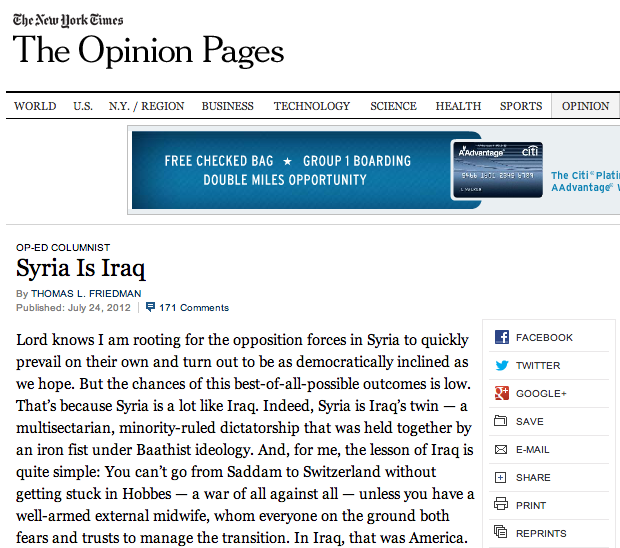
Screen Shot 2013-05-06 at 10.20.43 AMScreen Shot 2013-05-06 at 10.21.40 AM


Last night, New York Times columnist (and former executive editor) Bill Keller’s column, “Syria Is Not Iraq,” appeared online. (It’s seen in the above screenshot at right, juxtaposed against equally intellectually-challenged fellow columnist Thomas Friedman’s piece from last year.) As usual, it was a doozy:

As a rule, I admire President Obama’s cool calculation in foreign policy; it is certainly an improvement over the activist hubris of his predecessor. And frankly I’ve shared his hesitation about Syria, in part because, during an earlier column-writing interlude at the outset of the Iraq invasion, I found myself a reluctant hawk. That turned out to be a humbling error of judgment, and it left me gun-shy.

Of course, there are important lessons to be drawn from our sad experience in Iraq: Be clear about America’s national interest. Be skeptical of the intelligence. Be careful whom you trust. Consider the limits of military power. Never go into a crisis, especially one in the Middle East, expecting a cakewalk.

But in Syria, I fear prudence has become fatalism, and our caution has been the father of missed opportunities, diminished credibility and enlarged tragedy.

Keller concludes:

Whatever we decide, getting Syria right starts with getting over Iraq.

No, Keller, it doesn’t. Getting Syria right starts with acknowledging how Iraq happened. But doing that would require directly confronting the central role of Keller’s paper in propagating a flimsy and ultimately disastrous case for war in Iraq. Getting over Iraq, to use Keller’s convenient word choice, is a euphemism for allowing the same source that got everything so wrong in Iraq to make the same case for war in another country — again, with no exit strategy or, even, any strategy at all.

Keller argues that our failure to arm the rebels for fear of assisting al-Qaeda is in fact resulting in the same outcome, by ceding ground to the Saudis and Qataris, who are all too willing to assist radicals on the ground in Syria. But what Keller fails to mention is the fact that, after two years of civil war, an American decision to intervene now would raise more questions than it answers and may very well cause a public opinion backlash in the Arab world. Instead of being lauded as saviors, there is at least an equivalent likelihood of rebels asking, “How many lives could you have saved if you’d been here earlier?”

That alone is not a reason to stay away. But the audacity of the clamor for intervention — led by people like John McCain and, yes, now Bill Keller, the same people who so badly misjudged the prospects for success in Iraq — is that it makes the same characterizations about Syria that it did about Iraq. You’d think once would be enough.

Keller writes:

What you hear from the Obama team is that we know way too little about the internal dynamics of Syria, so we can’t predict how an intervention will play out, except that there is no happy ending; that while the deaths of 70,000 Syrians are tragic, that’s what happens in a civil war; that no one in the opposition can be trusted; and, most important, that we have no vital national interest there. Obama conceded that the use of poison gas would raise the stakes, because we cannot let the world think we tolerate spraying civilians with nerve gas. But even there, the president says he would feel obliged to respond to “systematic” use of chemical weapons, as if something less — incremental use? sporadic use? — would be O.K. This sounds like a president looking for excuses to stand pat.

This is a sickening, absurdist paragraph. “Looking for excuses to stand pat?” In Keller’s conceptualization, then, war is the default option, and Obama is doing somersaults in an attempt to evade his natural obligations. But this is simply not the case. Obama is perfectly right to observe that no vital national interest necessitates an American intervention in Syria (although he is seemingly less confident on this score than previously thought).

Keller’s not done:

In contemplating Syria, it is useful to consider the ways it is not Iraq.

First, we have a genuine, imperiled national interest, not just a fabricated one. A failed Syria creates another haven for terrorists, a danger to neighbors who are all American allies, and the threat of metastasizing Sunni-Shiite sectarian war across a volatile and vital region. “We cannot tolerate a Somalia next door to Israel, Lebanon, Jordan, Iraq and Turkey,” said Vali Nasr, who since leaving the Obama foreign-policy team in 2011 has become one of its most incisive critics. Nor, he adds, can we afford to let the Iranians, the North Koreans and the Chinese conclude from our attitude that we are turning inward, becoming, as the title of Nasr’s new book puts it, “The Dispensable Nation.”

Again, Keller’s historical — and personal — amnesia, combined with his implicit but entirely unsubtle smearing of prudent foreign policy analysts as appeasers, is appalling. There is no “genuine, imperiled national interest.” The primary reason everyone’s suddenly started talking about Syria is that Israel started bombing it. As always, Israel’s security interests take precedence over our own: where two years of civilian death and suffering elicited little more than yawns and sighs of boredom in living rooms throughout America, a few targeted airstrikes by Israel are amazingly effective at focusing the hive mind.

Keller writes:

But, as Joseph Holliday, a Syria analyst at the Institute for the Study of War, points out, what gets lost in these calculations is the potentially dire cost of doing nothing. That includes the danger that if we stay away now, we will get drawn in later (and bigger), when, for example, a desperate Assad drops Sarin on a Damascus suburb, or when Jordan collapses under the weight of Syrian refugees.

Yes, let’s go to war now, risking very real American lives, to prevent a hypothetical outcome that may or may not cause mass fatalities in another country’s civil war.

Here is perhaps my favorite line:

Fourth, in Iraq we had to cajole and bamboozle the world into joining our cause. This time we have allies waiting for us to step up and lead. Israel, out of its own interest, seems to have given up waiting.

Israel?! That’s his example? Israel, he may recall, was perfectly onboard with the American invasion of Iraq as well. And why shouldn’t it be? Any half-conscious human being can see the natural advantage of allowing a foreign country to wage war on another’s behalf — including paying the costs in lives and massive budget deficits. Israel can stand pat and let Americans take the heat again, as we’ve been doing for years.

“Why wait for the next atrocity?” Keller asks. Indeed, why? For neoconservative warmongers like Bill Keller, waiting is for appeasers. The case for intervention in Syria, like that in Iraq, recalls the title of the famous post-financial crisis book, This Time Is Different. Each time, excuses and half-justifications are lazily proffered so as to distinguish one hawkish prophecy from its disastrous predecessors. This time, let’s approach the problem differently, instead of feebly attempting to differentiate this potential foreign policy quagmire from another, very real one from the past.


Enhanced by Zemanta

Belieber

The New Yorker, following up on pop star Justin Bieber’s awkward attempt at memorializing Anne Frank, has a little fun re-imagining history:

Göring: You see, mein Führer, being a Belieber isn’t just about music. It’s about love and trust, about being sweet but still complicated, cocky but non-threatening, sexy but not precisely sexual—whether you’re commanding the Wehrmacht or hiding in an attic somewhere in the Netherlands. Sure, it’s easy to sit here and talk about making a Fascist Bieber, but chances are we would all just end up Bieber-Fascists. Look, Himmler’s already doing the slide-glide thing.

(Hitler turns to see Himmler doing Bieber’s signature dance move across the room. Hitler sighs heavily, realizing it’s useless.)

Hitler: Well, in that case, I suppose we ought to surrender.

Enhanced by Zemanta

How we are all unwitting terrorists

twitter

There’s been a lot of speculation in the past week or so about the Twitter feeds of Dzhokhar and Tamerlan Tsarnaev. Here are a few representative samples from The New York Times alone. First up is columnist Charles Blow:

On Friday, BuzzFeed and CNN claimed to verify Dzhokhar’s Twitter account. The tweets posted on that account give a window into a bifurcated mind — on one level, a middle-of-the-road 19-year-old boy, but on another, a person with a mind leaning toward darkness.

He was a proud Muslim who tweeted about going to mosque and enjoying talking — and even arguing — about religion with others. But he seemed to believe that different faiths were in competition with one another. On Nov. 29, he tweeted: “I kind of like religious debates, just hearing what other people believe is interesting and then crushing their beliefs with facts is fun.”

Dzhokhar Tsarnaev had strong views on the Middle East, tweeting on Nov. 28, “Free Palestine.” Later that day he tweeted, “I was going to make a joke about Hamas but it Israeli inappropriate.”

Toward the end of last year, the presence of dark tweets seemed to grow — tweets that in retrospect might have raised some concerns.

He tweeted about crime. On Dec. 28 he tweeted about what sounds like a hit-and-run: “Just saved a bunch of money on my car insurance by switching my car into reverse and driving away from the accident.” And on Feb. 6 he tweeted, “Everything in life can be free if you run fast enough.”

He posted other tweets that could be taken as particularly ominous.

Oct. 22: “i won’t run i’ll just gun you all out #thugliving.”

Jan. 5: “I don’t like when people ask unnecessary questions like how are you? Why so sad? Why do you need cyanide pills?”

Jan. 16: “Breaking Bad taught me how to dispose of a corpse.”

Then yesterday, the Times‘ head book reviewer, Michiko Kakutani, delved in a little further:

Given the layers of irony, sarcasm and joking often employed on Twitter, it can be difficult to parse the messages of a stranger. Yet some of them can seem menacing or portentous, given what we now suspect: “a decade in america already, I want out,” “Never underestimate the rebel with a cause” or, drawing from lyrics from a Kendrick Lamar song, “No one is really violent until they’re with the homies.” But others suggest a more Holden Caulfield-like adolescent alienation: “some people are just misunderstood by the world thus the increase of suicide rates.” Sometimes, Dzhokhar sounds downright sentimental (unless, of course, he is being ironic): “There are enough worms for all the birds stop killing each other for ‘em.”

Parts of Dzhokhar’s VKontakte page are harsher and more serious. Under personal priority, it says “Career and money.” Under worldview, it says “Islam.” There is a link to a video indicating outrage at the violence in Syria, and a link to an Islamic Web site that says “And do good, for Allah loves those who do good.” Another video features a blind boy talking to an older man, saying he believes his blindness will be absolved on Judgment Day; the man starts to cry, and wonders how many people who have their sight are as committed to the study of the Koran as the boy.

To her credit, she at least had the self-awareness to observe the obvious:

These posts instantly became dots that people began trying to connect. Some details ratified the views of those former friends and neighbors who said they were utterly shocked at the brothers’ possible involvement in such a horrifying crime. Other posts pointed to Tamerlan Tsarnaev’s growing interest in Islamic radicalism and possibly a dark subtext to the friendly, boy-next-door affect of Dzhokhar.

At the same time, they were reminders of the complexities of online identity — of the ways in which people strike poses and don masks on the Web (which can sometimes turn into self-fulfilling prophecies), and the ways in which the Web can magnify or accelerate users’ interests and preoccupations.

The social media droppings the Tsarnaev brothers left behind not only attest to their own immersion in the interactive, electronic world, but they have also provided everyone else with plenty of digital data from which to try to extract patterns and possible meaning — fulfilling that very human need to try to make narrative sense of the tragic and the overwhelming.

And, unsurprisingly, BuzzFeed and New York Magazine, among others, joined in on the Twitter-parsing/stalking fun as well.

You may see where I’m going with this. Yes, it increasingly looks like Tamerlan and Dzhokhar Tsarnaev bought into a radical fringe of Islam prior to bombing the Boston Marathon. And so it is theoretically possible that breadcrumbs from their evolving radicalization are discoverable by sifting through tweets and Russian social networking sites.

But it is much, much more likely that these tweets are simply being scrutinized with that 20/20 hindsight so familiar to tragic events: everything always looks clearer in the rear-view mirror. Even the most “menacing” of Dzhokhar’s tweets pointed out by the mainstream media reveal less “a “bifurcated mind…leaning toward darkness” and more the typical musings of a 19-year-old college student.

This voyeuristic, retrospective fine-combing of the younger Tsarnaev’s Twitter profile is not only useless. It is counterproductive and dangerous too: reading too deeply into the abbreviated, 140-character-length thoughts of a suspected bomber promotes the notion that such heinous acts could have been stopped if only we had been able to access more information earlier on — if only we had been watching earlier on.

There are signs of this mindset already. Take this article from today’s Boston Globe:

House Speaker John Boehner this morning said he was concerned that federal agencies hadn’t learned their lessons from the attacks of Sept. 11, 2001, and he vowed to hold agency heads responsible if they didn’t do enough to stop the Boston bombings.

The response in Washington is increasingly focused on potential intelligence failures, and a lack of sharing information among territorial federal agencies – a problem that was supposed to be fixed after the attacks nearly 12 years ago.

“I have concerns about what agencies knew what — and the fact that it wasn’t shared,” Boehner said at a press conference. “You know if the information is good enough for one agency of the government, why shouldn’t it be appropriate for other agencies of the government? We’re going to get to the bottom of it.”

It’s the same story in The New York Times:

Emerging from a closed two-hour hearing with three senior law enforcement and intelligence officials, several members of the Senate Intelligence Committee raised new questions about how the F.B.I. and the Department of Homeland Security apparently handled information about Tamerlan Tsarnaev, 26, the suspect who was killed in a shootout with the police on Friday.

“I’m very concerned that there still seem to be serious problems with sharing information, including critical investigative information,” Senator Susan Collins, Republican of Maine, told reporters. “That is troubling to me that this many years after the attacks on our country in 2001, that we still seem to have stovepipes that prevent information from being shared effectively, not only among agencies but also within the same agency, in one case.”

The problems with these interpretations are twofold. First, they assume that some form of Omniscience Lite is actually achievable. Well, it’s not. There is no such thing as perfect intelligence nor perfect crime prevention (sorry, Minority Report aficionados). Terrorism will happen from time to time. Maybe instead of freaking out, we can actually try to (gasp) get a little more used to it and, therefore, manage to return to normalcy more quickly.

Secondly, the implications of this type of thinking can be quite terrifying. If, with the benefit of hindsight, we can now perfectly see the seeds of radicalism sprouting on Dzhokhar Tsarnaev’s Twitter feed, then it follows that we can discover — and halt — someone’s budding radicalization taking place right now, in real-time. Many are already advocating for increased surveillance, more CCTV cameras, and so on. But even beyond the installation of more virtual eyes over our urban areas, the impulse to counter terrorism with an even bigger Big Brother is just one more step in the wrong direction for a country that’s already all too willing to surrender its civil liberties in the service of an unconvincing “security.”

Which brings me to the headline of this post. Take a look at the below tweets of mine, and then try to imagine reading them after I’ve been accused of a hypothetical bombing:

http://twitter.com/jaypinho/status/1637073148710912

http://twitter.com/jaypinho/status/45353903868485632

http://twitter.com/jaypinho/status/89339781535899648

http://twitter.com/jaypinho/status/94878752827375616

http://twitter.com/jaypinho/status/125352426701209601

http://twitter.com/jaypinho/status/226286900388966400

http://twitter.com/jaypinho/status/260104243510407168

http://twitter.com/jaypinho/status/270555250694426624

http://twitter.com/jaypinho/status/279597722326147073

http://twitter.com/jaypinho/status/281503668493246465

http://twitter.com/jaypinho/status/327061292244418560

Do you see the problem here? It took me all of about ten minutes to select these tweets out of nearly 5,000 I’ve written. So yes, there are plenty of dots and data points in a Twitter feed. But connecting them arbitrarily after the fact to create a portrayal of something sinister does nothing to help prevent terrorism. And it may do a lot to help push us just a little bit closer to 1984.

Enhanced by Zemanta