College – Rogue Wave
All posts by Jay Pinho

Find yourself a “Safe House,” or a relative close by…you’re probably wanted for murder — Sam Lim and I discuss The Americans, Episode 9

That’s right: two references in one headline. “Safe House” refers to this week’s episode of FX’s The Americans, and the rest of it…well, just have a look at this. As for the recap of Wednesday’s episode, you’ve come to the right place. And away we go.
Jay: I gotta say, when Amador showed up in that parking lot behind Phil after having already run into him at the Beemans’ party, I really thought they’d stolen our April Fool’s Day fake episode narrative and turned it into a real storyline on the show.
 But that might not have even been my favorite part. Even better was when the FBI agents began to discuss plans for killing Arkady (a conversation that took place in the kitchen of a dinner party, improbably: welcome back, The Americans) — and I immediately knew it couldn’t possibly happen, because I’d just seen the actor who plays him filming a scene on the Upper West Side last week.
The usual complaints still apply here, although they were slightly mitigated by the uptick in action. Throughout the episode, it seemed as if neither Phil nor Elizabeth had any real idea what they were going to do with Amador. In some ways, this echoed their indecision of the pilot episode, which ultimately also ended in the victim’s untimely demise. (The general rule on The Americans seems to be that, if you’re working for either American or Soviet intelligence and you end up in the Jennings’ custody, you’re probably screwed. If you’re just an innocent bystander — like the son of that poor old lady who got poisoned by Elizabeth — well, you’ll be OK eventually.) Continue reading Find yourself a “Safe House,” or a relative close by…you’re probably wanted for murder — Sam Lim and I discuss The Americans, Episode 9
“A gun is the most powerful device there is to accessorize the ego.”
Adam Gopnik has penned a beautiful piece for The New Yorker that gets to the heart of the American gun problem:
And so the real argument about guns, and about assault weapons in particular, is becoming not primarily an argument about public safety or public health but an argument about cultural symbols. It has to do, really, with the illusions that guns provide, particularly the illusion of power. The attempts to use the sort of logic that helped end cigarette smoking don’t quite work, because the “smokers” in this case feel something less tangible and yet more valued than their own health is at stake. As my friend and colleague Alec Wilkinson wrote, with the wisdom of a long-ago cop, “Nobody really believes it’s about maintaining a militia. It’s about having possession of a tool that makes a person feel powerful nearly to the point of exaltation. …I am not saying that people who love guns inordinately are unstable; I am saying that a gun is the most powerful device there is to accessorize the ego.”
…
We should indeed be as tolerant as humanly possible about other people’s pleasures, even when they’re opaque to us, and try only to hive off the bad consequences from the good. The trouble is that assault weapons have no good consequences in civilian life. A machine whose distinguishing characteristic is that it can put a hundred and sixty-five lethal projectiles into the air in a few moments has no real use except to kill many living things very quickly. We cannot limit its bad uses while allowing its beneficial ones, because it has no beneficial ones.
Related articles


2 A.M. Tune
Veins – Mt. Wolf
“Gun shops were jammed.”
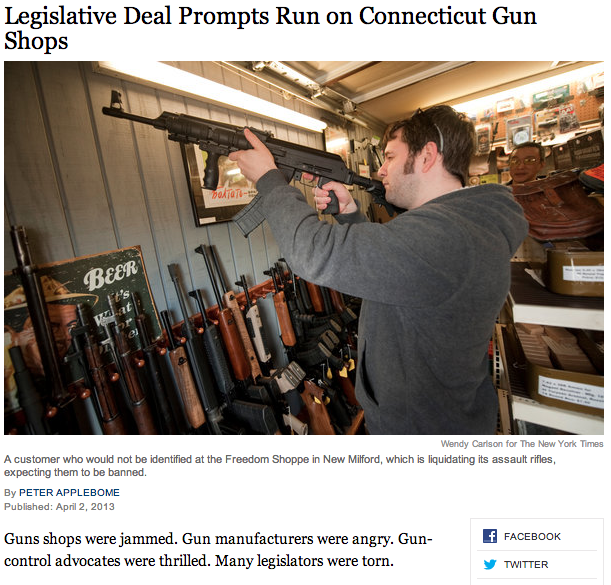
Last month, I noted an article by The New York Times‘ Sabrina Tavernise and Robert Gebeloff, in which the two reported a long-term, steady decrease in gun ownership. They explained:
The findings contrast with the impression left by a flurry of news reports about people rushing to buy guns and clearing shop shelves of assault rifles after the massacre last year at an elementary school in Newtown, Conn.
“There are all these claims that gun ownership is going through the roof,” said Daniel Webster, the director of the Johns Hopkins Center for Gun Policy and Research. “But I suspect the increase in gun sales has been limited mostly to current gun owners. The most reputable surveys show a decline over time in the share of households with guns.”
In my post, after providing three examples of recent Times articles (here, here, and here) that had noticeably contributed to the aforementioned “flurry of news reports” about people rushing to buy guns, I concluded:
One can be forgiven for reading The New York Times and leaving with the impression that, yes, the entire country is stampeding its nearest weapons shops and loading up on anything with a trigger. This is just the latest in a long line of examples of the media helping to create a story, then reporting on the fallout from that story from a detached perspective, as if the press had nothing to do with the preceding whirlpool of artificially manufactured “news” in the first place.
Well, as you can see above, the Times has yet to lose its appetite for stories about panicked weapons rushes:
Guns shops were jammed. Gun manufacturers were angry. Gun-control advocates were thrilled. Many legislators were torn.
But as President Obama on Tuesday announced a visit to Connecticut next week in the wake of an agreement on a far-ranging package of state gun legislation, Connecticut was bracing for the consequences, intended or not.
The most immediate result of the agreement, which came more than three months after the massacre of 26 children and educators in Newtown, was a run on gun shops on Tuesday, following months of already brisk sales. Gun owners are rushing to buy weapons, ammunition and magazines in anticipation of limits on their sale and possession.
…
Vic Benson, co-owner of the Freedom Shoppe, a gun shop in New Milford, said that his store was not usually even open on Tuesday, but that he opened its doors in anticipation of panicked buyers, and also to get rid of inventory he thinks he will be unable to sell after lawmakers vote on Wednesday.
The only indication in this entire article that all is not as depicted is the muted phrase “Gun owners are rushing…” — meaning that it is current owners, and not prospective gun buyers, that are leading the proverbial charge.
Look, the point isn’t that the Times shouldn’t cover news. And to some extent, delirious gun enthusiasts rushing their nearest weapons depot for a recharge so they can continue to shoot their high-powered guns with impunity even after stricter gun control legislation is passed is news.
Nevertheless, I would venture to guess that the Times‘ venerable voice is not well-utilized by devoting significant space in at least four articles in just over three months to the wildly exaggerated fears of armed paranoiacs. Perhaps, for example, some of those column inches could go towards additional coverage of shooting victims. Or of car dealerships, baseball, or whatever. After awhile, one starts to get the point: a lot of people love guns, and the Times is all over it.
But the larger point is that it’s ludicrous to continue covering these gun shop rushes on the one hand, while simultaneously remarking — as Tavernise and Gebeloff did — on the misleading “impression left by a flurry of news reports about people rushing to buy guns and clearing shop shelves of assault rifles,” as if the Times itself had nothing to do with creating this perception.
This paradox is especially concerning precisely because of what Tavernise and Gebeloff point out: gun ownership is decreasing. So publishing article after article portraying gun shops as overwhelmed by the demand for their products not only makes for boring reading, but doesn’t really present an accurate picture either.

2 A.M. Tune
[youtube http://www.youtube.com/watch?v=sBWnTzEhpbc]
Compliment Your Soul – Dan Croll
Now there’s a whimsical little music video.
Up, up, and away we go

The month of March was a good one for The First Casualty. On several occasions in the past, I’ve mentioned that the site has been growing pretty quickly from month to month, but I’ve never shared specific numbers. So just for fun, I decided to open the kimono a bit this time — if for no other reason than to use the phrase “open the kimono,” which I have always found both overwhelmingly creepy and hilarious.
As the above graph illustrates, there’s a clear upward trend from January through March. The bars representing pageviews and visitors align with the axis at left, and the line representing posts corresponds to the axis at right. So last month I published 50 posts (many of which were written by Victoria Kwan and Sam Lim) and had 3,722 pageviews from 2,656 visitors.
A brief explainer: although I’ve been posting at jaypinho.com since December 2010 (and at 50 Books for 2010 since January of that year: all of the posts from that blog are archived and searchable here), I didn’t start making it a regular thing until roughly the end of September last year. Previously, it had been a hit-or-miss affair. Now it’s more of a project. Anyway, the huge drop-off from December 2012 to January of this year is simply due to the fact that I was in mainland China for the first two-thirds of January and had extremely limited access to social media (including WordPress) during that time.
However, while the pageviews and visitors decreased that month since I was posting less, the proportion (pageviews per post, for example) actually increased from December to January. But it wasn’t until March that it really took off: we came within 107 pageviews of besting The First Casualty‘s record month of December 2012 (3,828 views), but with fewer than half the posts (106 last December, only 50 this March).
The point? You guys — whoever you are out there in the Internet mists, scouring cyberspace for SCOTUS analysis, media criticism, and Red Sox fandom alike — have been great. Even better, there are more of you now than before. So thank you. Lastly, please feel free to post comments liberally (by which I mean “as much as you’d like:” comments from all across the political spectrum are welcomed).
Thanks again, and keep reading!

Petition of the day

Well, of course.
Are online paywalls too little, too late?
Michael Wolff thinks so:
Without a dramatic turnaround in advertising income, there are only two strategies – neither mutually exclusive – for the continued existence of newspapers, in digital or any other form:
• Having established the paywall model, the goal, in a race against time, is to extend it to a greater and greater part of the user base. Like the paywall itself, this is unchartered territory. Rupert Murdoch’s more absolute paywalls having worked significantly less well than the New York Times’ porous wall. The Times, however, counting on its brand power and on the gradual change in consumer behavior, is trying to up the ante, recently cutting its free take from 20 to ten articles.
• Re-orient the cost basis of the business, still largely modeled on advertising income, to the much smaller subscription revenue base. That is, fire a lot of people.
This is, actually, good news, if not necessarily for shareholders or for many employees. Some newspapers can continue to exist, albeit as vastly smaller and less profitable businesses.
I have a few points in response. First, Wolff characterizes newspapers’ plummeting revenue in the following terms: “A digital advertising environment on the web – one even more pronounced in mobile – that relentlessly increases the amount of advertising space available and lowers the value of all space overall.”
Wolff is mostly right, for now. But that’s only because advertisers have yet to figure out what’s valuable. I worked in online advertising for two years (including one year for a behavioral targeting firm), and I can say with some confidence that we still don’t have adequate metrics to measure advertising success online — hence the degradation of online real estate. But soon enough, the advertising landscape will have to revert to form.
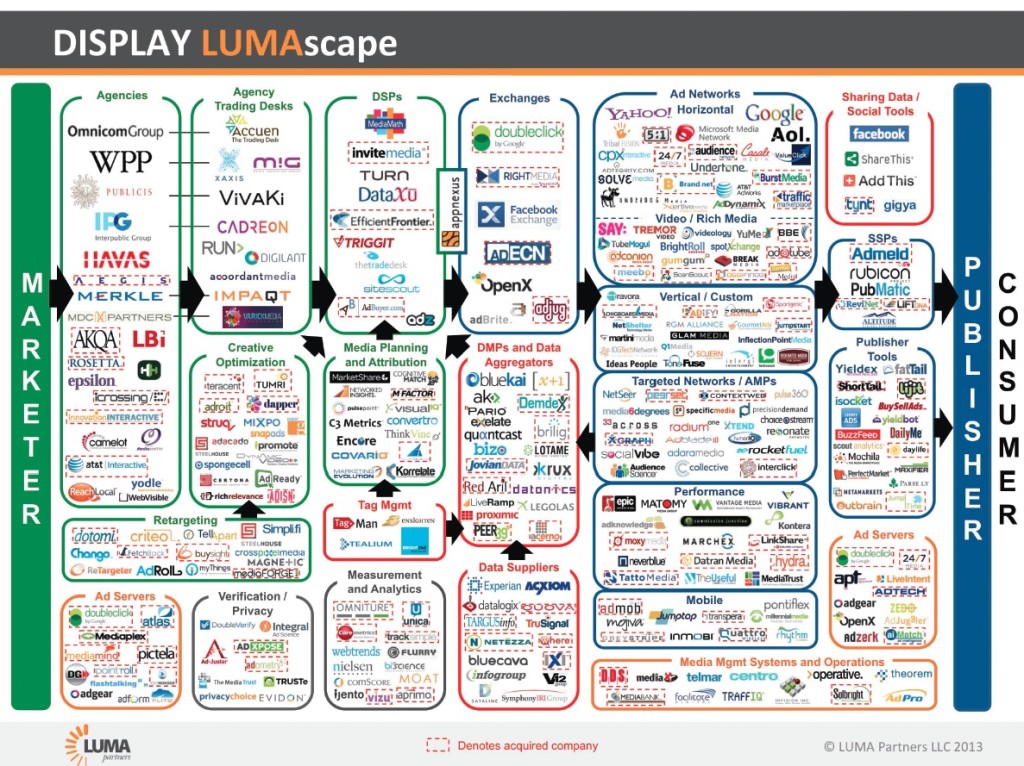
Why? Well, because advertisers don’t like paying for something that provides no value. It’s astonishing just how little advertisers still know about their own data in 2013 — that is, the audiences on their own web sites, the customers buying their products, and so on. The problem is even worse when it comes to connecting with new audiences, also known as advertising. Not only do the companies themselves not understand the data, but many of the online advertising firms that these companies have hired know little about what they’re selling as well. (Take a look at the above headache-inducing graphic of the online media landscape to understand why.) Continue reading Are online paywalls too little, too late?
House Republicans are coming around. Slowly. Finally.
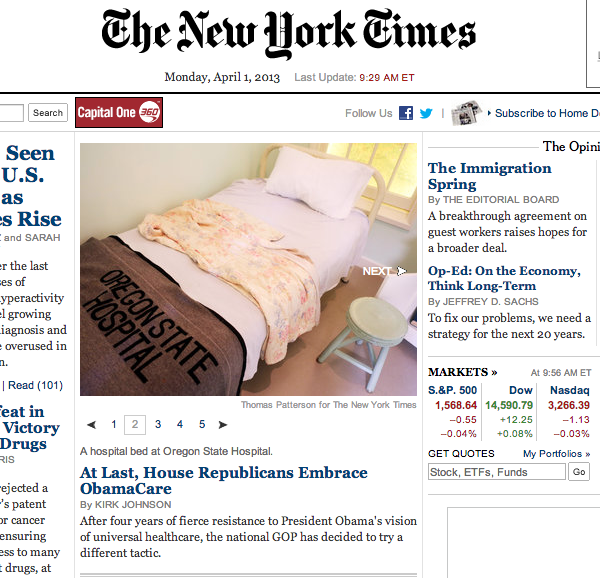
Light at the end of the tunnel? One can only hope. But whatever the reason — political expediency, acknowledgment of a battle lost, cynical opportunism, or something else entirely — it’s an encouraging development nonetheless. Considering that the foundation of Obama’s healthcare law was a Heritage Foundation proposal, it’s about damn time.
UPDATE: Happy April Fool’s Day.
