Fantasy – MS MR
All posts by Jay Pinho

Adding to the archives
I’ve just imported all posts from my old blog, 50 Books for 2010. Longtime readers will know this (hello, family), and the rest of you can probably surmise as much from the title, but that blog chronicled my attempt to read — and review — fifty books in 2010. It was a lot of fun, and a lot of work, but until now it had remained on a separate site.
Well, it’s still there, but going forward it’s now right here at The First Casualty too. So you can search through the archives, check out reviews of your favorite books, and so on. And feel free to leave comments on anything you (dis)like! I’ll read and respond to them.
“The Clock” is ticking for The Americans: Sam Lim and I discuss Episode 2
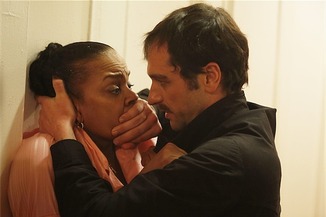 Sam and I are back — a little late this time — to talk about Episode 2 of The Americans, titled “The Clock.” The consensus? Lower expectations make for a more enjoyable viewing experience. (I guess we should all know that by now given the inexplicable long-term popularity of Two and a Half Men.)
Sam: At first glance, this week’s episode wasn’t that bad. I wasn’t impressed, but I wasn’t supremely disappointed either. I must be managing my expectations well.
Stan Beeman, though. I just find him annoying. First of all, they found caviar at some stereo store. Is it just me or does that just seem too convenient a storyline? And after pocketing that caviar, why does Stan feel the need to take it to Philip’s house that night? Is his gut telling him that caviar will make Philip admit he’s a KGB officer?
Interesting development at the FBI office though. Beeman takes a congratulatory phone call, and I noticed Amador’s face contort all of a sudden. Might this have been The Americans‘ subtle attempt to hint at race-relations in the workplace in the early 80s? Or this might’ve just been another tangential sequence with no direction (like the child predator from the first episode).
Also, in this episode, Elizabeth just seemed like a totally different character to me. Gone was the steely, nationalistic resolve from last week. Instead, perhaps fueled by her conversations with Philip (which still would be strange, given what we’d seen of their seemingly complicated relationship from last week), she wants to spend more time as a mother. I don’t know. I said it last week, and I’ll say it again. I find her character development sporadic and weak at best. Who randomly wakes up their daughter in the middle of the night to pierce their ears? Bizarre.
Your take?
Jay: Your last point cracked me up: there really is very little explanation for Elizabeth barging in on her sleeping daughter to pierce her ears. And on a similar note, I really don’t know why they insert gratuitous scenes like Phil watching over his sleeping son with hands folded. What is that scene supposed to accomplish? Let us know that, despite nearly suffocating an innocent guy earlier, he’s still a loving dad? I mean, great?!
The funny thing is, I know exactly what you mean about managing expectations: a big part of the reason I didn’t see this episode until today is because I was really busy, but the other part is that I just wasn’t that excited about it. So when I finally did watch it, my expectations were low enough that it allowed me to actually enjoy the episode much, much more than I did the pilot.
And I have to say, things were better this time around. Elizabeth, like you said, was much less dogmatic and more of a real person. Stan’s workplace dynamics are starting to shape up — although, again, we don’t know exactly what that look on Amador’s face meant yet, other than what seemed to be office politics (Stan taking the credit for other people’s hard work). Even the scene with Stan in Phil’s kitchen wasn’t as awful as it could have been. Granted, the whole caviar side-plot is a bit strange, but it seemed conceivable that Stan came over just to be friendly. He seems to be a bit of a loner, even with a family.
I’m also curious to see how the story with the newly recruited Russian caviar thief works out. I have to admit, I didn’t really pay close attention during Stan’s scene with her, so I’m not entirely sure what the racket was that she had gotten herself involved in — stealing caviar from an embassy and buying stereos with it? did I hear that right? — but I’m looking forward to seeing what she ends up doing.
My biggest complaint, weirdly enough, is about the girl Phil’s stringing along in his roleplaying as a Swedish intelligence officer: why are her lines so cheesy? No one talks like that, not even back in the 1980s. At least I certainly hope not.
Do you see any themes shaping up? Anything to get you more engaged? I have to admit that I’m somewhat less down on the show now, even if I remain wary.
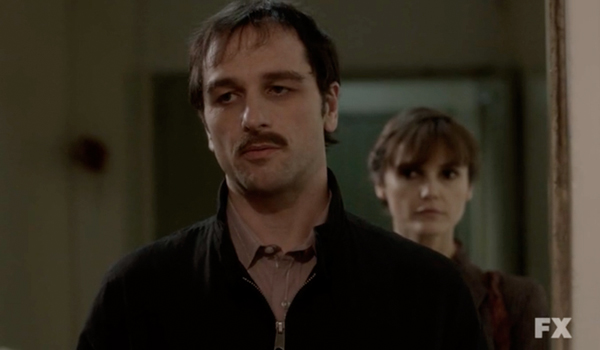 Sam: I had forgotten about Philip and the whole Swedish intelligence officer thing! You know, as part of my lowered expectations mantra, I think I just kind of approached that one with an “eh” reaction.
I do think you’re right, though, that such an approach allows the episode to do better this time around. You might be right about Stan just being friendly or not having much of a family life. Or perhaps he just felt bad for breaking into the Jennings’ garage.
Theme-wise, so far, I feel like we’re going to see a lot of family influence on the main characters’ actions and inactions. That seems to be a major theme of the series — that you have these covert spies who are supposed to blend in by having a normal family, etc. but have to balance a dangerous hidden life.
As for anything to get me more engaged, I’m honestly not sure. I can’t help wondering if some sort of Homeland-like twist where one of the main characters becomes a double agent might not make me more interested. But then it’d just become an even more second-rate Homeland ripoff. So I’ll just continue managing my expectations and enjoying more scenes of confiscated caviar being consumed. That’s it. I enjoy food, so perhaps introducing more good food would be a nice development (I’m only being somewhat facetious on this point).
What about you? What would you do to make this better?
Jay: I’m with you on the family aspect: I think this will continue to play a large role on the show. In fact, I think I read an interview with the creator, who said that the show was really about marriage and family, and that the spying was almost secondary (paraphrasing hugely here).
The Americans is in a somewhat strange position: it’s arriving on the heels of another very popular spy show, and yet there may actually be an opening for this one too just by virtue of the fact that Homeland went almost completely off the rails at various times during Season 2. And yet anything The Americans does will — at least in our minds, quite obviously — be compared against Homeland.
I think they need to make sure they take The Americans in a different direction. Obviously, they can’t avoid certain similarities: double agents, covert operations, and so on are all necessary staples of the spy genre, but one advantage The Americans has is its historical setting: the 1980s and the beginning of Ronald Reagan’s administration. It seems to me that they’re a bit more willing to “get political” (given the multiple references to Reagan being crazy and whatnot) than Homeland was, possibly simply due to the benefit of hindsight (people don’t always get as angry discussing the politics of thirty years ago than they would about contemporary issues like terrorism). That, and the look exchanged between Stan and his Number 2 make me think the show could edge in a direction that establishes itself as social commentary. I say “could” because, so far, these seem like mostly irrelevant blips that don’t connect to any broader themes, but that may be just because we’ve seen only two episodes. I guess we’ll find out.
Finally, Israel gets its day on SNL
Andrew Sullivan deems it a “cultural breakthrough.” That may be overly optimistic, but it’s certainly hilarious:
2 A.M. Tune
Recover – Chvrches
Read on and on: The Dish, before and after the meter
 As most of the world knows by now — and by that I refer mainly to people like the ones that populate my Twitter feed — Andrew Sullivan has cut himself loose. On Monday, February 4th, The Dish officially switched over from the Daily Beast to Sullivan’s own WordPress-hosted site.
The change comes with a few extra bells and whistles: no ads or clutter, automatic resizing on smartphones (although this has yet to work on my iPhone), infinite scrolling, and so on. Probably my favorite new feature is the search engine — or as Sullivan put it, “I have given a sharp dagger for anyone who wants to make me look foolish.” On the very first day his new site appeared, in fact, I inadvertently stumbled upon this gem from October 2002:
The last phony anti-war argument was that President Bush had yet to “make the case” for war against Iraq, as if grown-ups didn’t have the capacity to make their own minds up on the issue without constant guidance from the commander-in-chief. But that surely must now be in tatters as a point, since the president has made speech after speech in the last year clearly laying out the rationale for the war on terror, a rationale that has always included defanging Saddam.
Oops.
Anyway, the main transformation of The Dish is that it will now charge for its content. More precisely, after seven “Read On” clicks within a 30-day period, readers will be directed to a subscription page, where they’ll be able to sign up for a year of The Dish at the very manageable annual rate of $19.99.
As a medium-intensity Dish obsessive (on the spectrum, I’m somewhere between “regular reader” and “currently tattooing the Dish beagle to my forehead”) and aspiring journalist, I took great interest in Sullivan’s gamble, which basically amounted to throwing off the corporate chains — chains that were accompanied, of course, by a large financial backing — and going it alone. I began to wonder, as did many other readers, how the switch from a principally advertising-supported venture to one backed directly by the readers would affect the content and form of The Dish itself.
This being Andrew Sullivan, he was only too happy to share his readers’ concerns in the days leading up to the switchover. (In fact, Sullivan’s masochistic willingness, rare among bloggers, to frequently publish reader emails excoriating his commentary is one of the main reasons I was so happy to subscribe to the new reader-supported iteration of The Dish.)
After Sullivan published one reader’s blunt adieu to The Dish on January 3rd — “For better or worse I like my Internet free,” (s)he declared, and then, one hopes, enrolled in Microeconomics 101 — he reassured his audience: “A reminder to our reader and others that the vast majority of Dish content will remain free to non-members.”
Two weeks later, in response to more reader reactions, Sullivan again noted: “Even if all of my longer posts are metered, only a portion of my writing will go behind the read-on, thus allowing all readers to get the gist of the post, regardless of subscription.”
Perhaps most interestingly to me, however, was the cautionary point raised by another reader several days earlier:
Another reader worries that “there may be potential copyright issues if it was less than 50% original content/comments by the Dish team with a “charge” being issued by the Dish.” But another writes:
The read-on might actually work to the external sources’ advantage, in that non-payers will then have more reason to follow the link to the original if they’re interested.
The above-mentioned post, in fact, contained a variety of creative suggestions from readers as to how, exactly, Sullivan should handle the “Read On” issue. Now that all content beyond the “Read On” button (after the first seven monthly clicks, that is) requires payment, it would be interesting to see just what type of content Sullivan is placing behind the “paywall” (a term Sullivan himself dislikes but which more or less describes his new model).
Long story short: I’ve just now completed such a study. First, I analyzed every post on The Dish in the one-week period from January 1 to January 7, 2013, in which I categorized each entry by:
A) whether it included a “Read On” button
B) what type of content came before the “Read On” button (as in, the part that is visible without expanding the post): (1) primarily Sullivan and/or reader commentary, (2) primarily third-party content (e.g. excerpts from an article, column, or essay), or (3) a combination of both Sullivan/readers and third-party content (as when Sullivan excerpts articles and then critiques their points, rather than, for example, simply excerpting another article rebutting the first one)
C) what type of content came beyond the “Read On” button (using the same criteria), if there was one
I chose the first week of 2013 (somewhat arbitrarily) as my control group because it preceded the implementation of the meter model. I then performed the same analysis on all posts on The Dish in the week from February 4th (the first full day under the new meter model) to February 10th. (All times are in EST, by the way.)
A few caveats are in order. First, as Andrew Sullivan himself made clear, the opening week of his new site is not exactly a perfect representation of how the “Read On” button will be utilized in the future. On February 6th, in response to a reader who questioned the additional value granted by subscribing, Sullivan noted:
That’s because after two days, we’ve been going easy on the meter. We’ll adjust as we go along. We want to keep the majority of the site free, but the deeper analyses, reader threads, my own writing, and other features will slowly become less accessible to the non-subscriber. It’s a balance, and we’re trying to figure our way forward with it.
As you will see below, so far this formulation has meant a significant departure from Sullivan’s use of “Read On” prior to the advent of the meter. Back then, in my sample, over two-thirds of all “Read On” segments — that is, the portions of his posts that lay beyond the “Read On” button — consisted primarily of third-party content. Now, however, “deeper analyses, reader threads, [his] own writing, and other features” have gained an increasing share of the “Read On” pie. (Again, keep in mind that things are still in flux: it’s only been a week.)
A second caution applies to my criteria for categorizing the posts. Obviously, there is a small subjective element to the endeavor. However, this is probably much less significant than one might think: the vast majority of posts on The Dish — and this applies equally to the “Read On” and non-“Read On” sections of each post — quite clearly fall into one of the three categories specified above: content produced primarily by Andrew and/or his readers, content produced primarily by third parties, and content containing a mixture of both.
To use some of his more popular features as an example, both sections of a typical “View From Your Window” post (both the content before and beyond the “Read On” button, in other words) would obviously fall into the first category. A “Mental Health Break,” which rarely contains a “Read On” button, would usually fit into the second, since these posts generally consist of a video produced by someone else with no more than an accompanying line or two from Sullivan. And an “Yglesias Award Nominee” post, while possibly fitting into the second category, often instead went into the third — as Sullivan frequently added his own commentary to the quote itself (either in the pre- or post-“Read On” sections of the post). Anyway, in the interest of transparency, I have included a link to my full Excel spreadsheet analysis here.
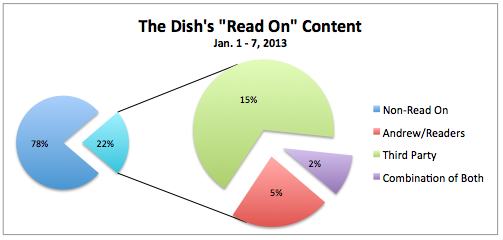
Bottom line: Andrew Sullivan has almost perfectly inverted his “Read On” content from before to after the implementation of the meter. From January 1 to 7, he posted 231 times; of those, only 52 (22.5%) included “Read On” buttons. Of those 52 “Read On” sections, 35 consisted primarily of third-party content (67.3%), 12 mostly contained material produced by Andrew and his readers (23.1%), and the remaining 5 were a combination of Andrew/readers and third-party content (9.6%).
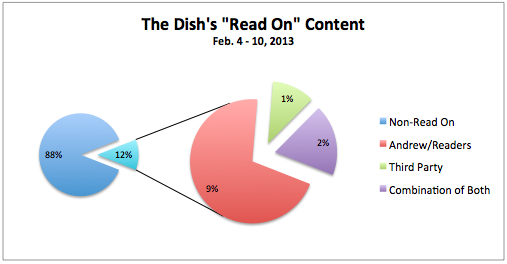
From February 4 to 10, however, several things changed. The number of total posts was almost identical to the January period (227), but — as he promised — there were significantly fewer “Read On” posts in the first week of the new meter (27, or only 11.9% of the total). Of those 27, 19 contained content primarily contributed by Andrew and his readers (70.4%), 5 contained a combination (18.5%), and only 3 “Read On” sections during the entire week contained content mostly attributable to third parties (11.1%, or 1.3% of the entire population of posts this past week).
Of course, only time will tell if this trend of more original material after the “Read On” button continues. It would certainly make sense, since this section is now being charged for after seven monthly clicks (which probably took the average Dish reader, what, five minutes to hit on February 4th?). I’d expect the percentage of posts that contain “Read On” buttons to rise pretty soon, because that’s one of the primary added-value propositions of subscribing. But I suppose how quickly this all happens will depend on a number of factors, including how many new subscribers Sullivan is scooping up on a regular basis now that more and more casual readers are starting to hit the meter.
In any case, I’m excited to see a blogger of Sullivan’s caliber jumping into such a bold experiment, and I wish him the best! I certainly don’t always agree with him, but even when he’s wrong, he’s never boring.
The cost of innovation
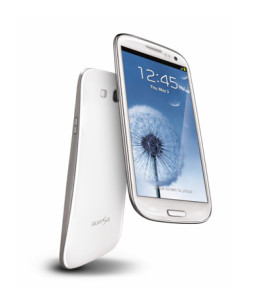
Every time a business hits it big — in this case, Samsung with its steady line of state-of-the-art phones and tablets — some intrepid reporter feels the need to explain that a significant portion of its success is attributable to the company’s organizational structure, its ethos, or the number of complimentary amenities available at the headquarter’s on-site gym. The latest exemplar of this approach:
Designers of the Galaxy S III say they drew inspiration from trips to Cambodia and Helsinki, a Salvador Dalí art exhibit and even a balloon ride in an African forest. (It employs 1,000 designers with different backgrounds like psychology, sociology, economy management and engineering.)
“The research process is unimaginable,” said Donghoon Chang, an executive vice president of Samsung who leads the company’s design efforts. “We go through all avenues to make sure we read the trends correctly.” He says that when the company researches markets for any particular product, it is also looking at trends in fashion, automobiles and interior design.
Hangil Song, a Samsung product designer, described a visit to the Marina Bay Sands resort in Singapore, where he said he was amazed by the views of the sky, the cityscape and the water. He wanted to create an effect where water was overflowing from the screen. As a result, taps and swipes on the Galaxy S III’s phone screen create a unique ripple effect.
That’s quite the overhead for a CPU-intensive transition visual.
The new First Casualty
We’ve finally made the switch to an independently hosted site — meaning the blog’s going to be more customizable and will allow for a lot of cool new looks and features going forward. (Case in point: you can now comment via your Facebook or Twitter logins.) Let me know what you think of the new look in the comments section! There will probably be a few glitches here and there, so make sure to keep checking back. Also, if you’d already subscribed to the blog before, please double-check to ensure you still are; I believe everyone’s been transferred over but you can just re-subscribe if not.
And, as always, thanks for reading!
– Jay
Where is the outcry?
The New York Times reports on soccer team Beitar Jerusalem’s recruitment of two Muslim players — who aren’t even Arab; they’re from Chechnya — and the reaction of racist fans:
The team, Beitar Jerusalem, has long been linked to Mr. Netanyahu’s Likud Party, and for 15 years has been notorious for racism and violence, including an incident last spring in which fans stormed a local mall chanting “Death to Arabs” and beat up several Arab employees. Founded in 1936, it is the only one of Israel’s professional soccer teams never to have recruited an Arab player.
The current controversy concerns the team’s addition of two Muslim players from Chechnya. Although one is injured, the other is expected to play for the first time in a match on Sunday against a team from Sakhnin, an Arab-Israeli town.
In anticipation of the Muslim players’ arrival, some fans unfurled a banner at the team’s Jan. 26 game saying “Beitar Pure Forever.” Some critics said the banner was reminiscent of Nazi Germany’s expulsion of Jews from sport, and it led to nationwide soul-searching.
The greatest irony?
“We cannot accept such racist behavior,” Mr. Netanyahu said. “The Jewish people, who suffered excommunications and expulsions, need to represent a light unto the nations.”
There has long been a double standard in the American media in which blatant Israeli racism towards Arabs and Muslims is largely ignored — or, at best, excused as an outlier — while even the slightest hint of negative sentiments towards Israel — even if motivated primarily by political considerations — is reflexively excoriated as anti-Semitic.
Take, for example, the recent brouhaha at Brooklyn College, where a predictable uproar was fortunately insufficient to prevent the institution from holding an event featuring speakers who support Boycott, Divestment, and Sanctions (B.D.S.) policies relating to Israel. Following the event, Brooklyn College professor Corey Robin blogged about a previous speaker at the school:
In March 2011, David Horowitz spoke at Brooklyn College. Someone yesterday brought to my attention this report from the event. A few highlights:
Given this context, it was all the more disturbing last night when I looked across the crowd and saw tears run down the face of a member of the Palestine Club as Horowitz said to the group of mostly nodding heads, “All through history people have been oppressed but no people has done what the Palestinians have done—no people has shown itself so morally sick as the Palestinians have.”
Horowitz, who admitted he had actually never even been to Israel, proceeded to give everyone a lesson in Middle East politics: according to him, Muslims in the Middle East are “Islamic Nazi’s” who “want to kill Jews, that’s their agenda.” He added later, “all Muslim associations are fronts for the Muslim Brotherhood.”
…
The most revealing moment came when a young Arab-American woman directed a question to Horowitz and the audience: “You talk about Muslims as if you know them—We have a Muslim American Society, we have a Palestine Club [on campus]. I want to raise the question to any of the Jews in this room, and students, have you guys ever been threatened by a Muslim on campus or an Arab?” To this, the crowd almost unanimously spun around in their seats to face the young woman and replied “yes.” Someone shouted, “and we’re scared when we see Muslims on buses and airplanes too.”
Horowitz encouraged anti-Muslim hate by telling the crowd, “no other people have sunk so low as the Palestinians have and yet everybody is afraid to say this,” claiming that Muslims are a “protected species in this country” and that he’s “wait[ing] for the day when the good Muslims step forward.”
As Robin then asked:
First, how is it that the comments of Horowitz can be so easily admitted into the mansion of “the open exchange of ideas” while the comments of Butler and Barghouti [who spoke at the recent BDS event] seem to threaten the very foundation of that edifice?
It’s a good question, but not one we’re likely to see answered by traditional media establishments any time soon.
2 A.M. Tune
Colombia – Local Natives
Beautiful, haunting track from the talented group’s new album, Hummingbird.