Category Archives: Politics

Justifying the unjustifiable in Syria

Let’s start with the premise that some wars are justifiable. I’m with Jonathan Chait there. But he loses me very shortly thereafter in his piece from Tuesday:

The merits of intervening in Syria strike me as both a closer call and a lower-stakes matter than what we think of as “major wars.” The apparently forthcoming operation has much more modest ends than the intervention in Libya, which I supported and that succeeded in its aim. We will not be toppling a brutal regime or preventing an imminent massacre. The purpose of air strikes is to impose a cost on regimes that deploy chemical weapons against civilians. Attacking the Syrian regime won’t stop all future massacres of civilians, or even all chemical attacks on civilians, but it does strike, on balance, as better than doing nothing at all.

Essentially every line of this paragraph is inaccurate or incoherent. First, what, exactly, constitutes a “major war?” If a two-year-old civil war with a death toll exceeding 100,000 and displaced totals in the millions doesn’t count as one, then I’m not certain what it would take to persuade Chait of the war’s significance. (Like Mitt Romney’s conception of the upper class as households earning over $250,000 annually, it appears that Chait’s dataset of “major wars” is restricted to ones in which Americans die in sufficiently large numbers.)

I get what he’s trying to say: war may be devastating Syria, but an American intervention would pose little risk to the United States. To illustrate this point, he compares the proposed military action in Syria to that in Libya and concludes that the former actually represents the safer course of action.

This is, of course, absurd. Libya was led by Muammar Qaddafi, an increasingly isolated autocrat whose idiosyncrasies even his authoritarian Arab brothers despised, and they were only too happy to be rid of him. Virtually no one felt threatened, or was even particularly bothered, by what transpired in Libya: only a duped Russia (sign up for the no-fly zone, stay for regime change!) and a coterie of jittery Middle Eastern despots showed much concern. It was quite clear, in the end, that Qaddafi had no real leverage with anyone.

Contrast that with the situation in Syria today. Assad has the support of both Hezbollah and Iran. Oh, and Russia, which has already warned of the “catastrophic consequences” of an intervention in the Middle East. Meanwhile, Israel is standing ready to respond in case of retaliation in the event of an American-led strike in Syria. In short, it is really quite easy to imagine a scenario in which at least six nations (Syria, Lebanon, Russia, Iran, Israel, and the United States — and this doesn’t even include likely NATO partners such as the U.K.) are pulled into an increasingly intractable conflict. Syria is intricately woven into the political fabric of the Middle East in a way that Qaddafi’s Libya could only dream of being.

But Chait doesn’t stop there. He also insists, echoing a persistent journalistic theme that bears little resemblance to reality, that the Libya operation was a success. It is unclear whether he is referring to the prevention of a massacre in Benghazi or regime change itself as barometers of victory. In this failure, however, he is at least joined by the initial proponents of the Libya intervention, none of whom seemed to know the true objective either. In a preemptive rebuttal of his critics, he writes:

The argument for intervening in Libya was not that doing so would turn the country into a peaceful, Westernized democracy moving rapidly up the OECD rankings. It was that it would prevent an immediate, enormous massacre of civilians. Libya remains an ugly place; it would have been so regardless of whether NATO intervened. But the narrow, humanitarian goal that drove the U.S. to act was unambiguously accomplished without the larger dangers of mission creep that foes warned against.

Again, this is sheer madness. The “narrow, humanitarian goal” to which Libya intervention advocates staked their early justifications was to prevent a massacre in Benghazi by establishing a no-fly zone, and not regime change. Of course, we never had any definitive proof that such a massacre would take place, only the histrionics of a famously melodramatic leader. So was the intervention a success? Only if measured against the presumed alternative of a guaranteed massacre, an event that — by definition — we can never know for certain would have happened in the first place. The goal was far from “unambiguously accomplished.”

What really gets me, though, is this part: “…without the larger dangers of mission creep that foes warned against.” This is a truly astounding declaration. Here is a White House statement from March 22, 2011:

Ben Rhodes, a deputy national security adviser, issued a statement acknowledging that President Obama would like to see a democratic government in Libya, but explained that the aim of the U.S. military’s intervention there is not to enact regime change.

“We’re clarifying, as we’ve said repeatedly, that the effort of our military operation is not regime change, that as we actually say in this readout, it’s the Libyan people who are going to make their determinations about the future,” Rhodes said. “We support their aspirations, their democratic aspirations, and have stated that Gadhafi should go because he’s lost their confidence.”

This “narrow, humanitarian” NATO campaign to prevent a massacre eventually lasted seven months, included nearly 8,000 bombs and missiles, and played a decisive role in the rebels’ eventual capture of Qaddafi — long after he possessed any capacity to massacre anyone.

And yet even this incongruence is hardly the worst aspect of Chait’s argument. That prize is awarded to this sentence: “Libya remains an ugly place; it would have been so regardless of whether NATO intervened.”

Exactly. That’s just the point.

And so here we are again, pondering a supposedly limited engagement in Syria. Once again, the White House has explicitly denied that the goal of the (decreasingly hypothetical) intervention in Syria would be regime change. Once again, the objective is muddy: murkier, even, than the Libya strikes — which were at least superficially described, at the outset, as a response to an impending massacre. In Syria, the massacre has already taken place, and Obama has seemingly settled on the phrase “strong signal” (against the use of chemical weapons) as ample justification for a potential military mission.

And, once again, Syria will remain an ugly place with or without external intervention.

Chait concludes thusly:

But I continue to be amazed that some of my younger liberal friends find it so easy to dismiss any weighing of pros and cons by venturing arguments structurally identical to ones that, in a domestic context, they recognize as absurd.

I, in turn, continue to be amazed that Jonathan Chait finds war so casually justifiable. In the first quote I excerpted in this post, he wrote: “Attacking the Syrian regime won’t stop all future massacres of civilians, or even all chemical attacks on civilians, but it does strike, on balance, as better than doing nothing at all.”

That’s right: an intervention strikes him as better than doing nothing. That’s only slightly worse than going to war to send a “strong signal.” And yet, “doing nothing at all” isn’t even an option on the table. (For one, the U.S. has already promised to supply the rebels with arms, even if that vow has not necessarily been fulfilled yet.)

Indeed, this is the principal victory that the national security hawks have wrested from their dovish foes in the American political sphere: the idea that ever deciding not to intervene somewhere is a form of cowardice and isolationism. It’s why Rand Paul is consistently portrayed as a hermetic isolationist for the sole crime of opposing thoughtless military adventurism. (He’s rightly portrayed as a “wacko bird” for many other things, however.) And it’s why the decision to go to war is consistently portrayed as a garden-variety policy decision, like raising taxes or modifying vehicle emissions standards.

But it’s not. John Adams once said that “great is the guilt of an unnecessary war.” After a string of them — initiated via flawed reasoning and later feted for their imaginary victories — it appears that war remorse, like John Adams, is history.

Enhanced by Zemanta

Journalistic civil war

David Carr has really hit the nail on the head with his latest:

The larger sense I get from the criticism directed at Mr. Assange and Mr. Greenwald is one of distaste — that they aren’t what we think of as real journalists. Instead, they represent an emerging Fifth Estate composed of leakers, activists and bloggers who threaten those of us in traditional media. They are, as one says, not like us.

“By no means was I treated as a hero when I first came forward. I was indicted and spent two years in court,” Mr. Ellsberg said in an interview. “But in those days, journalists were not turning on journalists. With Snowden in particular, you have a split between truly independent journalists and those who are tools — and I mean that in every sense of the term — of the government. Toobin and Grunwald are doing the work of the government to maintain relationships and access.”

Enhanced by Zemanta

Fact-checking The Newsroom

The Season 2 premiere of The Newsroom aired last night.

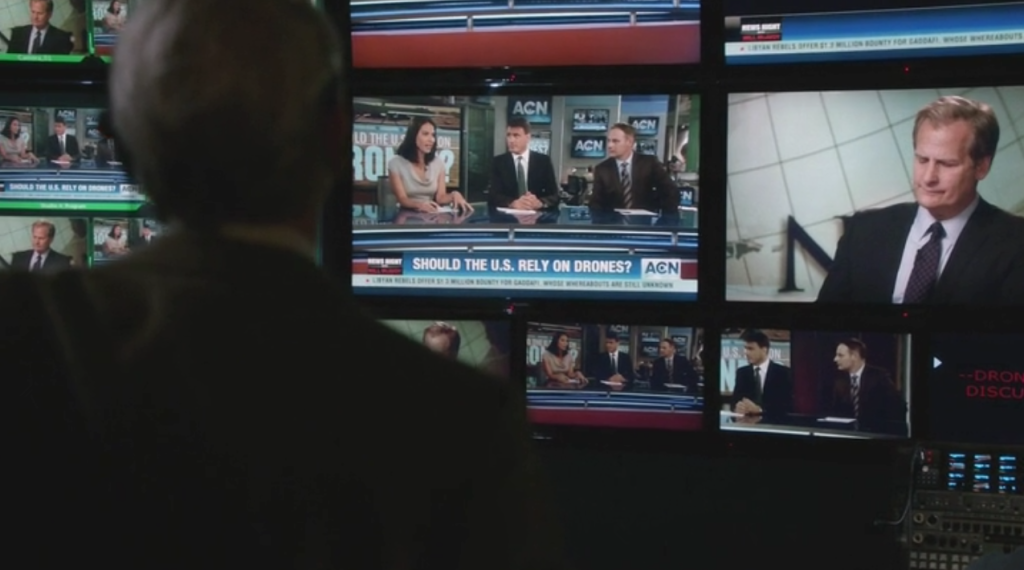
HBO’s The Newsroom returned to television last night, and it was borderline obsessive about drone strikes. (As for the storytelling itself, there is, so far, no sign of improvement since the conclusion of Season 1.) In the midst of the rhetorical maelstrom — this is an Aaron Sorkin show, after all — I couldn’t help but notice that Sloan Sabbith (Olivia Munn) had this to say about drone strikes during an on-air panel:

We don’t know exactly what that collateral damage is because of the lack of any transparency or accountability. Now factor in that the B.D.A. — the bomb damage assessment — counts all military-age males as militants.

The show depicted this particular airing of News Night as having taken place on August 24th, 2011. The only problem? The New York Times actually broke the story about all military-age males being counted as combatants nearly a full year later, in an article published on May 29, 2012:

It is also because Mr. Obama embraced a disputed method for counting civilian casualties that did little to box him in. It in effect counts all military-age males in a strike zone as combatants, according to several administration officials, unless there is explicit intelligence posthumously proving them innocent.

But in interviews, three former senior intelligence officials expressed disbelief that the number could be so low. The C.I.A. accounting has so troubled some administration officials outside the agency that they have brought their concerns to the White House. One called it “guilt by association” that has led to “deceptive” estimates of civilian casualties.

“It bothers me when they say there were seven guys, so they must all be militants,” the official said. “They count the corpses and they’re not really sure who they are.”

As far as I know, the closest that most of the mainstream media came to openly contesting the administration’s counting policy before the night of August 24th, 2011 was in another New York Times article from August 11th of that year:

The civilian toll of the C.I.A.’s drone campaign, which is widely credited with disrupting Al Qaeda and its allies in Pakistan’s tribal area, has been in bitter dispute since the strikes were accelerated in 2008. Accounts of strike after strike from official and unofficial sources are so at odds that they often seem to describe different events.

The debate has intensified since President Obama’s top counterterrorism adviser, John O. Brennan, clearly referring to the classified drone program, said in June that for almost a year, “there hasn’t been a single collateral death because of the exceptional proficiency, precision of the capabilities we’ve been able to develop.” Other officials say that extraordinary claim still holds: since May 2010, C.I.A. officers believe, the drones have killed more than 600 militants — including at least 20 in a strike reported Wednesday — and not a single noncombatant.

But that article is a far cry from the definitive declaration made by Sloan Sabbith on last night’s episode of The Newsroom. I suppose this is just one more trademark of Aaron Sorkin. It’s not just his depiction of women that’s anachronistic: even his series on news reporting can’t get the story in the right order.

Enhanced by Zemanta

[Infographic] Supreme Court Rules DOMA Unconstitutional

In a barn-burner of a decision today, the Supreme Court found unconstitutional the federal Defense of Marriage Act (DOMA), striking down the law based on a combination of states’ rights, equal protection and due process arguments. As expected, Justice Anthony Kennedy wrote the majority opinion for United States v. Windsor, joined by Justices Breyer, Kagan, Sotomayor and Ginsburg. Justices Scalia, Roberts, Alito and Thomas dissented, with the former three each penning his own dissent.

The voiding of DOMA, which had kept the United States government from recognizing married same-sex couples, means that all legally-married couples can now receive the federal benefits allocated based on marital status, regardless of whether your spouse is of the same sex or not. The question of whether you can legally marry a person of the same sex in the first place, however, remains in the hands of the states, as the Court stopped short of declaring same-sex marriage to be a fundamental right.

The above interactive graphic shows key quotes from the justices, pulled from the March oral argument and from today’s ruling. You can scroll over each justice to open up a text box with his/her quotes. The red dot indicates the author of the majority opinion; yellow dots indicate the other justices in the majority; blue dots indicate the dissenters.

Further analysis of the Court’s decision in United States v. Windsor to come.

Some Thoughts on DOMA on the Eve of Supreme Court’s Ruling

Edie Thea
Thea Spyer and Edie Windsor. Windsor is suing the federal government for the return of over $363,000 that it charged her in federal taxes after she inherited her late wife Spyer’s estate. Had Windsor been married to a man instead of a woman, she would have been exempt from the tax. Picture via CNN.

We are now hours away from the last rulings of the Supreme Court’s term, and we know for certain that we’ll be getting a decision in United States v. Windsor, the challenge to the federal Defense of Marriage Act (as well as Hollingsworth v. Perry, the California Proposition 8 case). On the eve of what will surely be a historic day for gays and lesbians across the country, it’s worth going back and reading the March oral argument for the case. A few points I’d like to make ((With the major caveat, of course, that I realize oral arguments are not always an accurate indicator of the eventual outcome of a case.)):

  • Based on the way the other Justices were falling in line behind his questions at the oral argument and some deduction skills on the part of SCOTUSblog, there’s a decent chance that Justice Anthony Kennedy has the majority opinion in Windsor.
  • Assuming that Windsor isn’t decided on a standing issue (and I freely admit that it could be), I expect a Kennedy opinion to discuss states’ rights. Traditionally, family law has been left exclusively to the states, and Kennedy seemed quite concerned at the oral argument about the federalism issues implicated by DOMA, which orders the federal government not to recognize same-sex marriages even if they are legally recognized by the state. At one point, he reminded Paul Clement, the attorney defending the law: “[DOMA] applies to over 1,100 federal laws… when it has 1,100 laws, which in our society means that the Federal government is intertwined with the citizens’ day-to-day life, you are at real risk of running in conflict with what has always been thought to be the essence of the State police power, which is to regulate marriage, divorce, custody.”
  • Alternatively, if it does reach the merits of Windsor, the Supreme Court could strike down DOMA as a violation of the Fourteenth Amendment’s Equal Protection Clause (i.e. the law is unconstitutional because it singles out same-sex people for unfavorable treatment versus their opposite-sex counterparts). Such a ruling would, going forward, provide heightened legal protections for gays and lesbians in the face of discriminatory laws. However, this is also a much broader and groundbreaking route, and I’m not convinced that Kennedy will take it if he can decide the case based on a narrower states’ rights argument instead.

Associate Justice Elena Kagan Investiture Ceremony

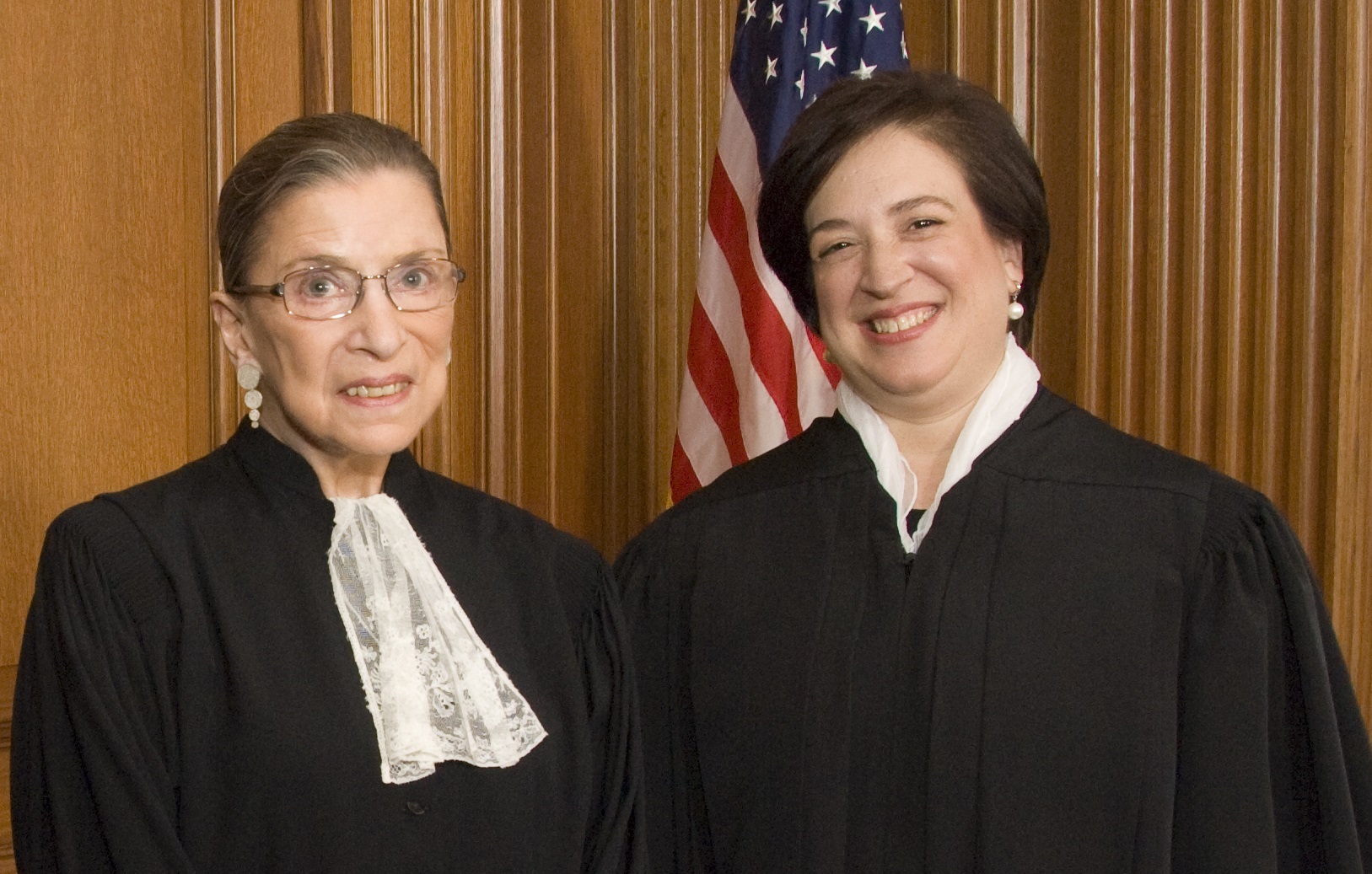
While the lion’s share of attention re: DOMA has been focused on Kennedy (including, of course, this post, which has already given him three bullet points), I also want to highlight a couple of points that Justices Ruth Bader Ginsburg and Elena Kagan made at the Windsor oral argument:

        • Ginsburg drew big laughs at the argument when she compared the current state of same-sex marriage to “skim milk”i.e. not the real thing. Snappy sound bite aside, however, it’s interesting to note that Ginsburg–who by all accounts had a happy, fulfilling marriage to the late tax attorney Martin Ginsburg–was the one justice who focused the most on the everyday effects DOMA has on very real people and very real relationships. Again and again, Ginsburg steered the discussion back to the everyday hardships caused by this law–the loss of benefits, a higher tax burden, the inability to take leave to tend to a sick spouse–implicitly asking her colleagues to think about what a marriage really means. We need to strike down DOMA, she was saying, because it is unconstitutional to subject these Americans to a lower quality of life than what their heterosexual brothers and sisters expect and receive.
        • Whereas Justice Ginsburg made it a point to talk about (to put it in a cheesy way) love being love, Justice Kagan had an equally compelling observation about hate. Kagan’s strategy at oral argument was to focus on the people behind the law rather than the people the law affected. DOMA has no place in our society, Kagan suggested, because there are indications that it was motivated by “fear,” “animus” and “moral disapproval” against gays and lesbians–all constitutionally impermissible reasons for imposing differential treatment on a whole class of people. Memorably, she shut down Paul Clement when he tried to dispute this by reading aloud the House Report for DOMA: “‘Congress decided to reflect an honor of collective moral judgment and to express moral disapproval of homosexuality.'”
        • Together, Kagan and Ginsburg’s arguments about the suspect motivations and unjust results of DOMA made for a pretty good one-two punch. Assuming, again, that Kennedy actually has the majority opinion and dispatches DOMA based on a theory of states’ rights, I’m really hoping for a concurrence or two from either (or both) of these Justices, laying the intellectual groundwork for an equal protection decision somewhere down the line.
        • If that is the outcome, we can expect at least one fiery dissent as well. My money’s on Justice Scalia, who just last Friday gave a speech to the North Carolina Bar Association insisting that courts had no business deciding moral issues, which should be left to the political process. (He forgets that mixed-race marriage was also considered immoral back when Loving v. Virginia [the 1967 Supreme Court decision overturning anti-miscegenation laws] was decided, and that it was the Court that pulled public opinion along on this, not the other way around.)

Finally, it bears remembering that exactly ten years ago, the Supreme Court issued its landmark decision in Lawrence v. Texas, striking down the criminal convictions of two men who had been arrested and tried under a Texas law that prohibited certain forms of sexual conduct between members of the same sex. In overruling an earlier Supreme Court decision that had upheld the application of state sodomy bans to gay and lesbian sexual activity, majority opinion author Justice Anthony Kennedy invoked the Founding Fathers:

They knew times can blind us to certain truths and later generations can see that laws once thought necessary and proper in fact serve only to oppress. As the Constitution endures, persons in every generation can invoke its principles in their own search for greater freedom.

In a few short hours, we’ll find out just how committed Kennedy and the rest of the Supreme Court remain to this principle.


Waiting for #SCOTUS: now we know next week is going to be amazing

Thursday morning came and went without any decisions from the Supreme Court on same-sex marriage, affirmative action in public universities and the constitutionality of a key provision in the Voting Rights Act, meaning that next week (the last scheduled week of this term) is going to be amazing. We did get rulings in three other cases (Descamps v. United States on enhanced sentences for those with prior convictions, American Express v. Italian Colors on class action suits and arbitration clauses, and Agency for International Development v. Alliance for Open Society on government preconditions for aid and the First Amendment), leaving the number of yet-to-be decided cases at 11 now. Here’s the tweet recap (tweetcap?) of the frenzied period between 10:00-10:30 a.m. EST this morning:

https://twitter.com/jamisonfoser/status/347715709201174529

https://twitter.com/ryanjreilly/status/347715159898349570

https://twitter.com/ryanjreilly/status/347716461692854272

https://twitter.com/CBSAndrew/status/347718361028890627

https://twitter.com/ryanjreilly/status/347719087515906049

https://twitter.com/melissagira/status/347719299244380160

https://twitter.com/CBSAndrew/status/347719635149402116

https://twitter.com/ryanjreilly/status/347720576258932736

Finally, of course:


Enhanced by Zemanta

Whose “journalistic malfeasance?” Fact-checking Joshua Foust’s Guardian critique

Joshua Foust posted an article on Medium today, titled “A Catalogue of Journalistic Malfeasance.” In it, he castigated the work of The Guardian‘s Glenn Greenwald for allegedly misstating all sorts of facts in the rush to get Edward Snowden’s story to the public:

So what’s the solution? For one, stop assuming the first version of the “facts” is correct. So much of the initial round of NSA reporting has turned out to be false or misleading that it’s a wonder such misreporting hasn’t become its own scandal. The speed with which false information propagates in the public (and worse, in commentaries) is dismaying to those of us who’d prefer public debates be based in fact rather than fiction.

Yet so long as breaking news dominates the coverage, there will continue to be frenzied periods of rushed reporting and eventual retractions or clarifications. Until we as people change our media consumption habits, the news organizations that continue to rush poorly researched information into the public record will have no reason to change their ways.

But even a cursory perusal of Foust’s piece reveals the same tenuous grasp of basic facts for which he passionately condemns The Guardian and The Washington Post (among others). In order, starting from near the beginning of his article:

1) Foust writes:

For one, there is still no evidence about how many other phone companies have been compelled to hand over their records. On Twitter, Greenwald wrote, “The program we exposed is the collection of all American’s [sic] phone records.” That isn’t true — he exposed the collection of Verizon’s records. The only evidence that this is an ongoing, long-standing program involving other telecos is a statement by Senate Intelligence Committee chairwoman Diane Feinstein and various anonymous leaks to national security reporters.

Let’s get the obvious point out of the way: if the chairwoman of the Senate Intelligence Committee confirms the existence of an “ongoing, long-standing program involving other telcos,” then how can Foust write that “there is still no evidence about how many other phone companies have been compelled to hand over their records?” (Unless, of course, he means that there could be even more than those already uncovered.) Feinstein has made it painfully clear what she thinks of Snowden — “I don’t look at this as being a whistle-blower,” she said at one point, “I think it’s an act of treason” —  and so she has absolutely no incentive to lie about the existence of the programs he uncovered (certainly not, at least, in the direction of making him look more truthful).

Secondly, Foust’s link to Feinstein’s alleged statement goes, bizarrely, to Huffington Post article that makes no mention of other telecom companies at all. But based on its content, Foust seems to be referring to a Feinstein statement reported in a Politico article from the same morning, in which Feinstein not only did not state that similar operations were taking place at other phone companies, but specifically said she could not confirm that that was happening:

Feinstein said she could not answer whether other phone companies have had their records sifted through as Verizon has.

“I know that people are trying to get to us,” she said. “This is the reason why the FBI now has 10,000 people doing intelligence on counterterrorism. This is the reason for the national counterterrorism center that’s been set up in the time we’ve been active. its to ferret this out before it happens. “It’s called protecting America.”

The same incongruence holds true for the “various anonymous links to national security reporters.” The Wall Street Journal reported the following on June 7th:

The disclosure this week of an order by a secret U.S. court for Verizon Communications Inc.’s phone records set off the latest public discussion of the program. But people familiar with the NSA’s operations said the initiative also encompasses phone-call data from AT&T Inc. and Sprint Nextel Corp., records from Internet-service providers and purchase information from credit-card providers.

This, a prominently reported article by an internationally prominent newspaper, is also evidence. So it is decidedly unclear what Foust means when he writes, “There is still no evidence about how many other phone companies have been compelled to hand over their records.” That’s at least three in total, right there.

Finally, Foust claims that Greenwald only “exposed the collection of Verizon’s records,” not those of all American customers — as Greenwald had claimed in his Twitter feed. But Foust appears to be wrong on this count too (as is Greenwald). The secret court order published by The Guardian demands the following material from Verizon:

…all call detail records or “telephony metadata” created by Verizon for communications (i) between the United States and abroad; or (ii) wholly within the United States, including local telephone calls…Telephony metadata includes comprehensive communications routing information, including but not limited to session identifying information (e.g., originating and terminating telephone number, International Mobile Subscriber Identity (IMSI) number, International Mobile station Equipment Identity (IMEI) number, etc.), trunk identifier, telephone calling card numbers, and time and duration of call.

Nowhere in the above order does it specify that this information be restricted to Verizon customers only. In other words, if an American Verizon customer calls — or receives a call from — someone abroad (or even locally) who is not a Verizon customer, this order appears to obtain at least the phone number of the non-Verizon customer and perhaps more. (My low level of telecom technical expertise is not sufficient to speculate about the IMSI and IMEI numbers.)

2) Foust continues:

The next leak Greenwald published, with veteran national security reporter Ewan MacAskill, made an even more eyepopping claim: “The National Security Agency has obtained direct access to the systems of Google, Facebook, Apple and other US internet giants.” That report also turned out to be largely exaggerated. Experienced tech journalists immediately seized on the description of the PRISM program (which accesses the data of internet companies) and poked it full of holes. Despite being described as “data-mining,” PRISM is really “nothing of the sort,” according to journalists who have covered the NSA in detail.

Foust is correct that the early descriptions of PRISM as a program of direct, real-time access to huge tech companies’ servers has since been walked back, in part. In retrospect, it’s become clear that The Guardian displayed an insufficient level of technical savvy — and perhaps even a spate of wishful thinking — in describing the program. Nevertheless, the above quote that Foust extracts from the article, written by Glenn Greenwald and Ewen MacAskill, leaves out a crucial qualifier that immediately follows the words he excerpted:

The National Security Agency has obtained direct access to the systems of Google, Facebook, Apple and other US internet giants, according to a top secret document obtained by the Guardian.

The NSA access is part of a previously undisclosed program called Prism, which allows officials to collect material including search history, the content of emails, file transfers and live chats, the document says.

“…according to a top secret document obtained by the Guardian.” And then, in the next paragraph, “the document says.” Now I’m not justifying Greenwald’s and MacAskill’s carelessness with words: the difference between direct access and, say, submitting individual requests for data is enormous and should be treated as such. But despite its obvious flaws, the article does make clear its reliance on the secret document — which itself, according to The Guardian, claimed “collection directly from the servers” of large American technology companies. It would, therefore, appear that at least some of the blame for the “exaggeration” rests with whatever NSA employee or contractor created the PowerPoint, not solely with The Guardian.

3) Foust writes, “IT work is not spying, even if it’s classified.” OK? Is there some new dictionary edict from on high about this, of which I’m not aware? “IT work” can refer to almost anything — and “anything” absolutely, positively includes spying. To be honest, I’m not confident I understood what Foust was trying to get across here, because reading the above sentence at face value makes no sense at all.

4) Contra Edward Snowden, Foust writes that “Robert Deitz, a former top lawyer at the NSA and CIA, told the L.A. Times that claim [that Snowden could ‘access any CIA station in the world’] was a ‘complete and utter’ falsehood.”

To his credit, Foust admits the obvious reality that this is hardly proof of Snowden’s lying. (Consider the source, to put it lightly.) But Foust again errs when he quotes Snowden as saying he could “access any CIA station in the world.” That phrase has been repeated elsewhere as well. But Snowden never said it. Here is what he actually said:

I had access to, you know the full rosters of everyone working at the NSA, the entire intelligence community, and undercover assets all around the world, the locations of every station we have, what their missions are, and so forth.

It’s a very similar statement. But it’s not identical. Even more concerning than the misquoted phrase, however, is the fact that Snowden refers to “every station” immediately after referencing the NSA, not the CIA — as Foust incorrectly wrote. Yes, it is still likely that Snowden was implicitly referring to the CIA in his above statement about “the locations of every station we have,” but the quote Foust excerpts simply doesn’t exist.

5) Foust writes:

Snowden said he participated in a CIA operation to “recruit” a Swiss banker in Geneva through a manufactured drunk driving arrest. Swiss President Ueli Maurer over the weekend said that such a claim “does not seem to me that it… played out as it has been described by Snowden and by the media.”

But much like the quote above by Robert Deitz, Ueli Maurer has quite the incentive to downplay the incident. Switzerland would rather not get into a diplomatic tussle with the United States. Moreover, it would be embarrassing for a president to admit to the bumbling incompetence of one of his own countrymen in the face of the crudest spook tactics. (Getting a banker drunk and then encouraging him to drive? Not a good look for the banker, his president, or his country.)

6) Foust quotes NSA head Keith Alexander — of all people — as rebutting Snowden’s claims. Well, then…that settles it?

7) Foust writes:

The rush to be first out of the gate with explosive new details of anything — or, in the Guardian’s case, the rush to publish before Snowden could be located and arrested — created perverse incentives to publish without verification. Washington Post freelancer Barton Gellman even said that his attempts to verify some of Snowden’s claims led to Snowden pushing the same documents to the Guardian because they would publish faster.

Once again, the Gellman article to which Foust links says no such thing. Here is the actual excerpt to which Foust appears to be referring:

To effect his plan, Snowden asked for a guarantee that The Washington Post would publish — within 72 hours — the full text of a PowerPoint presentation describing PRISM, a top-secret surveillance program that gathered intelligence from Microsoft, Facebook, Google and other Silicon Valley giants. He also asked that The Post publish online a cryptographic key that he could use to prove to a foreign embassy that he was the document’s source.

I told him we would not make any guarantee about what we published or when. (The Post broke the story two weeks later, on Thursday. The Post sought the views of government officials about the potential harm to national security prior to publication and decided to reproduce only four of the 41 slides.)

Snowden replied succinctly, “I regret that we weren’t able to keep this project unilateral.” Shortly afterward he made contact with Glenn Greenwald of the British newspaper the Guardian.

And then further on down, Gellman refers to his “dispute [with Snowden] about publishing the PRISM document in full.” In other words, Snowden’s decision to go to The Guardian was apparently based on The Washington Post‘s unwillingness to accept certain conditions, not because The Guardian had sloppier fact-checking or looser editorial standards.

At the end, Foust laments the barrage of misleading and inaccurate news. He is right: the mainstream American press has had a rocky few months. (In reality, it’s been rocky for far longer than that.) Twitter and other real-time social networks have certainly contributed to the proliferation of these deceptions at ever-faster speeds, although they fact-check just as fast. I actually agree with the general thrust of Joshua Foust’s analysis of The Guardian‘s hasty reporting that appears to have cut corners in dangerous ways. But sometimes even the fact-checker needs a fact-checker.

Enhanced by Zemanta

Waiting for #SCOTUS: Tweets from the Peanut Gallery

As the Supreme Court inches toward the end of its term in late June with fourteen cases still undecided, court-watchers are now surging toward Twitter and SCOTUSblog every Monday and Thursday morning at 10 a.m. EST in anticipation of history-making rulings on same-sex marriage, voting rights, and affirmative action in higher education. No one outside of the Court knows what and how many opinions are issued on any given day–and we did not in fact get any of the aforementioned “marquee” decisions today, which only adds to the tension for Thursday–but waiting is half the fun, right?

Here’s a roundup of today’s action in tweet form, showing our collective breath being held, held, held and then released over the span of 30 long minutes (thus freeing everyone up with time to spare for the Edward Snowden Q&A). In all, #SCOTUS handed down five opinions today, including a couple of important criminal procedure decisions and an Arizona voter registration ruling that saw Chief Justice Roberts and Justice Scalia siding with the liberal wing of the Court against the state’s proof-of-citizenship requirement. It also agreed to hear oral argument in four more cases for its next term. We begin with the one and only SCOTUSblog, the definitive source for everything Court-related:

https://twitter.com/CaptainSemantic/status/346621336346583041

https://twitter.com/ben_mccall/status/346628902707417089

https://twitter.com/CBSAndrew/status/346629167443480577

https://twitter.com/feddog/status/346687368755027969

https://twitter.com/CU_Health/status/346659487769296896

https://twitter.com/bradagreenberg/status/346674223080669187

https://twitter.com/ryanjreilly/status/346630143483187200

https://twitter.com/briansrants/status/346667416614469632

https://twitter.com/khjEsq/status/346705366123438081

https://twitter.com/ishapiro/status/346635203642527745

https://twitter.com/Nagler/status/346632712490205186

https://twitter.com/julierheinstrom/status/346632980514631680

https://twitter.com/sahilkapur/status/346633327219990528

https://twitter.com/Nagler/status/346640304616640512

https://twitter.com/ishapiro/status/346632388203401216

https://twitter.com/Profepps/status/346674687289487360

https://twitter.com/pourmecoffee/status/346634276667793408

Austerity has lost its truthiness

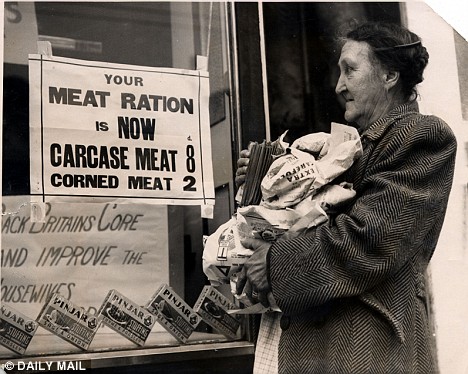
I googled "austerity," and this was the first image that appeared in the results. (Thanks, The Independent.)
I googled “austerity,” and this was the first image that appeared in the results. Seemed appropriate enough. (Thanks, The Independent.)

Back in February, The Washington Post‘s Ezra Klein registered his frustration with the way that deficit reduction was covered in the media:

For reasons I’ve never quite understood, the rules of reportorial neutrality don’t apply when it comes to the deficit. On this one issue, reporters are permitted to openly cheer a particular set of highly controversial policy solutions. At Tuesday’s Playbook breakfast, for instance, Mike Allen, as a straightforward and fair a reporter as you’ll find, asked Simpson and Bowles whether they believed Obama would do “the right thing” on entitlements — with “the right thing” clearly meaning “cut entitlements.”

A few days earlier, Ron Fournier, the editor of the National Journal, wrote that President Obama was giving America “the shaft” by taking an increase in the Medicare age off the table. It is difficult to imagine him using similar language for a situation in which Republicans reject universal health care, or Democrats say no to a tax cut. Over the past couple of weeks, MSNBC’s Joe Scarborough has reacted with evident astonishment to Paul Krugman’s argument that the long-term deficit is not a problem we need to solve right this second.

The secret to the special treatment that deficit reduction enjoys in Washington, I think, is that it’s a rare policy area that lends itself to pox-on-both-their-houses politics. “It’s such fun for me to irritate the AARP and Grover Norquist in equal measure,” Simpson told Allen. “It makes your life worthwhile.” It also makes deficit reduction a safe topic for otherwise strenuously nonpartisan figures to issue strong opinions on. After all, they can’t be accused of being partisan, as both parties are standing in the way!

Klein’s disappointment came, of course, only two months before the ideological underpinnings of austerity itself were subjected to the same remedy they proposed for American and European governments: death by a thousand cuts. And thus, two additional months later, the case for austerity has now been severely damaged.

Which is why yesterday’s article in The New York Times caught my eye. Regarding the newfound optimism of many economists in the expected growth rate of the American economy, reporter Nelson D. Schwarz provides some context:

“It’s better than it looked,” Mr. Cowen said. “Technological progress comes in batches and it’s just a little more rapid than it looked two years ago.” His next book, “Average Is Over: Powering America Beyond the Age of the Great Stagnation,” is due out in September.

Certainly, there are significant headwinds that will not abate anytime soon, including an aging population, government austerity, the worst income inequality in nearly a century and more than four million long-term unemployed workers.

Since when did “government austerity” become an accepted consensus target of criticism, so obviously detrimental to whatever economy it affects that even The New York Times feels safe citing it as a “significant headwind” in a news article?

Well, since mid-April, when the Reinhart-Rogoff paper was in large part dismantled. On a very surface-y level, this can be seen as progress — a sign that the dense fog of austerity has lifted and been replaced with a healthy level of skepticism. But far more concerning is the ease with which “straightforward and fair” reporting incorporates whatever dominant perspective holds sway in government offices at the time, as if it were an uncontested truth.

In other words, if austerity (or rapid deficit reduction, to use the example from Klein’s article) was right back in February — when even the news media’s straight reporting sections treated its efficacy as a foregone conclusion — then it can’t possibly be wrong (or a “significant headwind”) now.

Something’s got to give — and not just the viability of austerity as an economic policy. The entire foundation of traditional journalism — objective reporting — rests on the notion that some sort of absolute truth exists and that reporters are bound to it regardless of prevailing political ideologies. But when such a premise is shown to be so clearly false — as it is here with austerity — then the viability of objective reporting itself appears vanishingly low.

Wynn Resorts confirms financial support of Everett United

I’ve been in Seattle the past couple days, so I hadn’t had a chance to search for Everett United news until today. Now that I have, I’m happy to report that a bit of sunlight has begun to seep into the organization’s inner workings. Two separate articles published last Friday by the Boston Business Journal and The Boston Globe confirmed Wynn’s financial backing of Everett United.

First, The Boston Globe (“Wynn finances ballot drive for Everett casino”):

In the critical campaign to win local support for his $1.2 billion casino resort, Las Vegas developer Steve Wynn has foregone a television or radio advertising blitz and put his faith and money into a street-level, door-to-door campaign, performed by unpaid volunteers under the guidance of professional political consultants he has hired.

“Wynn Resorts financially supports Everett United and its hundreds of volunteers committed to bringing our development to Everett,” said Wynn spokesman Michael Weaver. “They are a dedicated group, and we are grateful for their enthusiasm and support.”

To guide the effort, Wynn has hired Saint Consulting, a Hingham-based political specialist with expertise in winning controversial land-use campaigns, and ML Strategies, the high-powered Boston lobbying firm run by former Massport director Stephen Tocco.

Wynn Resorts did not disclose how much it has spent to support the campaign. The company will disclose campaign spending in a mandatory filing in mid-June, according to Wynn.

And the Boston Business Journal (“In Everett, as in Eastie, casino campaign groups are not what they seem”):

Steve Wynn’s firm isn’t the only one pumping cash into the race to build an Eastern Massachusetts casino. Wynn Resorts is backing Everett United, the pro-casino group disclosed Thursday – but like other developers, Wynn has been loath to disturb the grass-roots illusion that adheres to the groups they fund, and state campaign finance law does little to compel them to do so.

We still don’t know how much Wynn paid Everett United – and we probably won’t, until eight days before the June 22 special election, when municipal ballot question campaign law will require Everett United to file a finance report.

“Wynn Resorts financially supports Everett United and its hundreds of volunteers committed to bringing our development to Everett,” the company informed me in a statement. “We worked this past year to introduce our development plans and to inform the public,” Suffolk Downs chairman Bill Mulrow wrote in a similar statement. Neither addressed questions about how their on-the-ground campaign groups were presented to the public.

Everett United’s “about” page still calls the group “a coalition of local residents and business leaders,” and makes no mention of Wynn’s financial support – other than promoting a “special VIP party” for “Founders Club” supporters, hosted by Wynn.

Interestingly, the Globe article refers to “unpaid volunteers,” suggesting that Wynn’s financial backing extends only to Saint Consulting Group and non-labor expenses incurred by Everett United (such as the ubiquitous yard signs in Everett). This would appear to indicate that Everett United founder and president Sandy Juliano, for example (about whom I wrote in my original piece), is not being paid for her efforts.

Speaking of not being paid, I had a brief, interesting conversation on Twitter with Galen Moore, the author of the above-excerpted Boston Business Journal article, the day before he posted it. He asked me if I’d been paid to write my original piece that exposed Saint Consulting Group’s ties to Everett United. Naively, until he asked me this question, it had never even occurred to me that such a perception might seem plausible.

But I’m glad he asked. So let me be clear here, as I was to Moore: I am not in any way being compensated in monetary form or otherwise, nor have I ever been, by any casino or casino-affiliated group, nor any other group that stands to benefit from opposition to a Wynn casino resort in Everett. Everything I’ve written about Everett United, Saint Consulting Group, and Wynn Resorts (like everything I’ve ever written on my blog) has been done without compensation.

Indeed, if you’ve followed this blog for the past couple years, you’ll quickly notice that a common thread is my passion for transparency — especially as it pertains to financial transactions that affect public policy. This is true not just in content I’ve written for my own blog, but elsewhere as well: my sole Huffington Post article to date, for example, lambasted Michael Bloomberg for attempting to influence Congressional elections via a Super PAC.

Everett United, therefore, captured my attention both for its utter lack of financial transparency and, perhaps more crucially, due to my own longtime connection to the town of Everett. It was a Facebook acquaintance’s Liking of the group’s page that first led to my curiosity about it. And I’m glad to see that, thanks to Galen Moore and Mark Arsenault (the Globe reporter of the above-excerpted piece, with whom I also communicated prior to the publication of his article), Wynn Resorts, Saint Consulting Group, and Everett United are slightly more transparent now than they were just a few weeks ago.

There is still a long way to go. Outside of that one open letter posted last week to Everett United’s Facebook page, I haven’t yet seen any references on the group’s Facebook page or Web site explicitly linking Everett United to Wynn Resorts. Moreover, this continued opacity has taken its toll on casino opponents who lack comparable funding. From the Globe article:

The relentless Everett United campaign has overwhelmed opponents, who lack a sponsor.

“It’s pretty intense from the pro side, Everett United,” said Everett resident Evmorphia Stratis, an opponent who has tried to organize against the development without much luck. “There is so much money behind it, and who am I?”

This is not to say that Wynn Resorts has no right to fund a pro-casino group simply because its opponents lack similar funding. But the secrecy of the coordinated effort certainly contributes to an impression of widespread organic support that may not be quite as unanimous as it currently appears.

Enhanced by Zemanta