Category Archives: Politics

“The administration has now lost all credibility.”

Screen Shot 2013-06-06 at 5.19.16 PM
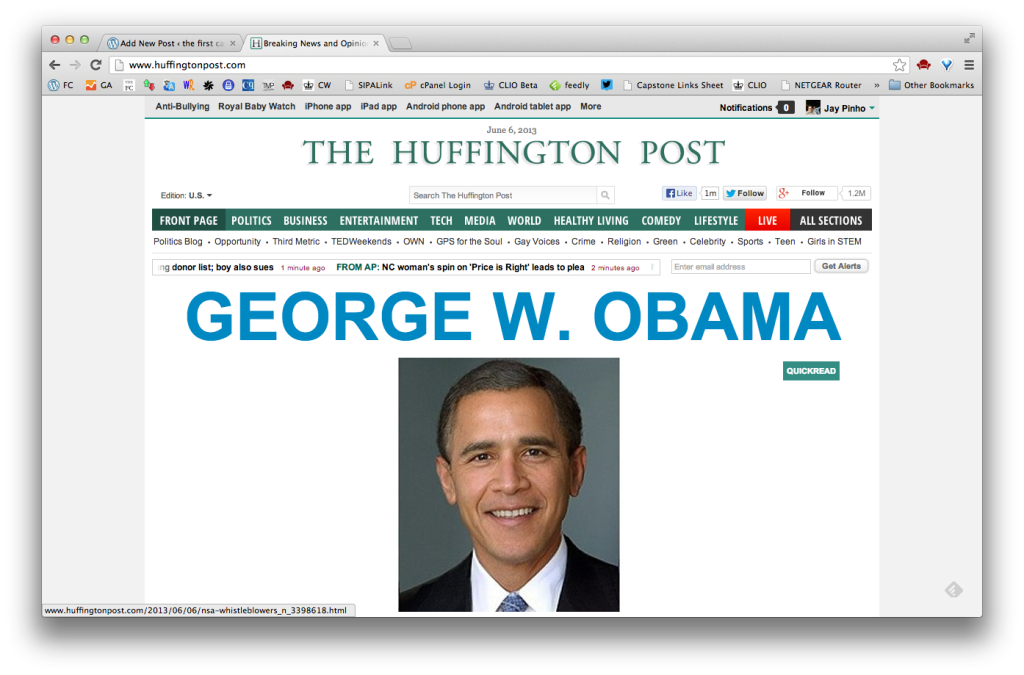
The Huffington Post, with a typically subtle headline.

When you’re a Democratic president and The New York Times’ editorial board has utterly lost its faith in you, you may have done something wrong:

Within hours of the disclosure that the federal authorities routinely collect data on phone calls Americans make, regardless of whether they have any bearing on a counterterrorism investigation, the Obama administration issued the same platitude it has offered every time President Obama has been caught overreaching in the use of his powers: Terrorists are a real menace and you should just trust us to deal with them because we have internal mechanisms (that we are not going to tell you about) to make sure we do not violate your rights.

Those reassurances have never been persuasive — whether on secret warrants to scoop up a news agency’s phone records or secret orders to kill an American suspected of terrorism — especially coming from a president who once promised transparency and accountability. The administration has now lost all credibility. Mr. Obama is proving the truism that the executive will use any power it is given and very likely abuse it.

Many responses to yesterday’s Guardian bombshell about Verizon call data being scooped up en masse by the NSA have been less than furious. Notably, the chair of the Senate intelligence committee, Senator Dianne Feinstein, said, “This is called protecting America. People want the homeland kept safe.” She also helpfully pointed out, without a trace of concern, that this secret court order is apparently just one in a long string of them dating back consecutively to 2006. She also made sure to explain: “This is just metadata. There is no content involved. In other words, no content of a communication.”

Andrew Sullivan likewise joined the quickly swelling ranks of those that are mostly unbothered by the revelation:

I’m neither shocked nor that outraged. Meta-data is not the content of our phone records.

On that front, this kind of meta-data gathering hasn’t outraged me too much under either administration. This kind of technology is one of the US’ only competitive advantages against Jihadists. Yes, its abuses could be terrible. But so could the consequences of its absence.

But Sullivan and his cohorts are completely wrong on this point — and they’re wrong in three crucial but different ways: technically, logistically, and philosophically.

First, metadata — even when it excludes the subscriber’s name, as the secret court order claims — is just about the furthest thing from anonymity. Back in March, MIT News reported on a new study showing just how little metadata is required to pinpoint a specific individual:

Researchers at MIT and the Université Catholique de Louvain, in Belgium, analyzed data on 1.5 million cellphone users in a small European country over a span of 15 months and found that just four points of reference, with fairly low spatial and temporal resolution, was enough to uniquely identify 95 percent of them.

In other words, to extract the complete location information for a single person from an “anonymized” data set of more than a million people, all you would need to do is place him or her within a couple of hundred yards of a cellphone transmitter, sometime over the course of an hour, four times in one year. A few Twitter posts would probably provide all the information you needed, if they contained specific information about the person’s whereabouts.

Second, as Jane Mayer of The New Yorker points out, the actual content of the call — that is, audio or a transcript of the conversation — is not necessarily as valuable as the patterns and networks that can be traced from metadata:

For example, she said, in the world of business, a pattern of phone calls from key executives can reveal impending corporate takeovers. Personal phone calls can also reveal sensitive medical information: “You can see a call to a gynecologist, and then a call to an oncologist, and then a call to close family members.” And information from cell-phone towers can reveal the caller’s location. Metadata, she pointed out, can be so revelatory about whom reporters talk to in order to get sensitive stories that it can make more traditional tools in leak investigations, like search warrants and subpoenas, look quaint. “You can see the sources,” she said. When the F.B.I. obtains such records from news agencies, the Attorney General is required to sign off on each invasion of privacy. When the N.S.A. sweeps up millions of records a minute, it’s unclear if any such brakes are applied.

Finally, even on a philosophical or ideological level, Sullivan is wrong about the danger of not pursuing such invasive surveillance tactics. Stephen Walt takes it away:

There are two obvious counters. First, the United States (and its allies) are hardly lacking in “competitive advantages” against jihadists. On the contrary, they have an enormous number of advantages: They’re vastly richer, better-armed, better-educated, and more popular, and their agenda is not advanced primarily by using violence against innocent people. (When the United States does employ violence indiscriminately, it undermines its position.) And for all the flaws in American society and all the mistakes that U.S. and other leaders have made over the past decade or two, they still have a far more appealing political message than the ones offered up by Osama bin Laden, Ayman al-Zawahiri, and the various leaders of the Taliban. The United States is still going to be a major world power long after the contemporary jihadi movement is a discredited episode in modern history, even if the country repealed the Patriot Act and stopped all this secret domestic surveillance tomorrow.

Second, after acknowledging the potential for abuse in this government surveillance program, Sullivan warns that the “consequences of its absence” could be “terrible.” This claim depends on the belief that jihadism really does pose some sort of horrific threat to American society. This belief is unwarranted, however, provided that dedicated and suicidal jihadists never gain access to nuclear weapons. Conventional terrorism — even of the sort suffered on 9/11 — is not a serious threat to the U.S. economy, the American way of life, or even the personal security of the overwhelming majority of Americans, because al Qaeda and its cousins are neither powerful nor skillful enough to do as much damage as they might like. And this would be the case even if the NSA weren’t secretly collecting a lot of data about domestic phone traffic. Indeed, as political scientist John Mueller and civil engineer Mark Stewart have shown, post-9/11 terrorist plots have been mostly lame and inept, and Americans are at far greater risk from car accidents, bathtub mishaps, and a host of other undramatic dangers than they are from “jihadi terrorism.” The Boston bombing in April merely underscores this point: It was a tragedy for the victims but less lethal than the factory explosion that occurred that same week down in Texas. But Americans don’t have a secret NSA program to protect them from slipping in the bathtub, and Texans don’t seem to be crying out for a “Patriot Act” to impose better industrial safety. Life is back to normal here in Boston (Go Sox!), except for the relatively small number of people whose lives were forever touched by an evil act.

In other words, the NSA’s wiretapping program that began under Bush and has now very apparently flourished under Obama is every bit as bad as it sounds. The New York Times got it exactly right: the Obama administration has lost all credibility. So why is it that we always seem so willing to forget this news so quickly?

Enhanced by Zemanta

No Saint in this game: Is Wynn Resorts using Everett United to gain casino support?

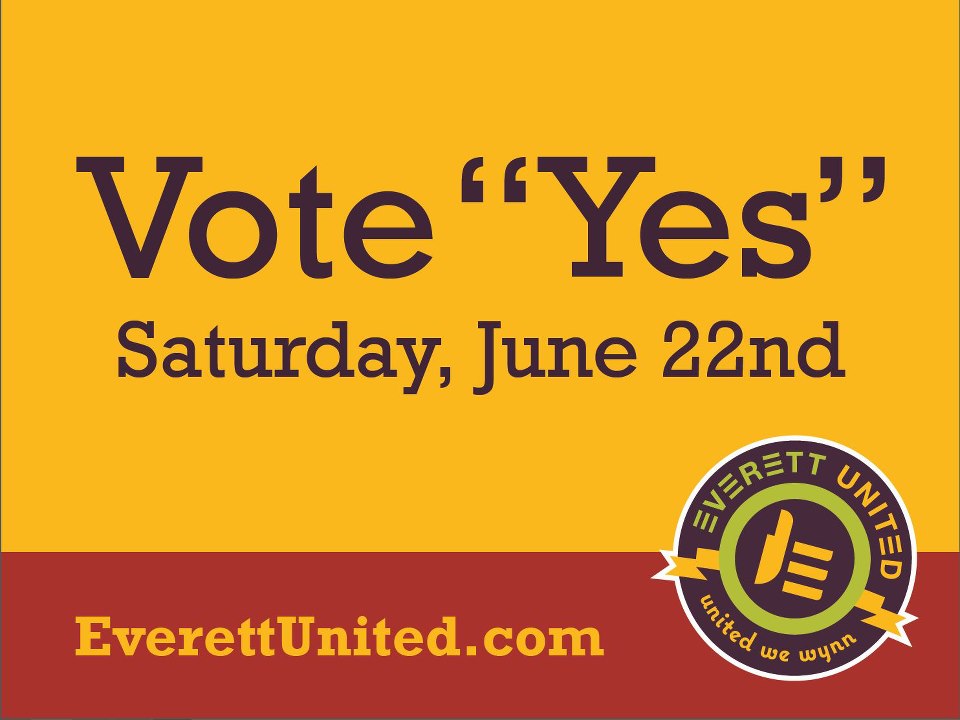
An image on Everett United's Facebook page.
An image on Everett United’s Facebook page.

(UPDATE 5/31/2013 6:48 PM EST: The headline of this post has been changed from “No Saint in this game: Wynn Resorts uses Everett United to gain casino support” to “No Saint in this game: Is Wynn Resorts using Everett United to gain casino support?” Additionally, per Seth Cargiuolo’s request, I have removed a screenshot of his Facebook profile that included a photo of his minor children. This photo has since been replaced with a screenshot of his newest profile.)

(UPDATE 6/3/2013 11:34 AM EST: I have updated this post to reflect confirmation from one of the Facebook commenters that she did not delete her own post on the Everett United Facebook page.)

Several weeks ago while scrolling through my Facebook newsfeed, I ran across a post that had been Liked by an acquaintance from my old hometown of Everett, Massachusetts. The post was written by Everett United, a group I’d never heard of before, and it concerned a new casino being proposed for Everett by Las Vegas casino/resort mogul Steve Wynn.

Out of curiosity, I began reading through the group’s Facebook page. Having lived for nine years in Everett, it seemed improbable to me that anyone would find it a good idea to place a casino there. A small suburb just north of Boston, Everett had just under 42,000 residents in the 2010 census, and its median household income is $48,319 (about 8.4% below the national average). From long personal experience, I know that Everett is, in every way, the polar opposite of glamorous.

The Facebook page for Everett United, which launched in March, describes the group as “a coalition of local residents and business leaders who support the idea of a world-class resort hotel and entertainment complex in Everett.” The group’s dedicated web site, EverettUnited.com, contains a similar statement: “Everett United are your neighbors…the clerk at the checkout counter…your friends and co-workers. Together, we view the Wynn Resort and Hotel in Everett as a once-in-a-lifetime opportunity to greatly improve our city and quality of life. It’s a project we need, and deserve, more than any other community” (ellipses in original).

The objective of the group is to drum up support for a June 22 citywide referendum in Everett, required under state casino law, in which Everett residents will decide whether to approve the host agreement between Wynn Resorts and their city. If they do, the proposed hotel and casino complex will then be one of three contestants for a Greater Boston casino license, whose winner will be decided by the Massachusetts gambling commission.

Continue reading No Saint in this game: Is Wynn Resorts using Everett United to gain casino support?

The amorality of economics

In an easily-digestible piece for The New York Review of Books, Paul Krugman explains why economic austerity became so mainstream so fast:

Everyone loves a morality play. “For the wages of sin is death” is a much more satisfying message than “Shit happens.” We all want events to have meaning.

When applied to macroeconomics, this urge to find moral meaning creates in all of us a predisposition toward believing stories that attribute the pain of a slump to the excesses of the boom that precedes it—and, perhaps, also makes it natural to see the pain as necessary, part of an inevitable cleansing process. When Andrew Mellon told Herbert Hoover to let the Depression run its course, so as to “purge the rottenness” from the system, he was offering advice that, however bad it was as economics, resonated psychologically with many people (and still does).

By contrast, Keynesian economics rests fundamentally on the proposition that macroeconomics isn’t a morality play—that depressions are essentially a technical malfunction. As the Great Depression deepened, Keynes famously declared that “we have magneto trouble”—i.e., the economy’s troubles were like those of a car with a small but critical problem in its electrical system, and the job of the economist is to figure out how to repair that technical problem.

Enhanced by Zemanta

Like shooting fish in a barrel

[youtube http://www.youtube.com/watch?v=x92OWufIWcU]

Anthony Weiner officially announced his candidacy for mayor of New York City on Wednesday:

The improbable campaign that Mr. Weiner, a Democrat, unveiled on Wednesday hinges on his image as a shunned outsider whose political solitude has unburdened him from coddling New York’s powerful special interests and freed him to speak uncomfortable truths, according to those close to him.

A scrappy political street fighter, never known for forging alliances or sharing the limelight, Mr. Weiner said in an interview that “to some degree, this is my most natural footing.”

Of the endorsements that his rivals are collecting like trophies this year, he said, “I’ve never really structured a campaign that way.”

Instead, after a self-imposed two-year exile, the 48-year-old former congressman will initiate a series of neighborly public outings intended to showcase him interacting with ordinary New Yorkers and send a clear message: The scandal has passed, and a tough city is prepared to hear him out. That process is expected to start on Thursday, when Mr. Weiner visits a subway station in Harlem.

“There may be, or are, many New Yorkers who would never vote for me,” he said. “Even those New Yorkers, I want to have a conversation with.”

Enhanced by Zemanta

“Too Far, Too Fast:” A Timeline of Ruth Bader Ginsburg’s Disappointment with Roe v. Wade

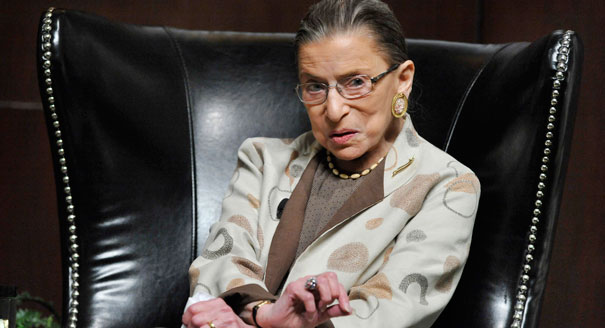
Judging. Picture via AP.

Justice Ruth Bader Ginsburg made headlines this past weekend when she criticized the legal basis of Roe v. Wade at an event marking its 40th anniversary, saying that the 1973 decision had gone too far and “given opponents of access to abortion a target to aim at relentlessly.”

Ginsburg, who was at the time of the decision head of the ACLU’s Women’s Rights Project, told the packed audience at the University of Chicago Law School that the Supreme Court should have stuck to a narrower ruling striking down the Texas statute challenged in Roe. (That law had banned abortion in all cases except for those that would save the woman’s life.) Instead, however, the Court issued a sweeping pronouncement on the right to privacy encompassing a woman’s choice to end her pregnancy–a decision which, Ginsburg said, stopped the momentum of grassroots pro-choice groups and galvanized the anti-abortion movement.  Ginsburg also characterized Roe as not being “woman-centered” enough, as the opinion focused mainly on “a doctor’s freedom to practice his profession as he thinks best” rather than “a question of a woman’s choice.”

Though Justice Ginsburg’s remarks may be particularly relevant now–her preferred bottom-up, state-by-state approach to abortion mirrors the strategy that same-sex marriage advocates have been using–this isn’t the first time that the justice has publicly expressed disappointment with Roe’s lack of judicial restraint. Over the years, Ginsburg has been quite vocal about the many roads not taken, even while she approves of the outcome of increased access to abortion. The following is a timeline of Ginsburg’s comments from 1985 to present (you can zoom in and click on each box for more detail):


If I’ve missed any other quotes from Justice Ginsburg during this period, please let me know in the comments.

Newt Gingrich is gently ushered into the 21st century

[youtube http://www.youtube.com/watch?v=jmKVRVX4q-k]

Newt Gingrich just won the Internet…again:

Newt Gingrich wants you to know that he is “puzzled” about what to call his cellphone, which can do a whole lot more than simply make calls. I’m puzzled by his entire video on the topic, but mostly by the fact that he hasn’t heard of the term smartphone.

The former House speaker uploaded the above video to YouTube on Friday, although it’s only starting to rack up the views now. In it, Gingrich asks for help coming up with a new name for that fancy black rectangle in his hand, one that will help “explain to people that they carry in their hand literally the potential to have a dramatic revolution in how we get things done.” The best alternative he and his team—yes, he has his best men at Gingrich Productions working on this—have come up with in the “weeks” they’ve spent on the task is: “handheld computer.”

Enhanced by Zemanta

Bill Keller wants to repeat history, which would make him wrong twice.

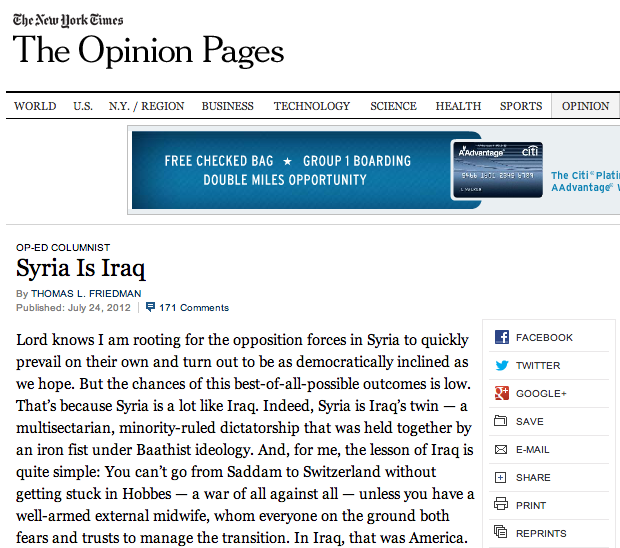
Screen Shot 2013-05-06 at 10.20.43 AMScreen Shot 2013-05-06 at 10.21.40 AM


Last night, New York Times columnist (and former executive editor) Bill Keller’s column, “Syria Is Not Iraq,” appeared online. (It’s seen in the above screenshot at right, juxtaposed against equally intellectually-challenged fellow columnist Thomas Friedman’s piece from last year.) As usual, it was a doozy:

As a rule, I admire President Obama’s cool calculation in foreign policy; it is certainly an improvement over the activist hubris of his predecessor. And frankly I’ve shared his hesitation about Syria, in part because, during an earlier column-writing interlude at the outset of the Iraq invasion, I found myself a reluctant hawk. That turned out to be a humbling error of judgment, and it left me gun-shy.

Of course, there are important lessons to be drawn from our sad experience in Iraq: Be clear about America’s national interest. Be skeptical of the intelligence. Be careful whom you trust. Consider the limits of military power. Never go into a crisis, especially one in the Middle East, expecting a cakewalk.

But in Syria, I fear prudence has become fatalism, and our caution has been the father of missed opportunities, diminished credibility and enlarged tragedy.

Keller concludes:

Whatever we decide, getting Syria right starts with getting over Iraq.

No, Keller, it doesn’t. Getting Syria right starts with acknowledging how Iraq happened. But doing that would require directly confronting the central role of Keller’s paper in propagating a flimsy and ultimately disastrous case for war in Iraq. Getting over Iraq, to use Keller’s convenient word choice, is a euphemism for allowing the same source that got everything so wrong in Iraq to make the same case for war in another country — again, with no exit strategy or, even, any strategy at all.

Keller argues that our failure to arm the rebels for fear of assisting al-Qaeda is in fact resulting in the same outcome, by ceding ground to the Saudis and Qataris, who are all too willing to assist radicals on the ground in Syria. But what Keller fails to mention is the fact that, after two years of civil war, an American decision to intervene now would raise more questions than it answers and may very well cause a public opinion backlash in the Arab world. Instead of being lauded as saviors, there is at least an equivalent likelihood of rebels asking, “How many lives could you have saved if you’d been here earlier?”

That alone is not a reason to stay away. But the audacity of the clamor for intervention — led by people like John McCain and, yes, now Bill Keller, the same people who so badly misjudged the prospects for success in Iraq — is that it makes the same characterizations about Syria that it did about Iraq. You’d think once would be enough.

Keller writes:

What you hear from the Obama team is that we know way too little about the internal dynamics of Syria, so we can’t predict how an intervention will play out, except that there is no happy ending; that while the deaths of 70,000 Syrians are tragic, that’s what happens in a civil war; that no one in the opposition can be trusted; and, most important, that we have no vital national interest there. Obama conceded that the use of poison gas would raise the stakes, because we cannot let the world think we tolerate spraying civilians with nerve gas. But even there, the president says he would feel obliged to respond to “systematic” use of chemical weapons, as if something less — incremental use? sporadic use? — would be O.K. This sounds like a president looking for excuses to stand pat.

This is a sickening, absurdist paragraph. “Looking for excuses to stand pat?” In Keller’s conceptualization, then, war is the default option, and Obama is doing somersaults in an attempt to evade his natural obligations. But this is simply not the case. Obama is perfectly right to observe that no vital national interest necessitates an American intervention in Syria (although he is seemingly less confident on this score than previously thought).

Keller’s not done:

In contemplating Syria, it is useful to consider the ways it is not Iraq.

First, we have a genuine, imperiled national interest, not just a fabricated one. A failed Syria creates another haven for terrorists, a danger to neighbors who are all American allies, and the threat of metastasizing Sunni-Shiite sectarian war across a volatile and vital region. “We cannot tolerate a Somalia next door to Israel, Lebanon, Jordan, Iraq and Turkey,” said Vali Nasr, who since leaving the Obama foreign-policy team in 2011 has become one of its most incisive critics. Nor, he adds, can we afford to let the Iranians, the North Koreans and the Chinese conclude from our attitude that we are turning inward, becoming, as the title of Nasr’s new book puts it, “The Dispensable Nation.”

Again, Keller’s historical — and personal — amnesia, combined with his implicit but entirely unsubtle smearing of prudent foreign policy analysts as appeasers, is appalling. There is no “genuine, imperiled national interest.” The primary reason everyone’s suddenly started talking about Syria is that Israel started bombing it. As always, Israel’s security interests take precedence over our own: where two years of civilian death and suffering elicited little more than yawns and sighs of boredom in living rooms throughout America, a few targeted airstrikes by Israel are amazingly effective at focusing the hive mind.

Keller writes:

But, as Joseph Holliday, a Syria analyst at the Institute for the Study of War, points out, what gets lost in these calculations is the potentially dire cost of doing nothing. That includes the danger that if we stay away now, we will get drawn in later (and bigger), when, for example, a desperate Assad drops Sarin on a Damascus suburb, or when Jordan collapses under the weight of Syrian refugees.

Yes, let’s go to war now, risking very real American lives, to prevent a hypothetical outcome that may or may not cause mass fatalities in another country’s civil war.

Here is perhaps my favorite line:

Fourth, in Iraq we had to cajole and bamboozle the world into joining our cause. This time we have allies waiting for us to step up and lead. Israel, out of its own interest, seems to have given up waiting.

Israel?! That’s his example? Israel, he may recall, was perfectly onboard with the American invasion of Iraq as well. And why shouldn’t it be? Any half-conscious human being can see the natural advantage of allowing a foreign country to wage war on another’s behalf — including paying the costs in lives and massive budget deficits. Israel can stand pat and let Americans take the heat again, as we’ve been doing for years.

“Why wait for the next atrocity?” Keller asks. Indeed, why? For neoconservative warmongers like Bill Keller, waiting is for appeasers. The case for intervention in Syria, like that in Iraq, recalls the title of the famous post-financial crisis book, This Time Is Different. Each time, excuses and half-justifications are lazily proffered so as to distinguish one hawkish prophecy from its disastrous predecessors. This time, let’s approach the problem differently, instead of feebly attempting to differentiate this potential foreign policy quagmire from another, very real one from the past.


Enhanced by Zemanta

The public safety exception

Breaking news from The New York Times:

The surviving suspect in the Boston Marathon bombings told F.B.I. interrogators that, as he and his brother plotted their deadly assault, they considered suicide attacks and striking on the Fourth of July, according to a law enforcement official…

The brothers finished building the bombs in Tamerlan’s apartment in Cambridge, Mass., faster than they anticipated and so decided to accelerate their attack to the Boston Marathon on April 15, Patriots Day in Massachusetts, from July, according to the account that Dzhokhar provided authorities. They picked the finish line of the marathon after driving around the Boston area looking for alternative sites, according to this account.

In addition, Mr. Dzhokhar told authorities that he and his brother viewed the Internet sermons of Anwar al-Awlaki, a radical American cleric who moved to Yemen and was killed in September 2011 by an American drone strike. There is no indication that the brothers communicated with Mr. Awlaki before his death.

How do we know all this new information, you ask? Why, under the public safety exception to the Miranda Rule. In other words, authorities questioned Dzhokhar Tsarnaev and discovered all of this information prior to reading him his Miranda rights.

And yes, in case you were wondering, you are forgiven for thinking that none of that information is even remotely related to protecting the public from imminent danger. But don’t let it happen again.

Enhanced by Zemanta

Who are the 7%?

From today’s Washington Post:

A large majority of Americans support the death penalty for the suspect in the Boston Marathon bombing should he be convicted in federal court, according to a new Washington Post-ABC News poll.

Overall, 70 percent of those surveyed say they support the death penalty for 19-year-old Dzhokhar Tsarnaev. While most Democrats and Republicans alike say they would support the death penalty for Tsarnaev, there are deep racial divisions on the matter, reflecting a common gap in public views of the death penalty itself.

And from a Gallup press release on January 9th:

Americans’ support for the death penalty as punishment for murder has plateaued in the low 60s in recent years, after several years in which support was diminishing. Sixty-three percent now favor the death penalty as the punishment for murder, similar to 61% in 2011 and 64% in 2010.

So 63% support for the death penalty, but 70% if it’s Dzhokhar Tsarnaev. Assuming that the national sentiment on the death penalty hasn’t substantively changed since January, this means that 7% of Americans allow their feelings to be changed by a massive police overreaction and overblown media coverage of an attack that took fewer lives than your run-of-the-mill school shooting.

It makes you wonder how many more of us are so easily manipulated on issues other than the death penalty as well. And it certainly helps explain the need for critics like Glenn Greenwald.

On the other hand, this may just be an extension of the futility of poll-watching, as is hopefully evidenced by a recent survey which found that 42% of Americans didn’t know Obamacare was still in effect.

Note to future self: write post about the nonsensicality of polling (replete with a brief digression in which I nevertheless praise Nate Silver for his innovation).

Enhanced by Zemanta

How we are all unwitting terrorists

twitter

There’s been a lot of speculation in the past week or so about the Twitter feeds of Dzhokhar and Tamerlan Tsarnaev. Here are a few representative samples from The New York Times alone. First up is columnist Charles Blow:

On Friday, BuzzFeed and CNN claimed to verify Dzhokhar’s Twitter account. The tweets posted on that account give a window into a bifurcated mind — on one level, a middle-of-the-road 19-year-old boy, but on another, a person with a mind leaning toward darkness.

He was a proud Muslim who tweeted about going to mosque and enjoying talking — and even arguing — about religion with others. But he seemed to believe that different faiths were in competition with one another. On Nov. 29, he tweeted: “I kind of like religious debates, just hearing what other people believe is interesting and then crushing their beliefs with facts is fun.”

Dzhokhar Tsarnaev had strong views on the Middle East, tweeting on Nov. 28, “Free Palestine.” Later that day he tweeted, “I was going to make a joke about Hamas but it Israeli inappropriate.”

Toward the end of last year, the presence of dark tweets seemed to grow — tweets that in retrospect might have raised some concerns.

He tweeted about crime. On Dec. 28 he tweeted about what sounds like a hit-and-run: “Just saved a bunch of money on my car insurance by switching my car into reverse and driving away from the accident.” And on Feb. 6 he tweeted, “Everything in life can be free if you run fast enough.”

He posted other tweets that could be taken as particularly ominous.

Oct. 22: “i won’t run i’ll just gun you all out #thugliving.”

Jan. 5: “I don’t like when people ask unnecessary questions like how are you? Why so sad? Why do you need cyanide pills?”

Jan. 16: “Breaking Bad taught me how to dispose of a corpse.”

Then yesterday, the Times‘ head book reviewer, Michiko Kakutani, delved in a little further:

Given the layers of irony, sarcasm and joking often employed on Twitter, it can be difficult to parse the messages of a stranger. Yet some of them can seem menacing or portentous, given what we now suspect: “a decade in america already, I want out,” “Never underestimate the rebel with a cause” or, drawing from lyrics from a Kendrick Lamar song, “No one is really violent until they’re with the homies.” But others suggest a more Holden Caulfield-like adolescent alienation: “some people are just misunderstood by the world thus the increase of suicide rates.” Sometimes, Dzhokhar sounds downright sentimental (unless, of course, he is being ironic): “There are enough worms for all the birds stop killing each other for ‘em.”

Parts of Dzhokhar’s VKontakte page are harsher and more serious. Under personal priority, it says “Career and money.” Under worldview, it says “Islam.” There is a link to a video indicating outrage at the violence in Syria, and a link to an Islamic Web site that says “And do good, for Allah loves those who do good.” Another video features a blind boy talking to an older man, saying he believes his blindness will be absolved on Judgment Day; the man starts to cry, and wonders how many people who have their sight are as committed to the study of the Koran as the boy.

To her credit, she at least had the self-awareness to observe the obvious:

These posts instantly became dots that people began trying to connect. Some details ratified the views of those former friends and neighbors who said they were utterly shocked at the brothers’ possible involvement in such a horrifying crime. Other posts pointed to Tamerlan Tsarnaev’s growing interest in Islamic radicalism and possibly a dark subtext to the friendly, boy-next-door affect of Dzhokhar.

At the same time, they were reminders of the complexities of online identity — of the ways in which people strike poses and don masks on the Web (which can sometimes turn into self-fulfilling prophecies), and the ways in which the Web can magnify or accelerate users’ interests and preoccupations.

The social media droppings the Tsarnaev brothers left behind not only attest to their own immersion in the interactive, electronic world, but they have also provided everyone else with plenty of digital data from which to try to extract patterns and possible meaning — fulfilling that very human need to try to make narrative sense of the tragic and the overwhelming.

And, unsurprisingly, BuzzFeed and New York Magazine, among others, joined in on the Twitter-parsing/stalking fun as well.

You may see where I’m going with this. Yes, it increasingly looks like Tamerlan and Dzhokhar Tsarnaev bought into a radical fringe of Islam prior to bombing the Boston Marathon. And so it is theoretically possible that breadcrumbs from their evolving radicalization are discoverable by sifting through tweets and Russian social networking sites.

But it is much, much more likely that these tweets are simply being scrutinized with that 20/20 hindsight so familiar to tragic events: everything always looks clearer in the rear-view mirror. Even the most “menacing” of Dzhokhar’s tweets pointed out by the mainstream media reveal less “a “bifurcated mind…leaning toward darkness” and more the typical musings of a 19-year-old college student.

This voyeuristic, retrospective fine-combing of the younger Tsarnaev’s Twitter profile is not only useless. It is counterproductive and dangerous too: reading too deeply into the abbreviated, 140-character-length thoughts of a suspected bomber promotes the notion that such heinous acts could have been stopped if only we had been able to access more information earlier on — if only we had been watching earlier on.

There are signs of this mindset already. Take this article from today’s Boston Globe:

House Speaker John Boehner this morning said he was concerned that federal agencies hadn’t learned their lessons from the attacks of Sept. 11, 2001, and he vowed to hold agency heads responsible if they didn’t do enough to stop the Boston bombings.

The response in Washington is increasingly focused on potential intelligence failures, and a lack of sharing information among territorial federal agencies – a problem that was supposed to be fixed after the attacks nearly 12 years ago.

“I have concerns about what agencies knew what — and the fact that it wasn’t shared,” Boehner said at a press conference. “You know if the information is good enough for one agency of the government, why shouldn’t it be appropriate for other agencies of the government? We’re going to get to the bottom of it.”

It’s the same story in The New York Times:

Emerging from a closed two-hour hearing with three senior law enforcement and intelligence officials, several members of the Senate Intelligence Committee raised new questions about how the F.B.I. and the Department of Homeland Security apparently handled information about Tamerlan Tsarnaev, 26, the suspect who was killed in a shootout with the police on Friday.

“I’m very concerned that there still seem to be serious problems with sharing information, including critical investigative information,” Senator Susan Collins, Republican of Maine, told reporters. “That is troubling to me that this many years after the attacks on our country in 2001, that we still seem to have stovepipes that prevent information from being shared effectively, not only among agencies but also within the same agency, in one case.”

The problems with these interpretations are twofold. First, they assume that some form of Omniscience Lite is actually achievable. Well, it’s not. There is no such thing as perfect intelligence nor perfect crime prevention (sorry, Minority Report aficionados). Terrorism will happen from time to time. Maybe instead of freaking out, we can actually try to (gasp) get a little more used to it and, therefore, manage to return to normalcy more quickly.

Secondly, the implications of this type of thinking can be quite terrifying. If, with the benefit of hindsight, we can now perfectly see the seeds of radicalism sprouting on Dzhokhar Tsarnaev’s Twitter feed, then it follows that we can discover — and halt — someone’s budding radicalization taking place right now, in real-time. Many are already advocating for increased surveillance, more CCTV cameras, and so on. But even beyond the installation of more virtual eyes over our urban areas, the impulse to counter terrorism with an even bigger Big Brother is just one more step in the wrong direction for a country that’s already all too willing to surrender its civil liberties in the service of an unconvincing “security.”

Which brings me to the headline of this post. Take a look at the below tweets of mine, and then try to imagine reading them after I’ve been accused of a hypothetical bombing:

http://twitter.com/jaypinho/status/1637073148710912

http://twitter.com/jaypinho/status/45353903868485632

http://twitter.com/jaypinho/status/89339781535899648

http://twitter.com/jaypinho/status/94878752827375616

http://twitter.com/jaypinho/status/125352426701209601

http://twitter.com/jaypinho/status/226286900388966400

http://twitter.com/jaypinho/status/260104243510407168

http://twitter.com/jaypinho/status/270555250694426624

http://twitter.com/jaypinho/status/279597722326147073

http://twitter.com/jaypinho/status/281503668493246465

http://twitter.com/jaypinho/status/327061292244418560

Do you see the problem here? It took me all of about ten minutes to select these tweets out of nearly 5,000 I’ve written. So yes, there are plenty of dots and data points in a Twitter feed. But connecting them arbitrarily after the fact to create a portrayal of something sinister does nothing to help prevent terrorism. And it may do a lot to help push us just a little bit closer to 1984.

Enhanced by Zemanta