Category Archives: Politics

SCOTUS Opinion Alert: In Which Transparency is Dealt a Body Blow

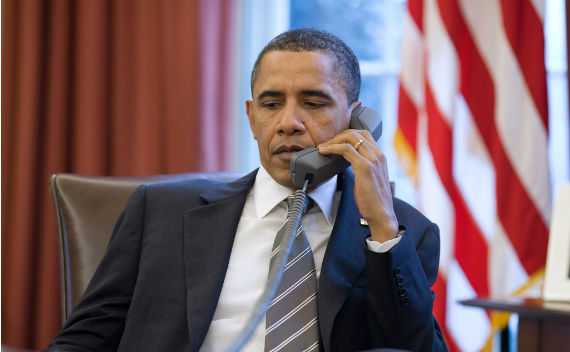
Obama on Phone

How do you know he’s not listening in on your conversations? Answer: you don’t.

 [Photo by Pete Souza, found via the Council on Foreign Relations]

For those of us who believe that the government needs to be more transparent in matters of national security, yesterday was not a very good day. In its first 5-4 opinion of this term, the Supreme Court split along ideological lines and ruled in favor of protecting a wide-ranging international surveillance program from constitutional challenges. Specifically, the Clapper v. Amnesty International opinion makes it much more difficult for lawyers, journalists, and human rights practitioners who suspect the United States of wiretapping their communications with non-Americans abroad to bring suit for such governmental behavior unless they have concrete proof that their correspondence will be intercepted.

At issue in Clapper is the Foreign Intelligence Surveillance Act (FISA), which allows the United States to target the communications of non-citizens on foreign soil. First authorized in 1978, FISA originally limited the Government to instances where it could show probable cause (to a special closed court known as a Foreign Intelligence Surveillance Court) that its individual targets were “foreign powers or the agents of foreign powers.”  In 2008, however, Congress amended FISA to include Section 1881a, a provision which removed the probable cause requirement and greatly expanded both the pool of people and the kinds of communications that could be monitored.

While FISA is aimed at foreign nationals who fall outside the protection of the Fourth Amendment, one effect of the law was the warrantless interception of thousands of international communications between FISA targets and American citizens. Shortly after the passage of 1881a, a group of American legal, labor, media and human rights organizations led by Amnesty International asked the Supreme Court to overturn that provision. Claiming that they frequently communicate with non-American clients, coworkers, witnesses and sources abroad, the challengers argued that this law violated their First and Fourth Amendment rights.

Before they could even get to the constitutionality of 1881a, however, the challengers ran into a practical problem: because of the secrecy involved in such surveillance programs, they couldn’t find any hard evidence that the United States was actually looking at their correspondence. Since Article III of the Constitution requires that you show some “injury” before you can bring a suit, Amnesty International argued that the injury lay in the “objectively reasonable likelihood” their conversations were or might be intercepted. The challengers further claimed that they had suffered numerous economic and professional harms in trying to avoid these interceptions, such as having to fly abroad to speak with clients in-person rather than over phone or email, and the reluctance of sources to disclose information in light of the potential eavesdropping. In response, the United States claimed that no one in this group had standing to bring this lawsuit, because (1) FISA targets only non-Americans, and (2) they simply could not prove that they were being intercepted. After the Second Circuit agreed with Amnesty International, the United States brought an appeal.
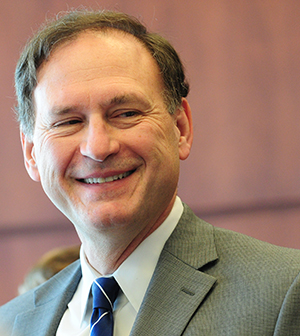
 Justice Alito

Justice Samuel Alito, a huge fan of certainty.

[Photo via Columbia Law School]

Justice Alito’s opinion, which was joined by Chief Justice Roberts and Justices Scalia, Thomas and Kennedy, reverses the Second Circuit ruling by accepting the Government’s stance that the challengers’ claimed injuries were too speculative to allow the suit to continue to trial. Alito found the Second Circuit’s “objectively reasonable likelihood” standard inconsistent with his reading of Supreme Court precedents, which he believes require a (much harder to show) “certainly impending” injury in order to establish standing. Ignoring the fact that it would be nearly impossible for any American to prove that the Government will monitor his correspondence under 1881a, Alito repeatedly emphasized that the challengers’ fears of future surveillance were nothing more than a “highly attenuated chain of possibilities.” Likewise, Alito brushed aside the fact that some of the challengers’ foreign contacts included the friends and family of Guantanamo detainees (including rather high-profile clients like Khalid Sheikh Mohammed and Mohammedou Ould Salahi) whose communications had already been monitored by the United States.

The majority opinion was also quite unsympathetic to the increased economic and professional costs of operating under 1881a, despite the fact that lawyers and journalists have an ethical duty to protect confidential communications with clients and sources:

“[The challengers] cannot manufacture standing merely by inflicting harm on themselves based on their fears of hypothetical future harm that is not certainly impending… Because [they]do not face a threat of certainly impending interception under 1881a, the costs that they have incurred to avoid surveillance are simply the product of their fear of surveillance.”

Naturally, the liberal wing of the Court, which had vociferously questioned the United States at oral argument about the fairness of a law for which virtually no one has standing to challenge, took issue with all parts of the majority opinion. The Justice Breyer-penned dissent also looked to precedent and rejected the majority’s “certainly impending” injury standard in favor of a “reasonable probability” or “high probability” injury standard:

“…[C]ertainty is not, and has never been, the touchstone of standing. The future is inherently uncertain. Yet federal courts frequently entertain actions for injunctions and for declaratory relief aimed at preventing future activities that are reasonably likely or highly likely, but not absolutely certain, to take place. And that degree of certainty is all that is needed to support standing here.”

Breyer went on to list no fewer than 18 cases in which federal courts found standing even where the likelihood of injury was “far less certain than here.” In addition, he argued that under the Supreme Court’s 2010 decision in Monsanto Co. v. Geertson Seed Farms, “reasonable efforts to mitigate the threatened effects of the future injury”–i.e., the economic costs that the 1881a challengers incurred in trying to keep their communications confidential–could constitute an injury sufficient enough for standing. Looking at the Government’s motive, capabilities and previous actions under 1881a and some other “commonsense inferences,” the dissent concluded that the challengers had in fact met the “reasonable probability” of injury standard and should have been allowed to contest 1881a’s constitutionality at trial.

Unfortunately, the dissenting justices were unable to convince a fifth colleague over to their side, meaning that the federal government is now incentivized to take one more step away from transparency. In his opinion, Justice Alito countered this concern by choosing to place his faith in the special Foreign Intelligence Surveillance Courts, which he believes will keep the Government accountable to the Constitution. As Justice Breyer’s dissent pointed out, however, these closed, secret courts (which do not make their hearings or records available to the public) very rarely reject any of the Government’s surveillance plans, and should not be the only safeguard for Americans’ civil liberties.  Nonetheless, the message that the Supreme Court sent yesterday is clear: the more secretive the United States keeps its national security programs, the safer they are from constitutional challenges, and the harder it is for ordinary Americans to vindicate what may be flagrant violations of their rights. We should all be very scared.

A win for gun control, perhaps not for democracy

Robin Kelly, a Democratic candidate in the Illinois special election to replace Jesse Jackson, Jr. in Congress, just won her primary today — and is now a shoe-in to win the seat. The Times explains part of how this happened:

Riding a wave of “super PAC” spending that helped catapult her to the front of a crowded Democratic field, Robin Kelly, whose campaign called for tougher national gun laws, clinched her party’s nomination Tuesday in a special primary election for the House seat vacated by Representative Jesse L. Jackson Jr.

The outcome of the contest, which had been unexpectedly cast into the center of the national gun debate, was welcome news for Michael R. Bloomberg, the mayor of New York and a staunch gun-control advocate. He poured more than $2.2 million into attacking Ms. Kelly’s chief opponent, Debbie Halvorson, this month.

Flooding Chicago airwaves, Mr. Bloomberg’s super PAC, Independence USA, ran a series of advertisements criticizing Ms. Halvorson for opposing certain gun control measures and endorsing Ms. Kelly as the alternative candidate.

The advertising campaign, a huge amount for a single House race, set up Ms. Halvorson’s defeat on Tuesday as a shot across the bow to other Democrats supporting gun rights, a sign of what could await future candidates who do not align with Mr. Bloomberg’s quest to change firearm laws across the country.

Last October, I examined Bloomberg’s strategy and came away disappointed:

In the face of this frontal assault on our democratic ideal of “one person, one vote,” Mayor Bloomberg’s attempt to launch political moderates back into the halls of power amounts to little more than a bandage. And it is the worst kind, because it confuses the symptom for the underlying illness: by using the very same funding tactics that helped drive the fringe into the mainstream American political landscape in the first place, Bloomberg’s efforts constitute an implicit endorsement of the post-Citizens United world. But accelerating the funding arms race is not the right long-term approach.

Enhanced by Zemanta

This is bad reporting.

Let’s assume you’re a normal person. And let’s propose a scenario in which, after years of gridlock between Republicans and Democrats in Washington, the GOP finally seems to be willing to give a little — now that they’ve definitively lost the last two presidential elections and polling appears to be mostly on the side of Democratic policies.

In such a situation, you’d probably welcome the prospect of a Republican thaw and assume it may help produce actual bipartisan legislation for once, no?

Well, no. Not if you’re the New York Times:

But the politics of one core dispute between Democrats and Republicans — what to do about Medicare — are changing. And some of those changes complicate President Obama’s agenda, even as he continues to flex his postelection muscle.

One shift is the shrinking magnitude of the Medicare spending problem — a consequence, at least for now, of a recent slowdown in the rise of health care costs. That diminishes the willingness of Congressional Democrats, and perhaps the administration, too, to accept the sort of Medicare curbs that Mr. Obama has indicated that he favors.

Another is a moderation in the public stance of Republican leaders. In recent weeks, they have advocated smaller changes to Medicare than the “premium support” or voucher plan that Mitt Romney advocated and that Mr. Obama denounced in last year’s presidential campaign.

As a result, Mr. Obama’s ability to deliver a bipartisan compromise on entitlement spending may be waning even as Republicans edge closer to one.

That’s right: Republican moderation is partly why President Obama may be unable to “deliver a bipartisan compromise.” If that sounds ridiculously counterintuitive, it’s because it is.

Yes, I realize the point of the article: that Obama and the Democrats now feel they have the upper hand, which might make them likelier to press their advantage while they have it — thus derailing the hope of a deal. (Never mind the fact that there is virtually no historical/empirical basis to support the notion that the Democrats have taken, or will ever take, advantage of whatever leverage they have.)

But this contorted logic only makes any sense in the context of the conventional wisdom that major media players like the New York Times help create. Mainstream journalists love to mock bloggy sites like Politico for their seeming giddiness in reporting on Washington insider politics, and yet this article — appearing in the Paper of Record, no less — is Beltway cynicism at its worst.

Maybe if the Times focused less on creating counter-incentives that don’t yet exist and exerted more effort instead on sensible reporting of actual political developments, we wouldn’t have so many of these manufactured crises in the first place.

Delusion of the day

Jennifer Rubin in the Washington Post:

Israeli Prime Minister Benjamin Netanyahu sounded the alarm that Iran was approaching “a red line.” Did the U.S. president even mention any of this? No, he was running around the country crying wolf and catastrophizing about an invented crisis. The real international threats go unremarked upon. For all intents and purposes Netanyahu is now the West’s protector.

What they said:

http://twitter.com/ggreenwald/statuses/305764175563591681

Enhanced by Zemanta

TEDx SIPA revisited

[youtube http://www.youtube.com/watch?v=VAz0bOtfVfE]

Last Sunday, I posted a not entirely positive review of TEDx SIPA. At one point, I took issue with a speaker’s depiction of the Peace Corps:

Later, a SIPA student passionately critiqued the Peace Corps model, declaring, “Grateful as I am for my experience in the Peace Corps, I recognize that the developing world cannot just be a training ground for young, idealistic Americans. The problems in communities like the one I lived in are far too serious for that.” And yet he was speaking at a conference created entirely for young, idealistic (and often inexperienced) Americans interested in solving enormous global problems — the type whose very presence at TEDx signalled their personal enthusiasm for the brand of fifteen-minute bursts of inspiration in which the speaker was participating himself. Indeed, his extrapolation of his own disillusionment with his two-year volunteering effort in South Africa into an ardent condemnation of the entire Peace Corps’ allegedly flawed practices was itself a case study in misplaced idealism.

It appears I wasn’t the only one. Today, SIPA’s student-run newspaper The Morningside Post (disclosure: I am its opinion editor) ran a piece by Audrey Huse that zeroed in on the Peace Corps talk’s flaws:

I’m surprised Mr. Kortava finished his two years, and I commend him for it. But it seems he thought he was going to South Africa to singlehandedly halt the HIV epidemic, and such high expectations can lead to disillusion and disappointment. The TEDx event did not seem an appropriate venue to vent his frustrations. The TEDx  platform is intended to present innovative ideas worth spreading. If there was one in Kortava’s talk, I missed it.

Granted, Kortava’s is hardly the first critique of the Peace Corps, nor will it be the last. (It’s also not the first time he’s done it himself, either.) But I wasn’t primarily interested in discussing the specific merits of the Peace Corps in my previous post. I was bothered more by Kortava’s overly simplistic take on it, and the way in which that “quick fix” attitude permeated so many of the speeches I heard during the TEDx conference that day.

Anyway, my friend and flatmate Andres Lizcano Rodriguez — who, incidentally, runs a very cool blog of his own — took issue with some of my comments. With his permission, I’ve reproduced portions of his response here:

I think you’re being a big, arrogant ass. Of course there’s a problem in fitting everything into a 17-minute presentation. The fact is, most of the world does not consist of Ivy League grad students, and not everyone can simply digest complicated critiques or fact-based lectures and policy analysis.

I’m not sure those Krugman graphs would be for everyone. I think your critique is in large part a critique of the ascendant pop-intellectual craze, but what is the problem with making intellectuality a popular thing? TEDx conferences will never be intellectual activities, but that isn’t their goal in the first place. (I think…and I hope.) They’re meant to motivate you to start considering something that you might not have known about, or seen in the same way, before. All the “goddamn assholes” that already know all this stuff aren’t representative of the broader population.

(By the way, the Peruvian author Mario Vargas Llosa makes a similar point to yours — not about TED talks but about culture. He keeps whining about the fact that everybody can be an artist or writer now, and that that has diminished the quality….all because he seems to feel that the intellectual aristocracy is threatened.)

Additionally, I think you’re underestimating the importance of passion and empowerment. Granted, it’s a big US-American cliché — I also despise all this “OMG that was so inspiring” stuff — but it’s not like that everywhere in the world.

You said:

There is a clear line connecting the type of thinking exemplified by TEDx and that of similarly grandiose but ill-informed ventures like the “Kony 2012” campaign. It’s not passion that’s lacking. But passion is dangerous in the hands of an institution that encourages superficial speech-giving and a daylong mutual back-scratch with an adoring audience.

But passion and self-esteem actually lack in many places. In my college in Bogotá — an elite university — we were not told all the time, like we are here, that we would be the future leaders of our country, that we could do everything we wanted, etc. etc. And thus I was often surrounded by many people — who were much smarter and more competent than I was — who didn’t dare to do anything because they didn’t feel they could actually achieve their goals. Most people had never actually considered that they could “dream big.”

Essentially, here are my points:

1. I think you’re misinterpreting the objective of a TED talk and, if interpreted differently, it could actually be of greater value to a broad audience than you’ve given it credit for.

2. I think you’re underestimating the importance of inspiration, empowerment, and passion.

After watching the above video, he summarized:

While we all agree on his points, nothing is being done about them. And I think part of the reason for this is that there are not enough people reminding us of his points. Meanwhile, there are tons of people (such as our own Office of Career Services) telling us all day long (in other formats) that we need to find a job at Goldman Sachs or the World Bank. Maybe it would be more efficient if TED opened offices at the big schools and scared the hell out of people so that they started behaving correctly. The point is that people need to be reminded of these big ideas, even if they already know them.

Enhanced by Zemanta

Double talk on the sequester

Jamelle Bouie cries foul on Republican attempts to portray the looming sequester as the Democrats’ fault:

A key part of the GOP’s strategy on the sequester is to blame President Obama for the fact it exists at all. One good example is House Speaker John Boehner’s op-ed in today’s Wall Street Journal:

With the debt limit set to be hit in a matter of hours, Republicans and Democrats in Congress reluctantly accepted the president’s demand for the sequester, and a revised version of the Budget Control Act was passed on a bipartisan basis.

Ultimately, the super committee failed to find an agreement, despite Republicans offering a balanced mix of spending cuts and new revenue through tax reform. As a result, the president’s sequester is now imminent.

The big problem with this narrative is that it directly contradicts Boehner’s rhetoric at the time. After the deal was crafted, in July 2011, Boehner told GOP House members that “There was nothing in this framework that violates our principles.” Later, in an interview with CBS News following the House vote on the bill, he described the deal as such: “When you look at this final agreement that we came to with the White House, I got 98 percent of what I wanted. I’m pretty happy.” And, as a whole, the House GOP was fine with the deal too—it passed 269-161, with 174 Republicans voting in favor.

Enhanced by Zemanta

Editor in Chief

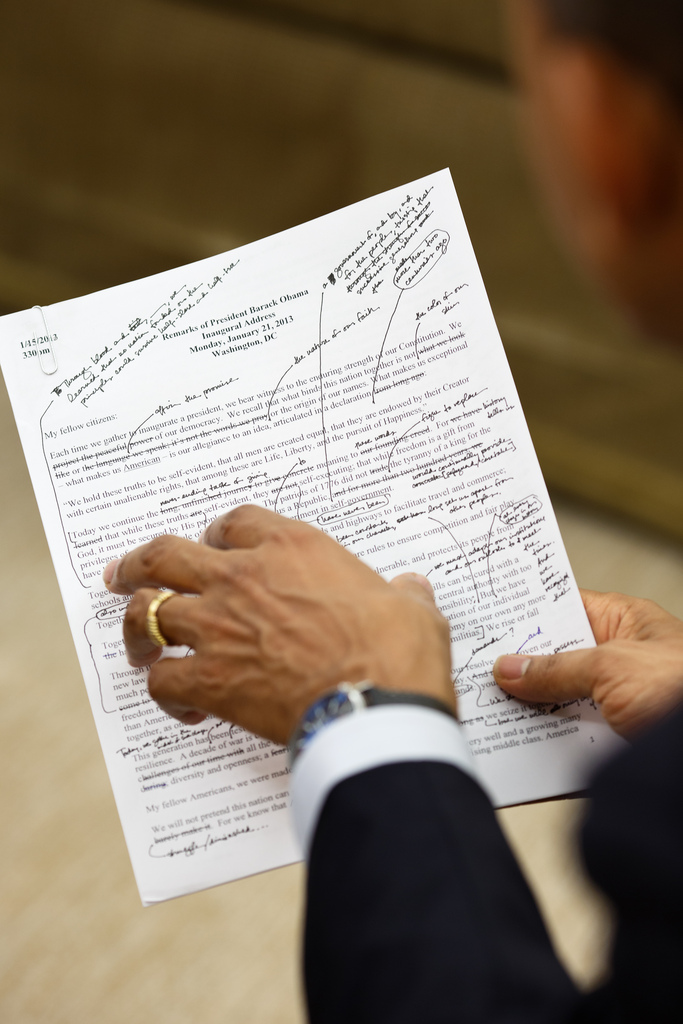
President Barack Obama works on his inaugural address with Jon Favreau, Director of Speechwriting, not pictured, in the Oval Office, Jan. 16, 2013. (Official White House Photo by Pete Souza)

Slate highlights this photo from White House photographer Pete Souza:

The photo shows only a portion of the first page of what was a rather lengthy speech, but what we can see nonetheless largely confirms previous anecdotes that Obama prefers to take an active role in shaping his remarks, particularly for major events like an inauguration or State of the Union address…The changes you can make out if you zoom in on this particular photo range from minor grammar tweaks to some relatively heavy rewrites.

A Big Data divide at the Times

David Brooks says Big Data matters, but perhaps not as much as people think:

Big data has trouble with big problems. If you are trying to figure out which e-mail produces the most campaign contributions, you can do a randomized control experiment. But let’s say you are trying to stimulate an economy in a recession. You don’t have an alternate society to use as a control group. For example, we’ve had huge debates over the best economic stimulus, with mountains of data, and as far as I know not a single major player in this debate has been persuaded by data to switch sides.

Paul Krugman takes a look and says, “Waittt a minute here:”

It would be lovely to live in a world in which the failure of interest rates to soar as predicted would lead Brian Riedl of Heritage and Niall Ferguson to concede that their anti-stimulus critiques of 2009 were based on a completely wrong model; in which the economic downturns that have followed austerity policies almost everywhere they have been applied would lead Alberto Alesina to concede that his work on expansionary austerity was probably flawed, and lead George Osborne to proclaim publicly that he led Britain down the wrong path. But such things very rarely happen, and the fact that they don’t happen has nothing to do with the limitations of data…

So yes, it has been disappointing to see so many people sticking to their positions on fiscal policy despite overwhelming evidence that those positions are wrong. But the fault lies not in our data, but in ourselves.

It’s a good point from Krugman, who’s also been quite busy dealing with other knuckleheads.

Enhanced by Zemanta

My problem with TEDx

krugman
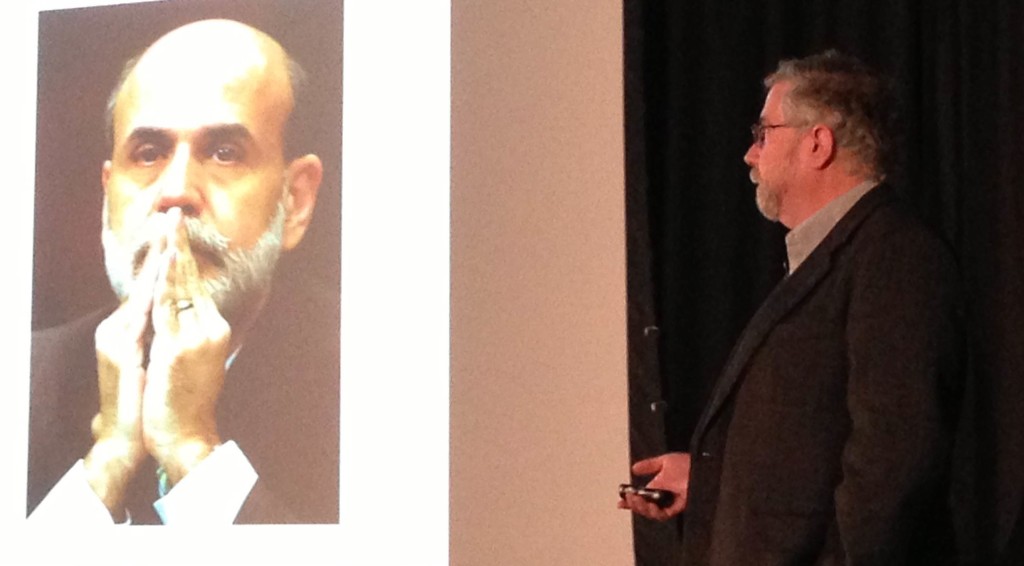
Battle of the Beards: Paul Krugman eyes his sometime bête noire, Ben Bernanke. TEDx talk at Columbia University’s School of International and Public Affairs. Friday, February 15, 2013.)

It wasn’t until after all the speeches had ended and everyone was mingling around the makeshift bar outside that I finally made the connection: TEDx is just like church.

I can’t remember the first time I heard about TED, the conference series that emerged into the spotlight rather suddenly several years ago and has become a staple of the socially conscious set ever since. But I distinctly recall feeling mounting skepticism with each new mention of the organization, which was often expressed in near-mythic terms and was almost always unqualifiedly positive.

The first full talk I recall actually watching myself was Dutch General and then-Chief of Defence Peter van Uhm’s TEDx speech in the Netherlands in 2011. I’d been assigned the video for a graduate class in January of last year. The course was on the American military, and the TEDx talk I’d been instructed to watch was titled “Why I Chose the Gun.” Here’s how it started:

Well, ladies and gentlemen, first of all, thank you for giving me an applause before I even started. As the highest military commander of the Netherlands, with troops stationed around the world, I’m really honored to be here today. When I look around this TEDx Amsterdam venue, I see a very special audience: you are the reason why I said yes to the invitation to come here today. When I look around, I see people who want to make a contribution. I see people who want to make a better world — by doing groundbreaking scientific work, by creating impressive works of art, by writing critical articles or inspiring books, by starting up sustainable businesses. And you all have chosen your own instruments to fulfill this mission of creating a better world.

This, as I would soon discover, was as perfect a microcosm of the TED experience (TEDxperience?) as one could find. First, the establishment of his credentials; then, the obligatory salute to the audience; and, finally, the ode to the transcendent ideal of “a better world.” Continue reading My problem with TEDx

Obama Calls for Expansion of Early Childhood Services

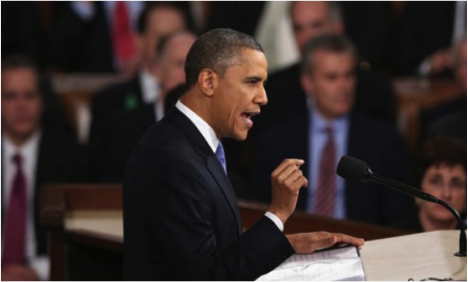
Alex Wong/Getty Images.

President Obama has been busy in the last few days rousing thousands of early childhood practitioners and advocates with his call for high-quality pre-k for all low- and moderate-income families. The administration has clarified parts of the plan, which have answered some questions and opened some new ones. The proposal is the biggest push for early childhood services since Head Start in the 1960s, a federally funded pre-k program to serve low-income families.

The plan, which I will henceforth refer to as “Obama-garten” (you’re welcome), proposes a four-pronged approach to supporting the development of young children through the expansion of high-quality pre-k access, full-day kindergarten, Early Head Start for infants to 3-year-olds, and a home visiting initiative. Many are pleased that the plan involves the under-three crowd, which is often neglected in U.S. policy. The details of the “new federal-state partnership” to expand high-quality pre-k to children up to 200% of the poverty line and incentivize states to “broaden participation in their public preschool program for additional middle-class families” have yet to be fully explained, but my guess is that some pretty tasty looking carrots will be dangled in front of states in order for them to participate. And participate they should. In fact, a handful of states, both red and blue, have already pledged some kind of commitment to supporting young children and their families in the last few months, signaling increased readiness to beef-up their early childhood services.

Several elements of the plan need to be pulled apart and further explained to get a sense of whether the plan is feasible. Continue reading Obama Calls for Expansion of Early Childhood Services