Category Archives: Media

The power of the bully pulpit

There’s been a lot of talk lately about Obama’s (non-)use of the bully pulpit in pressing his agenda, especially in the wake of his administration’s embarrassing defeat on gun control. Maureen Dowd kicked things off on Sunday:

How is it that the president won the argument on gun safety with the public and lost the vote in the Senate? It’s because he doesn’t know how to work the system. And it’s clear now that he doesn’t want to learn, or to even hire some clever people who can tell him how to do it or do it for him.

It’s unbelievable that with 90 percent of Americans on his side, he could get only 54 votes in the Senate. It was a glaring example of his weakness in using leverage to get what he wants. No one on Capitol Hill is scared of him.

Even House Republicans who had no intention of voting for the gun bill marveled privately that the president could not muster 60 votes in a Senate that his party controls.

That got the ball rolling. Yesterday, The New York Times Michael D. Shear and Peter Baker reported on the same theme:

Senator Mark Begich, Democrat of Alaska, asked President Obama’s administration for a little favor last month. Send your new interior secretary this spring to discuss a long-simmering dispute over construction of a road through a wildlife refuge, Mr. Begich asked in a letter. The administration said yes.

Four weeks later, Mr. Begich, who faces re-election next year, ignored Mr. Obama’s pleas on a landmark bill intended to reduce gun violence and instead voted against a measure to expand background checks. Mr. Obama denounced the defeat of gun control steps on Wednesday as “a shameful day.”

But Mr. Begich’s defiance and that of other Democrats who voted against Mr. Obama appear to have come with little cost. Sally Jewell, the interior secretary, is still planning a trip to Alaska — to let Mr. Begich show his constituents that he is pushing the government to approve the road.

The trip will also reinforce for Mr. Begich and his colleagues a truth about Mr. Obama: After more than four years in the Oval Office, the president has rarely demonstrated an appetite for ruthless politics that instills fear in lawmakers. That raises a broader question: If he cannot translate the support of 90 percent of the public for background checks into a victory on Capitol Hill, what can he expect to accomplish legislatively for his remaining three and a half years in office?

But Jonathan Chait isn’t having any of it:

During Bill Clinton’s first two terms, a Democratic senator from a red state (Richard Shelby of Alabama) defected on key votes. Clinton tried the “ruthless” approach of punishing Shelby by denying him these sorts of discretionary executive branch perks — first limiting his tickets to a ceremony honoring the Alabama football team, then threatening to move some NASA jobs out of his state. The tactic was universally seen to have backfired.

Did it really backfire? Probably not. Shelby voted the way he did because he assessed his own beliefs and interests. But that is the beauty of ignoring structural factors for stories about people: You can always tell a new one. If the president was nice, he should have been mean. If he was mean, he should have been nice. (Unless he prevailed, in which case his shrewd politicking saved the day!)

Obama faces a House controlled by far-right Republicans, and a Senate majority not sufficient to break what has become a routine supermajority requirement. And note that despite his national majority, Obama carried only 48 percent of House districts and 52 percent of the states, short of the threshold for passing laws in either chamber, which suggests that even a perfect effort to apply his popularity to any given issue is insufficient to pass a law.

Chait has a point. But I think there are two questions at play here simultaneously. One relates to Obama’s seeming unwillingness to get his hands dirty and shake some senators down, LBJ-style. The other is essentially a structural problem: when the vast majority of Americans support a legislative measure and it fails to succeed, one must ask whether our system is designed correctly for modern governance.

The answer to that question is almost assuredly no. The very fact that many news organizations now refer to votes that fail to obtain a supermajority in the same way they report on ones that don’t even receive a simple majority — as if the two scenarios equally demonstrate the bill’s unpopularity — is proof that the grinding inefficiency of Congress has permeated all aspects of our political activity. Broken institutions are so commonplace we don’t even notice them anymore.

This part is not Obama’s fault. But ironically enough, what the president’s team excelled at during his presidential campaign — setting the tone of the conversation early and defining his opponent before he had a chance to introduce himself to the broader public — his administration has abjectly failed at now. Virtually every major proposal Obama has introduced since he took office has been exaggerated, demonized, castigated, and lied about incessantly — only now and then provoking long-overdue and (by that point) completely ineffective responses in defense. So there is something to the bully pulpit theory. But it has less to do with what Obama should do today, now that gun control has lost anyway, and more to do with what he should have done years ago.

Enhanced by Zemanta

The bombing backlash, and a false equivalence

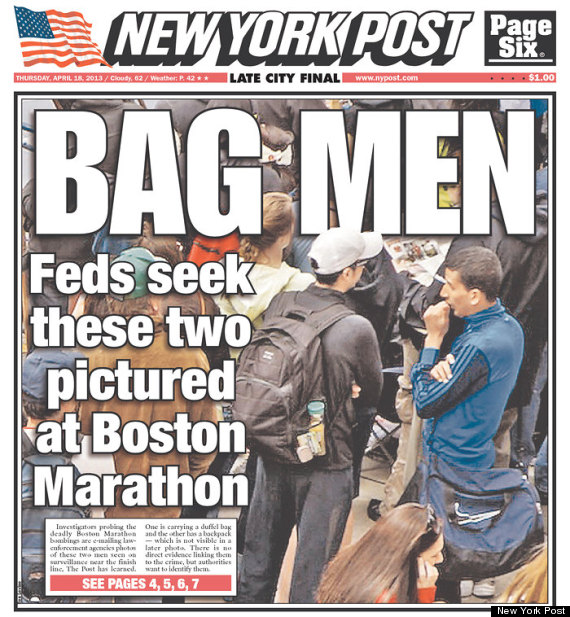
bagmen
Mm, not so much.

Jonathan Chait recaps the checkered performance of the media and the public in the Boston marathon bombing story:

In polarized America, both the reds and the blues have legitimate reason to fear that a tragedy will unleash an overly broad backlash. Liberals recall the false blame heaped on Muslim terrorists after Oklahoma City, and the real blame of 9/11 transforming into a fever of Bush-worship and jingoism. Conservatives recall mainstream reporters rushing to blame them, falsely, for shootings in Aurora and Tucson. It is also true that many Americans are eager, in senseless and fearful situations, for confirmation that the particular evil on display is the brand that conforms to their particular worldview. On Monday, there was comfort for some in the idea that the bombing was an act of tea-party loonies looking to exploit tax day. Among that same cohort was relief when the first pictures of the Tsarnaevs were released: The suspects were white, not Arab—maybe they were just another set of crazed teens with access to firearms. All week, nearly everyone was in a frenzy to profile, even those who should have known better.

There’s just one problem with this analysis: the consequences of misidentification are disproportionately stacked on one “side.” After the Oklahoma City bombing, the arrest and eventual execution of Timothy McVeigh had relatively little impact on American foreign and domestic policy. Sure, security was beefed up around federal buildings and other areas of interest, and President Bill Clinton attempted to leverage the attack into increased government powers, but life mostly went on.

Even after Aurora and Tucson, no one was rushing to strip conservatives of their legal rights, to surveil them more intensely, or anything else of the sort. Even if the killers had been conservatives, the most that liberals could’ve achieved is to point out (quite fairly) that conservatives can be just as extremist and violent as liberals (or liberals’ perceived “allies:” more on that in a moment).

Take, for example, the Norwegian massacre in 2011. Much of the American media rushed to broaden the scope of the gruesome attack, speculating immediately that the perpetrator was Muslim and, in so doing, implicating an entire religion. When it turned out he was a Christian conservative extremist instead, the cacophony of media bloodlust and anti-Muslim vitriol dwindled to mere whispers, the target of public anger was narrowed to a single man, and familiar defenses were trotted out: he was a lone madman, he didn’t represent any group other than himself, etc. These are, of course, sentiments not afforded Muslims and Arabs very often by these same publications.

There are, in other words, very light societal consequences for terrorism committed by ideological neighbors of the American conservative spectrum. But how quickly the tables turn when the suspect is a Muslim. (This is, in itself, an irony: nothing about fundamentalist Islam is remotely linkable to conventional liberalism, whereas fundamentalist Christianity is a crucial element within American conservatism. Islamic fundamentalism is, in fact, a much closer cousin of its Christian counterpart than it is of American progressivism.)

When the suspect is a Muslim, the consequences tend to be far greater and the overreactions more severe. September 11th, via a combination of mass hysteria, presidential incompetence, and public geopolitical ignorance, became a clear example of the catastrophe that can be unleashed on people-groups even in countries completely unrelated to the attacks.

A similarly frenzied dynamic is already enveloping the Boston Marathon bombing suspects, in some quarters. None other than U.S. Senator Lindsey Graham began publicly advocating the denial of basic rights to Dzhokhar Tsarnaev yesterday (a plea that was eventually successful, using a controversial “public safety” measure):

Indeed, Graham, joined by Senators John McCain and Kelly Ayotte, as well as Representative Peter King, released a statement imperiously deeming Tsarnaev a “good candidate for enemy combatant status” and concluding:

We hope the Obama Administration will consider the enemy combatant option because it is allowed by national security statutes and U.S. Supreme Court decisions.

We continue to face threats from radical Islamists in small cells and large groups throughout the world. They have, as their primary focus, killing as many Americans as possible, preferably within the United States. We must never lose sight of this fact and act appropriately within our laws and values.

Even seemingly unrelated public policy issues are coming under fire as a “result” of the Boston Marathon bombing. See this piece from today, for example:

Opponents of immigration reform — the most promising priority of Obama’s second term remaining after the defeat of gun control — are already using the attack to try to slow progress on a bipartisan Senate bill.

More broadly, the attack is raising questions about how the administration should deal with 19-year-old Dzhokhar Tsarnaev, who was captured Friday after an exhaustive manhunt in Boston, and concerns over whether the FBI was too complacent in letting his older brother Tamerlan Tsarnaev out of its sight after interviewing him in 2011.

So yes, it is true that, once the initial shock of the tragedy itself has been absorbed, both liberals and conservatives begin wincing at the possible fallout depending on who committed the crime. But as we have learned well over the years, public policy changes most when the suspect is part of a group used as a favorite conservative punching bag (in this case, Muslims). When the suspect is in any way connected to conservatism, the consequences are virtually nonexistent.

Enhanced by Zemanta

Running from terror in Boston

_MG_1142
Journalists in the Pulitzer World Room during Pulitzer Prize announcements. Monday, April 15, 2013.

http://twitter.com/rolldiggity/status/323888998558867456

On the third floor of the Columbia University Graduate School of Journalism is the Pulitzer World Room, a mid-sized chamber that could easily double as a church sanctuary. Today, at around 2:30 PM, I arrived there to cover the official announcement of the Pulitzer Prize winners that was scheduled to take place at 3 PM.

After setting up with my computer, camera, and obligatory coffee, I began scanning TweetDeck, trying to find which hashtag was associated with the event and generally catching up on news. At around 2:51 PM, I ran across this tweet:

At the time, it seemed out of place in my newsfeed, but it quickly became apparent just how relevant it was. Within minutes, a torrent of reports began flooding my computer screen in 140-character increments.

As it turns out, few places are more depressing than Twitter in the aftermath of a tragedy. What remains for most sentient human beings an unalloyed catastrophe that is mourned in solidarity with its victims requires all of thirty seconds on Twitter to devolve into a circus of self-righteous finger-wagging.

Of which I, like so many others, played my part. And yet there were so many aspects of today’s perfect Twitter storm that were so enraging in their lack of imagination and their utter predictability that it all felt, somehow, as if it were too much to handle at once.

I am from Boston (Everett, more precisely), and — like all Bostonians — have walked down Boylston Street far too many times to remember. Patriots’ Day is really, in the end, about two things: morning baseball and the Boston Marathon. Drinking plays a large role in both, and that is that.

And so part of my disbelief at the initial reports stemmed directly from the fact that a bombing in my hometown seemed so surreal, so otherworldly, so impossible, that it couldn’t have actually happened. I tried getting through to my parents and my little sister and kept bumping up against voicemail messages, endlessly ringing phones, and the even more ominous technical messages informing me the call could not be connected “at this time.” Eventually, I discovered none of them had even been in Massachusetts that day, let alone at home in Boston. But the horror remained.

There is a natural coming together after a tragedy. But even within this organic human impulse are concentric circles, ever-widening (or ever-narrowing, depending on the perspective) to include various scopes of “there”-ness. On September 11th, all Americans felt like New Yorkers. And all New Yorkers felt as if they had been at Ground Zero.

In reality, some people actually were there. Then, these geographical distinctions seemed not to matter. But today, there appeared to be a self-sorting taking place: the Bostonians versus the non-Bostonians, the true mourners versus the politicizers, those who demonstrated online “tact” versus the opportunists, and so on.

And yet we were all opportunists. If nothing else, today reminded me of how enormously petty people can be, as an actual human calamity was subsumed online under a wave of concern trolling and one-upsmanship. I don’t mean to pick on any one person in particular — because there truly was an enormous number of people doing this today — but it just so happened that one particular tweeter was especially prolific in this regard:

http://twitter.com/SaraMorrison/status/323880863672709120

http://twitter.com/SaraMorrison/status/323881303307075584

http://twitter.com/SaraMorrison/status/323888982779916288

http://twitter.com/SaraMorrison/status/323924796918358017

http://twitter.com/SaraMorrison/status/323950201163354112

Again, my point is not to pick on Morrison, with whom I’ve briefly interacted on Twitter in the past without incident (is there such a thing as a Twitter incident? a Twitcident?). She’s just the one particular user handle I remember from a long day of staring at my computer screen. I normally find her quite interesting, which is why I follow her in the first place.

But tweets like the above, in which boundaries are quickly drawn and stakes are claimed to some online/virtual form of legitimacy or sensitivity are just…ridiculous. Similarly maddening (and yet entirely predictable) is the knee-jerk scouring for the nearest maniac to provide a useful unhinged quote:

http://twitter.com/zackbeauchamp/status/323904005384323074

Why do these people even matter? Coverage is exactly what they want, but it is not at all clear what they have achieved to deserve it.

One final complaint: the obsession with the word “terrorism.” Everyone seemed to be holding his or her breath, waiting for the magic “T word” to escape President Obama’s lips during his press conference: after he didn’t, the conversation on TV turned to why not, and the conversation on Twitter turned to castigating the conversation on TV. This entire succession itself played out like a tired TV sitcom, with all the characters playing to typecast without the faintest trace of irony. Indeed, as Nate Silver succinctly put it:

Enhanced by Zemanta

Death of the ombudsman

Edward Wasserman, the dean of UC Berkeley’s Graduate School of Journalism, laments the elimination of The Washington Post‘s ombudsman position:

No matter how the job is structured, ombudsmen generally please no one. While journalists complain that they’re quick on the trigger and unsympathetic to the pressures of deadline-driven news production, outsiders say they’re too soft, and lack the spine to challenge their own employers over the most vexing new practices.

To that is joined now the criticism that they’re simply obsolete. That’s a point The Post itself endorsed when it noted the profusion of tough media commentary from unaffiliated online critics, implying there was no longer a need for The Post itself to weigh in as well.

That’s an interesting point, but I didn’t hear any corresponding commitment to cooperate with these outside inquiries. And I can’t imagine The Post deciding that in light of the ramped-up coverage of Capitol Hill by Politico, The New York Times and others, it need no longer cover Congress.

Enhanced by Zemanta

“Did you get into Harvard?!?”

Every spring, the title question is inevitably posed by wide-eyed, sleep-deprived high school seniors to their peers. The rat race otherwise known as the college admissions process in the United States is nearing its end (too slowly, for some).

In a guest post on Valerie Strauss’s The Answer Sheet blog in the Washington Post, Liz Willen from The Hechinger Report (shout out to Teachers College, Columbia University!) brilliantly captured the ritualistic process to which rankings-obsessed teens and parents around the country subject themselves year after year:

Listen closely, and the list of rejected valedictorians, team captains and accomplished test-takers will go on and on. You may even hear navel-gazing parents and students who received too many thin envelopes ask themselves, “Where did we go wrong?”

Willen’s point, however, is that this whole hubbub we (yes, I’m guilty of it, too) have built up throughout the academic year is completely wrong-headed, in terms of how it portrays higher education and in relation to what higher education actually means.

English: Teacher's College 2004 2004 Christoph...
English: Teacher’s College, 2004. Christopher Matta, free to use for any purpose. (Photo credit: Wikipedia)

On my regular bus to Teachers College the other day, the quiet space I occupied alone in the back was suddenly overrun by high school seniors speaking much too loudly for a public space. Initially annoyed at having my peace and quiet disturbed, I became intrigued at the banter thrown around from one corner of the bus to another.

Student A: You applied to Harvard?? You know only like 6% get admitted, right?!

Student B: I know…

Student A: That means, if you filled up this bus with 100 people, only 6 people would get in!

Conversations like these are precisely the target of Ms. Willen’s post:

We go wrong by engaging in this wrong-headed, waste-of-time conversation at all, and by comparing our kids’ test scores and GPAs, their merits and drawbacks. Sure, it’s seductive to be drawn into side-by-side comparisons and speculate about the “secret formula” for getting into top schools like Brown University, where 28,919 applicants vied for acceptances that totaled just 2,649.

Even the new movie starring Tina Fey and Paul Rudd, Admission, has contributed to this cycle of hair-pulling and eye-gouging.

In the new comedy Admission, the Princeton admissions officer played by Tina Fey is repeatedly asked to divulge that formula.

“Just be yourself,” Fey falsely answers. The film illustrates how largely unsuccessful such advice is by showing a parade of accomplished applicants falling through the floor of Princeton’s committee room and into oblivion.

Unfortunately, the movie perpetuates Ivy League angst, promoting the wrong conversation in a country where community colleges enroll more than half of the students in higher education—and where the percentage of Americans between the ages of 25 and 64 with a two- or four-year college degree is just 38.7 percent.

How often have we heard this statement of “just be yourself?” Few colleges I know of actually say that, though. (For more on the waste-of-time conversation that Ms. Willen points out, these three words recently got lots of play after a satirical WSJ op-ed by a high school senior and a subsequently swift response via Gawker.)

College access and affordability issues have long been the focus of my research, and as such, it’s what I’ve written about. But, the real conversation about college admissions that Ms. Willen notes is absolutely a critical dialogue: it’s not about where you go to college; it’s about what you do in college.

While the general perception is that having a degree from an Ivy League school, Stanford, or MIT automatically trumps a degree from most other institutions, the truth is our focus should be on the substance of the degrees and not the degrees themselves.

And until all the guidance, mentorship, and training that we can offer high school students truly helps them and their families embrace substance over style as a key outcome of higher education, we’ll be having this same conversation next spring.

It looks like we have some work to do.

Enhanced by Zemanta

“Gun shops were jammed.”

The New York Times is at it again.

Last month, I noted an article by The New York Times‘ Sabrina Tavernise and Robert Gebeloff, in which the two reported a long-term, steady decrease in gun ownership. They explained:

The findings contrast with the impression left by a flurry of news reports about people rushing to buy guns and clearing shop shelves of assault rifles after the massacre last year at an elementary school in Newtown, Conn.

“There are all these claims that gun ownership is going through the roof,” said Daniel Webster, the director of the Johns Hopkins Center for Gun Policy and Research. “But I suspect the increase in gun sales has been limited mostly to current gun owners. The most reputable surveys show a decline over time in the share of households with guns.”

In my post, after providing three examples of recent Times articles (here, here, and here) that had noticeably contributed to the aforementioned “flurry of news reports” about people rushing to buy guns, I concluded:

One can be forgiven for reading The New York Times and leaving with the impression that, yes, the entire country is stampeding its nearest weapons shops and loading up on anything with a trigger. This is just the latest in a long line of examples of the media helping to create a story, then reporting on the fallout from that story from a detached perspective, as if the press had nothing to do with the preceding whirlpool of artificially manufactured “news” in the first place.

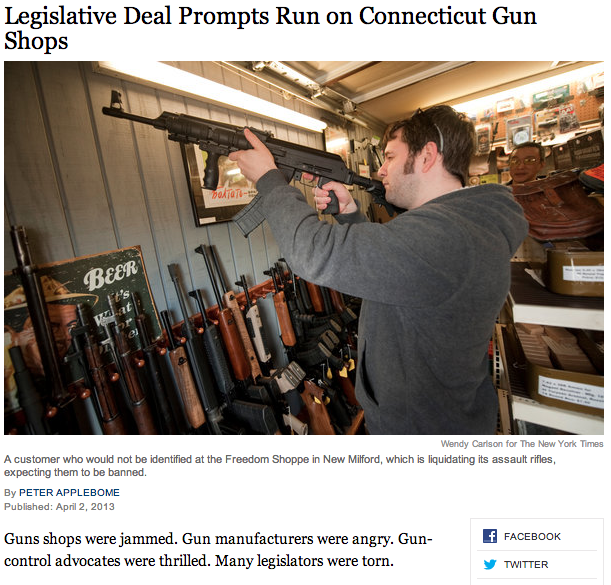
Well, as you can see above, the Times has yet to lose its appetite for stories about panicked weapons rushes:

Guns shops were jammed. Gun manufacturers were angry. Gun-control advocates were thrilled. Many legislators were torn.

But as President Obama on Tuesday announced a visit to Connecticut next week in the wake of an agreement on a far-ranging package of state gun legislation, Connecticut was bracing for the consequences, intended or not.

The most immediate result of the agreement, which came more than three months after the massacre of 26 children and educators in Newtown, was a run on gun shops on Tuesday, following months of already brisk sales. Gun owners are rushing to buy weapons, ammunition and magazines in anticipation of limits on their sale and possession.

Vic Benson, co-owner of the Freedom Shoppe, a gun shop in New Milford, said that his store was not usually even open on Tuesday, but that he opened its doors in anticipation of panicked buyers, and also to get rid of inventory he thinks he will be unable to sell after lawmakers vote on Wednesday.

The only indication in this entire article that all is not as depicted is the muted phrase “Gun owners are rushing…” — meaning that it is current owners, and not prospective gun buyers, that are leading the proverbial charge.

Look, the point isn’t that the Times shouldn’t cover news. And to some extent, delirious gun enthusiasts rushing their nearest weapons depot for a recharge so they can continue to shoot their high-powered guns with impunity even after stricter gun control legislation is passed is news.

Nevertheless, I would venture to guess that the Times‘ venerable voice is not well-utilized by devoting significant space in at least four articles in just over three months to the wildly exaggerated fears of armed paranoiacs. Perhaps, for example, some of those column inches could go towards additional coverage of shooting victims. Or of car dealerships, baseball, or whatever. After awhile, one starts to get the point: a lot of people love guns, and the Times is all over it.

But the larger point is that it’s ludicrous to continue covering these gun shop rushes on the one hand, while simultaneously remarking — as Tavernise and Gebeloff did — on the misleading “impression left by a flurry of news reports about people rushing to buy guns and clearing shop shelves of assault rifles,” as if the Times itself had nothing to do with creating this perception.

This paradox is especially concerning precisely because of what Tavernise and Gebeloff point out: gun ownership is decreasing. So publishing article after article portraying gun shops as overwhelmed by the demand for their products not only makes for boring reading, but doesn’t really present an accurate picture either.

Enhanced by Zemanta

Are online paywalls too little, too late?

Courtesy of LUMA Partners.
Courtesy of LUMA Partners LLC.

Michael Wolff thinks so:

Without a dramatic turnaround in advertising income, there are only two strategies – neither mutually exclusive – for the continued existence of newspapers, in digital or any other form:

• Having established the paywall model, the goal, in a race against time, is to extend it to a greater and greater part of the user base. Like the paywall itself, this is unchartered territory. Rupert Murdoch’s more absolute paywalls having worked significantly less well than the New York Times’ porous wall. The Times, however, counting on its brand power and on the gradual change in consumer behavior, is trying to up the ante, recently cutting its free take from 20 to ten articles.

• Re-orient the cost basis of the business, still largely modeled on advertising income, to the much smaller subscription revenue base. That is, fire a lot of people.

This is, actually, good news, if not necessarily for shareholders or for many employees. Some newspapers can continue to exist, albeit as vastly smaller and less profitable businesses.

I have a few points in response. First, Wolff characterizes newspapers’ plummeting revenue in the following terms: “A digital advertising environment on the web – one even more pronounced in mobile – that relentlessly increases the amount of advertising space available and lowers the value of all space overall.”

Wolff is mostly right, for now. But that’s only because advertisers have yet to figure out what’s valuable. I worked in online advertising for two years (including one year for a behavioral targeting firm), and I can say with some confidence that we still don’t have adequate metrics to measure advertising success online — hence the degradation of online real estate. But soon enough, the advertising landscape will have to revert to form.

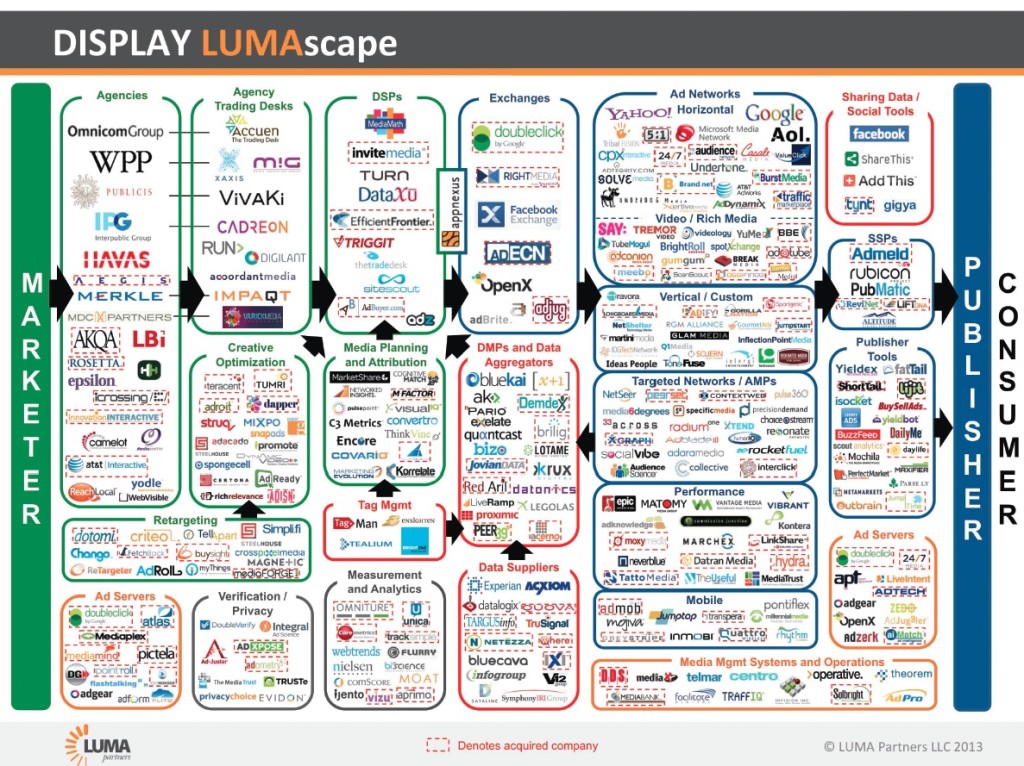
Why? Well, because advertisers don’t like paying for something that provides no value. It’s astonishing just how little advertisers still know about their own data in 2013 — that is, the audiences on their own web sites, the customers buying their products, and so on. The problem is even worse when it comes to connecting with new audiences, also known as advertising. Not only do the companies themselves not understand the data, but many of the online advertising firms that these companies have hired know little about what they’re selling as well. (Take a look at the above headache-inducing graphic of the online media landscape to understand why.) Continue reading Are online paywalls too little, too late?

The Supreme Court decision will (not) be televised

Courtesy of TheAtlantic.com.
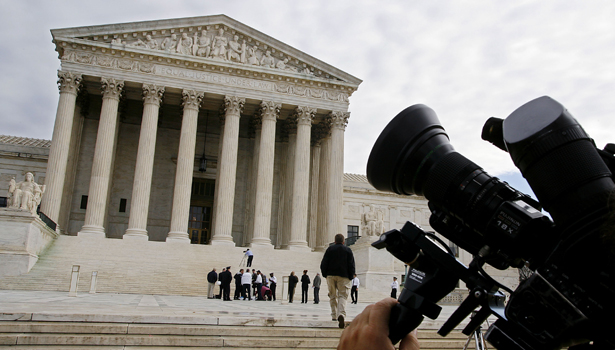
…Even though the world might be a better place with Sotomayor reaction GIFs. Picture via TheAtlantic.com.

I’m of two minds about Al Tompkins’ Poynter piece (excerpted below) advocating cameras in the Supreme Court, which Andrew Sullivan highlighted on The Dish yesterday:

This is at the heart of what courts do every day in America; they hear the people’s business. It’s not entertainment, like Judge Judy. It is a living civics lesson, and exactly what the public should be able to see.

Live coverage would give the people unfettered access to the words the justices say, and would make it harder for journalists to add their own spin. Live coverage would also help us visualize what’s going on much more than words can.

My thoughts can be divided into roughly two camps: (1) SCOTUS’ Problem with Embracing Technology (or, Why I Think We Will See Live Video of Arguments In the Future), and (2) SCOTUS’ Problem with Protecting Court Integrity (Why Cameras are Both Good and Bad). Continue reading The Supreme Court decision will (not) be televised

Iraq War anniversary apologies

Courtesy of PolicyMic.com.

There’s an interesting discussion taking place on Corey Robin’s blog regarding Ezra Klein’s apology for supporting the Iraq War:

Like many people who supported the Iraq War, Ezra Klein has written his apologia.

But he fails to identify—indeed, repeats—his biggest mistake in supporting the war: When thinking of the US government, he  thinks “we.”

Iraq, [Kenneth Pollack] said, shouldn’t be America’s top priority. We should first focus on destroying al-Qaeda. We should then work on the Israeli- Palestinian conflict. Only then should we turn to Hussein. Moreover, when and if we did invade Iraq, we should do so only as part of a coordinated, multilateral operation…

After all, what other chance would we get to topple Hussein?

It wasn’t worth doing precisely because the odds were high that we couldn’t do it “right.”

Klein doesn’t think a state invaded another state; he thinks “we” went to war. He identifies with the state. Whether he’s supporting or dissenting from a policy, he sees himself as part of it. He sees himself on the jeeps with the troops. That’s why his calls for skepticism, for not taking things on authority, ring so hollow. In the end, he’s on the team. Or the jeep.

I’ve learned a lot from reading the comments. (Now there’s a sentence you rarely see on the Internet these days.) One commenter, Justin, replied:

Maybe I’m too naive, but isn’t the problem that more people DON’T identify with the government? If we identify with the government, then its failings are our failings and there’s more motivation to change things because they’re being done in our names. If we don’t identify with it, then it’s just this abstract entity that we can have nothing to do with, which leads to the government abusing its power because none of us feel responsible for it.

I guess I don’t think it’s a problem that Klein is “on the team” – it’s that most of us aren’t on it and thus don’t have any say on what’s happening.

Another commenter, Ned Ludd, raised a different point:

Because he supported the stablishment position on Iraq, Ezra Klein was able to rise into the ranks of the establishment. Back in January 2007, Jebediah Reed of the now-defunct Radar Magazine took a look at some of the career trajectories of pundits who supported the war (Tom Friedman, Peter Beinart, Fareed Zakaria, Jeffrey Goldberg) and the subsequent careers of vocal opponents of the invasion (Robert Scheer, William. S. Lind, Jonathan Schell, Scott Ritter). If Klein had been against the war, he never would have been promoted from obscurity to the pages of the Washington Post.

All of these points raise the question of how such a calamity as Iraq can be avoided in the future. As The Atlantic‘s Elspeth Reeve has ably demonstrated, the 10-year anniversary edition of self-flagellation for supporting the Iraq War has blossomed so ubiquitously as to necessitate a taxonomy of apology bullet points: “I was but a lowly worm,” “I was fooled by bad intelligence,” and so on.

However, what many such Iraq War apologists and (much later) apologizers seem to have in common is an inability to grasp their deeper failing for directing much of their vitriol at the anti-war crowd and castigating those people (who turned out to be very right in the end) as a bunch of hippies. Freddie deBoer remembers this specifically:

You know, I’m reading all of the Iraq mea culpas, some good, some bad. But they are all systematically ignoring one of the most obvious and salient aspects of the run up to the war: the incredible power of personal resentment against antiwar people, or what antiwar people were perceived to be. As someone who was involved in day-to-day antiwar activism at the time, the visceral hatred of those opposing the war, and particularly the activists, was impossible to miss. It wasn’t opposition. It wasn’t disagreement. It was pure, irrational hatred, frequently devolving into accusations of antiwar activists being effectively part of the enemy. Yet for as visible and important as this distaste was for the debate, it’s missing from the postmortems.

Ta-Nehisi Coates has similar memories:

I am not a radical. But more than anything the Iraq War taught me the folly of mocking radicalism. It seemed, back then, that every “sensible” and “serious” person you knew — left or right — was for the war. And they were all wrong. Never forget that they were all wrong. And never forget that the radicals with their drum circles and their wild hair were right.

And Conor Friedersdorf compiles a roundup of mockery aimed at anti-war protesters before and during the war.

It’s enough to make one wonder if we ever learn anything, at all, from history.

Enhanced by Zemanta

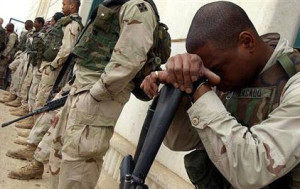
“But the war was politics.”

President George W. Bush addresses sailors dur...
President George W. Bush addresses sailors during the “Mission Accomplished” speech, May 1, 2003. (Photo credit: Wikipedia.)

Howard Fineman takes a look back at the beginning of the Iraq War, whose “shock and awe” campaign began ten years ago on Wednesday:

There were some reasons to expect success, or at least not to accept the dire warnings against invading Iraq. Bush’s critics had predicted disaster in Afghanistan, but in the first year or two after Operation Enduring Freedom, it seemed as though the “war lords” of the Bush administration were tough customers who knew what they were doing.

On the other hand, American ignorance of the Arab and Muslim worlds 10 years ago was alarmingly vast. More than ignorance, there was fear, prejudice and propaganda…

As for me, I could say that I was covering politics, not war, and that it wasn’t my job to try to pierce the veil of lies and “precog” justifications of the Bush-Cheney-neocon axis.

But the war was politics. It was a new battle for the president to be seen fighting as he headed toward a reelection run. I should have known more, studied more, asked more questions and been more skeptical.

I hope I am wiser now. I hope we all are.

Enhanced by Zemanta