Category Archives: Politics

[UPDATED] With Utah Stay Application Filed, Ball is Now in the Supremes’ Court [Infographic]

Justice Sonia Sotomayor of the Supreme Court is set to decide whether same-sex marriages in Utah, which have been conducted since a federal trial judge overturned on December 20 a state ban on such marriages, can continue while the case is being appealed, or whether they must cease for the time being.

After both Judge Robert Shelby and the Tenth Circuit Court of Appeals denied its application for an emergency stay, Utah took its request up to the Circuit Justice assigned to the Tenth Circuit, Justice Sonia Sotomayor, on December 31. Justice Sotomayor asked the plaintiffs to submit its response opposing the stay by noon, January 3. Their brief can be found here (courtesy of the Legal Times).

From here, Justice Sotomayor can choose to decide the stay herself, or she can refer the issue to the full Supreme Court. I’ve created a flowchart (click to enlarge) to help explain how a non-capital stay ((As opposed to capital stays, where a convicted individual has received the death penalty–these play out differently because of the nature of such cases)) moves through the federal courts. The magenta box on the left lists out what a party must show in order to obtain a stay.

(This flowchart was created using information from Supreme Court Rule 22 on “Applications to Individual Justices” and the Supreme Court Public Information Office’s “Reporter’s Guide to Applications.” The latter includes a chart showing which Justices are assigned to which Circuits.) 

In terms of where in the process we are right now, Utah’s stay application is at the teal box labeled “Circuit Justice (Justice Sotomayor).”

There has been a lot of speculation in the last few days over whether Justice Sotomayor will keep the stay application for herself or bring in the rest of her colleagues, with many predicting that she will refer it to the full Court. As the chart shows, that seems to be the quickest, most efficient way to dispose of the application–once the full Court has voted on the stay, its decision is final.

Individual Circuit Justice rulings, meanwhile, are theoretically subject to “appeal.” If the Circuit Justice denies the stay, the party petitioning for a stay can resubmit the request to another individual Justice of its choosing (Supreme Court Rule 22.4, however, points out that this tactic is “not favored,” and the Justice to whom the request is resubmitted will usually then refer it to the full court, out of deference to the Circuit Justice and to defuse attempts at “justice shopping”). If the Circuit Justice individually grants the application, the party opposing the stay can then ask the full court to vacate the stay. Now, in practice, the Circuit Justices are accorded a great deal of deference in their individual decisions–Sotomayor, after all, did just individually grant a stay on a separate case two days ago–but the possibility that their rulings might end up being reviewed by the full Court anyway may incentivize them to “share.”

UPDATE: The Supreme Court granted Utah’s request for a stay this morning, halting same-sex marriages in the state until the Tenth Circuit has decided the case on appeal. The one-paragraph order, which can be found here, shows that Justice Sotomayor did in fact refer the stay request to the full court. The Supreme Court did not touch the merits of the case in its grant of the stay, providing no explanation of its decision or analysis of the two parties’ arguments. As Utah’s Fox 13 News reporter Ben Winslow notes, over 900 same-sex marriages have been conducted in the state since Judge Shelby’s initial ruling on December 20. Winslow reports that the Tenth Circuit expects to hear oral argument in the case this March.

After Political and Weather Delays, Patricia Millett Set For Confirmation Vote in Post-Nuclear Senate

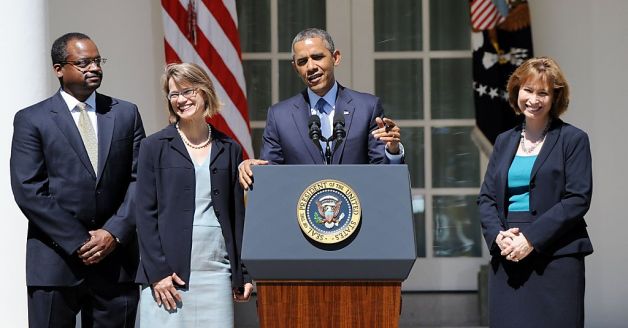
President Obama with D.C. Circuit nominees (L-R) Robert Leon Wilkins, Nina Pillard and Patricia Millett in June 2013. Picture by Olivier Douliery, McClatchy-Tribune News Service.

Nearly three weeks after Democrats triggered the “nuclear option” and altered filibuster rules to make it easier for sitting presidents to appoint federal judicial nominees, the Senate is set to vote on Patricia Ann Millett’s nomination to the United States Court of Appeals for the District of Columbia Circuit at 10 a.m. on Tuesday morning.

President Obama originally nominated Millett, who has argued 32 cases before the Supreme Court and currently co-heads the Supreme Court and national appellate practices at the Washington, D.C. law firm Akin Gump Strauss Hauer & Feld LLP, to a seat on the D.C. Circuit in June 2013. Senate Republicans deemed Millett too partisan and filibustered her nomination in October, which blocked her from receiving a confirmation vote before the full Senate.

Under the previous rule, Senate Democrats would have needed a sixty-person supermajority to overcome the minority party’s filibuster and force a confirmation vote—a number that they fell short of, with Republicans holding forty-five out of 100 seats. After the Republicans used the same tactic this fall to block two more D.C. Circuit nominees, however—Georgetown law professor Cornelia “Nina” Pillard and United States District Court Judge Robert Leon Wilkins—Democrats changed the rule outright so that only a simple majority would be required to obtain a confirmation vote. With the math on the Democrats’ side now, Millett is expected to be confirmed today. No date has been set yet for voting on Pillard and Wilkins.

The D.C. Circuit is widely referred to as the second most important court in the country after the Supreme Court, as it hears a disproportionate number of high-profile, high-impact regulatory and administrative cases compared to the other twelve federal circuit courts. In a paper published by the Cornell Journal of Law and Public Policy last week, four former D.C. Circuit law clerks examined the jurisdiction of the court and further noted that Congress often “carve[s] out certain areas of federal law as the special preserve of the D.C. Circuit,” which, when combined with the Supreme Court’s tendency to review only a small number of cases each term, effectively gives the D.C. Circuit “the final say—and the only appellate say—over numerous laws and rules affecting the entire nation.” The article’s authors found 150 statutory provisions in the United States Code that referred specifically to the D.C. Circuit, as opposed to eighty-eight mentions for the rest of the circuit courts combined.

In addition, the Circuit has become a stepping stone of sorts for judges aspiring to the highest bench of all: four out of the nine sitting Supreme Court justices have previously served on the D.C. Circuit. ((They are Chief Justice John G. Roberts, Jr. (2003-2005) and Justices Ruth Bader Ginsburg (1980-1993), Antonin Scalia (1982-1986) and Clarence Thomas (1990-1991).))

Of the eleven seats on the D.C. Circuit, four are currently filled by Republican-appointed judges and four by Democratic appointees, while three seats remain vacant. Because of this numerical tie, any changes that President Obama makes to its membership is seen as tipping the court’s balance toward his side of the political spectrum. Senate Republicans have tried to pre-empt this by proposing legislation earlier this year that would have eliminated the three vacancies on the circuit entirely, arguing that the court does not need eleven judges because it faces a lower caseload than it has in past years (and accusing Obama of “packing” the court by filling the empty seats). Given last month’s changes to the filibuster rule, however, this bill is likely to become moot as Democrats now push forward with confirming the President’s nominees.

The vote on Patricia Millett was originally scheduled for Monday evening but was postponed after bad weather in D.C. delayed the travel plans of some Senators.

Enhanced by Zemanta

A broken Constitution, and a few misplaced facts

Jeffrey Toobin’s latest piece for The New Yorker, “Our Broken Constitution” (paywalled), is an illuminating stroll through a myriad of justifiable complaints about the American founding document. But I couldn’t help but notice several questionable (and, in some cases, completely inaccurate) statements.

The essay opens thusly: “If there is a single point of consensus in this heated political moment, it’s that everyone loves the Constitution.” In the next paragraph, Toobin continues: “The Constitution, and the structure of government that it established, provides the backdrop, but never the subject, for every controversy.”

Skip ahead two paragraphs, however, and you’ll find the exact opposite: “Outside Washington,” Toobin explains, “discontent with the founding document is bipartisan and widespread…On the left and the right, [critics] are asking whether the pervasive dysfunction in Washington is in spite of the Constitution or because of it.” How can both be true simultaneously?

That’s not the only problem. Toobin’s opening statement, even if evaluated in the absence of his self-rebuttal a few lines down, is demonstrably inaccurate. Of course, there’s a certain futility to disproving any theory that includes the phrase “everyone loves” — which, to his credit, Toobin couldn’t possibly have meant literally. Nevertheless, even if afforded an ostensibly looser interpretation of “everyone,” his argument simply doesn’t work.

In fact, Toobin’s essay is itself just the latest in a series, all of which harp on the same general theme (a mostly justified one, to my eyes) that the Constitution is — to put it simply — overrated. A July 2012 Slate piece titled “Fixing the U.S. Constitution” invited readers and experts to amend the venerable document, introducing the effort thusly: “Politicians talk about the Constitution as if it were as sacrosanct as the Ten Commandments. But the document itself invites change and revision.”

In December of that same year, The New York Times ran an op-ed piece by Louis Michael Seidman, a constitutional law professor at Georgetown, headlined “Let’s Give Up on the Constitution.” In it, Seidman laments “our insistence on obedience to the Constitution, with all its archaic, idiosyncratic and downright evil provisions.” He also points out the long history of constitutional dissent: “Constitutional disobedience may seem radical, but it is as old as the Republic. In fact, the Constitution itself was born of constitutional disobedience…No sooner was the Constitution in place than our leaders began ignoring it.”

Less than three months ago, in September, Kevin R.C. Gutzman asked in The American Conservative: “Do We Need a New Constitutional Convention?” Perhaps more to the point, a National Journal article the following month by Alex Seitz-Wald was self-explanatorily titled, “A How-To Guide to Blowing Up the Constitution.” And these are just a few representative samples in a long canon of disenchantment with the output of “We the People” (or, rather, of their aristocratic appointees to the constitutional convention).

A second problem crops up soon enough. A little further along, but still on the article’s first page (p. 64 in the print edition), Toobin writes: “Implicitly but unmistakably, the 1787 Constitution allowed for the continuation of slavery.”

There is nothing implicit about the Constitution’s allowance for slavery. In the very first Article, Section 2, Clause 3 states, in part:

Representatives and direct Taxes shall be apportioned among the several States which may be included within this Union, according to their respective Numbers, which shall be determined by adding to the whole Number of free Persons, including those bound to Service for a Term of Years, and excluding Indians not taxed, three fifths of all other Persons.

Later on, in Article I, Section 9, Clause 1, the Constitution explicitly allows for the slave trade’s continuation until at least 1808:

The Migration or Importation of such Persons as any of the States now existing shall think proper to admit, shall not be prohibited by the Congress prior to the Year one thousand eight hundred and eight, but a Tax or duty may be imposed on such Importation, not exceeding ten dollars for each Person.

Article IV, Section 2, Clause 3 states:

No Person held to Service or Labour in one State, under the Laws thereof, escaping into another, shall, in Consequence of any Law or Regulation therein, be discharged from such Service or Labour, but shall be delivered up on Claim of the Party to whom such Service or Labour may be due.

And finally, Article V reaffirms the impossibility of eliminating the slave trade until at least 1808:

The Congress, whenever two thirds of both Houses shall deem it necessary, shall propose Amendments to this Constitution, or, on the Application of the Legislatures of two thirds of the several States, shall call a Convention for proposing Amendments, which, in either Case, shall be valid to all Intents and Purposes, as Part of this Constitution, when ratified by the Legislatures of three fourths of the several States, or by Conventions in three fourths thereof, as the one or the other Mode of Ratification may be proposed by the Congress; Provided that no Amendment which may be made prior to the Year One thousand eight hundred and eight shall in any Manner affect the first and fourth Clauses in the Ninth Section of the first Article; and that no State, without its Consent, shall be deprived of its equal Suffrage in the Senate.

Midway through Toobin’s piece, a third flaw emerges. Speaking of President Obama, Toobin writes:

Though he will spend eight years in office, his tenure as the actual leader of the national government lasted about a year and a half. On July 7, 2009, Al Franken was seated, after a recount, as the sixtieth Democratic senator. (Sixty votes are needed to overcome a filibuster.)…In the midterm elections of 2010, Obama’s party lost control of the House and fell below the filibuster threshold in the Senate.

But as has been well-documented (here, and here, and here, to name a few places) — and especially visible, one would imagine, to a political junkie such as Toobin — Obama’s actual filibuster-proof Senate majority lasted only four months in reality. Rachel Maddow’s blog explains:

In January 2009, there were 56 Senate Democrats and two independents who caucused with Democrats. This combined total of 58 included Sen. Ted Kennedy (D-Mass.), whose health was failing and was unable to serve. As a practical matter, in the early months of Obama’s presidency, the Senate Democratic caucus had 57 members on the floor for day-to-day legislating.

In April 2009, Pennsylvania’s Arlen Specter switched parties. This meant there were 57 Democrats, and two independents who caucused with Democrats, for a caucus of 59. But with Kennedy ailing, there were still “only” 58 Democratic caucus members in the chamber.

In May 2009, Sen. Robert Byrd (D-W.Va.) was hospitalized, bringing the number of Senate Dems in the chamber down to 57.

In July 2009, Sen. Al Franken (D-Minn.) was finally seated after a lengthy recount/legal fight. At that point, the Democratic caucus reached 60, but two of its members, Kennedy and Byrd, were unavailable for votes.

In August 2009, Kennedy died, and Democratic caucus again stood at 59.

In September 2009, Sen. Paul Kirk (D-Mass.) filled Kennedy’s vacancy, bringing the caucus back to 60, though Byrd’s health continued to deteriorate.

In January 2010, Sen. Scott Brown (R-Mass.) replaced Kirk, bringing the Democratic caucus back to 59 again.

Thus Obama’s supermajority, for all practical purposes, lasted only from September 24, 2009 until February 4, 2010, when Scott Brown took Kennedy’s old seat in the Senate.

Finally, towards the end of his article Toobin notes the undemocratic nature of the House of Representatives: “In 2012, House Democratic candidates across the country won about half a million more votes than their Republican opponents, but the G.O.P. emerged with thirty-three more seats than the Democrats.”

Toobin is correct on the seat differential, but significantly off on the vote gap. According to analysis performed by the Cook Political Report’s U.S. House editor, Dave Wasserman (and briefly explained by Talking Points Memo editor Josh Marshall), House Democrats actually won 1,365,157 more votes than Republicans in 2012 — a differential nearly three times that cited by Toobin.

Out of an abundance of caution — since Toobin had specifically compared the Democrats’ vote totals to those of their Republican opponents (emphasis mine) — I copied Wasserman’s Google spreadsheet and eliminated all House races in which either the Democrat or Republican candidate received 0 votes. This, I believe, should serve as a reasonably good proxy for uncontested races — in other words, those with no opponents. When only contested races are counted, the Democrats’ vote advantage over the GOP extends to 2,444,369. This is nearly five times as high as Toobin’s count.

I bring all this up not to rag on Toobin, who is obviously an astute legal mind. I enjoyed his article and am generally sympathetic to the complaints registered by the progressive movement regarding the Constitution’s many inadequacies. But several passages somehow slipped past The New Yorker‘s legendary fact-checking desk.

Enhanced by Zemanta

My Days of Fire review is now up

I took a look at New York Times White House correspondent Peter Baker’s new book, Days of Fire: Bush and Cheney in the White House:

Baker, in his acknowledgments, hopes that readers comprehend “the value in attempting a neutral history of a White House about which almost no one is neutral.” But here he stumbles down the well-worn path of journalists like his colleague (and former Times executive editor) Bill Keller, whose tired defense of reportorial objectivity masks, time and again, their own inevitable — precisely because they are human, not because they are flawed — prejudices.

Chief among Baker’s faux neutralities is his characterization of the CIA’s brutal interrogations, which he fastidiously avoids calling torture. At one point, Baker describes the methodology as “the interrogation program that many called torture.” Elsewhere, a National Security Council press secretary refused to defend “the interrogation program many considered torture.” Later on, Baker writes that Bush “pared back the harsh interrogation techniques that critics called torture,” echoing his earlier characterization of waterboarding as a practice that (ostensibly subjectively) “was deemed torture by the rest of the world.”

Enhanced by Zemanta

After Illinois, Look West for the Next Same-Sex Marriage Battles

IMG_1679
Celebrations at the Chicago Pride Parade in June 2013. Today, Illinois becomes the 16th state (plus Washington, D.C.) to legalize same-sex marriage.

When Illinois Governor Pat Quinn signs a same-sex marriage bill into law today, the Land of Lincoln will officially become the 16th state to grant recognition to same-sex spouses, just one week after Hawaii.

2013 has been a banner year for gay rights activists–in addition to the Supreme Court decisions striking down the federal Defense Of Marriage Act and permitting same-sex marriage in California, the movement has seen the legalization of same-sex marriage almost double at the state level. Nearly one year ago, when the Supreme Court first agreed to hear United States v. Windsor and Hollingsworth v. Perry, only nine states and the District of Columbia recognized same-sex marriage.

Of course, their work is still far from done. After Illinois, the focus will turn west toward New Mexico and Oregon.

Traditionally, states have legalized same-sex marriage through one of three ways: by referendum, through the state legislature, or via a ruling from the state’s judiciary.

New Mexico, the only state that has neither a constitution nor a state law explicitly addressing same-sex marriage, could become the 17th state to legalize such unions, thanks to the third route. Because of the state law’s silence on the matter, eight out of thirty-three counties began issuing marriage licenses to gay and lesbian couples after the Windsor and Hollingsworth rulings–eventually prompting all thirty-three New Mexico county clerks to ask the state supreme court for clarification on the constitutionality of same-sex marriage. The New Mexico Supreme Court heard oral argument in October 2013 and is expected to hand down a decision by the end of this year.

If the New Mexico Supreme Court rules in favor of legalizing same-sex marriage, the state will join Massachusetts, Connecticut, Iowa, California and New Jersey as having decided the issue through a judicial ruling.

Meanwhile, advocates in Oregon are planning to overturn the state constitution’s ban on same-sex marriage through a referendum. The coalition Oregon United For Marriage is in the process of collecting the 116,284 signatures required by next July in order to place the question on the ballot in November 2014. If it succeeds (as of today, it needs only 1,204 more names), there’s cause for optimism: a December 2012 poll showed that 54% of Oregon voters would support marriage equality, versus 40% who would vote against it. Though gay and lesbian couples cannot be legally married in Oregon just yet, the state announced in October 2013 that it would start recognizing valid same-sex marriages from other states.

Should a same-sex marriage initiative pass in Oregon, the state will join Washington, Maine and Maryland as having settled the issue by popular vote.

The Human Rights Campaign anticipates that 40% of Americans will live in a state with marriage equality by the end of 2014.

At Fernandez v. California Oral Argument, Supreme Court Debates What It Means To Be Roommates

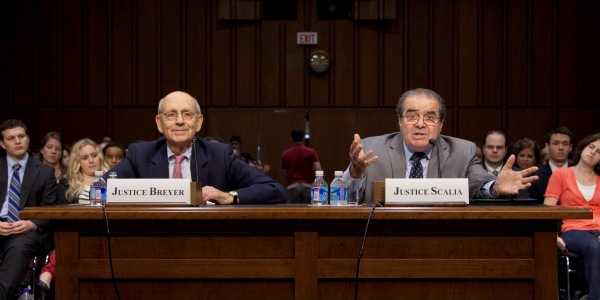
At yesterday’s oral argument over a warrantless search, Breyer tries to draw lines while Scalia seems to have made up his mind. Picture via The Atlantic.
At yesterday’s oral argument, Breyer tries to draw lines while Scalia seems to have made up his mind. Picture via The Atlantic.

Last term, the Supreme Court’s Fourth Amendment cases made for some curious cross-aisle alliances, pitting a privacy-friendly Justice Scalia and his liberal colleagues Ginsburg, Sotomayor and Kagan against a government-supporting Justice Breyer and the conservative bloc of Chief Justice Roberts and Justices Alito and Thomas (and sometimes Kennedy). Wednesday’s oral argument in Fernandez v. California, however, saw Breyer and Scalia falling back along more conventionally ideological lines, with the former attempting to balance a rather unsympathetic defendant’s rights against a domestic violence victim’s needs, and the latter coming out in favor of a more expansive reading of law enforcement’s investigatory powers.

Fernandez v. California stems from a 2009 encounter between Los Angeles police and a man suspected of committing robbery and gang-related assault, who was spotted near the crime scene and subsequently seen running into an apartment. After Fernandez’s live-in girlfriend, Roxanne Rojas, opened the door for officers, fresh bruises and blood visible on her body, Fernandez told them that they could not legally come inside. He was removed from the premises anyway based on suspicion of domestic violence, arrested and taken to the police station. Two officers then returned to the apartment without a warrant and received consent from Rojas to search the premises, where they found evidence that would later be introduced at Fernandez’s robbery and assault trial, resulting in his conviction. The question before the Supreme Court now is whether the police violated Fernandez’s Fourth Amendment rights by warrantlessly searching his home with only the permission of the co-tenant girlfriend, even though Fernandez had earlier told the police in no uncertain terms that they could not enter. (If so, the state would not have been able to use the incriminating evidence from the apartment at his trial.)

In 2006’s Georgia v. Randolph, the Supreme Court established that a co-occupant’s objection to the police search of a home overrides another co-occupant’s consent if both co-occupants are present. California argues that its search did not violate Randolph because Fernandez was absent at the time the police officers returned and Rojas, as the only present co-tenant then, had the right to open her home to whomever she wished to grant entry. The removal of Fernandez from the apartment–even if it was forcible–effectively nullified his refusal to consent to a search.

Fernandez, on the other hand, interprets Randolph to mean that once a physically present co-tenant has objected to the search, “an objection… remains in effect until officers learn that the objector no longer wishes to keep the police out of his home”–or until the police get a warrant. In other words, for the seven-year-old precedent to have any force, the police must not be allowed to gain consent for a warrantless search simply by carting an objecting tenant away from the premises.

This reading of Randolph appeared to be in trouble from the moment that Justice Breyer– whose Fourth Amendment jurisprudence typically reflects an optimistic view of the government using its investigatory powers in good faith–opened questioning with a hypothetical about a domestic abuse victim who is unable to ask the police to come investigate a shared home for evidence of the crime even after the assailant has been arrested, because there is no clear probable cause for a warrant and no consent from the violent co-tenant. Breyer is clearly troubled by Fernandez’s argument, which he believes would deny Rojas her rightful authority as co-occupant to admit a visitor into their home during the 500-plus days he spent in custody.

On the other hand, Breyer, who joined the majority (and authored a concurrence) in Randolph, also doesn’t want to undermine his previous position by giving free rein to law enforcement to change presences into absences. So he tries to reconcile his vote in Randolph with his unease in Fernandez with a compromise: the known objection of a tenant who is then removed from the house by law enforcement could remain valid for a limited “reasonable time” afterward (the exact definition of “reasonable time” to be decided by the lower courts), during which the police cannot search the house without a warrant.

Unfortunately for Breyer, none of his colleagues seem terribly receptive to this idea. Of the nine justices, Alito articulates the case against Fernandez most vociferously, suggesting at several points that Georgia v. Randolph was wrongly decided and ought to be overturned entirely. “I don’t understand why the fact that one is a joint tenant is not the end of the analysis. Why shouldn’t it be?” Justice Alito asked Fernandez’s lawyer, indicating his belief that present consent should always override a present objection, much less an absent one. For Alito, Randolph has got it reversed–since he can’t imagine having the authority to ever tell his co-tenant what visitors she could or couldn’t permit into the home, Rojas’ consent alone should have disposed of the entire case.

Justice Scalia, who was in last Term’s cases a champion of privacy interests and mistrustful of government in search and seizure cases, dissented in Georgia v. Randolph, in part over concerns that abusers would use the rule privileging present objections to prevent police from investigating domestic violence, over the wishes of their battered partners. Today, he returned to that stance, telling Fernandez he was asking for an overbroad extension of a narrow ruling. Likewise, Chief Justice Roberts (who dissented in Randolph) and Justice Kennedy (who was in the majority) treated Fernandez’s Fourth Amendment rights as virtually nonexistent in this situation, repeatedly stating that assault victims should not be deprived of the law enforcement assistance they might want to ask for in the abuser’s absence. The fact that Fernandez is basically the world’s worst roommate has made this an easier case for them to decide.

USA - Politics - Supreme Court Nominee Judge Sotomayor on Capitol Hill
Sotomayor thinks the police need to try harder before resorting to warrantless searches. Picture via The New Yorker.

With the conservative justices focusing mainly on the social customs of roommates and the rights of Fernandez’s co-tenant, it fell on Justice Sotomayor, the most vocal defender of Fernandez’s position yesterday, to point out that California’s proposed reading might grant law enforcement too much control in situations where they already have a great amount of power. Sotomayor questioned the wisdom of giving the police carte blanche to manipulate Randolph’s absence/presence test –“[a]ll they have to do is arrest and remove people”– and circumvent proper search and seizure procedures. When California’s lawyer told Justice Breyer that his “reasonable time” compromise would not be a sufficiently “clear answer” for law enforcement, Sotomayor interjected: “How about a clear answer? Get a warrant.” She reiterated this point again later: “I don’t know why that’s so difficult for police officers to understand. Your first obligation under the Fourth Amendment is to get a warrant.”

While that may be true in principle, there’s an argument to be made that the Roberts Court has been slowly weakening the warrant requirement over the years, and the unsympathetic facts of Fernandez’s case surely did not help his cause. From today’s argument, it looks as though the Supreme Court will reduce Georgia v. Randolph to “nothingness,” as Justice Ginsburg mused. Sotomayor may be able to convince Ginsburg and Kagan, who both showed some discomfort with the amount of control their conservative colleagues would hand to the police. She might also get Breyer’s vote if she can somehow figure out a test that is consistent with both his Randolph concurrence and his desire to limit it in situations like these. Without the support of Scalia, however, the list of justices supporting Fernandez’s claim is stuck at four, which, in the Supreme Court, is still a losing number.

To Blame Everything, Read Here: The Folly of Technological Defeatism

My inner cynic was pleased to discover that the back cover of Evgeny Morozov’s latest book, To Save Everything, Click Here, included a blurb from noted war journalist and scholar David Rieff. The curmudgeonly critic was a professor of mine at Sciences Po in Paris two years ago, and his class was a weekly tour de force of disillusionment with the modern human rights-industrial complex.

In praise of Morozov’s latest effort, Rieff wrote, “Against the reigning consensus — that there is a digital fix for every social and political problem, and that thanks to the technologies that we group together for convenience’s sake as the Internet, the brave new world of the future will be one of endless, limitless improvement in every realm of life — Morozov offers a sophisticated, eloquent, and definitive rebuttal.” This was the Rieff I remembered from my time in grad school, as I heard him wearily repudiate the moralist cri de coeur of peers like Michael Ignatieff and even Bernard Kouchner. It’s the same Rieff I read with great interest in the virtual pages of Foreign Policy, where he took a moment between excoriations of “Kony 2012” and the Singularity movement to dub Morozov “cyber-utopianism’s severest and most eloquent critic.”

That may not be inaccurate. But it is hardly the whole story. A mid-sized hamlet’s worth of straw men make brief cameos in To Save Everything, Click Here, only to be set ablaze by Morozov’s rapid-fire denunciations. Intellectual broadsides are not innately problematic, of course. But like fellow fire-breather Glenn Greenwald — whom Morozov, in his book, dubs “a terrific polemicist…[with] a tendency to overstate his case” — the Belarusian-born author often employs scorched-earth rhetoric against stunning illogic. Continue reading To Blame Everything, Read Here: The Folly of Technological Defeatism

Schuette v. Coalition to Defend Affirmative Action: Death By A Thousand Cuts for Race-Based Affirmative Action?

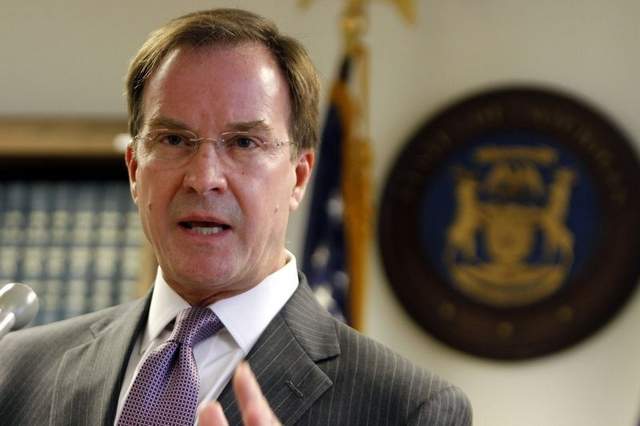
Michigan Attorney General Bill Schuette will defend Proposal 2, which changed the state constitution to ban affirmative action in public education, before the Supreme Court Tuesday. (Picture via Detroit Free Press)

Tomorrow afternoon, the Supreme Court will once again tackle the thorny question of affirmative action in higher education, less than four months after bouncing Fisher v. University of Texas back to a lower court for a newly-tightened and more rigorous examination of the constitutionality of Texas’ race-conscious undergraduate admissions process. ((Fisher will be heard on remand by the Fifth Circuit on November 13th of this year.)) While the central dispute in Fisher involved the limits of one university’s specific plan to use race as a factor amongst others to achieve a diverse student body, the question in Schuette v. Coalition to Defend Affirmative Action comes at the issue from a different direction: can a state’s voters change their constitution to ban public universities from considering race in their admissions plans at all?

In 2006, Michigan voters did precisely that by passing Proposal 2, which amended the state’s constitution to prohibit preferential treatment on the basis of race, sex, ethnicity or national origin in its public education system. ((Other parts of Proposal 2 also barred preferential treatment for the same categories in public employment and public contracting, but the challengers in Schuette are only questioning the validity of the affirmative action ban in the context of public education.)) Proposal 2 was written as a direct response to Grutter v. Bollinger, the 2003 Supreme Court decision that reaffirmed the constitutionality of universities considering race as one factor in holistic admissions policies, while simultaneously noting that such plans, if challenged, were still subject to strict scrutiny, the toughest level of judicial review. Under the strict scrutiny standard, a university (in Grutter, the University of Michigan Law School) must do two things: it must show that it has a compelling interest in the challenged admissions scheme, and then show that it has narrowly tailored its admissions process to fit that interest.

In the Grutter opinion, Justice Sandra Day O’Connor wrote that the First Amendment right of a university to attain a diverse student body–a principle first laid out in 1978’s Regents of the University of California v. Bakke–sufficed as a compelling interest in the context of higher education. “[U]niversities occupy a special niche in our constitutional tradition,” she asserted, and are therefore entitled to “educational autonomy” that allows them to “make [their] own judgments as to … the selection of [their] student body.” Because of this First Amendment right, the Supreme Court should in the process of applying strict scrutiny accord a great deal of deference to the University of Michigan’s “educational judgment that diversity is essential to its educational mission.” In fact, where diversity is the compelling reason for an affirmative action plan, courts should presume the school has acted “in good faith” in narrowly tailoring the plan to that interest. Using this standard, the Grutter court deemed constitutional the University of Michigan Law School’s admissions plan.

Three years after Grutter, opponents of affirmative action successfully pushed through Proposal 2 in order to stop the state’s universities from implementing such plans. In turn, the day after the amendment’s passage, a number of individuals and interest groups (including the Coalition to Defend Affirmative Action) banded together to file suit against Proposal 2 as it pertained to higher education. A federal district court upheld the affirmative action ban, but an en banc Sixth Circuit subsequently overruled that decision, 8-7, in 2012 on the basis that the prohibition violated the Equal Protection Clause of the Fourteenth Amendment.

Whose rights were being violated? Was it the universities’ rights to put together a diverse student body in order to fulfill its educational mission–an academic freedom that, as Bakke and Grutter told us, long has been viewed as a special concern of the First Amendment? Given what Justice O’Connor had written in 2003, one might have assumed so, but the Coalition and its allies had decided to take a different tack. Instead, they–and the en banc Sixth Circuit opinion, in turn–relied on the “political restructuring” doctrine first set out in 1969’s Hunter v. Erickson and later reaffirmed in 1982’s Washington v. Seattle School District No. 1 to find that Proposition 2 had unconstitutionally deprived minorities of equal access to “the tools of political change.”

In Hunter v. Erickson, the citizens of Akron, Ohio overturned a municipal fair housing ordinance and changed the city charter to require a citywide vote on any similar laws in the future. The Supreme Court invalidated the amendment, ruling that “the State may no more disadvantage any particular group by making it more difficult to enact legislation in its behalf than it may dilute any person’s vote or give any group a smaller representation than another of comparable size.” In Washington v. Seattle, the Supreme Court struck down a voter-approved state law that banned the use of mandatory busing in general, non-racial terms, but included so many exceptions that its true effect was to prohibit busing for the racial integration of public schools. Applying Hunter, the Seattle Court found Washington state had placed “unusual burdens” on the ability of racial minorities to enact legislation “specifically designed to overcome the ‘special condition’ of prejudice.”  Because the majority of voters had created an extra obstacle in the political process that specifically targeted a minority group unlikely to win at the ballot box, the judiciary was obligated to step in and “[safeguard] the interests of those groups that are relegated to such a position of political powerlessness as to command extraordinary protection from the majoritarian political process.”

Taken together, Hunter and Seattle created a two-part rule for determining when an enactment has engaged in impermissible political restructuring: (1) the law in question has a racial focus that targets a program that “inures primarily to the benefit of the minority,” and (2) reallocates political power in a way that puts special burdens on the minority group.  Applying this test, the Sixth Circuit found that Michigan’s Proposal 2 disadvantages minorities in this exact manner, by removing the decision of whether to use race consciousness in university admissions from the educational institutions and fixing the ban in the state constitution. Now, a citizen of Michigan who wants a public college or university to consider race as one factor in the admissions process–a practice still constitutional under Supreme Court precedent–cannot merely lobby the university for such a policy, as an individual who desires special preferences for legacies or athletes can do. Rather, he or she must undergo the expensive and time-consuming process of amending the state’s constitution as well.  This showed, the Sixth Circuit concluded, the majority had “not only won, but has rigged the game to reproduce its success indefinitely.”

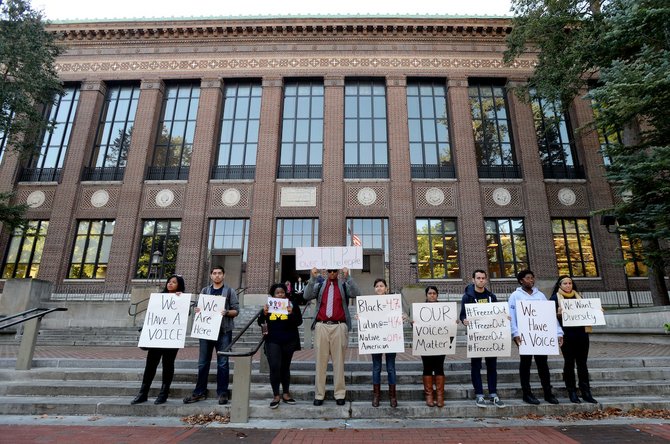
University of Michigan students at a pro-diversity rally on October 9, 2013. (AP Photo/The Ann Arbor News, Melanie Maxwell)
University of Michigan students at a pro-diversity rally on October 9, 2013. (Picture by AP Photo/The Ann Arbor News, Melanie Maxwell, via Monroe News)

Whether the Supreme Court agrees with the Sixth Circuit opinion will depend on how it distinguishes Proposal 2 from the laws challenged in Hunter and Seattle. Michigan Attorney General Bill Schuette (rhymes with ‘duty’) argues that the Sixth Circuit misapplied the political restructuring rule, which is only relevant to laws that create political obstacles to equal treatment, not laws that bar preferential treatment as Proposal 2 does. Rather, by “prohibit[ing] the State from classifying individuals by race or gender,” Proposal 2 actually furthers, not subverts, the goals of the Equal Protection Clause. “It is curious to say that a law that bars a state from discriminating on the basis of race or sex violates the Equal Protection Clause by discriminating on the basis of race and sex,” the Schuette brief states, in an unmistakable echo of Chief Justice John Roberts’ most famous line in Parents Involved in Community Schools v. Seattle School District No. 1, a 2007 case involving affirmative action at the elementary school level: “The only way to stop discriminating on the basis of race is to stop discriminating on the basis of race.” In addition, Schuette maintains that Proposal 2 could not have targeted a politically powerless minority, as the amendment bars both preferential treatment for race and for gender. “[T]o the extent [Proposal 2] can be characterized as ‘disadvantaging’ any groups, those groups constitute a majority of Michigan’s population,” the brief states, arguing that it would be much easier than the Sixth Circuit suggests for Proposal 2’s opponents to overturn the amendment.

Given the way that each Justice has voted on affirmative action programs in the past, there is good reason to believe that Chief Justice Roberts and Justices Alito, Thomas and Scalia will be sympathetic to Attorney General Schuette’s arguments. Though the Sixth Circuit’s en banc opinion purposely avoided revisiting Grutter and discussing the constitutionality of affirmative action, focusing solely instead on the political restructuring arguments, it is hard to imagine that Roberts, Alito and Scalia’s unease with race-conscious admissions policies will not come out in the oral argument tomorrow. Justices Sotomayor, Ginsburg and Breyer, on the other hand, are likely to be skeptical of Schuette’s position. Since Justice Kagan has recused herself from this case and there are only eight justices voting, a 4-4 split would allow the Sixth Circuit decision invalidating the affirmative action ban to stand–making Justice Anthony Kennedy, once again, the likely decider.

As I explained in a piece on Fisher and affirmative action last year, Justice Kennedy has long harbored conflicting feelings about affirmative action programs. Just last Thursday, Jess Bravin of The Wall Street Journal asked the justice whether the inclusion of women and ethnic minorities on the Court had benefited the institution. Kennedy replied: “Sure, I think it’s helpful that we have different points of view. I’m not sure that rigid categories of gender and ethnic background are always proxies for diversity, but it gives legitimacy to what the court does.” This, in a nutshell, is Kennedy’s continuing attitude toward affirmative action in public education–it’s somewhat good, but it’s also a somewhat lazy way to achieve true diversity. He doesn’t have a definite answer about how exactly schools can work around this contradiction, but he knows that he wants them to try harder. How well Proposal 2’s challengers fare at tomorrow’s oral argument may hinge on their ability to convince Kennedy that these schools should not be barred from even giving it a shot.

So where does all of this lead us? Personally, I find it most helpful to view Fisher and Schuette as parallel cases that hammer away at affirmative action from two different sides. When the 7-1 Fisher decision was first handed down in June, many supporters of affirmative action breathed a sigh of relief, as they had feared a wider-ranging decision ruling racial affirmative action unconstitutional outright. However, with Kennedy’s majority opinion in Fisher ordering the lower court to give “no deference” to the University of Texas’ narrow tailoring on remand, the public university’s First Amendment right to a diverse student body has been all but gutted, making it much harder for schools to defend race-conscious admissions policies. Schuette now presents another possible alternative for states to defeat affirmative action by pre-emptively prohibiting it, thus eliminating the need to even bring the university to court. In other words, the Roberts Court may well choose a “death by a thousand cuts” strategy rather than one fatal body blow–especially with Justice Kennedy’s ongoing ambivalence–but the result remains the same.

Playing the blame game

Courtesy of The New York Times.

Much ink has been spilled over the relative blame that should be assigned to various parties in the current government shutdown / impending debt-ceiling fiasco from hell. (About that spilled ink, I’m speaking virtually, of course: no one still publishes on physical paper anymore, do they?)

Aside from the predictable litany of “both sides need to compromise” bullshit from the zombie lords of political commentary — which The Atlantic‘s James Fallows, Al Jazeera‘s Dan Froomkin, and NYU professor Jay Rosen continue to eviscerate brilliantly — perhaps most distressing still are the results of today’s Gallup poll:

Americans are now more likely to name dysfunctional government as the most important problem facing the country than to name any other specific problem. Thirty-three percent of Americans cite dissatisfaction with government and elected representatives as the nation’s top issue, the highest such percentage in Gallup’s trend dating back to 1939. Dysfunctional government now eclipses the economy (19%), unemployment (12%), the deficit (12%), and healthcare (12%) as the nation’s top problem.

This is, in its own way, tantamount to a Republican victory — and one that could have more profound long-term implications than whatever short-term turbulence the GOP has inflicted upon itself courtesy of its decreasingly fringe-y “wacko bird” fringe. Indeed, although early indications suggest that House Republicans may suffer for their intransigence in next year’s midterms, there are plenty of reasons to bet against the Democrats’ chances of retaking the lower chamber in 2014.

Meanwhile, the broader national disgust with governmental dysfunction plays directly into Republicans’ hands: in fact, it could be argued that the GOP will always have a home-field advantage of sorts over the Democrats when the two parties are at loggerheads over just about anything of consequence. When bitterly contested policy issues cause Americans to blame government generally (even if, as is the case now, one side is clearly precipitating the immediate crisis), Republican ideology wins the day. Time will tell if this triumph is more durable than the Democrats’ current advantage in generic horse-race Congressional polling.

But there is yet another component to this struggle that’s extremely apparent but is somehow not gaining the traction I’d expect, especially from left-leaning media outlets. And that is the direct line connecting President Obama’s decision to negotiate the debt-ceiling increase in the summer of 2011 with the current crisis. While there is no question that Republican lunacy is the immediate cause of the budgetary and debt-ceiling impasses, much longer-term blame rests directly on the shoulders of Barack Obama.

Today’s manufactured crisis was an entirely foreseeable outcome of Obama’s capitulation two years ago. In fact, Paul Krugman predicted exactly this sort of future as soon as the 2011 deal with Republicans was announced. In an August 1, 2011 column titled “The President Surrenders,” Krugman wrote:

For the deal itself, given the available information, is a disaster, and not just for President Obama and his party. It will damage an already depressed economy; it will probably make America’s long-run deficit problem worse, not better; and most important, by demonstrating that raw extortion works and carries no political cost, it will take America a long way down the road to banana-republic status.

Republicans will supposedly have an incentive to make concessions the next time around, because defense spending will be among the areas cut. But the G.O.P. has just demonstrated its willingness to risk financial collapse unless it gets everything its most extreme members want. Why expect it to be more reasonable in the next round?

In fact, Republicans will surely be emboldened by the way Mr. Obama keeps folding in the face of their threats. He surrendered last December, extending all the Bush tax cuts; he surrendered in the spring when they threatened to shut down the government; and he has now surrendered on a grand scale to raw extortion over the debt ceiling.

And this is exactly what ended up happening. Two days ago, Jonathan Chait explained this very phenomenon:

They see the debt-ceiling fight as being mainly about the long-term question of whether Congress will cement into place the practice of using the debt ceiling to extort concessions from the president. The price of buying off a debt-ceiling hike would surely be less than the risk of a default. But doing so would enshrine debt-ceiling extortion as a normal congressional practice. This both skews the Constitutional relationship between branches — allowing an unscrupulous Congress to demand unilateral concessions at gunpoint rather than having to compromise — and creates endless brinksmanship that would eventually lead to a default.

The administration’s stance, then, is that submitting to ransom now creates the certainty of default eventually.

The primary quibble I have with Chait’s explanation — as I do with most analyses I’ve read of the situation thus far — is that the time to establish this stance was two years ago, not now. Of course, now is better than never, but the risk of actual default does appear to be greater now than it was back in 2011, and this is primarily due to Republicans’ increased confidence — based on very recent history — that the White House and Congressional Democrats would simply capitulate once again. And this very expectation, paradoxically enough, made it more dangerous for the Democrats to actually stand firm and demand that the Republicans raise the debt limit without preconditions — precisely because the overly-confident Republicans had virtually locked themselves into a rhetorical corner over raising the debt ceiling.

So what’s the point? Aside from the fact that President Obama is quite clearly a disastrous negotiator, the primary point is that — contrary to “centrist” notions of endless compromise that are entirely unmoored from the empirical reality of each party’s ideological flexibility — giving away the bank to a party steered by radicals absolutely does not guarantee healthy compromises or even engender good-faith efforts in the future. To the contrary, when confronted head-on with the awesome incoherence of Tea Party rage, the worst possible weapon is the one President Obama wielded back in 2011: procrastination.

Professor McCain

There’s a veritable feast of things to love in this video. First, it’s hard not to appreciate FOX‘s Brian Kilmeade delivering his profound commentary: “I have a problem helping those people out if they’re screaming that after a hit.” (Yelling “Allahu akbar” is, presumably, more offensive than stating, “Oh, yeah, look at those dead bastards.” Or openly rooting for an injured enemy soldier to pick up a weapon so you have a right to open fire on him. Or saying, while discussing a child wounded by your side’s gunfire, “Well[,] it’s their fault for bringing their kids into a battle.”)

But it only gets better from there, when John McCain gets all professorial:

Would you have a problem with Americans and Christians saying, “Thank God, thank God?” That’s what they’re saying. Come on! Of course they’re Muslims, but they are moderates. And I guarantee you that they are moderates. I know them, and I’ve been with them. For someone to say “Allah akbar” is about as offensive as someone saying “thank God.”

Aside from the fact that it’s funny to see John McCain suddenly realize that Muslims are human too, it’s even more hilarious to hear him say “I know them, and I’ve been with them.” Indeed he does, and has: unfortunately, it appears he couldn’t tell the moderates apart from the terrorist kidnappers. (Don’t you hate when that happens?)

Enhanced by Zemanta