Category Archives: Politics

With Bibi, the proof is in the muddling

[youtube http://www.youtube.com/watch?v=JrtuBas3Ipw]

Shaul Arieli, an Israeli negotiator with the Palestinians under several prime ministers, had much to say in an illuminating interview with +972 Magazine‘s Noam Sheizaf. A few of the many interesting passages are below.

On whether the Palestinians rejected a peace plan under Ehud Olmert:

I will quote Olmert himself: the Palestinians never refused. They didn’t accept some of our proposals, just as we didn’t accept some of theirs. Israelis think that Olmert gave “a generous offer” to the Palestinians. But the Palestinians would say the same. Mahmoud Abbas was ready for land swaps that would leave 75 percent of the settlers under Israeli authority, including in neighborhoods in East Jerusalem. Abbas went a long way toward Israel on every issue.

On Benjamin Netanyahu’s goals:

Then Netanyahu came, and he had tremendous experience and knowledge on these issues. After all, he took pride once in his ability to kill the Oslo process. I served under Netanyahu and I think he still believes in what he wrote in his book in 1995 – that ‘placing a PLO state 15 km from the beach of Tel Aviv poses an existential threat to the state of Israel.’

Netanyahu, when he came back to office in 2009, didn’t try to introduce his own demands. He went to changing the terms of reference. He declared that 1967 borders won’t serve as basis for the negotiations, and if he accepts land swaps, it will never be in a 1:1 ratio. He wants to annex 10 percent of the West Bank and give the Palestinians 1 percent in return. The same goes for Jerusalem. As long as he continues to speak about a united Jerusalem, anything he might say about the two-state solution is meaningless.

Bibi is the one who moved back from what was agreed upon. There is no reason to enter negotiations without the principles that were agreed upon, without the framework.

Netanyahu wants the process, not the agreement. Bibi doesn’t care about the Palestinians. He is interested in the way Israel is treated by the world. So he will take his time, and as far as he is concerned it [the talks] can take forever.”

Enhanced by Zemanta

“It’s a Magic Word:” Tweets from the Eminently Quotable DOMA Oral Argument

Today, the Supreme Court heard two hours of arguments in United States v. Windsor, with fifty minutes allotted on the technical question of standing–namely, whether the DOMA case should even be before the Supreme Court at all–and sixty minutes on the merits. Though the Prop 8 case on Tuesday seemed to get the lion’s share of media attention–pictures of the line and the protests outside the Courthouse this morning show a smaller audience than yesterday’s–initial reactions and reports indicate that the DOMA argument and subsequent press conference from plaintiff Edie Windsor are 10,000% more quotable. A collection of tweets recapping the day’s events:

“Uncharted Waters:” Confused By Array of Options, Justices Mull Deciding Proposition 8 Case on Procedural Grounds

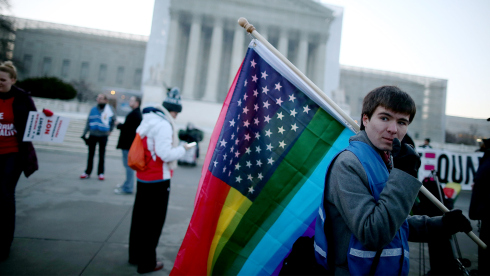
Prop 8 Flag
Picture via Variety.

When all was said and done, there weren’t any major revelations in Tuesday’s oral argument for Hollingsworth v. Perry, but it did set the stage for an interesting two hours of arguments on the Defense of Marriage Act that the Supreme Court will hear today.

Chief Justice John Roberts looked for ways to dispose of the Proposition 8 challenge based on the procedural question of standing–as he has done in so many other cases during his tenure–and at least four of his fellow Justices seemed receptive to that option, dissatisfied with the alternatives that the attorneys before them were offering.

The Prop 8 challengers and the United States government framed this fight as the latest in a long line of struggles for equality, appealing to the liberal wing of the Court as we thought they might. They drew parallels to Brown v. Board of Education and Loving v. Virginia, the 1967 case that outlawed state bans on interracial marriages. Justice Ruth Bader Ginsburg–a civil rights pioneer in her own right–reminded Charles Cooper, the lawyer defending Proposition 8, that it was unsound to rely on the Constitutional reasoning of a thirty-year-old Supreme Court decision unfavorable to gay marriage (Baker v. Nelson), given that gender discrimination was barely even recognized back then. Justice Sonia Sotomayor questioned Cooper about whether the government had any rational basis to deny gays and lesbians benefits other than marriage, and Justice Elena Kagan repeatedly pressed Cooper to specify the harm that same-sex marriage causes.

And, as expected, Justices Samuel Alito and Antonin Scalia did not take kindly to the arguments of the Prop 8 challengers. Scalia managed not to emit any overly damaging sound bites this time–the worst thing he said concerned potential “deleterious effects” of same-sex parenting on children–but got into a testy exchange with anti-Prop 8 attorney Ted Olson. Seeking to make a point about America’s long and treasured history of discriminating against gays, he interrogated Olson on when exactly gay marriage bans became unconstitutional, berating him when Olson attempted to answer with a rhetorical question about interracial marriage prohibitions, and responding triumphantly when Olson admitted that he could not provide a specific day: “Well, how am I supposed to decide the case, then–if you can’t give me a date when the Constitution changes?”

Debates that the public has been having for years spilled over into the courtroom as the Justices extended each side’s arguments to their logical conclusions. They grilled Cooper on why, if procreation is the main point of marriage, the state hasn’t banned marriages between infertile, elderly or incarcerated couples. They asked Olson whether a state could prohibit polygamy or incestuous marriages if marriage is in fact a fundamental right under the Constitution. Neither of the answers that the attorneys provided–a convoluted riff about preventing the evils of infidelity from Cooper, and a muddy distinction drawn by Olson between status and conduct–seemed to satisfy a clear majority of the Justices.

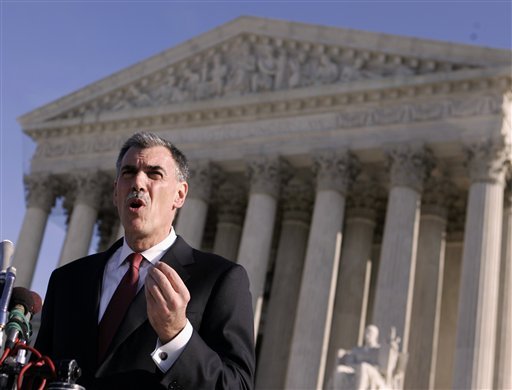
Donald Verrilli
Solicitor General Donald Verrilli in 2008. Picture by the Associated Press, via Cleveland.com.

Though none of the questions came out of left field, there weren’t any obvious winners or losers, as each of the lawyers’ arguments had holes that made several Justices uncomfortable. Solicitor General Donald Verrilli, Jr., arguing the federal government’s position in support of the Prop 8 challengers, probably fared the worst out of the three attorneys. He took a verbal beating from both liberal and conservative justices over the Obama administration’s dubious stance that states offering civil unions must be made to offer same-sex marriage as well, while states that have never allowed the civil union option should not be required to legalize same-sex marriage. Wouldn’t such an “all or nothing” approach incentivize states to grant their gay citizens no rights instead of some rights, Breyer asked? Verrilli didn’t have a good answer. Then again, as last year’s oral arguments for the Affordable Care Act showed, he doesn’t have to be on his A game for the Justices to find in his favor. Even if the Justices are loath to accept the federal government’s preferred “eight state” course of action, the Obama administration would still celebrate any California-specific result that leaves intact federal district judge Vaughn Walker’s ruling against Prop 8 (or the Ninth Circuit affirmation of that decision).

In the end, it all comes down to Anthony Kennedy, as it has many times before and will again in the future. Justice Kennedy did quite not tip his hand at yesterday’s argument, asking probing questions of both sides. He showed concern over what would happen to the 40,000 children in California with same-sex parents if their fathers and mothers were denied the right to marry, yet balked at the thought of finding a fundamental right to same-sex marriage, warning that the Court was wandering into “uncharted waters.” Kennedy pushed Cooper to concede that he couldn’t think of any specific ways in which same-sex marriage injures society, but also suggested that the case might have been improvidently granted in the first place and should be thrown out based on standing rules. Basically, he appeared to be searching for a rationale to justify a limited rather than broad ruling. Hence, it’s unlikely that the Court will uphold Proposition 8 or make same-sex marriage constitutional across all 50 states–but beyond that, it is unclear what the exact decision is going to be.

Prior to Tuesday’s oral argument, David Boies, Ted Olson’s partner in Hollingsworth v. Perry, had confidently predicted that the Proposition 8 challengers would win the case by at least a 6-3 margin. Emerging from the courthouse into the sunshine yesterday afternoon, however, Olson didn’t sound so sure. “Based on the questions the Justices asked, I have no idea” what the Supreme Court will rule, he said. Most court-watchers don’t, either, but it will be very interesting to see how the Prop 8 arguments over standing, states’ rights and respect for the legislative process play out when the Justices tackle similar questions in the United States v. Windsor DOMA challenge today.

Supreme Court Reactions: Tweets from the Prop 8 Oral Argument

Oral argument for the California Proposition 8 case has ended in Washington, D.C., and the Supreme Court audio and transcript are now up. It’s pretty inconclusive from today’s session what kind of ruling the Justices are going to come up with, but that didn’t stop the Twittersphere from exploding into varying degrees of rage, joy and punditry. Here is a brief recap in tweet form, culled from legal commentators, journalists and the rest of the peanut gallery:

In Palestine, a gap between words and actions

Stephen Walt, repeating much of what I wrote last week, reminds his readers what really happened during Obama’s much-heralded tour of Israel:

Obama also offered rhetorical support for Palestinian aspirations, and his speech went further than any of his predecessors. He spoke openly of their “right to self-determination and justice” and invited his Israeli listeners “to look at the world through their eyes.” He also told them “neither occupation nor expulsion is the answer” and said “Palestinians have a right to be a free people in their own land.” He reiterated his call for direct negotiations — though he no longer suggests that Israel stop building more settlements — and he called upon his youthful audience to “create the change that you want to see.”

But that’s all he did. He did not say that a Palestinian state would have to be fully sovereign (i.e., entitled to have its defense forces). He did not give any indication of where he thought the borders of such a state might lie, or whether illegal settlements like Ariel (whose presence cuts the West Bank in two) would have to be abandoned. He did not say that future American support for Israel would be conditional on its taking concrete steps to end the occupation and allow for the creation of a viable state (i.e. not just a bunch of vulnerable Bantustans). On the contrary, his every move and phrase made it clear that Israelis could count on the United States  providing generous and unconditional support to the vastly stronger of the two parties. He made no mention of a special envoy or an “Obama plan.” In short, he did not announce a single concrete policy initiative designed to advance the vision of “two states for two peoples” that he first laid out in the almost-forgotten Cairo speech of June 2009.

Walt’s conclusion:

For realists like me, in short, halting a colonial enterprise that has been underway for over forty years will require a lot more than wise and well-intentioned words. Instead, it would require the exercise of power. Just as raw power eventually convinced most Palestinians that Israel’s creation was not going to be reversed, Israelis must come to realize that denying Palestinians a state of their own is going to have real consequences. Although Obama warned that the occupation was preventing Israel from gaining full acceptance in the world, he also made it clear that Israelis could count on the United States to insulate them as much as possible from the negative effects of their own choices. Even at the purely rhetorical level, in short, Obama’s eloquent words sent a decidedly mixed message.

Because power is more important than mere rhetoric, it won’t take long before Obama’s visit is just another memory. The settlements will keep expanding, East Jerusalem will be cut off from the rest of the West Bank, the Palestinians will remain stateless, and Israel will continue on its self-chosen path to apartheid. And in the end, Obama will have proven to be no better a friend to Israel or the Palestinians than any of his predecessors.

Enhanced by Zemanta

Iraq War anniversary apologies

Courtesy of PolicyMic.com.

There’s an interesting discussion taking place on Corey Robin’s blog regarding Ezra Klein’s apology for supporting the Iraq War:

Like many people who supported the Iraq War, Ezra Klein has written his apologia.

But he fails to identify—indeed, repeats—his biggest mistake in supporting the war: When thinking of the US government, he  thinks “we.”

Iraq, [Kenneth Pollack] said, shouldn’t be America’s top priority. We should first focus on destroying al-Qaeda. We should then work on the Israeli- Palestinian conflict. Only then should we turn to Hussein. Moreover, when and if we did invade Iraq, we should do so only as part of a coordinated, multilateral operation…

After all, what other chance would we get to topple Hussein?

It wasn’t worth doing precisely because the odds were high that we couldn’t do it “right.”

Klein doesn’t think a state invaded another state; he thinks “we” went to war. He identifies with the state. Whether he’s supporting or dissenting from a policy, he sees himself as part of it. He sees himself on the jeeps with the troops. That’s why his calls for skepticism, for not taking things on authority, ring so hollow. In the end, he’s on the team. Or the jeep.

I’ve learned a lot from reading the comments. (Now there’s a sentence you rarely see on the Internet these days.) One commenter, Justin, replied:

Maybe I’m too naive, but isn’t the problem that more people DON’T identify with the government? If we identify with the government, then its failings are our failings and there’s more motivation to change things because they’re being done in our names. If we don’t identify with it, then it’s just this abstract entity that we can have nothing to do with, which leads to the government abusing its power because none of us feel responsible for it.

I guess I don’t think it’s a problem that Klein is “on the team” – it’s that most of us aren’t on it and thus don’t have any say on what’s happening.

Another commenter, Ned Ludd, raised a different point:

Because he supported the stablishment position on Iraq, Ezra Klein was able to rise into the ranks of the establishment. Back in January 2007, Jebediah Reed of the now-defunct Radar Magazine took a look at some of the career trajectories of pundits who supported the war (Tom Friedman, Peter Beinart, Fareed Zakaria, Jeffrey Goldberg) and the subsequent careers of vocal opponents of the invasion (Robert Scheer, William. S. Lind, Jonathan Schell, Scott Ritter). If Klein had been against the war, he never would have been promoted from obscurity to the pages of the Washington Post.

All of these points raise the question of how such a calamity as Iraq can be avoided in the future. As The Atlantic‘s Elspeth Reeve has ably demonstrated, the 10-year anniversary edition of self-flagellation for supporting the Iraq War has blossomed so ubiquitously as to necessitate a taxonomy of apology bullet points: “I was but a lowly worm,” “I was fooled by bad intelligence,” and so on.

However, what many such Iraq War apologists and (much later) apologizers seem to have in common is an inability to grasp their deeper failing for directing much of their vitriol at the anti-war crowd and castigating those people (who turned out to be very right in the end) as a bunch of hippies. Freddie deBoer remembers this specifically:

You know, I’m reading all of the Iraq mea culpas, some good, some bad. But they are all systematically ignoring one of the most obvious and salient aspects of the run up to the war: the incredible power of personal resentment against antiwar people, or what antiwar people were perceived to be. As someone who was involved in day-to-day antiwar activism at the time, the visceral hatred of those opposing the war, and particularly the activists, was impossible to miss. It wasn’t opposition. It wasn’t disagreement. It was pure, irrational hatred, frequently devolving into accusations of antiwar activists being effectively part of the enemy. Yet for as visible and important as this distaste was for the debate, it’s missing from the postmortems.

Ta-Nehisi Coates has similar memories:

I am not a radical. But more than anything the Iraq War taught me the folly of mocking radicalism. It seemed, back then, that every “sensible” and “serious” person you knew — left or right — was for the war. And they were all wrong. Never forget that they were all wrong. And never forget that the radicals with their drum circles and their wild hair were right.

And Conor Friedersdorf compiles a roundup of mockery aimed at anti-war protesters before and during the war.

It’s enough to make one wonder if we ever learn anything, at all, from history.

Enhanced by Zemanta

The two-state solution is dying

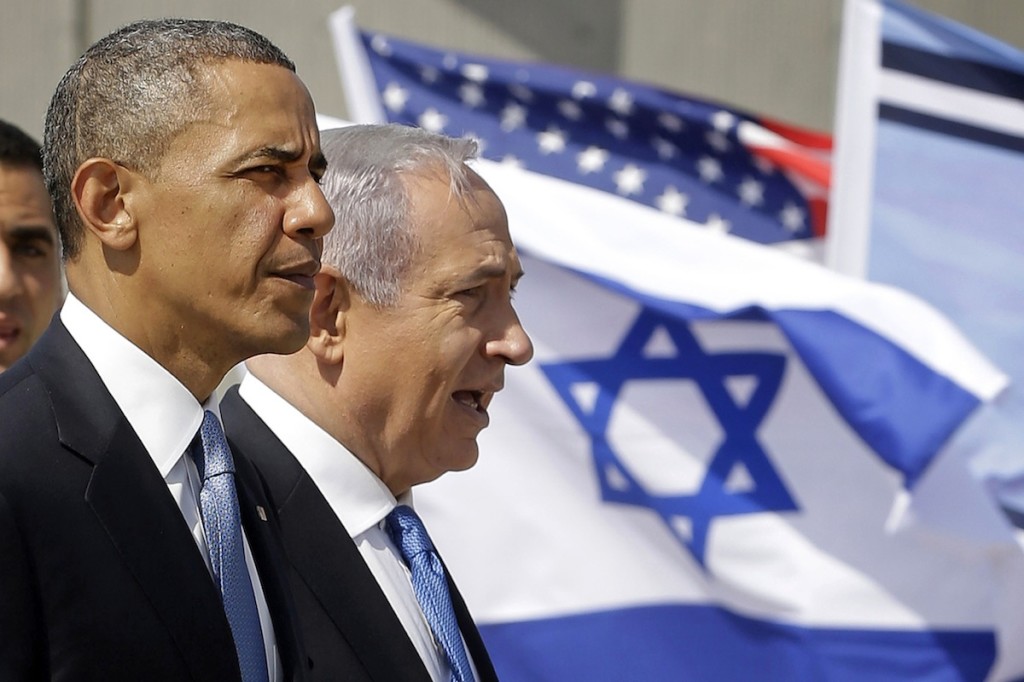
(AP Photo/Pablo Martinez Monsivais.)

My piece for The Morningside Post is up:

Indeed, Obama was right to decry the injustice of the occupation. But much of the blame for the perpetuation of what he termed the “grinding status quo” should rest squarely upon the president himself. Lacking from tonight’s speech was any semblance of a serious framework for peace talks, never mind for peace. A settlement freeze, once the centerpiece of Obama’s roadmap for peace negotiations, was never even timidly mentioned in passing.

Thus the cycle of endless backtracking is completed. Under Jimmy Carter, settlements were illegal. Under Ronald Reagan, they became an “obstacle to peace.” Now, as per Obama’s speech tonight, they are simply “counterproductive.” The progressively more muted rhetoric matches the devolution of the peace process from actual negotiation into something resembling kabuki theater.

And theater is precisely what it is: the continued half-hearted affirmations of the two-state solution by successive American presidents belie their rapidly vanishing interest in taking the steps necessary to achieve it.

Supreme Court Opinion Alert: In Kirtsaeng v. Wiley, Supreme Court Chooses Consumers of Foreign-Made Products over Copyright Holders

libraries

The American Library Association estimates that libraries in the United States contain over 200 million foreign-printed books. Picture via Wired.

Eliciting a huge sigh of relief from libraries, museums, used-car salesmen and wide swaths of eBay and Amazon, the Supreme Court held today that buyers of foreign-made works do not have to seek permission from the copyright holders to import the works into the United States. Under the 6-3 ruling in Kirtsaeng v. John Wiley & Sons, a copyright owner’s exclusive distribution rights to a product is extinguished once it is legally sold–even if the work in question was manufactured abroad and then brought overseas to be sold for a “gray market” profit.

Those who remember being broke students and working extra shifts at the university library, participating in mundane experiments for the Psychology department for a $5 bill, or balking at the price of required textbooks in the bookstore might appreciate the ingenuity of Supap Kirtsaeng. Kirtsaeng, a Thai student who had come to the United States in 1997 to study mathematics and subsequently obtained an undergraduate degree from Cornell and a Ph.D. from USC, had been looking for a way to make some cash while in the U.S. After he noticed that the textbooks he purchased in the United States were more expensive than identical Asian editions that he could buy back home, he asked friends and family to mail copies of the Asian editions to him for resale. Despite the fact that the foreign edition textbooks specifically carried a page stating that such books were not to be exported out of Europe, Asia and the Middle East, Kirtsaeng sold them in the United States, reimbursed his friends and family for the price of the books purchased in Thailand, and kept the difference.

Naturally, John Wiley, the publisher of the textbooks and the owner of Wiley & Sons Asia (the subsidiary that produced the Asian editions), did not appreciate Kirtsaeng’s moneymaking scheme and brought a copyright infringement suit once it caught wind of his business. To do this, however, they had to get around the “first sale” doctrine, an exception written into the Copyright Act which cuts off a manufacturer’s exclusive right to distribute a copyrighted work at the moment that it is originally sold. Once a lawful sale is made, the copyright holder no longer gets a say in where the product can go, and the buyer is free to do what he/she wants to do with it–whether the buyer’s purpose to gift it, put it in a library, donate it to a museum, or resell it to fellow students.

While there is no dispute that this purchaser-friendly first sale doctrine applies to domestically made works, Wiley successfully argued in lower courts that the language of the exception, as codified under Section 109(a) of the Copyright Act, only applies to works that are “lawfully made under this title.” In Wiley’s interpretation, the phrase “lawfully made under this title” limits the first sale exception to only works that are produced in territories subject to the Copyright Act (the United States), and not works that are made overseas, where the Copyright Act has no force. Under such a reading, then, Kirtsaeng needed Wiley’s permission to import the Asian textbooks into the United States and sell them there. Since he had not done so, the trial court found that he had infringed Wiley’s copyright and awarded Wiley damages of $75,000 per work, totaling $600,000 in all. The Second Circuit affirmed this ruling.

Today, however, the Supreme Court rejected that argument by a 6-3 vote, ruling that the “first sale” doctrine has no geographical limitation and does in fact apply to works manufactured abroad. Justice Stephen Breyer, writing for a majority that included Chief Justice Roberts and Justices Sotomayor, Alito, Kagan and Thomas, pointed out that Wiley’s interpretation of “lawfully made under this title” would affect many sections of the Copyright Act, leading to a parade of nonsensical and nearly-unenforceable horribles. For example, this reading would give copyright owners the power not only to control the resale but also the display of foreign-made works–the result being that tourists would not be able to attach to their cars bumper stickers bought on vacation, arcades would not be able to install video games manufactured overseas, and teachers would not be able to show their students documentaries made abroad without first obtaining permission from the copyright holder.

Breyer’s opinion snowballs on: havoc would be wreaked on museums and libraries across the country, which collectively host millions of foreign-made works. Technology companies that create products made of multiple copyrightable foreign-manufactured components would be affected. The used-car market–a good portion of which involves cars made abroad–and the $2.3 trillion imported goods market would be impacted. Looking to the text and the history of the Copyright Act and “considerations of simplicity and coherence,” Breyer concluded that Congress could not have intended such restrictive consequences. Thus, the first sale doctrine barred John Wiley from exercising distribution rights over the Asian-edition textbooks that were lawfully sold to Kirtsaeng’s family and friends.

Justice Ruth Bader Ginsburg’s dissent, which was joined by Justice Kennedy in full and Justice Scalia in part, argued that the Court’s ruling “shrinks to insignificance” copyright protections against gray market unauthorized imports and hurts the U.S.’ trade interests in the long run. Characterizing Breyer’s parade of horribles as “imaginary” and “absurd,” the dissent dismissed the majority’s fear of a flood of litigation against museums and libraries and used-car salesmen, pointing out that the Copyright Act already has other exemptions that would allow for the importation, without copyright holders’ permission, of products for certain governmental, academic, educational and personal uses.

From a practical standpoint, however, it isn’t difficult to see why Breyer, and not Ginsburg, was able to line up five Justices behind his position. In the end, there are just too many things in this country that would have been swept up under Wiley & Sons’ proposed rule, and the deep fear of an ensuing legal avalanche won the day for Supap Kirtsaeng. Few things are made in the USA anymore, and foreign trade is increasingly important to the national economy. Giving publishers and manufacturers such immense and potentially perpetual power over legally sold products would have up-ended, as Breyer said, “ordinary scholarly, artistic, commercial and consumer activity,” and it is too late for Wiley to go back and change the rules that everyone has been playing by for decades. Some genies, as it turns out, cannot be put back into their Made In China bottles.

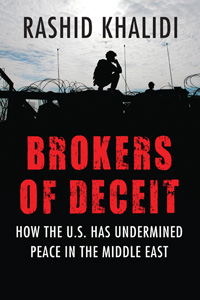
Book Review – Brokers of Deceit: How the U.S. Has Undermined Peace in the Middle East

brokers of deceitRashid Khalidi, Brokers of Deceit: How the U.S. Has Undermined Peace in the Middle East (Beacon Press: 2013)


On Wednesday, Barack Obama will travel to Israel for his first official visit as President of the United States. The day after he arrives, he will deliver a speech to Israeli students at the International Convention Center that is expected to tread conventional ground regarding the peace process while gently reminding his audience that respecting Arab public sentiment on the occupation is a necessary condition for achieving a two-state solution.

Such modest objectives may seem anathema to true believers in Middle Eastern peace. But they are perfectly in keeping with the “peace process” industrial-complex portrayed by Palestinian-American historian Rashid Khalidi in his new book, Brokers of Deceit: How the U.S. Has Undermined Peace in the Middle East.

“I want to examine here…the veil that conceals how the policy of the United States toward the Palestine question has actually functioned to exacerbate rather than resolve this problem,” writes Khalidi in his introduction. Central to this disguise is the use of deliberately misleading language that wraps the decades-long stalemate in the ennobling lexicon of progress, before smothering it in the bureaucratic technobabble of “road maps” and “facts on the ground.” (If this sounds familiar, the bloodied remains of innocent drone strike victims have now attained the similarly reverential status of “collateral damage.”) Indeed, the all-encompassing term “peace process,” which Khalidi deems an “Orwellian rubric” obscuring “decades of futile initiatives,” is itself a figment of erstwhile imaginations warped beyond recognition by enough conferences, talks, and accords to fashion world peace several times over.

A question naturally presents itself: why bother with this charade at all? For Khalidi, much of the answer can be found in the goals of the various parties. He defines a successful resolution of the Israeli-Palestinian conflict as one entailing complete Israeli withdrawal from the West Bank and East Jerusalem, a “just resolution” for Palestinian refugees, and national autonomy for the Palestinian people. That all of these outcomes have failed to materialize is a product of Israeli and Palestinian deficiencies, of course. But it is also an indictment of American foreign policy on the subject, which has unfailingly taken Israel’s side as the prospects for peace slide with increasing urgency into history.

The reasons for the American-Israeli two-step and the United States’ consequent inability to end the Israeli-Palestinian conflict are threefold, Khalidi argues. The oil-exporting Gulf states have exerted almost no pressure on the United States over the plight of the Palestinians, domestic politics (especially the overwhelmingly hawkish Israel lobby) has prevented a change in strategy, and American policymakers demonstrate virtually no sympathy for the political and psychological duress of the Palestinians. On this last point, Khalidi quotes Richard Nixon, who in 1973 confided to Henry Kissinger: “You’ve got to give [Arabs] the hope…You’ve got to make them think that there’s some motion; that something is going on; that we’re really doing our best with the Israelis.”

“Doing our best,” it is no surprise to learn, meant something quite different to the Americans than it did to their Palestinian interlocutors. Behind Nixon’s Machiavellian scheming lay a rather simple truth: the domestic constituency for Palestinians was nonexistent, while Israel’s supporters regularly raised an unholy clamor. Forty years later, the Oval Office has occasionally changed hands but the calculation remains maddeningly identical. If anything, the din of the hawks has grown even louder: Khalidi accurately notes that an “increasingly formidable constellation of obstructionist forces” confronted Obama’s every timid attempt at course correction. Continue reading Book Review – Brokers of Deceit: How the U.S. Has Undermined Peace in the Middle East

The GOP’s wake-up call

The New York Times reports:

In a sweeping self-critique of the party’s 2012 election efforts, Republican leaders on Monday unveiled a set of proposals aimed at convincing younger voters, ethnic minorities and women that they have a home in the party, even if they do not agree with all of its positions.

“The report minces no words in telling us that we have to be more inclusive,” Reince Priebus, the chairman of the Republican National Committee, said on Monday. “I agree. And as President Reagan said, our 80 percent friend is not our 20 percent enemy.”

The national party’s report, called the Growth and Opportunity Project, is the latest contribution to a conversation among conservatives after disappointing losses in the 2012 presidential and Senate elections.

The report’s introduction is admirably candid:

At our core, Republicans have comfortably remained the Party of Reagan without figuring out what comes next. Ronald Reagan is a Republican hero and role model who was first elected 33 years ago — meaning no one under the age of 51 today was old enough to vote for Reagan when he first ran for President. Our Party knows how to appeal to older voters, but we have lost our way with younger ones. We sound increasingly out of touch.

As Mike Gerson and Pete Wehner wrote recently, “It is no wonder that Republican policies can seem stale; they are very nearly identical to those offered up by the Party more than 30 years ago. For Republicans to design an agenda that applies to the conditions of 1980 is as if Ronald Reagan designed his agenda for conditions that existed in the Truman years.”

The Republican Party needs to stop talking to itself. We have become expert in how to provide ideological reinforcement to like-minded people, but devastatingly we have lost the ability to be persuasive with, or welcoming to, those who do not agree with us on every issue.

Full text below.

Enhanced by Zemanta