President George W. Bush addresses sailors during the “Mission Accomplished” speech, May 1, 2003. (Photo credit: Wikipedia.)
Howard Fineman takes a look back at the beginning of the Iraq War, whose “shock and awe” campaign began ten years ago on Wednesday:
There were some reasons to expect success, or at least not to accept the dire warnings against invading Iraq. Bush’s critics had predicted disaster in Afghanistan, but in the first year or two after Operation Enduring Freedom, it seemed as though the “war lords” of the Bush administration were tough customers who knew what they were doing.
On the other hand, American ignorance of the Arab and Muslim worlds 10 years ago was alarmingly vast. More than ignorance, there was fear, prejudice and propaganda…
As for me, I could say that I was covering politics, not war, and that it wasn’t my job to try to pierce the veil of lies and “precog” justifications of the Bush-Cheney-neocon axis.
But the war was politics. It was a new battle for the president to be seen fighting as he headed toward a reelection run. I should have known more, studied more, asked more questions and been more skeptical.
Above: the front page of The Huffington Post as of 3:25 PM EST.
Below: my first piece for HuffPo, on Michael Bloomberg’s Super PAC and the scourge of outside campaign spending. (I’ve written previously about this here and here.)
At the time, many progressives cheered the appearance of Independence USA as a welcome response to the deluge of money then flooding the airwaves from conservative activists. After the Illinois special election results, the applause is likely to grow louder. But the degradation of campaign finance laws, a development that has facilitated the proliferation of organizations like Bloomberg’s, is an unqualified blight on democracy. Liberals may have triumphed in this round, but the true message of Robin Kelly’s victory is that no political candidate is immune to the scourge of outside (and outsized) spending.
If ever there were an indication of the influence exerted by Paul Krugman and his intellectual kin, take a look at this:
One day after Republicans rolled out a detailed proposal aimed at eliminating the federal deficit through steep cuts and repealing many of the president’s accomplishments, Mr. Obama told them pointedly in a rare visit that their highest fiscal priority was not his.
“Our biggest problems in the next 10 years are not deficits,” the president said, according to accounts from the meeting, bluntly rejecting an idea that has become Republican fiscal dogma…
Senator Patty Murray, the Washington Democrat and Senate Budget Committee chairwoman who outlined her budget on Wednesday, summed up her party’s objections to Republican austerity measures, which Democrats have said rob the country of needed investment.
“Deficit reduction at the expense of economic growth is doomed to failure,” she said.
Emphases mine. But mostly, Krugman’s.
Another gem from that piece:
“The president seemed to say, ‘If we’re going to do the areas we agree on, you have to also do some of mine,’ ” said Representative James Lankford of Oklahoma, bristling at Mr. Obama’s suggestion. “If we can find the areas we agree on, why can’t we just do those?”
Indeed, Sir Lankford. Why can’t we just enact all the policies that the party who just lost its second straight presidential election wants to implement? It’s truly a modern-day mystery.
The rate has dropped in cities large and small, in suburbs and rural areas and in all regions of the country. It has fallen among households with children, and among those without. It has declined for households that say they are very happy, and for those that say they are not. It is down among churchgoers and those who never sit in pews.
The household gun ownership rate has fallen from an average of 50 percent in the 1970s to 49 percent in the 1980s, 43 percent in the 1990s and 35 percent in the 2000s, according to the survey data, analyzed by The New York Times.
The story, reported by Sabrina Tavernise and Robert Gebeloff, noted the data’s seeming contradiction to prevailing media narratives:
The findings contrast with the impression left by a flurry of news reports about people rushing to buy guns and clearing shop shelves of assault rifles after the massacre last year at an elementary school in Newtown, Conn.
“There are all these claims that gun ownership is going through the roof,” said Daniel Webster, the director of the Johns Hopkins Center for Gun Policy and Research. “But I suspect the increase in gun sales has been limited mostly to current gun owners. The most reputable surveys show a decline over time in the share of households with guns.”
The Times should know a thing or two about the impression left by that “flurry of news reports:” it contributed substantially to creating it. Here is an excerpt from a New York Times article on December 21st of last year, headlined “Shop Owners Report Rise in Firearm Sales as Buyers Fear Possible New Laws:”
With gun-control legislation getting more serious discussion than it has in years, gun sales are spiking as enthusiasts stock up in advance of possible restrictions.
Gun sales have been increasing over the past five years, with marked increases around the 2008 and 2012 elections, and after mass shootings like the one in Aurora, Colo., and now in Newtown, Conn…
There is increasing demands for guns in the United States. Last year, the Federal Bureau of Investigation conducted 16.45 million background checks for firearm sales through the National Instant Criminal Background Check System, a 14 percent jump from the previous year. In the first 11 months of this year, the bureau conducted 16.8 million background checks, a record since the system’s founding in 1998.
The article goes on to check in on various online and brick-and-mortar gun shops, all of whom dutifully trumpet the massive demand at their stores. (Imagine that: a gun shop owner who’s just been given an enormous audience by a global newspaper declares that he is doing brisk business? I don’t know about you, but sounds like an “I’ll take him at his word” situation to me.)
As Washington focuses on what Vice President Joseph R. Biden Jr. will propose next week to curb gun violence, gun and ammunition sales are spiking in the rest of the country as people rush to expand their arsenals in advance of any restrictions that might be imposed…
Gun dealers and buyers alike said that the rapid growth in gun sales — which began climbing significantly after President Obama’s re-election and soared after the Dec. 14 shooting at a school in Newtown, Conn., prompted him to call for new gun laws — shows little sign of abating.
December set a record for the criminal background checks performed before many gun purchases, a strong indication of a big increase in sales, according to an analysis of federal data by the National Shooting Sports Foundation, a gun industry trade group. Adjusting the federal data to try to weed out background checks that were unrelated to firearms sales, the group reported that 2.2 million background checks were performed last month, an increase of 58.6 percent over the same period in 2011. Some gun dealers said in interviews that they had never seen such demand.
And finally, another three weeks and a day later, on February 2nd of this year, the Times struck again, heralding “The Most Wanted Gun in America,” the Bushmaster AR-15:
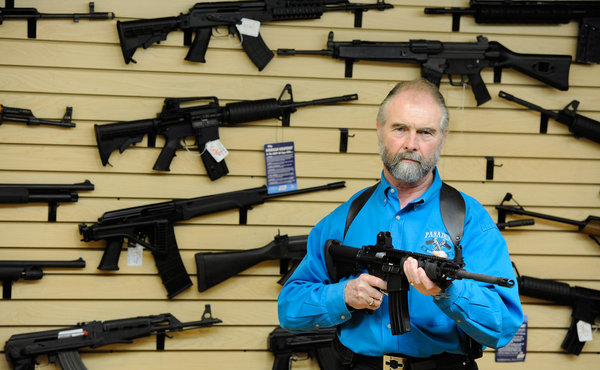
Before Newtown, the rifles sold for about $1,100, on average. Now some retailers charge twice that. At Pasadena Pawn, on the wall behind glass counters of handguns, are three dozen or so AR-15-style rifles. Dangling from nearly every one is a tag that says “Sold.”
“The AR-15, it’s kind of fashionable,” says Frank Loane Sr., the proprietor. His shop has a revolving waiting list for the rifles, and a handful of people are now on it. “The young generation likes them, the assault-looking guns…”
But despite the headlines, and partly because of them, commercial gun sales are growing. Last year, they were up 16 percent industrywide, according to estimates from the National Shooting Sports Foundation, an industry trade association. Semiautomatic rifles like the AR-15 are responsible for a significant share of that growth.
One can be forgiven for reading The New York Times and leaving with the impression that, yes, the entire country is stampeding its nearest weapons shops and loading up on anything with a trigger. This is just the latest in a long line of examples of the media helping to create a story, then reporting on the fallout from that story from a detached perspective, as if the press had nothing to do with the preceding whirlpool of artificially manufactured “news” in the first place.
change the national anthem to R. Kelly’s 2003 hit “Ignition (Remix).”
We, the undersigned, would like the Obama administration to recognize the need for a new national anthem, one that even a decade after its creation, is still hot and fresh out the kitchen. America has changed since Francis Scott Key penned our current anthem in 1814. Since then, we have realized that after the show, it’s the afterparty, and that after the party, it’s the hotel lobby, and–perhaps most importantly–that ’round about four, you’ve got to clear the lobby, at which point it’s strongly recommended that you take it to the room and freak somebody. President Obama: we ask you to recognize the evolution of this beautiful country and give us an anthem that better suits the glorious nation we have become.
Andrew Sullivan posted some thoughts — titled “Pwning Krugman” — on the above video:
Still, Scarborough came prepared and clearly prevailed over a Nobel laureate in economics. Not bad for a hack. And he’s dead right about Krugman’s contempt for those with whom he disagrees. It actually weakens his case unnecessarily. And I have to say that over the past five years, I think Krugman has been more right than wrong.
Is Sullivan watching the same video I am? Scarborough not only misrepresented the substance of Krugman’s critique (multiple times, via multiple intentional misreadings of Krugman’s older books), but he seems to have done this deliberately. If he “pwned” Krugman, it’s only in the sense that a Nobel Prize-winning economist doesn’t spend most of his time learning to look good while being consistently wrong on TV. (I should know this: I just saw Krugman speak at a TEDx event a few weeks ago, and he wasn’t any more impressive as a speaker from fifteen feet away as he is on TV.)
What Krugman (oddly enough) didn’t emphasize sufficiently in his exchange with Scarborough is that both of the excerpts from his books came from well before the financial crisis era: 1997 and 2005. Instead, he rather admirably admitted that he had “learned a few things” since that time. This is certainly the case — and, it might be said, contrasts with Sullivan’s depiction of “Krugman’s contempt for those with whom he disagrees.”
(Side note: The New Yorker ran a fascinating profile of Krugman and his wife, the economist Robin Wells, in March 2010. One of the great nuggets from that piece was the revelation that it is Wells, and not Krugman, who tends to write with more vitriol: “On the rare occasion when they disagree about something, she will be the one urging him to be more outraged or recalcitrant.”)
But back to the Krugman/Scarborough debate. In both of the Krugman quotes that Scarborough cites, the crisis was years away. (In the case of the first quote, it was an entire decade away.) As Krugman tried to explain, he wrote about the dangers of the deficit back then precisely because the economy was stronger during those periods. But Scarborough consistently ignored the fact that Krugman has, time and time again, emphasized the foolishness of tackling the deficit during a recovery from a recession. To simply ignore this central qualification of Krugman’s deficit critique is to ignore the entire argument. “Pwning” Krugman? Not in the least.
(UPDATE — 10:51 AM EST 3/6/2013): I’m watching the full debate now. Krugman actually did a substantively much better job of making his point clear — that deficit reduction should be contingent upon a healthier economy — than he did in the brief clip shown above. (He continued to stumble when Scarborough brought up his previous quotes, despite the fact that these words were written during healthier economic times.) Indeed, he seems to have performed much better in the full debate than he even did in that short clip.
One person who agrees with Andrew Sullivan’s depiction of the “pwnage?” Well, Paul Krugman (kinda):
Well, we’ll see how it comes out after editing, but I feel that I just had my Denver debate moment: I was tired, cranky, and unready for the blizzard of misleading factoids and diversionary stuff (In 1997 you said that the aging population was a big problem! When Social Security was founded life expectancy was only 62!) Oh, and I wasn’t prepared for Joe Scarborough’s slipperiness about what he actually advocates (he’s for more spending in the near term? Who knew?)
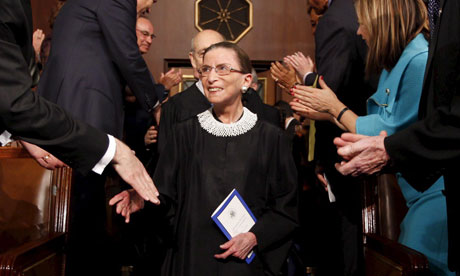
She’s still got it: Justice Ruth Bader Ginsburg receives a warm welcome at the State of the Union.
The New Yorker has just published Jeffrey Toobin’s illuminating profile on Justice Ruth Bader Ginsburg ahead of her 80th birthday on March 15th. (Subscribers to the magazine can access the full text of the ironically-titled piece, “Heavyweight,” at this link.) Chronicling Justice Ginsburg’s early struggles in the male-dominated legal world of the 1950s (Ginsburg had trouble finding someone who would hire her despite having graduated first in her class at Columbia Law), her triumphs as a leading women’s rights advocate with the ACLU, her marriage to the late tax attorney Martin Ginsburg, and her tenure on the Supreme Court, the profile is an understated and touching pre-tribute to the Justice who conventional wisdom tells us is most likely to retire next.
From same-sex marriage ceremonies to retired Justice Sandra Day O’Connor, partial-birth abortion bans to Lilly Ledbetter, “Heavyweight” is full of interesting tidbits and little gems from Justice Ginsburg herself:
On her brief-writing strategy while litigating cases before the Supreme Court:
“I was doing all these sex-discrimination cases, and my secretary said, ‘I look at these pages and all I see is sex, sex, sex. The judges are men, and when they read that they’re not going to be thinking about what you want them to think about,’ ” Ginsburg recalled. Henceforth, she changed her claim to “gender discrimination.”
On work-life balance:
“It bothers me when people say to make it to the top of the tree you have to give up a family. They say, ‘Look at Kagan, look at Sotomayor’ … What happened to O’Connor, who raised three sons, and I have James and Jane [her son and daughter with Martin Ginsburg]?”
On Chief Justice John Roberts:
“For the public, I think the current Chief is very good at meeting and greeting people, always saying the right thing for the remarks he makes for five or ten minutes at various gatherings.”
On how long she will remain on the bench:
“As long as I can do the job full steam… You can never tell when you’re my age. But, as long as I have the candlepower, I will do it. And I figure next year for certain. After that, who knows?”
Money quotes aside, Toobin’s piece is particularly fascinating when he discusses Justice Ginsburg’s views on the relationship between Congress and the Court. Though she is classified as one of the Supreme Court’s liberals in the vein of Earl Warren and Thurgood Marshall, Ginsburg does not share these predecessors’ conviction that the Court should be the driving force for widespread social change. Instead, Toobin writes, she believes that the Court’s role is to begin dialogue with the elected branches of government, to ask them to reconsider “ancient positions” that may no longer work in our day and age, and then to kick the proverbial ball back to them. In this respect, Justice Ginsburg is very much like President Obama, who also prefers to see social change enacted through the legislative rather than judicial arena (and whose similar views on the judiciary have also been discussed at length by Toobin). It is little wonder, then, that the two seem to get along so famously.
Anyway, the profile is a must-read for anyone who is interested in the Supreme Court, the women’s rights movement, or even just a good life story.
I’ve long mounted a soapbox in defense of two related ideas. The first is that average Americans care less about policy specifics than we give ourselves credit for, and that public perception is defined more by soundbites, rhetoric, and presentation than by substance.
The second idea, which follows from the first, is that liberal politicians could — and should — mount a stronger defense of their policies without fear of reprisals from the conservative end of the spectrum. This is not because such reprisals won’t come — unless you’ve been in hiding since 2009, this has been the position of Congressional Republicans since Day 1 — but because holding to one’s principles in the face of political opposition is quite often perceived as indicative of having a better, more sensible policy.
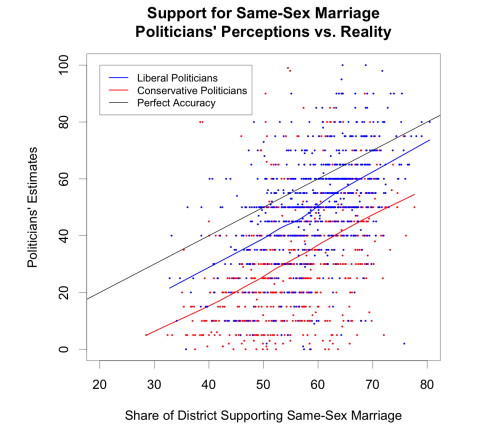
Broockman and Skovron find that legislators consistently believe their constituents are more conservative than they actually are. This includes Republicans and Democrats, liberals and conservatives. But conservative legislators generally overestimate the conservatism of their constituents by 20 points. “This difference is so large that nearly half of conservative politicians appear to believe that they represent a district that is more conservative on these issues than is the most conservative district in the entire country,” Broockman and Skovron write. This finding held up across a range of issues.
The authors conclude:
For those interested in strengthening democratic responsiveness, one tempting conclusion from this analysis is that alternative means of informing legislators about their constituents’ views need to be devised – democratic campaigns and elections appear to do little to update politicians’ perceptions of their constituents. However, on reflection, the fact that candidates and legislators know so little about their constituents and learn so little about them from campaigns and elections is perhaps indicative of a deeper and more basic problem of elite motivation. When Miller and Stokes (1963) conducted their authoritative study of information flows between representatives and their constituencies it was less clear how representatives might ascertain their constituencies’ views with a great deal of precision even if they so desired – reliable district-level opinion surveys were still relatively rare. However, if today’s elites viewed congruence with majority opinion as a primary goal we would expect considerably more knowledge of this opinion in our sample than we observe; such knowledge is quite inexpensive to obtain relative to the cost of modern campaigns. As with voters’ typically low level of motivation to learn about their representatives (Downs 1957, ch. 13), it thus appears that our respondents must have found little desire to accurately ascertain public opinion on political issues of the very highest salience. Politicians clearly do respond to cues about the political consequences of their actions when taking political positions (e.g. Kollman 1998; Bergan 2009), but accurately ascertaining the state of constituency opinion does not appear to rank fairly highly on their priorities necessary for gaining and maintaining access to political authority.
It’s simply too bad that there’s no institution designed to elucidate the opinions held by both the electorate and their chosen political representatives. An institution that could widely disseminate publicly relevant information on the vital policy issues of the day. An institution that would strip away the gratuitous sideshows, celebrity gossip, and tabloid fare, and focus instead on investigative reporting to enlighten its readers both within and without the halls of power.
We should build such an institution. And I propose we call it The Media.
If Congress doesn’t get its act together and pass legislation to avoid the 5% across-the-board cuts to the federal budget (aka the “sequester”), the higher education world will suffer through even more painful rounds of budget cuts. The Chronicle of Higher Education has this story covered:
“Thousands of researchers will lose their jobs, thousands of students will lose their financial aid, and thousands of unemployed workers will be turned away from college work-force programs.”
“Though Pell Grants would be exempt from the sequester this year, Federal Work Study and Supplemental Educational Opportunity Grants would not. Arne Duncan, the secretary of education, has told lawmakers his department will make 33,000 fewer work-study awards and 71,000 fewer supplemental grants next year if the cuts take effect.”
There might be some late nights here coming up… [Photo via U.S. House of Representatives]Besides this whole fiasco with the sequester though, Congress has some other higher ed-related legislative business to take care of in 2013: The Higher Education Act of 1965 is up for reauthorization. Judging by the sluggish pace at which the last reauthorization was passed (the 2003 reauthorization finally got passed…in 2008), we might be seeing the 2013 HEA reauthorization get pushed back for a while.
Let’s imagine, though, that the 113th Congress will actually do its job and reauthorize the HEA on time (ok, sorry, I didn’t mean to make you laugh there). But before it does, there are a few ideas Congress needs to hear first about overhauling the federal student financial aid system.
In Paris today, Kerry chose to speak in French unprompted, but the press conference in which he refused a direct request to speak in French took place in Washington. Kerry was famously mocked for his Francophilia during the 2004 presidential race, and perhaps, in his mind, speaking French in the Treaty Room of the White House — the very seat of American power — would open him up to the same kind of right-wing derision more so than would speaking French in France, which is really just good manners. It’s a theory based on a small sample size, admittedly.
The other possibility is that Kerry, justifiably, just hates Canada.
And here is the video of Kerry refusing to speak French in Washington: